
In the modern financial landscape, the speed at which we conduct transactions is often taken for granted. Whether you are transferring money via a mobile app, withdrawing cash from an ATM in a foreign country, or receiving a real-time notification of a point-of-sale purchase, the seamless nature of these actions is powered by a sophisticated infrastructure known as Core Banking. For financial institutions, business owners, and savvy investors, understanding core banking is essential to grasping how value is moved, tracked, and secured in the 21st century.
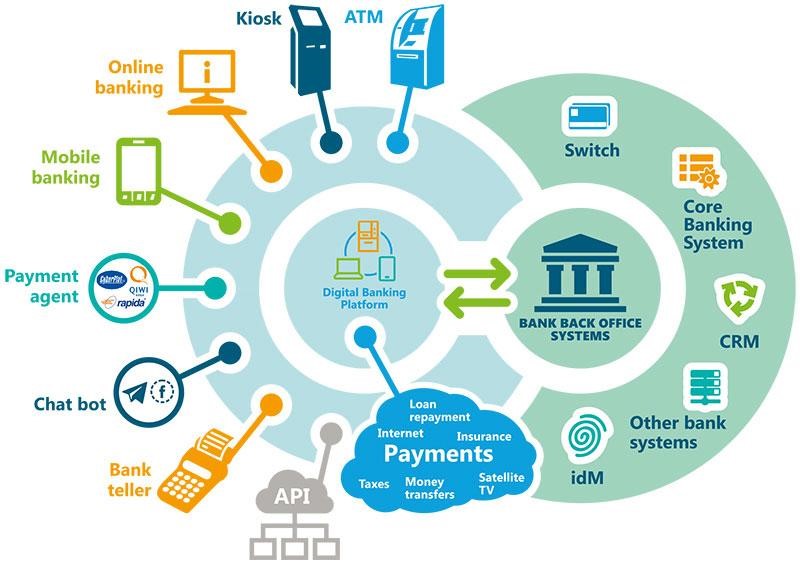
At its simplest, core banking is the “brain” of a bank. It is the centralized system that links a bank’s various branches and digital delivery channels to a single, unified database. This allows customers to access their accounts and perform transactions from any location, regardless of where they originally opened their account. As we move further into the era of digital transformation, core banking has evolved from a back-office necessity into a strategic asset that dictates a financial institution’s ability to compete in a crowded market.
Understanding the Fundamentals of Core Banking Systems
To understand core banking, one must first look at the acronym itself. In the financial industry, CORE stands for “Centralized Online Real-time Exchange.” This definition perfectly encapsulates the three pillars of modern banking: centralization of data, online accessibility, and the real-time processing of transactions.
Defining CORE: Centralized Online Real-time Exchange
Before the advent of modern core banking, banks operated on a branch-specific basis. If you opened an account at Branch A, Branch B might not have immediate access to your balance or signature card. Transactions were often processed in “batches” at the end of the business day.
The CORE acronym represents the shift away from this fragmented model. “Centralized” means all data resides in a single source of truth. “Online” ensures that all service points—ATMs, mobile apps, and teller terminals—are connected to this source. “Real-time Exchange” ensures that the moment you withdraw $100, your balance is updated across the entire network instantly. This prevents overdrawing and provides a level of security and transparency that legacy systems could never achieve.
The Transition from Legacy Systems to Modern Architecture
Many established global banks still operate on “legacy systems”—monolithic software structures built in the 1970s and 80s using languages like COBOL. While these systems are incredibly stable, they are often rigid and difficult to integrate with new technology.
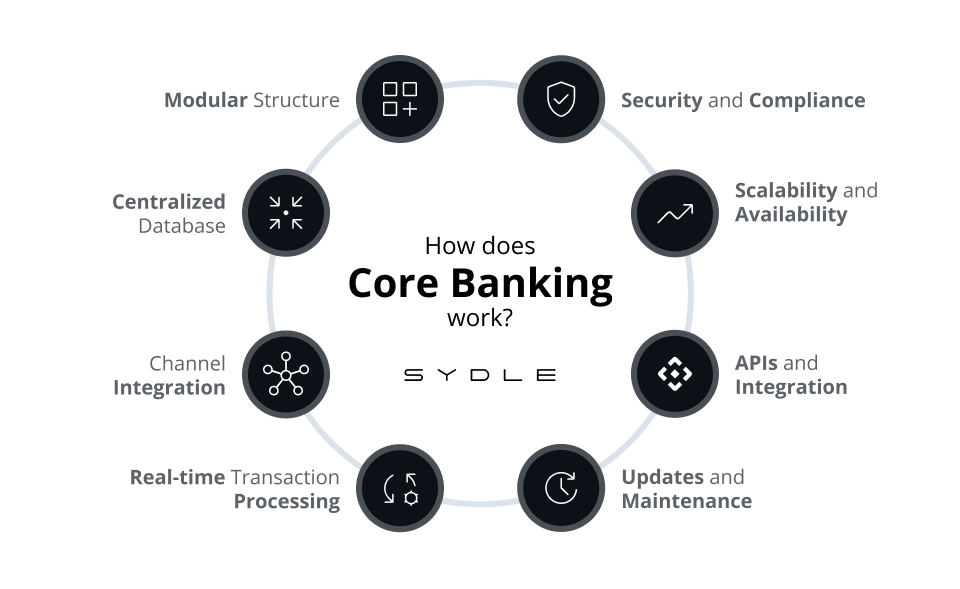
The modern shift in the money niche is toward “Modular Core Banking.” Instead of a single, unchangeable block of code, modern systems are built using microservices. This allows banks to update specific functions—like their loan processing engine or their fraud detection module—without taking the entire system offline. For the business of finance, this agility is the difference between leading the market and falling behind.
Key Features and Functions of a Core Banking Solution
A core banking system (CBS) is responsible for the fundamental operations that keep a financial institution running. It is the ledger of record for every cent that moves through the bank. While customer-facing apps are the “face” of the bank, the CBS is the “engine room.”
Transaction Processing and Account Management
The primary function of any core banking system is the management of deposits and withdrawals. This includes maintaining the general ledger, managing passbooks, and processing checks and electronic transfers. The system must handle millions of transactions daily with zero margin for error. In the world of business finance, the accuracy of these ledgers is paramount for auditing and regulatory reporting.
Loan Origination and Servicing
Beyond simple transactions, core banking systems manage the lifecycle of a loan. This includes the initial “origination” (the application and approval process), the disbursement of funds, the calculation of interest, and the tracking of repayments. Advanced core systems can automate credit scoring by pulling data from multiple sources, allowing for near-instant loan approvals that are common in the fintech and “buy now, pay later” (BNPL) sectors.
Interest Calculation and Regulatory Compliance
One of the most complex tasks a core system performs is the daily calculation of interest for millions of accounts with varying rates. Furthermore, the system must ensure that every transaction complies with local and international laws, such as Anti-Money Laundering (AML) and Know Your Customer (KYC) regulations. Modern core systems have these “Money” compliance rules baked into their logic, automatically flagging suspicious activities and generating reports for financial regulators.

The Strategic Importance for Financial Institutions and Businesses
For those focused on business finance and investing, core banking is not just a technical choice; it is a financial strategy. The efficiency of a bank’s core system directly impacts its bottom line and its valuation.
Improving Operational Efficiency and Cost Reduction
Legacy core systems are expensive to maintain. They require specialized personnel and significant physical server space. By migrating to modern core banking solutions, financial institutions can drastically reduce their operational expenditure (OPEX). Automation reduces the need for manual data entry, which in turn lowers the risk of human error—a major cost center in the financial world.
Enhancing Customer Experience through Real-Time Data
In the current “on-demand” economy, customers expect instant results. A bank with a high-performing core system can offer features like instant peer-to-peer transfers, real-time spending analytics, and immediate card freezing. These features are no longer “extras”; they are the baseline requirements for customer retention in the competitive personal finance niche.
Enabling Open Banking and API Integration
Perhaps the most significant strategic advantage of modern core banking is its ability to facilitate “Open Banking.” Through Application Programming Interfaces (APIs), a core system can securely share data with third-party developers. This allows customers to link their bank accounts to investment apps, budgeting tools, or accounting software like QuickBooks. For businesses, this connectivity streamlines cash flow management and financial planning.
The Shift Toward Cloud-Based and Neobank Infrastructure
The rise of “Neobanks” or “Challenger Banks” (like Monzo, Revolut, or Chime) has forced a radical rethinking of core banking. Unlike traditional banks, these entities were born in the cloud.
Traditional Core vs. Cloud-Native Banking
Traditional core banking often relies on “on-premise” hardware, meaning the bank owns and maintains the physical servers. Cloud-native core banking, however, runs on platforms like AWS, Google Cloud, or Microsoft Azure. This “Banking-as-a-Service” (BaaS) model allows new financial players to launch in months rather than years, as they don’t need to build the infrastructure from scratch. They simply “rent” the core functionality.
Security and Scalability in the Digital Age
Cloud-based systems offer unparalleled scalability. During peak times—such as Black Friday or tax season—a cloud-native core can automatically increase its processing power to handle the surge in volume. From a security perspective, these systems often employ more advanced encryption and biometric integration than older legacy systems, protecting the most valuable asset in the money niche: trust.
Future Trends: AI and Blockchain in Core Banking
As we look toward the future of money and financial tools, the integration of cutting-edge technology into core banking is inevitable. The “Next-Gen” core will be defined by its ability to process data intelligently and securely.
Hyper-Personalization of Financial Services
Artificial Intelligence (AI) integrated into the core system can analyze a customer’s spending patterns in real-time. This allows banks to offer personalized financial advice or product recommendations at the exact moment they are needed. For example, if the core system detects a customer is consistently overdrawing, it could automatically suggest a low-interest credit line or a personalized savings plan. This level of service transforms a bank from a passive vault into an active financial partner.
Distributed Ledger Technology for Settlement
While still in its early stages, some financial institutions are exploring how Blockchain or Distributed Ledger Technology (DLT) can be integrated into core banking. The goal is to make cross-border settlements—which currently take days and involve multiple intermediary banks—instantaneous and significantly cheaper. By replacing traditional ledgers with a decentralized, immutable record, banks can further reduce fraud and increase the speed of global commerce.
In conclusion, core banking is much more than a software suite; it is the invisible foundation upon which the entire global economy rests. As the lines between finance and technology continue to blur, the evolution of these systems will determine how we save, spend, and invest our money in the years to come. For any business or individual looking to navigate the future of finance, a deep understanding of core banking is the first step toward financial literacy in the digital age.
aViewFromTheCave is a participant in the Amazon Services LLC Associates Program, an affiliate advertising program designed to provide a means for sites to earn advertising fees by advertising and linking to Amazon.com. Amazon, the Amazon logo, AmazonSupply, and the AmazonSupply logo are trademarks of Amazon.com, Inc. or its affiliates. As an Amazon Associate we earn affiliate commissions from qualifying purchases.