
In the dynamic world of finance, understanding how quantities evolve over time is paramount. While many financial metrics fluctuate unpredictably, the concept of a “constant rate of change” provides a fundamental framework for comprehending stable, predictable movements. At its core, a constant rate of change describes a situation where one quantity increases or decreases by the same amount over consistent intervals, offering a powerful tool for financial analysis, planning, and forecasting.
The Foundation of Predictable Financial Movement
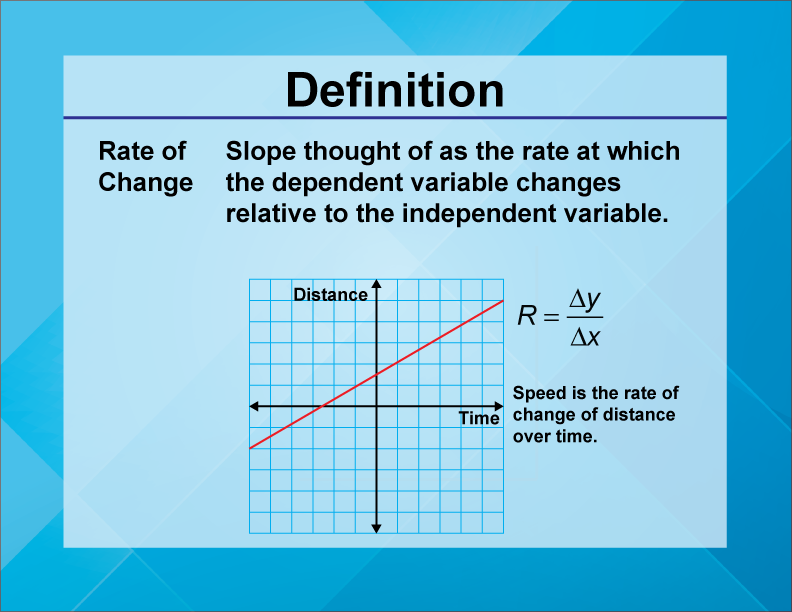
A constant rate of change signifies a linear relationship between two variables. In simpler terms, if you plot the data points on a graph, they would form a straight line. This unwavering consistency makes it a cornerstone concept in mathematics, and by extension, in finance. When a financial value exhibits a constant rate of change, it means that for every unit of change in one variable (like time), there is an identical, fixed amount of change in another variable (like an asset’s value or a debt’s principal).

The significance of this principle in finance cannot be overstated. It underpins numerous calculations and models, allowing individuals and businesses to make more informed decisions. Without understanding constant rates, predicting future financial states, assessing the impact of consistent actions, or even grasping the basic mechanics of many financial products would be impossible. It provides a baseline for understanding how money grows, how costs accumulate, and how debts are repaid when conditions are steady and predictable.
Constant Rate of Change in Personal Finance
For individuals managing their money, the constant rate of change appears in many everyday scenarios, offering clarity and structure to personal financial planning.
Understanding Simple Interest
Perhaps the most straightforward example of a constant rate of change in personal finance is simple interest. Simple interest is calculated solely on the principal amount of a loan or deposit. If you invest $1,000 at a simple annual interest rate of 5%, you will earn $50 each year, year after year, as long as the principal remains $1,000. The $50 earned per year is the constant rate of change in your investment’s value due to interest. This contrasts sharply with compound interest, where the interest earned also starts earning interest, leading to an accelerating, non-constant rate of growth. Understanding simple interest is crucial for evaluating certain savings accounts, bonds, or short-term loans where compounding might not be a significant factor.
Budgeting and Saving
Effective budgeting often relies on the principle of constant rates. When you commit to saving a fixed amount each month—for example, $200 for a down payment—your savings balance grows at a constant rate. After one month, you have $200; after two, $400; after three, $600, and so on. This predictable accumulation makes it easier to set and achieve financial goals, whether it’s saving for a vacation, an emergency fund, or a larger purchase. Similarly, many recurring expenses, such as subscription services, fixed loan payments, or rent, represent constant outflows from your budget, allowing for stable financial planning.
Loan Repayments and Amortization (Simplified View)
While the principal portion of a loan payment can change over time in an amortizing loan, the total monthly payment itself is often structured to be constant. For example, a car loan or a fixed-rate mortgage demands the same payment amount each month for a set period. This constant payment structure allows borrowers to budget effectively, knowing precisely how much money they need to allocate toward debt service each month. Although the breakdown between principal and interest within that constant payment shifts over the loan’s life, the regularity of the overall outflow demonstrates a critical application of consistency in financial commitments. Similarly, lines of credit or loans with simple, fixed interest charges, where interest is calculated only on the outstanding balance and repaid in consistent installments, reflect a constant financial obligation over a given period.
Constant Rate of Change in Business Finance and Investing
In the corporate world and investment markets, constant rates of change provide critical metrics for operational efficiency, asset valuation, and revenue forecasting.
Unit Economics and Profit Margins
Businesses frequently analyze their unit economics, which often involve constant rates. For instance, the cost to produce one unit of a product might be relatively constant within a certain production volume. If a company knows it costs $5 to produce one widget, and it sells each widget for $10, then its gross profit per unit is a constant $5. This consistent profit margin per unit is a critical constant rate that helps businesses determine pricing strategies, break-even points, and overall profitability. Understanding these constant rates allows businesses to scale operations while maintaining predictable profitability margins, forming the basis of sound financial modeling and strategic planning.
Depreciation Methods
Depreciation, the accounting method used to allocate the cost of a tangible asset over its useful life, often employs a constant rate of change. The straight-line depreciation method is a prime example. Under this method, an equal amount of an asset’s cost is expensed each year. If a machine costs $10,000, has a salvage value of $1,000, and a useful life of 5 years, its annual depreciation expense would be ($10,000 – $1,000) / 5 = $1,800 per year. This $1,800 is a constant annual decrease in the asset’s book value, providing a predictable accounting entry that affects a company’s financial statements consistently over time.
Dividends and Fixed Income
Many investments are designed to provide returns at a constant rate. Preferred stocks, for example, typically pay a fixed dividend amount periodically, offering investors a predictable income stream. Similarly, bonds often pay fixed coupon payments to bondholders at regular intervals (e.g., semi-annually). If a bond pays a 4% coupon on a $1,000 face value, it will consistently pay $40 per year until maturity. These constant payouts make such investments attractive to those seeking stable income and help investors project their future cash flows with a high degree of certainty.
Growth Projections and Valuations (Linear Models)
While true financial growth is often exponential (due to compounding), simpler linear models that assume a constant rate of change are frequently used for short-term projections or for specific components of a more complex financial forecast. For instance, a business might project sales to increase by a constant $50,000 per quarter for the next year based on historical trends or market analysis. While this might be an oversimplification for long-term forecasts, it provides a practical, constant rate for immediate planning and budgeting. Such linear assumptions are also foundational in certain valuation models, particularly when valuing stable assets or income streams that are expected to generate fixed cash flows.

Leveraging Constant Rate of Change for Financial Planning
Recognizing and utilizing constant rates of change empowers individuals and organizations to exert greater control over their financial futures.
Firstly, it aids in forecasting and setting realistic expectations. Knowing that a particular income stream or expense will change at a steady pace allows for more accurate budgeting, savings goal setting, and debt management. If your salary increases by a fixed percentage annually, or your car loan payment remains the same, you can reliably project your cash flow for months or years ahead.
Secondly, it facilitates informed decision-making. When comparing financial products, understanding which offer constant returns (like simple interest or fixed-rate bonds) versus variable or compounding returns, helps in choosing the right fit for specific financial goals and risk tolerances. For businesses, knowing the constant cost per unit allows for precise pricing decisions and production planning.
Lastly, understanding constant rates provides a baseline against which to identify deviations. When financial changes are not constant—for example, unexpected increases in expenses or volatile investment returns—it signals a need for reassessment and potential adjustments to the financial plan. This ability to distinguish between predictable changes and unpredictable fluctuations is invaluable for maintaining financial health and agility.
In conclusion, the constant rate of change is far more than a mathematical abstraction; it’s a practical and pervasive concept in finance. From calculating simple interest and budgeting personal savings to analyzing business unit economics and valuing fixed-income investments, its principles provide a bedrock of predictability in an otherwise complex financial landscape, enabling more effective planning and confident decision-making.
aViewFromTheCave is a participant in the Amazon Services LLC Associates Program, an affiliate advertising program designed to provide a means for sites to earn advertising fees by advertising and linking to Amazon.com. Amazon, the Amazon logo, AmazonSupply, and the AmazonSupply logo are trademarks of Amazon.com, Inc. or its affiliates. As an Amazon Associate we earn affiliate commissions from qualifying purchases.