
The intricate dance of electrons, the flow of current through a circuit, the very logic gates that power our digital world—all are fundamentally governed by a principle so pervasive it often goes unnoticed: the conservation of charge. Far from being an obscure physics concept, the conservation of charge is the bedrock upon which modern technology is built, dictating everything from the stability of a smartphone’s battery to the integrity of data in a supercomputer. For anyone engaged in technology, from hardware engineers to cybersecurity specialists, understanding this principle is not merely academic; it is essential for innovation, problem-solving, and ensuring the reliability of digital systems.

The Unseen Foundation of Electronics
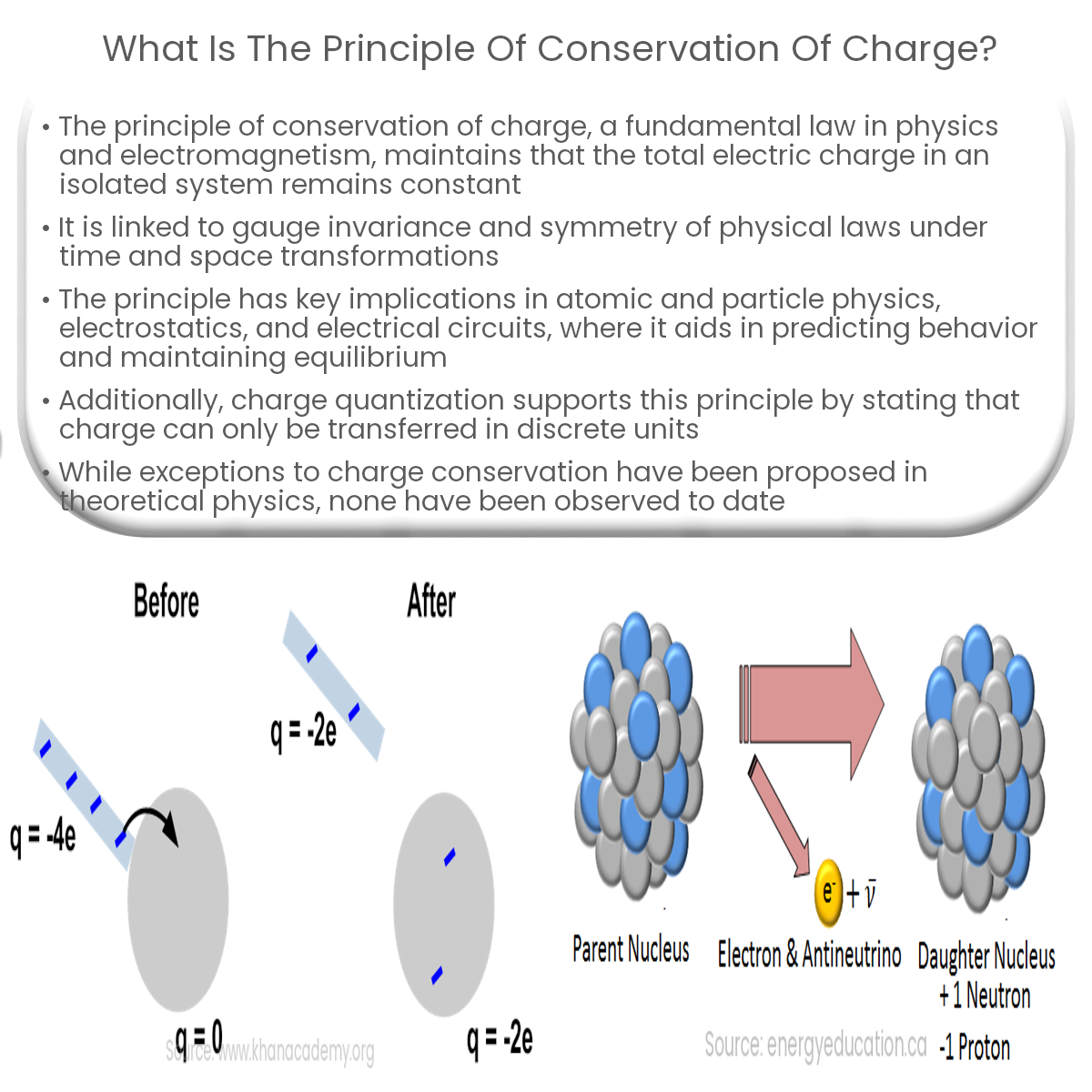
At its core, the conservation of charge states that the total electric charge within an isolated system remains constant. Charge can neither be created nor destroyed, only transferred from one body to another. This seemingly simple declaration has profound implications, acting as an immutable law that every electron, every proton, and every circuit must obey.
Defining Charge and Its Conservation
Electric charge is an intrinsic property of matter, carried by particles like electrons (negative charge) and protons (positive charge). In a macroscopic sense, charge gives rise to electromagnetic forces. The “isolated system” clause is crucial: if a system is completely cut off from its surroundings, no charge can enter or leave it, thus its total charge—the algebraic sum of all positive and negative charges—will stay the same over time. This means if a negatively charged electron disappears, a positively charged positron must also disappear (annihilation), or another electron must be created (pair production), to maintain the balance. In practical electronic systems, while they are rarely perfectly isolated, the principle applies within defined boundaries, ensuring that current entering a node must equal current leaving it.
The Isolated System and Constant Charge in Practice
Consider a simple electrical circuit. When you flip a switch, electrons begin to flow. The total number of electrons in the circuit doesn’t suddenly increase or decrease; rather, they move. If one part of the circuit loses electrons, another part gains them, maintaining the overall charge balance. This predictable flow, governed by charge conservation, allows engineers to design circuits where voltages and currents behave as expected. Without this principle, circuit analysis would be impossible, and electronic devices would be entirely unpredictable, prone to spontaneous generation or disappearance of electrical energy. Every time a capacitor charges or discharges, or a transistor switches states, the conservation of charge dictates the exact movement and redistribution of electrons, providing a stable and predictable foundation for digital operations.
Conservation of Charge in Modern Computing and Digital Systems
The relevance of charge conservation extends deeply into the architecture and function of every computing device. From the fundamental laws governing current flow to the mechanisms of data storage, this principle is relentlessly at play.
Circuit Design and Kirchhoff’s Laws
Perhaps the most direct application of charge conservation in electronics is found in Kirchhoff’s Current Law (KCL). KCL states that for any node (or junction) in an electrical circuit, the sum of currents entering the node must be equal to the sum of currents leaving the node. This is a direct consequence of charge conservation, as current is merely the rate of flow of charge. If more charge entered a node than left it, charge would accumulate indefinitely, violating the conservation principle. KCL is indispensable for analyzing and designing complex integrated circuits, microprocessors, and power delivery networks within any digital device. Engineers use KCL to ensure that power is efficiently distributed, signals propagate correctly, and no part of a circuit overloads or starves for current, which could lead to errors or device failure.
Data Storage: Capacitors and Memory
Data storage, particularly in volatile memory like Dynamic Random-Access Memory (DRAM), provides a compelling example of charge conservation in action. DRAM cells store bits of information (0s or 1s) as tiny packets of electric charge in capacitors. A charged capacitor represents a “1,” while a discharged one represents a “0.” When a bit is written or read, charge is meticulously moved into or out of these microscopic capacitors. The integrity of this stored data relies entirely on the conservation of this charge; any loss or gain of charge that isn’t intended would corrupt the data. While capacitors eventually leak charge, requiring periodic “refresh” cycles, the principle ensures that during the intended storage period, the charge representing a bit remains constant. Similarly, Flash memory, though non-volatile, also relies on trapping charge in a floating gate, again demonstrating the critical role of charge integrity.
Power Management and Energy Efficiency
In an era where energy efficiency is paramount, the conservation of charge guides the design of power management units (PMUs) in everything from smartphones to data center servers. These units are responsible for efficiently distributing and converting electrical power to various components. Understanding how charge flows and is conserved at different voltage levels allows engineers to optimize power converters (like DC-DC converters), minimize energy loss, and extend battery life. Every watt of power consumed by a processor, GPU, or sensor originates from a source where charge is being conserved and directed. Designing systems that efficiently manage this charge flow is crucial for both performance and environmental sustainability in the tech sector.
Advanced Applications and Emerging Technologies
Beyond foundational electronics, the principle of charge conservation continues to play a vital role in cutting-edge technological advancements, influencing everything from quantum mechanics to new energy solutions.
Quantum Computing Implications
While quantum mechanics often presents a departure from classical physics, the conservation of charge remains a critical principle. In quantum computing, information is encoded in qubits, which can exist in a superposition of states. Many qubit architectures, such as those based on superconducting circuits or trapped ions, rely on the precise manipulation and isolation of charged particles or charge distributions. Maintaining the coherence and integrity of these quantum states is fundamentally linked to ensuring that the charge associated with the qubit remains conserved and unaffected by the environment, preventing quantum errors. Research into robust quantum gates and error correction techniques often involves meticulously controlling charge interactions at the quantum level to prevent decoherence and preserve computational integrity.
Semiconductor Physics and Device Miniaturization
The incredible miniaturization of semiconductor devices, leading to billions of transistors on a single chip, hinges on a deep understanding of charge behavior at the nanoscale. In transistors, the flow of charge (electrons or holes) is precisely controlled by electric fields. As devices shrink, quantum effects become more prominent, but the overall principle of charge conservation still dictates how current flows through these tiny channels. Designing these nanoscale components requires predicting exactly how charge carriers will move, scatter, and interact within the semiconductor lattice. This precision ensures that logic gates function reliably and that the massive number of transistors within a modern CPU can execute billions of operations per second without error.
Energy Harvesting and Battery Technology
The quest for sustainable energy solutions heavily relies on the manipulation and storage of charge. Energy harvesting technologies, which convert ambient energy (light, heat, vibration) into electrical power, are essentially sophisticated systems for capturing and directing charge. Photovoltaic cells, for example, generate current by causing electrons to move due to incident light—a direct consequence of charge separation and flow. Battery technology, a cornerstone of mobile and portable devices, is fundamentally about storing and releasing chemical energy via the movement of ions (charged atoms). Innovations in battery chemistry and design aim to maximize the amount of charge that can be stored and the efficiency with which it can be released, all while adhering to the fundamental principles of charge conservation during the charging and discharging cycles.
Digital Security and the Integrity of Charge
Even in the realm of digital security, the conservation of charge plays an subtle yet critical role. The physical integrity of the electrical signals, which are manifestations of charge movement, is paramount for secure operations.
Protecting Data Flow
In secure communication and data processing, information is transmitted as electrical signals. Any unintentional alteration or corruption of these signals can lead to data breaches or system vulnerabilities. Maintaining the integrity of these charge flows throughout a system, from the initial input to the final output, is a security imperative. Robust circuit design, shielded cables, and electromagnetic compatibility (EMC) measures are all indirectly aimed at ensuring that charge flows exactly as intended, preventing external interferences that could compromise data through unintended charge redistribution or signal distortion.

Hardware Security Implications
Side-channel attacks, a sophisticated class of security vulnerabilities, often exploit minute, unintended emanations from electronic devices, such as variations in power consumption (which is directly related to charge movement) or electromagnetic radiation. By meticulously monitoring these “side channels,” attackers can infer sensitive information, such as cryptographic keys. Understanding the precise power profiles associated with different operations, dictated by the conservation of charge, helps engineers design hardware that minimizes these exploitable leakages. Designing secure hardware involves ensuring that the physical manifestations of charge flow do not unintentionally reveal secrets, reinforcing the principle that controlling charge distribution is critical for maintaining digital security.
In essence, “what is conservation of charge” transcends a simple physics definition. It is a foundational truth that underpins the entire edifice of modern technology, enabling the creation of reliable, efficient, and increasingly sophisticated digital systems. From the macroscopic circuits we design to the quantum realms we explore, the unchanging nature of charge provides a constant reference point for innovation and engineering excellence.
aViewFromTheCave is a participant in the Amazon Services LLC Associates Program, an affiliate advertising program designed to provide a means for sites to earn advertising fees by advertising and linking to Amazon.com. Amazon, the Amazon logo, AmazonSupply, and the AmazonSupply logo are trademarks of Amazon.com, Inc. or its affiliates. As an Amazon Associate we earn affiliate commissions from qualifying purchases.