
The phrase “compounded annually” is a cornerstone of personal finance and investing, representing a fundamental mechanism by which money grows over time. It signifies more than just earning interest; it encapsulates the powerful concept of earning interest on previously earned interest, a phenomenon Albert Einstein famously referred to as the “eighth wonder of the world.” For anyone looking to understand how their savings can multiply, how investments generate returns, or even how debt can accumulate, grasping the essence of annual compounding is not merely beneficial—it is essential.
In its simplest form, compounding annually means that the interest accrued on a principal amount over one year is added back to that principal, and then the next year’s interest is calculated on this new, larger sum. This cyclical process creates a snowball effect, where your money starts to grow at an accelerating rate, transforming modest beginnings into substantial sums given enough time. This article will delve into the intricacies of annual compounding, dissecting its mechanics, illustrating its impact with practical examples, and ultimately equipping you with the knowledge to harness its immense power for your financial well-being.
Understanding the Core Concept of Compounding
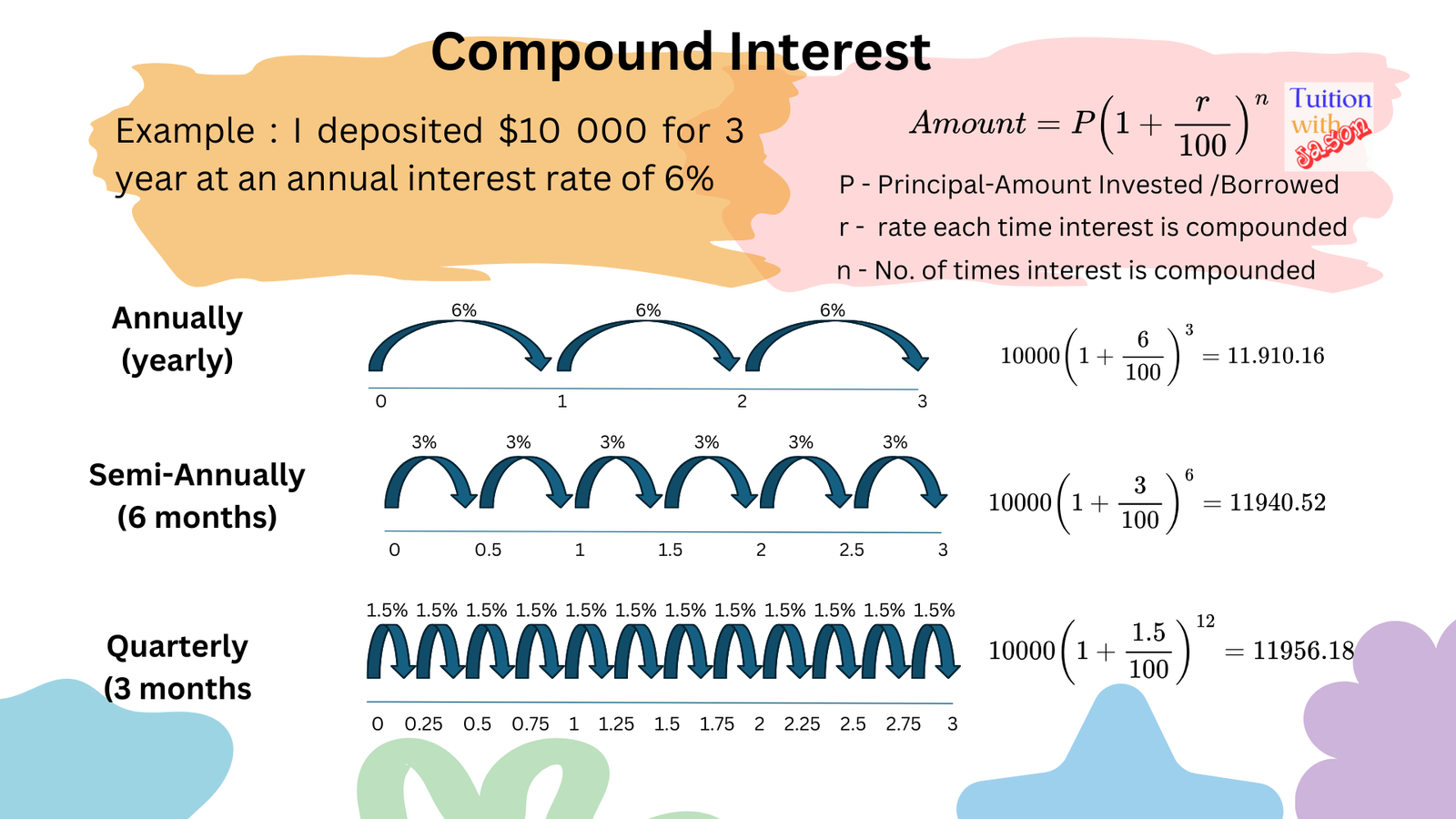
At the heart of “compounded annually” lies the broader principle of compound interest. To truly appreciate its power, it’s crucial to distinguish it from its simpler counterpart.
Simple Interest vs. Compound Interest: The Fundamental Difference
Before diving into compounding, let’s briefly touch upon simple interest. Simple interest is calculated solely on the initial principal amount. For example, if you deposit $1,000 in an account earning 5% simple interest annually, you would earn $50 each year ($1,000 x 0.05). After five years, you would have earned $250 in interest, and your total balance would be $1,250. The interest earned each year remains constant because it’s always based on the original principal.
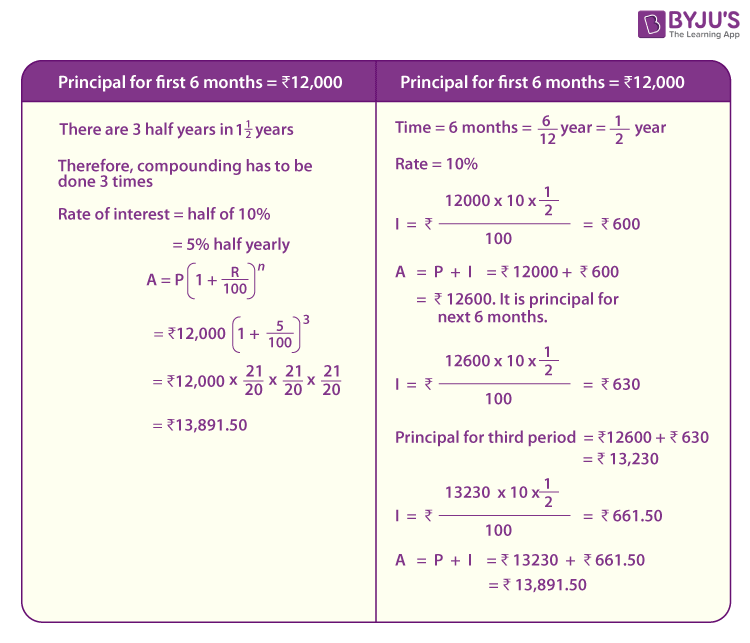
Compound interest, however, tells a different story. With compound interest, the interest earned in a given period is added to the principal, and then the interest for the subsequent period is calculated on this new, larger principal. This continuous cycle is what makes compound interest so potent. It means your money is not just earning interest; your interest is also earning interest.
The Mechanics of Annual Compounding
When we talk about “compounded annually,” it means this cycle of calculating and adding interest to the principal happens once every year. Let’s use our previous example: $1,000 deposited at a 5% compound interest rate, compounded annually.
-
Year 1: You start with $1,000. Interest earned is $1,000 x 0.05 = $50. Your new balance at the end of Year 1 is $1,000 + $50 = $1,050.
-
Year 2: Now, the interest is calculated on the new principal of $1,050. Interest earned is $1,050 x 0.05 = $52.50. Your new balance at the end of Year 2 is $1,050 + $52.50 = $1,102.50.
-
Year 3: Interest is calculated on $1,102.50. Interest earned is $1,102.50 x 0.05 = $55.13. Your new balance is $1,102.50 + $55.13 = $1,157.63.
Notice how the amount of interest earned each year progressively increases ($50, then $52.50, then $55.13), even though the interest rate remains constant. This is the power of annual compounding in action.
The ‘Snowball Effect’ Metaphor
The concept of compounding is often likened to a snowball rolling down a hill. Initially, the snowball is small, gathering snow slowly. But as it rolls, it picks up more snow, becoming larger. A larger snowball has a greater surface area, allowing it to pick up even more snow at a faster rate. Similarly, with compounded annual interest, your principal grows, and that larger principal generates even more interest, which in turn makes the principal even larger, accelerating the growth process over time. The longer the hill (time), the larger the snowball (your money) becomes.
The Mathematics Behind Annual Compounding
While the “snowball effect” provides an intuitive understanding, a more precise grasp of compounding comes from its mathematical representation.
The Compound Interest Formula Explained
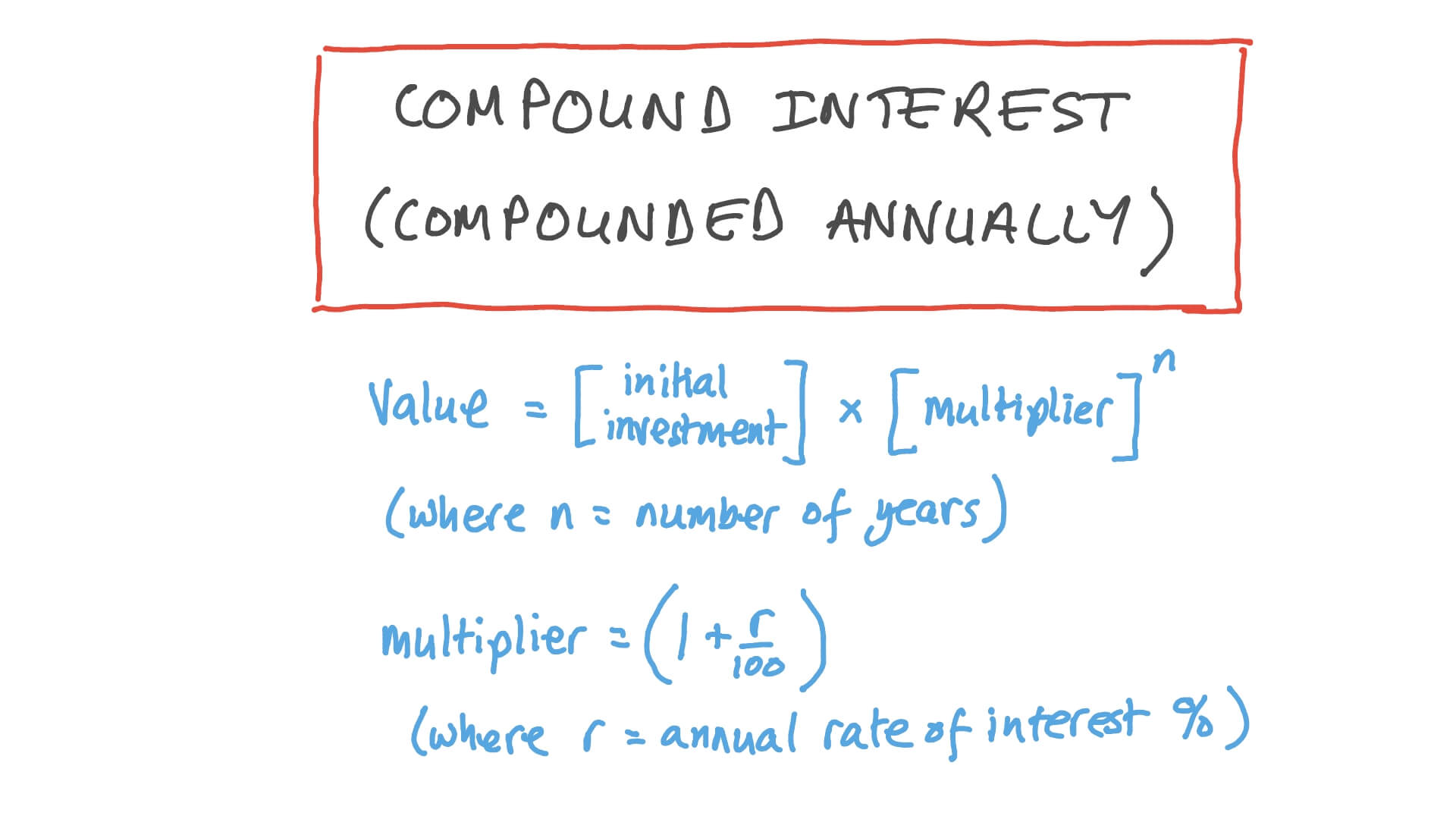
The standard formula for compound interest is:
A = P (1 + r/n)^(nt)
Let’s break down each variable, specifically for annual compounding:
-
A: The future value of the investment/loan, including interest. This is the total amount you will have at the end of the compounding period.
-
P: The principal investment amount (the initial deposit or loan amount).
-
r: The annual interest rate (as a decimal). For example, 5% would be 0.05.
-
n: The number of times that interest is compounded per year. For annual compounding, n = 1.
-
t: The number of years the money is invested or borrowed for.
When compounded annually, the formula simplifies slightly because n=1:
A = P (1 + r)^t
This simplified formula clearly shows how the principal, interest rate, and time are the three critical variables determining the future value when interest is compounded once a year.
Practical Examples of Annual Compounding
Let’s apply this formula to more long-term scenarios to truly appreciate its impact.
Example 1: A Savings Account Over 10 Years
Imagine you deposit $5,000 into a savings account that offers a 3% annual interest rate, compounded annually. What will your balance be after 10 years?
-
P = $5,000
-
r = 0.03
-
t = 10
-
A = $5,000 (1 + 0.03)^10
-
A = $5,000 (1.03)^10
-
A = $5,000 * 1.343916
-
A ≈ $6,719.58
After 10 years, your initial $5,000 would have grown to approximately $6,719.58, an increase of over $1,700 purely from compound interest.
Example 2: An Investment Fund Over 30 Years
Consider a more aggressive investment, like a stock market index fund, which historically might return 8% annually. If you invest $10,000 today with an 8% annual return, compounded annually, what would it be worth in 30 years?
-
P = $10,000
-
r = 0.08
-
t = 30
-
A = $10,000 (1 + 0.08)^30
-
A = $10,000 (1.08)^30
-
A = $10,000 * 10.062657
-
A ≈ $100,626.57
This example strikingly illustrates the long-term power: an initial $10,000 investment could grow to over $100,000, becoming ten times its original value, primarily due to the compounding effect over three decades.
The Role of Time and Interest Rate
These examples highlight the two most influential factors in annual compounding:
-
Time: The longer your money has to grow, the more cycles of compounding it undergoes, leading to exponentially larger returns. The difference between 10 years and 30 years in the examples above is staggering. This underscores the importance of starting early with savings and investments.
-
Interest Rate: A higher interest rate means a larger percentage of your principal (and accumulated interest) is added each year. Even a seemingly small difference, like 1% or 2%, can lead to substantial differences in future value over long periods.
Why Annual Compounding Matters for Your Money
Understanding annual compounding is not an academic exercise; it’s a critical tool for making informed financial decisions across various aspects of your life.
Building Wealth Through Savings and Investments
For many, annual compounding is the engine driving long-term wealth accumulation. It’s the mechanism behind:
-
Retirement Accounts: 401(k)s, IRAs, and similar vehicles rely heavily on compounding to turn regular contributions into a comfortable retirement nest egg. The earlier you start contributing, the more time your money has to compound.
-
College Savings Plans: Funds set aside for a child’s education can significantly benefit from annual compounding over 18+ years, reducing the burden of future tuition costs.
-
General Investments: Whether in mutual funds, ETFs, or individual stocks, the reinvestment of dividends and capital gains allows these investments to compound, leading to significant growth over decades.
The Dark Side: Debt and Compounded Annually
While powerful for wealth creation, compounding also works in reverse when it comes to debt. Interest on loans, especially high-interest ones like credit cards, often compounds annually (or even more frequently), rapidly increasing the amount you owe if balances are not paid off.
Consider a credit card with an 18% APR compounded annually. If you carry a balance of $2,000 for a year without making any payments, the interest would be $2,000 x 0.18 = $360. Your new balance would be $2,360. The next year, interest would be calculated on $2,360, quickly escalating the debt. This reverse compounding highlights the critical importance of paying off high-interest debt promptly.
Strategic Financial Planning with Annual Compounding in Mind
Armed with an understanding of annual compounding, you can make more strategic financial choices:
-
Setting Realistic Goals: Knowing how compounding works helps you project future values of your savings and investments, making goal setting (e.g., down payment for a house, early retirement) more realistic.
-
Prioritizing Investments: When comparing different investment options, consider not just the stated interest rate but also the compounding frequency and how it impacts the effective annual return.
-
Budgeting for Growth: Incorporate regular contributions into your budget, understanding that consistent deposits combined with compounding are far more effective than sporadic large sums.
Beyond Annual: Understanding Other Compounding Frequencies
While “compounded annually” is a common and important frequency, interest can be compounded at other intervals, which can slightly alter the total return.
Semi-Annually, Quarterly, Monthly, Daily, and Continuous Compounding
The variable ‘n’ in the compound interest formula (A = P (1 + r/n)^(nt)) accounts for these different frequencies:
-
Semi-annually: n = 2 (interest compounded twice a year)
-
Quarterly: n = 4 (interest compounded four times a year)
-
Monthly: n = 12 (interest compounded twelve times a year)
-
Daily: n = 365 (interest compounded 365 times a year)
-
Continuously: This is a theoretical limit where interest is compounded an infinite number of times per year. A different formula (A = Pe^(rt)) is used for continuous compounding, where ‘e’ is Euler’s number (approximately 2.71828).
Generally, the more frequently interest is compounded, the slightly higher the total return will be, assuming the same annual interest rate. This is because interest starts earning interest sooner. However, the difference between daily and annual compounding for a given annual rate is often less dramatic than many imagine, especially for typical interest rates. The most significant gains still come from the interaction of principal, rate, and time.
The Annual Percentage Yield (APY) vs. Annual Percentage Rate (APR)
This distinction is crucial for consumers when evaluating savings products or loans:
-
Annual Percentage Rate (APR): This is the nominal interest rate stated by the financial institution, typically without factoring in the effect of compounding. For loans, it often represents the cost of borrowing.
-
Annual Percentage Yield (APY): This is the effective annual rate of return, including the effect of compounding. APY provides a more accurate picture of how much you’ll actually earn on savings or pay on debt over a year, especially when interest is compounded more frequently than annually.
When choosing a savings account or CD, always compare APY, as it reflects the true earning potential. For loans, APR is commonly used, but understanding how that APR compounds (e.g., daily on a credit card) is essential to grasp the actual cost.
Maximizing the Power of Annual Compounding
To fully leverage the “eighth wonder of the world,” consider these strategic approaches:
Start Early and Be Consistent
The single most powerful lever for compounding is time. The earlier you begin saving and investing, the more years your money has to compound, leading to significantly larger sums down the line. Regular, consistent contributions, even small ones, made over decades will almost always outperform larger, sporadic contributions made later in life. This is the essence of dollar-cost averaging combined with compounding.
Reinvesting Returns
For investments that generate income (like dividends from stocks or interest from bonds), make sure to reinvest those returns. Reinvesting means that the income you earn is used to buy more shares or added back to your principal, creating an even larger base for future compounding. This accelerates the snowball effect dramatically.
Understanding Inflation’s Impact
While compounding grows your nominal money balance, it’s vital to consider inflation. Inflation erodes the purchasing power of money over time. A 3% annual compound return might feel less impressive if inflation is also 3%. Therefore, when evaluating investment opportunities, aim for returns that significantly outpace the rate of inflation to ensure your real wealth increases.
Seeking Professional Financial Advice
For complex financial situations, large investment sums, or intricate retirement planning, consulting a certified financial advisor can be invaluable. They can help you structure your investments, optimize for compounding, and account for your individual financial goals and risk tolerance, ensuring you make the most of this powerful financial principle.
Conclusion
“What is compounded annually?” is more than just a question about an interest calculation; it’s an inquiry into one of the most fundamental forces in finance. It represents the principle where your money doesn’t just work for you; it makes its own money, which then also works for you. This powerful “snowball effect” can transform modest savings into substantial wealth over time, making it an indispensable concept for personal finance and investing.
By understanding the mechanics of annual compounding, appreciating the crucial roles of time and interest rates, and distinguishing it from other frequencies, you gain a significant advantage in managing your financial future. Whether you’re building a retirement nest egg, saving for a down payment, or simply aiming to grow your wealth, harnessing the power of annual compounding by starting early, being consistent, and reinvesting your returns will set you on a clear path toward achieving your financial aspirations. It truly is the “eighth wonder of the world,” readily available for anyone willing to put it to work.
aViewFromTheCave is a participant in the Amazon Services LLC Associates Program, an affiliate advertising program designed to provide a means for sites to earn advertising fees by advertising and linking to Amazon.com. Amazon, the Amazon logo, AmazonSupply, and the AmazonSupply logo are trademarks of Amazon.com, Inc. or its affiliates. As an Amazon Associate we earn affiliate commissions from qualifying purchases.