
Commission, at its heart, is a financial concept deeply rooted in mathematics, representing a form of payment or fee that is directly proportional to the value of a transaction or service. In essence, it’s a percentage-based compensation model, where an individual or entity receives a share of the revenue generated from a sale or a specific business activity. Understanding commission involves more than just a simple percentage calculation; it delves into strategic financial planning, motivational economics, and the intricacies of income generation and cost management across various sectors.
The Core Concept of Commission
To truly grasp “what is commission in math,” one must first define its fundamental nature and explore its widespread application in the financial world. It serves as a powerful incentive mechanism and a common method for structuring compensation.
Defining Commission
Commission refers to a sum of money paid to an employee or agent for transacting a piece of business or performing a service. This payment is typically calculated as a percentage of the total value of the sale, the profit generated, or the service fee. Unlike a fixed salary, commission directly ties an individual’s earnings to their performance and productivity, creating a strong motivation to achieve specific financial outcomes. For instance, a real estate agent earns a commission based on the sale price of a home, while a financial advisor might earn a commission on the investment products they sell.
Why Businesses Use Commission
Businesses strategically employ commission structures for several compelling reasons, primarily centered on aligning employee incentives with organizational goals.
- Performance Motivation: Commission-based pay strongly motivates sales professionals and agents to perform at their highest level. The direct link between effort and reward drives increased sales volume and revenue generation.
- Cost Efficiency: For businesses, particularly startups or those with fluctuating revenue, commission can be a more manageable expense. Instead of a fixed salary overhead, compensation becomes a variable cost directly tied to income, reducing financial risk during leaner periods.
- Scalability: Commission structures are highly scalable. As a business grows, its sales force’s earning potential grows with it, without necessarily increasing fixed payroll costs exponentially.
- Risk Sharing: In some models, commission implies a degree of risk-sharing between the company and the salesperson. If sales are low, the company’s compensation outlay is also low.
Common Scenarios for Commission
Commission structures are pervasive across numerous industries, reflecting their versatility and effectiveness.
- Sales: This is perhaps the most common area, including retail sales, automotive sales, software sales, and business-to-business (B2B) sales.
- Real Estate: Agents and brokers earn a significant portion of their income through commissions on property sales and leases.
- Financial Services: Investment advisors, insurance agents, and mortgage brokers often operate on a commission basis for the products they sell or manage.
- Creative Industries: Freelance artists, photographers, or designers might earn a commission on custom projects or sales of their work.
- Online Income/Affiliate Marketing: Many online ventures, including affiliate marketers, earn a commission for driving traffic or sales to another business’s products or services.
- Gig Economy: Certain roles within the gig economy, particularly those involving sales or lead generation, may offer commission-based pay.
The Mathematics Behind Commission Calculations
Understanding commission is fundamentally a mathematical exercise involving percentages, fractions, and sometimes more complex algebraic equations. Proficiency in these calculations is essential for both earning individuals and the businesses paying them.
Basic Commission Rate Calculation
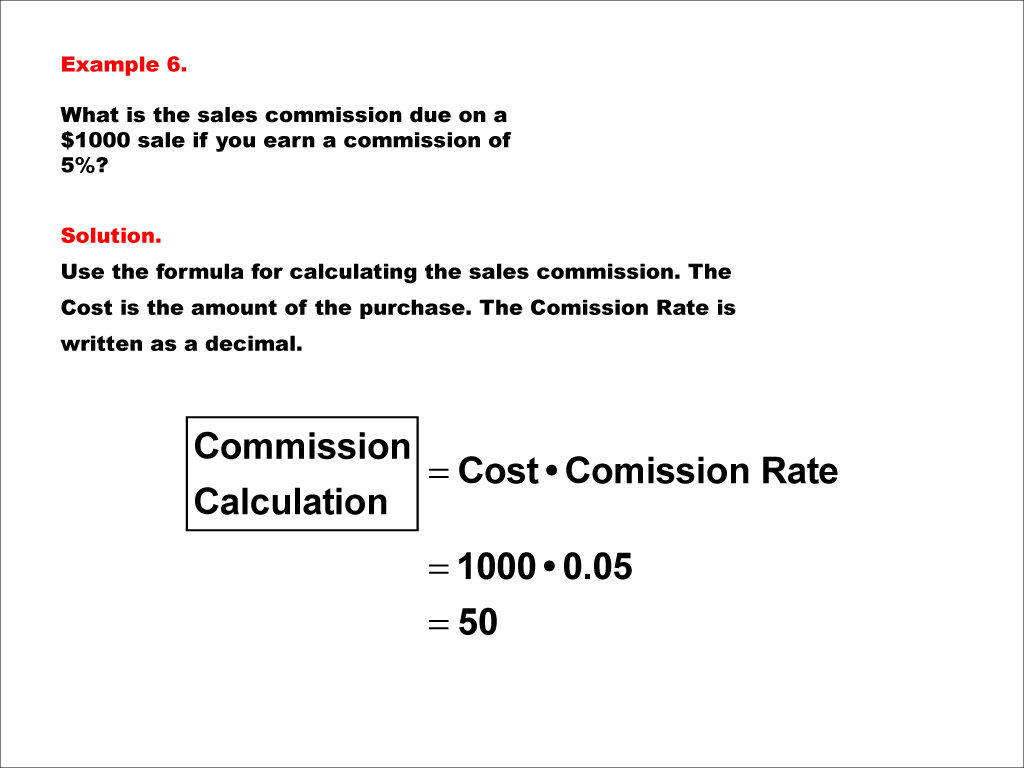
The simplest form of commission is calculated by multiplying the sales amount by the commission rate (expressed as a decimal or percentage).
- Formula: Commission Amount = Sales Amount × Commission Rate
For example, if a salesperson sells a product for $1,000 with a 10% commission rate, the commission earned would be $1,000 × 0.10 = $100. Similarly, to find the commission rate if you know the amount and the sale value: Commission Rate = (Commission Amount / Sales Amount) × 100%.
Tiered or Graduated Commission
Many businesses employ a tiered commission structure to further incentivize higher performance. In this model, the commission rate increases as sales volume or revenue milestones are met.
- Example: A salesperson might earn 5% on the first $10,000 in sales, 7% on sales between $10,001 and $20,000, and 10% on all sales above $20,000.
- If a salesperson makes $25,000 in sales:
- First Tier: $10,000 × 0.05 = $500
- Second Tier: ($20,000 – $10,000) × 0.07 = $10,000 × 0.07 = $700
- Third Tier: ($25,000 – $20,000) × 0.10 = $5,000 × 0.10 = $500
- Total Commission: $500 + $700 + $500 = $1,700
- If a salesperson makes $25,000 in sales:
This method requires careful segmenting of sales volume and applying different rates to each segment.
Commission with Base Salary
To provide a safety net and ensure a stable baseline income, many commission roles combine a fixed base salary with a commission component. This “salary-plus-commission” model is common in industries where sales cycles can be long or variable.
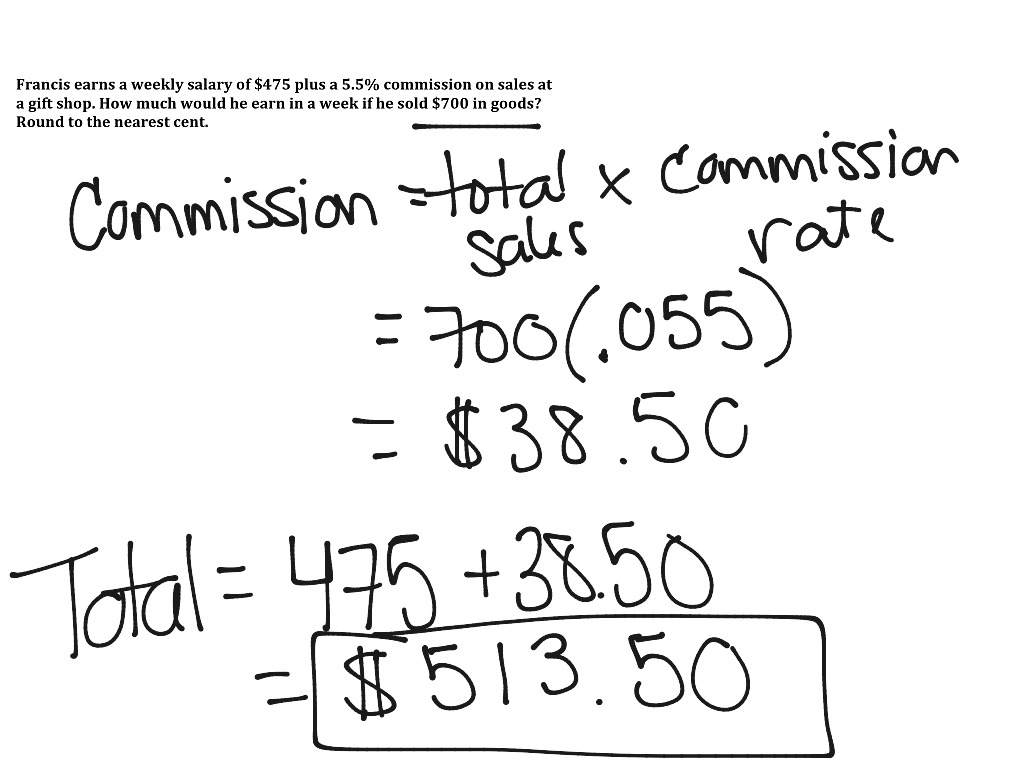
- Total Pay = Base Salary + Commission Amount
For instance, a sales manager might have a base salary of $4,000 per month plus a 2% commission on all team sales. If the team achieves $150,000 in sales for the month, the manager’s total pay would be $4,000 + ($150,000 × 0.02) = $4,000 + $3,000 = $7,000.
Residual Commission
Residual commission refers to ongoing payments earned from a single sale or customer acquisition, particularly common in services or products with recurring revenue streams. This motivates salespeople to not only make the initial sale but also to foster long-term customer relationships and retention.
- Example: An insurance agent might earn a commission on the initial policy sale and then a smaller, recurring percentage on the annual renewal premiums as long as the policy remains active. A software-as-a-service (SaaS) salesperson might earn a percentage of the monthly subscription fee for the lifetime of the client.
Commission in Personal and Business Finance
The financial implications of commission extend far beyond simple calculations, touching upon individual income stability, business profitability, and the dynamics of online earning models.
For the Individual: Maximizing Earnings and Understanding Paychecks
From a personal finance perspective, understanding commission is crucial for budgeting, financial planning, and career advancement. Individuals in commission-based roles must develop strategies to manage income volatility, save effectively during high-earning periods, and set realistic financial goals. They also need to meticulously track their sales performance to ensure accurate commission payouts and identify areas for improvement. Maximizing earnings often involves honing sales skills, expanding networks, and understanding market trends to consistently hit or exceed sales targets. Furthermore, understanding deductions, taxes, and other factors that impact net pay is vital, as these are often applied after commission calculations.
For the Business: Driving Sales and Managing Costs
For businesses, commission structures are a cornerstone of sales strategy and cost management. Properly designed commission plans can significantly boost sales, improve market penetration, and increase customer acquisition. However, designing an effective commission plan requires careful mathematical modeling and strategic consideration. The business must strike a balance between motivating its sales force and maintaining healthy profit margins. This involves:
- Setting Realistic Targets: Goals must be achievable yet challenging to prevent demotivation or unrealistic expectations.
- Controlling Costs: Commission expenses must be factored into the overall financial model, ensuring that the cost of sales does not erode profitability.
- Fairness and Transparency: A clear, understandable commission structure fosters trust and encourages maximum effort.
- Analyzing ROI: Businesses continuously analyze the return on investment (ROI) of their commission plans to ensure they are driving the desired financial outcomes.
Commission and Online Income Strategies
In the realm of online income and digital entrepreneurship, commission takes on new forms, particularly through affiliate marketing and direct sales of digital products.
- Affiliate Marketing: Individuals earn commission by promoting products or services of other companies. When a sale is made through their unique affiliate link, they receive a percentage of that sale. This often involves tracking conversions and understanding different commission models (e.g., pay-per-sale, pay-per-lead).
- Digital Product Sales: Creators of e-books, online courses, or software often use commission structures to incentivize partners or distributors to sell their products.
- Multi-Level Marketing (MLM): While often debated, MLM structures heavily rely on commission, not only from personal sales but also from the sales generated by recruits within one’s downline, adding layers of mathematical complexity to earnings.
Financial Implications and Best Practices
Effective management and understanding of commission are vital for financial health, both individually and corporately.
Pros and Cons of Commission Structures
Pros:
- For Individuals: Unlimited earning potential, direct reward for effort, autonomy.
- For Businesses: Lower fixed payroll costs, high motivation for sales teams, alignment of compensation with revenue generation, adaptability to market fluctuations.
Cons:
- For Individuals: Income instability, high pressure, potential for burnout, focus on volume over quality if not structured carefully.
- For Businesses: Potential for aggressive or unethical sales tactics if incentives are misaligned, administrative complexity in tracking and calculating, difficulty in forecasting payroll costs accurately.
Key Metrics and Financial Planning
Both individuals and businesses must track key metrics related to commission.
- For Individuals: Sales volume, conversion rates, average deal size, and actual commission earned vs. target. These metrics inform personal financial planning, budgeting for variable income, and strategizing for improved performance.
- For Businesses: Gross margin per sale, cost of sales (including commission), sales team productivity, customer lifetime value (CLV) relative to acquisition costs, and commission payout ratios. These metrics are critical for optimizing sales strategies, setting pricing, and managing overall profitability. Detailed financial forecasts and sensitivity analyses are necessary to model the impact of different commission scenarios.

Tools and Techniques for Tracking Commission
In today’s digital age, various financial tools and software facilitate the tracking and management of commission.
- Spreadsheets (Excel, Google Sheets): Essential for basic calculations, creating custom models, and tracking individual sales progress.
- Customer Relationship Management (CRM) Systems: Platforms like Salesforce or HubSpot often have built-in capabilities to track sales performance, opportunities, and even automate commission calculations based on predefined rules.
- Accounting Software: Tools like QuickBooks integrate sales data with financial reporting, making it easier to manage payroll and track commission expenses.
- Specialized Commission Software: For complex, multi-tiered, or residual commission structures, dedicated commission management software provides robust solutions for calculation accuracy, transparency, and reporting, reducing errors and administrative burden.
Understanding commission in its mathematical and financial dimensions is not merely an academic exercise; it is a critical skill for anyone involved in sales, business development, personal finance, or online income generation. It represents a fundamental principle where effort translates directly into financial reward, driving economic activity and personal wealth accumulation.
aViewFromTheCave is a participant in the Amazon Services LLC Associates Program, an affiliate advertising program designed to provide a means for sites to earn advertising fees by advertising and linking to Amazon.com. Amazon, the Amazon logo, AmazonSupply, and the AmazonSupply logo are trademarks of Amazon.com, Inc. or its affiliates. As an Amazon Associate we earn affiliate commissions from qualifying purchases.