
The stock market, a dynamic arena of buying and selling securities, is inherently susceptible to volatility. While price fluctuations are a normal part of its operation, extreme and rapid declines can trigger panic, leading to cascading sell-offs that can destabilize the entire financial system. To mitigate such extreme events, stock exchanges worldwide employ a mechanism known as a “circuit breaker.” Essentially, circuit breakers are designed to temporarily halt trading when prices fall by a predetermined percentage, providing a much-needed pause for reflection and preventing a complete market meltdown.
The Rationale Behind Stock Market Circuit Breakers
The concept of a circuit breaker in the stock market stems from a fundamental understanding of market psychology and the interconnectedness of global financial systems. In periods of intense selling pressure, driven by news, economic uncertainty, or simply widespread fear, prices can plummet at an alarming rate. This rapid decline can become a self-fulfilling prophecy. As prices fall, investors who are already exposed to losses might be forced to sell to meet margin calls or simply to cut their losses, further exacerbating the downward spiral. Without intervention, this can lead to a complete breakdown of liquidity and confidence.

Circuit breakers act as a safety net, a cooling-off period designed to prevent this domino effect. When triggered, trading is suspended across the market for a specific duration. This pause serves several crucial purposes:
- Allowing Information Dissemination and Assessment: In the heat of a market panic, investors may not have the time or the clarity to fully process incoming information or understand the underlying causes of the sell-off. The trading halt provides an opportunity for market participants, analysts, and regulators to gather more information, assess the situation, and communicate it effectively to the broader investment community.
- Preventing Herd Mentality: The psychological aspect of investing cannot be overstated. During sharp declines, a “herd mentality” can take hold, where investors follow the actions of others without independent analysis. Circuit breakers interrupt this flow, giving individuals a chance to step back, re-evaluate their investment strategies, and make rational decisions rather than succumbing to fear-driven impulses.
- Restoring Order and Liquidity: Extreme volatility can lead to a complete drying up of liquidity, meaning there are very few buyers for sellers at any given price. This makes it incredibly difficult to execute trades and can amplify price drops. A trading halt can help to restore some semblance of order, allowing market makers and other liquidity providers to reassess their positions and potentially re-enter the market with more confidence once trading resumes.
- Protecting Investors: Ultimately, circuit breakers are in place to protect investors from the most severe consequences of market irrationality. By preventing extreme price swings, they help to preserve capital and maintain confidence in the integrity of the financial markets.
The idea of circuit breakers is not unique to the stock market. Similar mechanisms are used in other financial markets, such as futures and options, and even in electrical systems to prevent overload. The principle remains the same: to temporarily disconnect the system when it’s under extreme stress to prevent catastrophic failure.
How Stock Market Circuit Breakers Function
The implementation and specific triggers for circuit breakers can vary slightly between different stock exchanges and jurisdictions. However, the general mechanism follows a tiered approach, typically based on percentage declines of a broad market index. In the United States, for example, the Securities and Exchange Commission (SEC) oversees trading halts for the stock market, with the New York Stock Exchange (NYSE) and Nasdaq being primary implementers.
Tiers of Circuit Breakers (US Market Example)
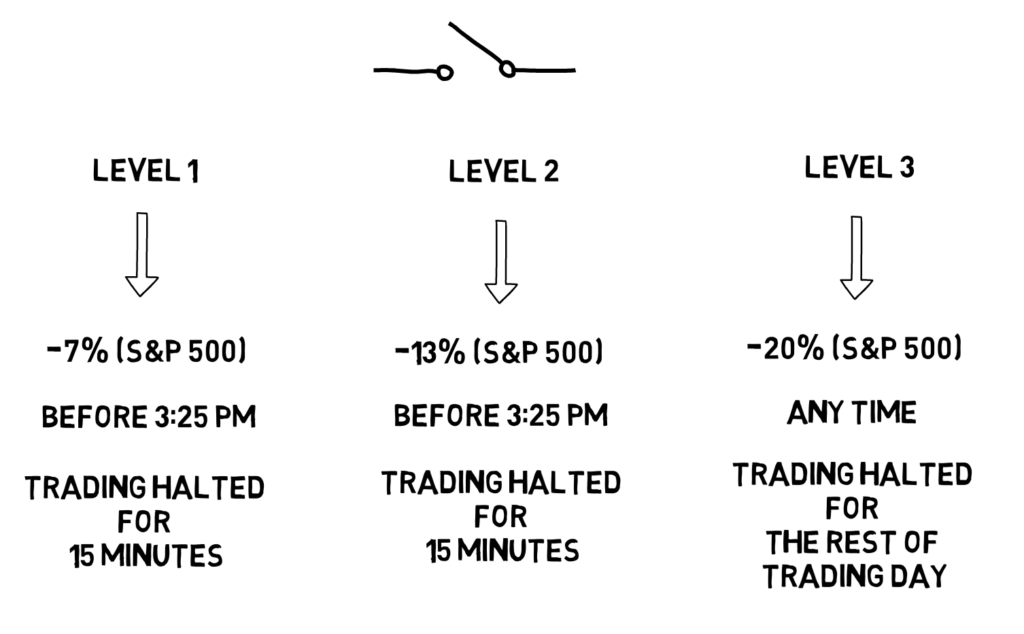
The current system for U.S. equities, implemented by the Stock Exchange Circuit Breaker (SECB) policy, is designed to kick in at various levels of market decline. These levels are tied to the S&P 500 index, a widely recognized benchmark for the U.S. stock market.
Level 1 Decline: 7%
- Trigger: When the S&P 500 index declines by 7% or more from its previous closing price.
- Action: A trading halt of 15 minutes is initiated. This pause applies to all U.S. equity markets.
- Timing Consideration: If the 7% decline occurs within the first hour of trading (before 3:30 PM ET), the halt will last for 15 minutes. However, if the decline happens after 3:30 PM ET, trading will continue until the market close, unless the Level 2 or Level 3 threshold is breached. This is to prevent premature halts that might not allow for sufficient market reaction.
Level 2 Decline: 13%
- Trigger: If the S&P 500 index falls by 13% or more from its previous closing price.
- Action: A trading halt of 15 minutes is initiated. Similar to Level 1, this halt applies to all U.S. equity markets.
- Timing Consideration: Again, the timing matters. If the 13% decline occurs before 3:30 PM ET, the halt will be 15 minutes. If it occurs at or after 3:30 PM ET, trading will continue until the market close, provided the Level 3 threshold is not breached.
Level 3 Decline: 20%
- Trigger: When the S&P 500 index drops by 20% or more from its previous closing price.
- Action: Trading is halted for the remainder of the trading day. This is the most severe circuit breaker level, signaling a significant market crisis.
- No Timing Exception: Unlike the lower levels, a 20% decline triggers an immediate and complete halt for the rest of the day, regardless of when it occurs during the trading session.
The Role of the S&P 500
The selection of the S&P 500 as the reference index for U.S. circuit breakers is deliberate. It is a broad, market-capitalization-weighted index that represents approximately 500 of the largest publicly traded companies in the U.S. Its performance is considered a strong indicator of the overall health and direction of the U.S. stock market. By using such a comprehensive index, the circuit breakers aim to capture systemic market stress rather than localized issues within specific sectors or individual stocks.
It’s important to note that these levels are not static. They are periodically reviewed and can be adjusted based on market conditions and regulatory considerations. The primary goal is to maintain a balance between allowing the market to function freely and intervening when extreme volatility threatens stability.
Historical Occurrences and Impact of Circuit Breakers
While circuit breakers are a crucial safety feature, their activation is relatively rare. However, when they have been triggered, their impact has been significant, both in terms of immediate market reaction and in shaping investor perception of market stability.
Notable Instances of Circuit Breaker Activation
The most prominent recent examples of circuit breakers being triggered occurred during the COVID-19 pandemic-induced market turmoil in March 2020. The rapid spread of the virus and the ensuing economic uncertainty led to unprecedented selling pressure.
- March 9, 2020: The S&P 500 fell by over 7% early in the trading session, triggering the first Level 1 circuit breaker in over two decades. This 15-minute pause did little to stem the tide of selling, as the market continued its precipitous decline.
- March 12, 2020: The market experienced another Level 1 circuit breaker activation as fears about the economic impact of the pandemic intensified.
- March 16, 2020: In one of the most dramatic days in market history, the S&P 500 plummeted by almost 12%, triggering a Level 2 circuit breaker. The subsequent 15-minute halt provided only a temporary respite, as the market continued to sell off sharply.
- March 18, 2020: For the first time in its history, the U.S. stock market triggered a Level 3 circuit breaker, with the S&P 500 falling by over 20%. This resulted in a full-day trading halt, a stark indication of the severity of the market crisis.
These events demonstrated the power of circuit breakers to interrupt extreme downward spirals. While they did not prevent significant losses in the short term, they provided crucial pauses that allowed for information to be processed and potentially prevented even more catastrophic outcomes.
The Psychological and Practical Impact
The impact of a circuit breaker can be dissected into psychological and practical dimensions:
Psychological Impact:
- Temporary Relief: For investors gripped by panic, the halt can provide a much-needed mental break, allowing them to step away from their screens and re-evaluate their positions with a clearer head.
- Signaling Severity: The activation of a circuit breaker, especially at higher levels, sends a strong signal to the market that conditions are extremely severe. This can paradoxically fuel further anxiety for some, while for others, it might be a cue to look for potential buying opportunities once the dust settles.
- Restoring Confidence (Longer Term): The existence of circuit breakers, and their successful implementation in preventing complete market collapse, can contribute to long-term investor confidence in the resilience of the financial system. Knowing there is a mechanism in place to prevent extreme chaos can be reassuring.
Practical Impact:
- Liquidity Restoration: As mentioned earlier, the pause can allow market makers and other liquidity providers to reassess their risk and potentially re-enter the market, improving the ability to trade once markets reopen.
- Orderly Reopening: After a halt, trading typically resumes at prices that are more reflective of a broader consensus after the initial panic has subsided. This leads to a more orderly resumption of price discovery.
- Preventing Systemic Risk: The primary practical function is to prevent the kind of cascading failures and systemic risk that could arise from unchecked panic selling, impacting not just stock markets but the broader economy.
While circuit breakers are not a panacea for market downturns, they represent a vital tool in the arsenal of financial regulators and exchanges, designed to safeguard the integrity and stability of the markets during times of extreme stress.
Criticisms and Considerations of Stock Market Circuit Breakers
Despite their intended benefits, stock market circuit breakers are not without their critics. Concerns have been raised about their effectiveness, potential unintended consequences, and the philosophical debate surrounding market intervention.
Debates on Effectiveness and Unintended Consequences
One of the primary criticisms revolves around whether circuit breakers truly achieve their goal of preventing panic or if they merely delay the inevitable.
- Delaying the Inevitable: Critics argue that if the underlying reasons for a market downturn are fundamental and severe, a temporary trading halt will not resolve the issues. Investors will likely resume selling once trading reopens, potentially at even lower prices, as seen in some of the March 2020 instances. The pause might simply compress the selling into a shorter, more intense period.
- Liquidity Drain: While intended to restore liquidity, some argue that prolonged halts can actually exacerbate liquidity problems. If market participants become uncertain about the market’s direction after a lengthy pause, they may be even more hesitant to commit capital when trading resumes.
- Market Manipulation Concerns: In extreme situations, there’s a theoretical concern that short-sellers could strategically time their positions to benefit from the volatility around circuit breaker activations, although regulatory oversight aims to mitigate such possibilities.
- Information Asymmetry: During a trading halt, information can continue to be disseminated among sophisticated investors or institutions that may have private channels or faster access to news, potentially creating an uneven playing field when trading resumes.
The Philosophy of Intervention
Beyond the practical concerns, there is a philosophical debate about the role of intervention in free markets.
- Free Market Principles: Some argue that the stock market should be allowed to function freely, with prices determined solely by supply and demand, regardless of the speed or magnitude of fluctuations. They believe that intervention, even with good intentions, distorts the natural price discovery process and can lead to moral hazard.
- Government Overreach: For those who subscribe to minimal government intervention, circuit breakers can be viewed as an example of regulatory overreach that interferes with the natural ebb and flow of economic activity.
- The “Artificially Smooth” Market: A concern is that over-reliance on circuit breakers could lead to markets that are perceived as “artificially smooth,” potentially masking underlying vulnerabilities until they manifest in a more dramatic and less predictable way.

Adapting and Evolving Mechanisms
In response to these criticisms and evolving market dynamics, stock exchanges and regulators continually evaluate and adapt circuit breaker mechanisms. This includes:
- Reviewing Trigger Levels and Durations: The percentages and timeframes for circuit breakers are subject to periodic review to ensure they remain appropriate for current market conditions.
- Considering Global Coordination: Given the interconnectedness of global markets, there’s ongoing discussion about the need for greater coordination of circuit breaker mechanisms across different countries.
- Enhancing Transparency and Communication: Clear and timely communication about the activation and implications of circuit breakers is crucial for managing market expectations and minimizing confusion.
Ultimately, the debate surrounding circuit breakers highlights the inherent tension between allowing markets to operate with minimal interference and the need to maintain stability and protect investors from extreme volatility. They remain a vital, albeit debated, tool in the modern financial landscape.
aViewFromTheCave is a participant in the Amazon Services LLC Associates Program, an affiliate advertising program designed to provide a means for sites to earn advertising fees by advertising and linking to Amazon.com. Amazon, the Amazon logo, AmazonSupply, and the AmazonSupply logo are trademarks of Amazon.com, Inc. or its affiliates. As an Amazon Associate we earn affiliate commissions from qualifying purchases.