
In the realm of personal finance, investors are often forced to choose between two competing priorities: the desire for high interest rates and the need for immediate access to their cash. Certificates of Deposit (CDs) have long been a staple of the conservative investor’s portfolio, offering higher yields than standard savings accounts in exchange for a commitment to leave the money untouched for a specific term. However, the rigidity of a traditional CD can be a significant drawback. If interest rates rise while your money is locked away, or if you face an unexpected financial emergency, the penalties for early withdrawal can quickly erode your gains.
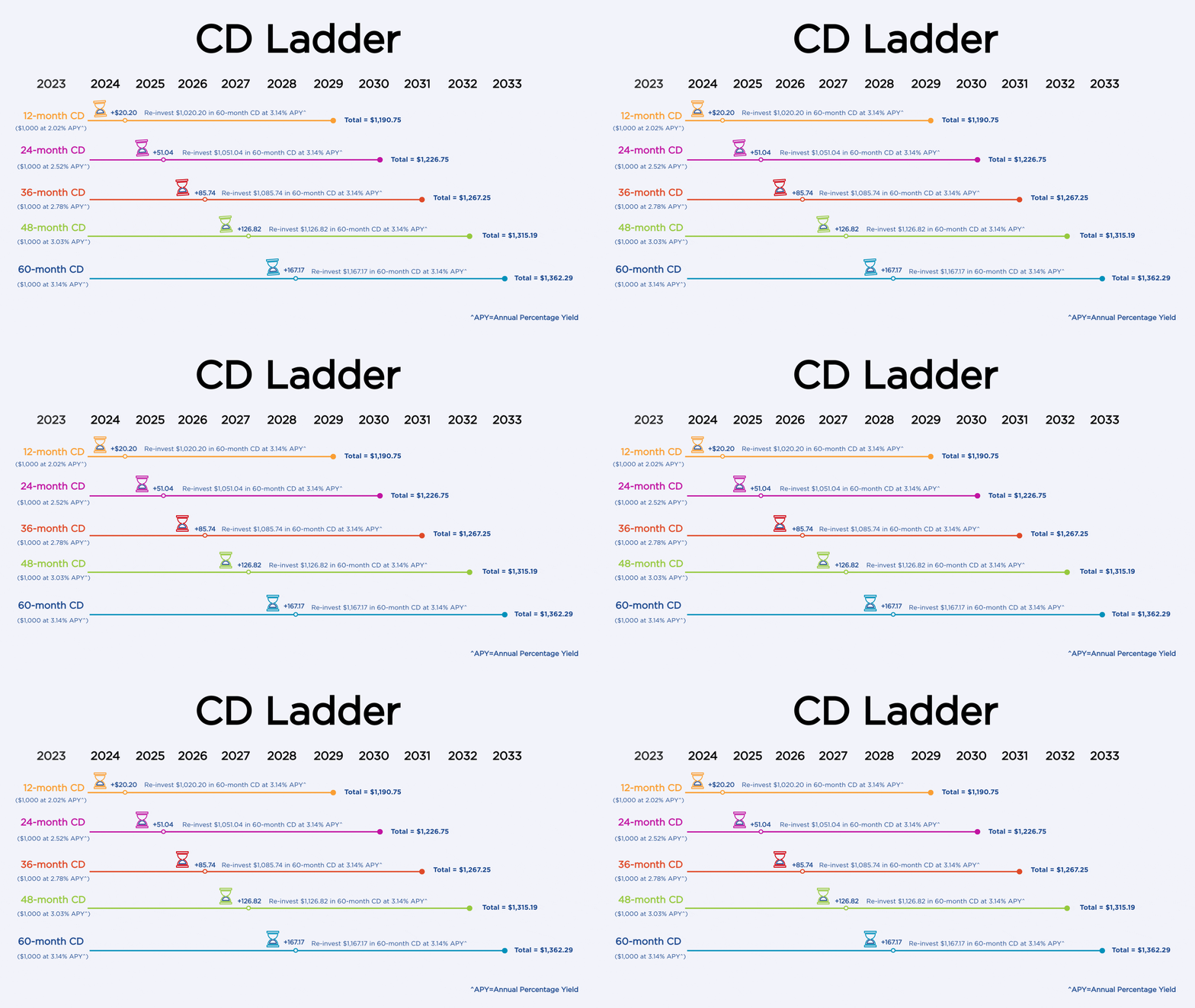
This is where CD laddering comes into play. CD laddering is a sophisticated yet accessible investment strategy designed to provide the best of both worlds. By staggering the maturity dates of multiple CDs, investors can enjoy the higher interest rates associated with long-term deposits while maintaining a steady stream of liquid cash. In an era of fluctuating interest rates and economic uncertainty, understanding the mechanics of a CD ladder is essential for anyone looking to optimize their fixed-income portfolio.
How CD Laddering Works: The Mechanics of the Strategy
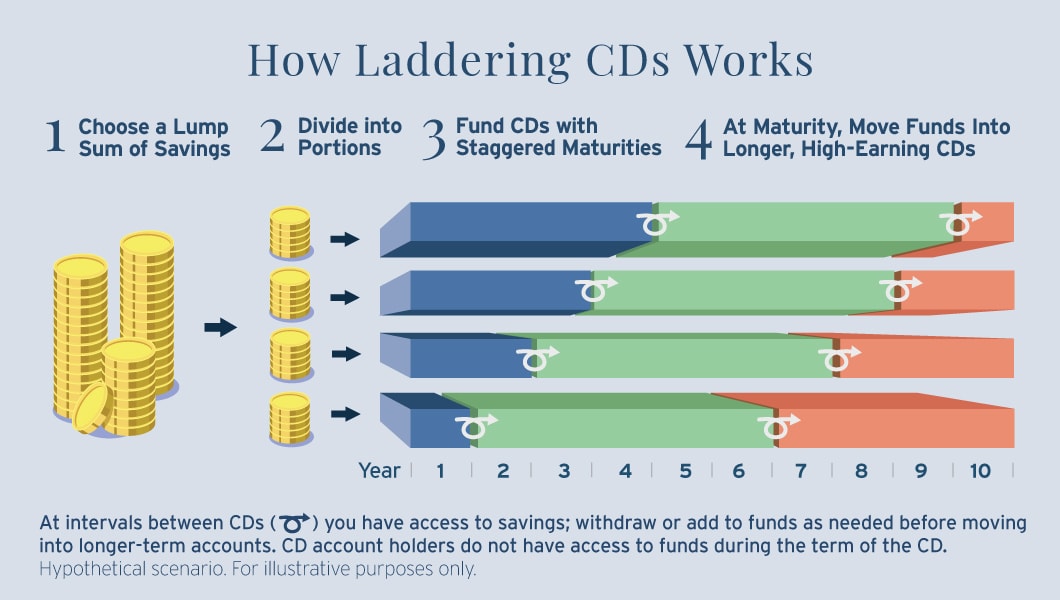
At its core, a CD ladder is a portfolio of several Certificates of Deposit with different maturity dates. Instead of placing a large sum of money into a single five-year CD, an investor divides that capital into several smaller increments and invests them in CDs of varying lengths.
Building the Rungs of the Ladder
Imagine you have $25,000 to invest. Instead of putting the full amount into one vehicle, you divide it into five “rungs” of $5,000 each. You would then open five different CDs:
- A 1-year CD
- A 2-year CD
- A 3-year CD
- A 4-year CD
- A 5-year CD
In this initial setup, you have successfully diversified your maturity dates. You have immediate visibility into when your cash will become available, with a portion of your principal maturing every twelve months.
The Reinvestment Cycle
The true power of the CD ladder is revealed when the first CD matures. When your 1-year CD reaches the end of its term, you don’t simply spend the cash (unless you need it). Instead, you reinvest that $5,000 into a new 5-year CD.
A year later, your original 2-year CD matures. You then reinvest that into another 5-year CD. After five years of this cycle, you will hold five different 5-year CDs, but they will be staggered so that one matures every single year. This allows you to capture the higher interest rates typically offered by 5-year terms while ensuring that 20% of your total investment is never more than 12 months away from being liquid.
The Core Benefits of a CD Ladder
The primary appeal of CD laddering lies in its ability to mitigate the inherent risks of fixed-income investing. By spreading out your deposits, you create a defensive structure that performs well in various market conditions.
Mitigating Interest Rate Risk
Interest rate risk is the danger that you lock your money into a low rate just before market rates climb. If you put all your money into a 5-year CD at 3% and rates jump to 5% the following year, you are stuck with an underperforming asset.
With a ladder, you are never locked in for the long haul with your entire principal. If rates rise, you will have a CD maturing soon, allowing you to reinvest that portion at the new, higher rate. Conversely, if rates fall, you still have the “top rungs” of your ladder—the 4-year and 5-year CDs—locked in at the previous higher rates, protecting your overall yield.
Managing Liquidity Without Penalties
One of the greatest fears of CD investors is the Early Withdrawal Penalty (EWP). These penalties can often cost three to six months of interest, sometimes even eating into the principal. A CD ladder provides a “liquidity runway.” Because a portion of your money matures at regular intervals (annually, or even every six months if you build a tighter ladder), you have frequent opportunities to access your cash without paying a dime in penalties. This makes CD ladders an excellent choice for a secondary emergency fund or for planned expenses like a wedding or a home down payment.
Capturing Higher Yields than Savings Accounts
While High-Yield Savings Accounts (HYSAs) and Money Market Accounts offer great liquidity, their rates are variable and can drop overnight if the Federal Reserve cuts interest rates. CDs offer a fixed rate of return. By using a ladder, you can lock in these fixed rates. Historically, the interest rates on 5-year CDs are significantly higher than those on 1-year CDs or savings accounts. A mature ladder allows you to earn those “long-term” rates on all your money while maintaining “short-term” access to a portion of it.
Step-by-Step Guide to Setting Up Your First Ladder
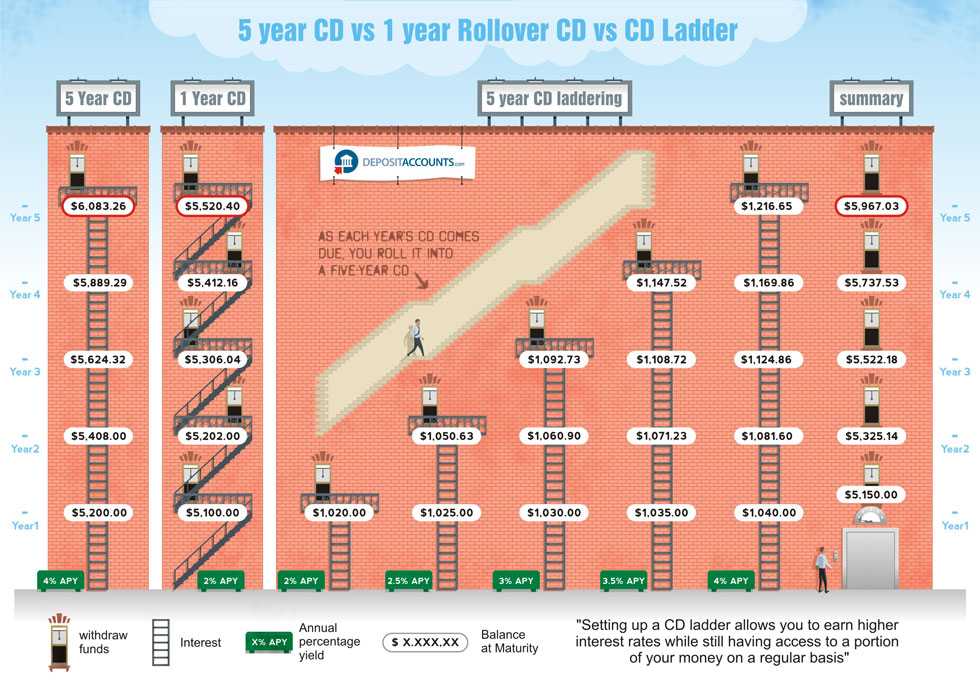
Setting up a CD ladder requires more planning than opening a single account, but the long-term benefits of financial stability and optimized yield make the effort worthwhile.
Determining Your Total Investment and Interval
The first step is deciding how much capital you can afford to set aside for the long term. Since CDs are timed deposits, this should be money you don’t expect to need for daily expenses. Next, decide on the “gap” between your rungs.
An annual ladder (1, 2, 3, 4, 5 years) is the most common, but if you want more frequent access to cash, you could build a monthly ladder using “short-term” CDs (3, 6, 9, 12 months). The choice depends entirely on your personal cash flow needs.
Selecting the Right Financial Institution
You do not have to buy all your CDs from the same bank. In fact, it is often better to shop around. Online banks frequently offer higher interest rates than traditional “brick-and-mortar” institutions because they have lower overhead costs.
When choosing a bank, ensure it is FDIC-insured (or NCUA-insured for credit unions). This guarantees that your investment—up to $250,000 per depositor, per institution—is backed by the full faith and credit of the U.S. government, making CDs one of the safest investments available.
Automating the Reinvestment
Many banks offer an “auto-renew” feature for CDs. While this sounds convenient, it can be a trap. Often, the renewal rate is the current “standard” rate, which might not be the most competitive. To maximize your money, you should manually manage your ladder. When a CD matures, take a few days to scan the market for the best available rate for the next “rung” of your ladder before committing the funds.
Advanced Strategies and Variations
Once you understand the basic structure of a CD ladder, you can customize the strategy to fit specific financial goals or market outlooks.
The Barbell vs. the Bullet Strategy
The “Barbell” strategy involves investing only in very short-term and very long-term CDs, skipping the middle years. This is used when an investor believes short-term rates will rise soon but wants to lock in some long-term stability.
The “Bullet” strategy involves buying CDs at different times that all mature in the same year. This is less of a “ladder” and more of a target-date strategy, often used by people saving for a specific event, like a child starting college, where they need the entire lump sum available at a specific point in time.
Utilizing No-Penalty and Bump-Up CDs
To add even more flexibility to your ladder, you can incorporate specialized CD products. A “No-Penalty CD” allows you to withdraw your full balance and interest at any time after the first few days of funding. The trade-off is usually a slightly lower interest rate.
A “Bump-Up CD” allows you to request a rate increase if the bank’s offered rates go up during your term. Including one or two of these in your ladder can provide an extra layer of protection against a rapidly rising interest rate environment.
Is CD Laddering Right for Your Financial Portfolio?
While CD laddering is a powerful tool, it is not a one-size-fits-all solution. Its effectiveness depends on your risk tolerance, your time horizon, and the current economic climate.
Comparing CDs to Bonds and Money Markets
For many investors, the choice is between a CD ladder and a bond ladder. Bonds can offer higher yields but come with the risk of price fluctuation if you need to sell them before they mature. CDs, conversely, have a fixed face value. Money Market accounts offer even more liquidity than a ladder but lack the “rate lock” feature that protects you if the market turns downward. A CD ladder sits in the “Goldilocks zone” of finance: safer than bonds, but higher-yielding than a standard savings account.
Assessing the Impact of Inflation
The primary risk of any fixed-income strategy, including CD laddering, is inflation. If your CD ladder is earning 4% interest but inflation is running at 5%, your “real” rate of return is negative—you are effectively losing purchasing power. Therefore, a CD ladder should generally be viewed as a tool for capital preservation and stability rather than aggressive wealth building. It serves as the “anchor” of a portfolio, providing a safe harbor while other investments, like stocks or real estate, pursue higher growth.
In conclusion, CD laddering is a disciplined, mathematical approach to savings that removes the guesswork from fixed-income investing. By systematically staggering your deposits, you create a self-sustaining cycle of liquidity and growth. Whether you are a retiree looking for a steady stream of supplemental income or a young professional building a robust emergency fund, the CD ladder offers a level of control and predictability that few other financial instruments can match. In the complex world of finance, sometimes the most effective strategies are the ones that rely on simple logic and consistent execution.
aViewFromTheCave is a participant in the Amazon Services LLC Associates Program, an affiliate advertising program designed to provide a means for sites to earn advertising fees by advertising and linking to Amazon.com. Amazon, the Amazon logo, AmazonSupply, and the AmazonSupply logo are trademarks of Amazon.com, Inc. or its affiliates. As an Amazon Associate we earn affiliate commissions from qualifying purchases.