
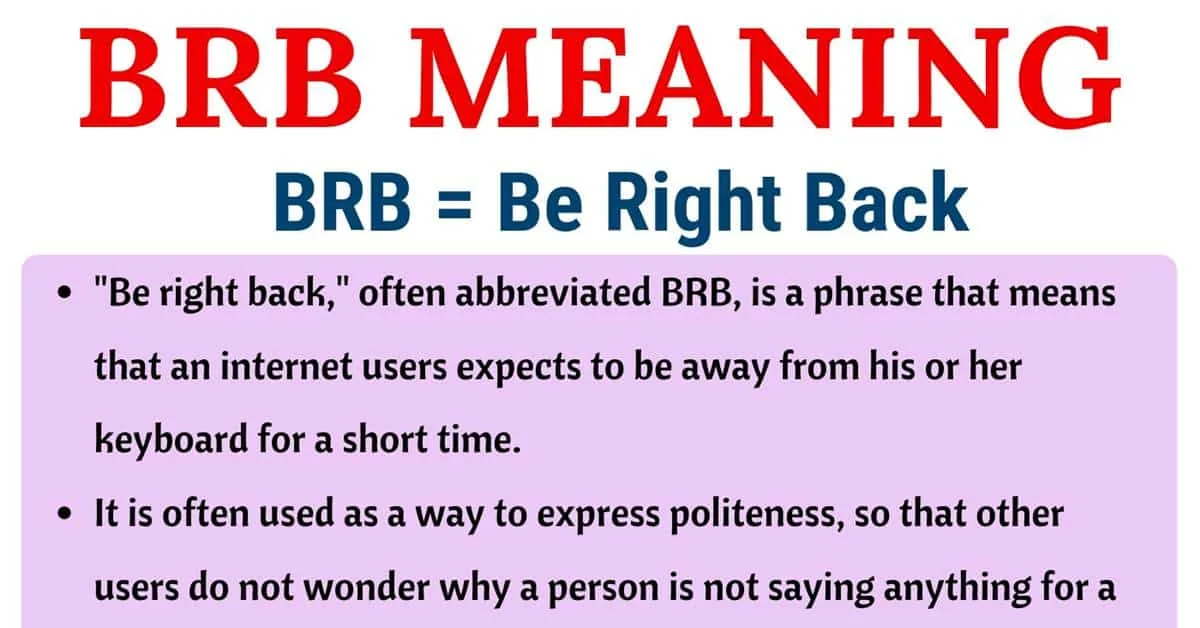
In the rapidly evolving landscape of digital communication, acronyms have become an indispensable part of our daily interactions. From quick chat messages to more formal online exchanges, understanding these abbreviations is key to navigating the modern web efficiently and effectively. Among the most fundamental and universally recognized is “BRB.” Standing for “Be Right Back,” BRB is more than just a convenient shortcut; it’s a testament to the dynamic nature of online presence and the need for quick, clear communication in a perpetually connected world. This seemingly simple acronym encapsulates a complex shift in how individuals manage their attention, availability, and engagement across multiple digital platforms. Its widespread adoption highlights the continuous effort to streamline conversations, minimize keystrokes, and maintain flow in real-time, often asynchronous, digital environments. As technology continues to integrate deeper into our lives, mastering this digital shorthand becomes less of a niche skill and more of a foundational aspect of digital literacy.

The Genesis of Digital Shorthand: Why BRB Became Indispensable
The emergence of acronyms like BRB is not merely a quirk of internet culture but a direct response to the technological constraints and social dynamics of early online communication. As the internet transitioned from academic networks to a public utility, the tools for interaction were often rudimentary, demanding efficiency from their users. This necessity forged a new lexicon.
From Early Internet Forums to Instant Messaging Platforms
The concept of digital shorthand predates modern instant messaging. In the early days of bulletin board systems (BBS), Usenet groups, and rudimentary chat rooms, communication was often text-based and asynchronous, yet still valued conciseness. Character limits in certain systems, coupled with the often laborious process of typing on early keyboards and slow dial-up connections, naturally encouraged brevity. Users sought ways to convey maximum meaning with minimum effort. When real-time interaction started to gain prominence with the advent of AOL Instant Messenger (AIM), ICQ, and MSN Messenger in the late 1990s and early 2000s, the demand for quick communication intensified. These platforms facilitated synchronous conversations, creating a need for immediate signals of presence and absence. BRB quickly became a cornerstone, allowing users to temporarily step away from their keyboards without abruptly ending a conversation or leaving others wondering about their sudden silence. It served as a digital “hold on a moment,” crucial for maintaining the rhythm of virtual dialogue.
BRB as a Solution for Real-Time Interruptions
In a world where digital presence often mirrors physical presence, the act of stepping away, even for a few moments, required an immediate and understandable signal. BRB precisely filled this void. Imagine a live chat scenario: a user might be in the middle of a gaming session, a work discussion on Slack, or a casual conversation with friends on Discord. An unexpected phone call, a knock at the door, or the need to grab a drink necessitates a brief interruption. Simply going silent could be interpreted as disinterest or a sudden disconnection. By typing “BRB,” users provide a clear, concise, and widely understood notification that they are temporarily unavailable but intend to return shortly. This simple four-letter message prevents miscommunication, manages expectations, and sustains the continuity of the interaction. It is a social contract forged in the digital realm, ensuring that even brief absences do not disrupt the flow of ongoing discussions, making it a powerful tool for managing attention and availability in real-time online environments.
BRB in Practice: Navigating Modern Digital Landscapes
The utility of BRB has not diminished with time; instead, it has evolved, adapting to the nuances of contemporary digital communication platforms. Its usage today reflects both its enduring relevance and the increasingly complex tapestry of online interactions.
Ubiquitous Across Chat Apps and Social Media
Today, BRB is an integral part of virtually every major chat application and social media platform. From casual exchanges on WhatsApp and Facebook Messenger to more structured group discussions on Discord and Telegram, the acronym serves its original purpose with unwavering effectiveness. Its simplicity makes it universally understood, transcending language barriers in many internet-native communities. In the fast-paced world of gaming, for instance, a quick “BRB” in the team chat can mean the difference between a coordinated pause and a disastrous defeat. In workplace communication tools like Slack or Microsoft Teams, while often less formal than email, BRB allows colleagues to briefly step away from a direct message or channel discussion without leaving others in limbo. Its quick adoption across such diverse platforms underscores its fundamental role in managing expectations regarding presence and responsiveness, a critical factor in the efficiency of digital collaboration and social interaction.
Professional Contexts: When to Use and When to Avoid
While BRB is highly effective in informal and semi-formal digital contexts, its appropriateness varies significantly in professional settings. In formal email correspondence or official documents, using “BRB” would be largely unprofessional and out of place. However, in more dynamic, real-time professional communication channels, the lines are blurrier. In an internal team chat on Slack or a collaborative document environment, a quick “BRB” can be acceptable, particularly if the team culture leans towards informality and efficiency. It signals transparency and avoids unnecessary delays. The key lies in understanding the specific cultural norms of your workplace or professional network. Overusing such acronyms, or employing them in contexts demanding full sentences and formal language, can detract from one’s professional image. The discerning professional knows when a simple “BRB” is a useful efficiency hack and when a more complete phrase like “I need to step away for a moment and will be back shortly” is warranted.
Related Concepts: AFK, OMW, and Other Temporal Acronyms
BRB is not alone in the pantheon of temporal acronyms that manage digital presence and movement. “AFK” (Away From Keyboard) is a close cousin, often used in gaming or continuous chat environments to indicate a more prolonged or indefinite absence. While “BRB” implies a quick return, “AFK” suggests a longer or less certain duration away. Similarly, “OMW” (On My Way) communicates immediate movement towards a destination, often used to inform others of one’s imminent arrival. These acronyms collectively form a sophisticated system for coordinating presence, absence, and movement in the digital realm. They reflect a shared understanding among digital citizens that time and attention are valuable commodities, and clear, concise communication about one’s availability is paramount for effective interaction. Mastering these related terms provides a fuller command of the etiquette and efficiency demanded by modern digital communication.
Beyond BRB: A Primer on Common Digital Acronyms
While BRB is a cornerstone, the digital lexicon is rich with numerous other acronyms that serve a variety of communicative functions, each contributing to the efficiency and nuance of online interaction. Understanding these terms is crucial for anyone participating in the digital ecosystem.

Essential Acronyms for Everyday Online Interaction
Many acronyms have become so ingrained in daily digital exchanges that they are almost second nature. “LOL” (Laughing Out Loud), for example, is perhaps one of the most recognized, signifying amusement. “IMHO” (In My Humble Opinion) or “IMO” (In My Opinion) are used to preface a subjective viewpoint, signaling that what follows is a personal perspective rather than an undisputed fact. “BTW” (By The Way) introduces a tangential piece of information or a change of subject. “TTYL” (Talk To You Later) functions as a common sign-off, indicating a temporary end to a conversation. “FYI” (For Your Information) provides context or data. “NVM” (Nevermind) is used to retract a statement or indicate that a previous query is no longer relevant. “TBH” (To Be Honest) adds a layer of candidness or sincerity to a statement. These acronyms, by allowing for rapid expression of common sentiments and conversational shifts, significantly accelerate the pace of digital dialogue, making interactions more fluid and less cumbersome.
Gaming and Niche Communities: Specialized Digital Lexicon
Digital communities, especially those centered around specific technologies or hobbies like online gaming, often develop their own highly specialized sets of acronyms. These serve not only for efficiency but also as a form of shorthand that binds the community, creating a shared language. In online gaming, for instance, “GG” (Good Game) is a polite and common end-of-match salutation. “GLHF” (Good Luck, Have Fun) is a customary pre-match greeting. “AFK,” as mentioned earlier, is vital for managing team expectations. Beyond these, terms like “PUG” (Pick-Up Group, a randomly assembled team), “DPS” (Damage Per Second, a combat role), “NPC” (Non-Player Character), and “MMORPG” (Massively Multiplayer Online Role-Playing Game) are ubiquitous. These niche acronyms are critical for quick tactical communication in fast-paced scenarios and for establishing a sense of belonging within the community. For newcomers, learning these specialized terms is often a rite of passage, demonstrating their integration into the group’s unique digital culture and understanding of its specific technological context.
The Impact of Digital Acronyms on Communication Efficacy
The proliferation of digital acronyms has had a profound impact on the efficacy of online communication, streamlining exchanges while also presenting potential challenges related to clarity and inclusivity.
Enhancing Speed and Efficiency
The primary benefit of digital acronyms is their ability to significantly enhance communication speed and efficiency. In an era where every second counts, and attention spans are often fragmented, acronyms allow users to convey complex ideas or common phrases with minimal keystrokes. This speed is invaluable in real-time chat environments, enabling faster responses and maintaining the momentum of a conversation. For mobile users, typing on smaller screens can be cumbersome, making acronyms a practical solution to reduce effort and potential errors. This efficiency extends beyond individual messages; it contributes to a higher overall rate of information exchange, which is critical in collaborative work environments and fast-moving social discussions. By condensing common phrases into easily digestible units, acronyms facilitate a more dynamic and responsive mode of interaction, perfectly suited to the demands of modern digital lifestyles.
Potential Pitfalls: Misunderstanding and Exclusivity
Despite their advantages, digital acronyms are not without their drawbacks. The most significant pitfall is the potential for misunderstanding. While terms like “BRB” are widely understood, many other acronyms, especially niche ones, can be context-dependent or unknown to certain individuals. This can lead to confusion, misinterpretations, and a breakdown in communication, particularly when interacting with new acquaintances, different cultural groups, or those less digitally native. Furthermore, the use of extensive jargon or acronyms can create an unintentional barrier to entry, fostering an exclusive environment. Newcomers to a particular chat group, online game, or professional team might feel alienated or struggle to keep up if they are constantly encountering terms they don’t understand. This exclusivity can hinder collaboration, reduce participation, and even create a perception of unfriendliness or elitism, underscoring the need for judicious use and an awareness of one’s audience.
Bridging Generational Divides in Digital Speak
Digital acronyms also play an interesting role in bridging, and sometimes widening, generational divides. Younger generations, who have grown up with constant internet access and instant messaging, tend to be highly fluent in digital shorthand, often incorporating it into their daily speech. For older generations, or those who adopted digital communication later in life, these acronyms can be a source of bewilderment. However, as digital literacy becomes increasingly universal, many common acronyms have transcended generational boundaries. Terms like “LOL” or “BRB” are now understood by a broad spectrum of age groups, fostering a common linguistic ground in the digital sphere. Educational initiatives and simple exposure have helped in this integration. Yet, more obscure or rapidly evolving acronyms continue to mark a distinction, prompting a continuous learning curve for all participants in the digital dialogue. Understanding this dynamic helps in tailoring communication to ensure clarity across diverse age groups.
The Evolving Lexicon of the Digital Age
The digital lexicon is far from static; it is a living, breathing entity that constantly adapts to new technologies, cultural shifts, and communicative needs. The future promises even more innovative ways to convey meaning quickly and effectively.
The Blurring Lines: Acronyms, Emojis, and Memes
The evolution of digital communication is marked by a fascinating convergence of different forms of shorthand. Acronyms, while foundational, are increasingly integrated with and complemented by emojis and internet memes. Emojis offer a visual, universally understood way to convey emotion, tone, and even complex ideas without words, often replacing or supplementing acronyms like “LOL” with a laughing face emoji. Memes, combining images with text, provide a highly contextual and culturally rich form of communication that can express intricate reactions or concepts with a single shared reference. This blending creates a multi-modal communication style where a message might combine text, acronyms, emojis, and a meme to convey a layered meaning efficiently. This synergistic approach allows for richer, more nuanced, and often more engaging interactions, pushing the boundaries of what is possible within digital conversation. The ability to fluidly navigate and employ these various forms of shorthand is becoming a hallmark of advanced digital literacy.
AI and Predictive Text: Shaping Future Shorthand
Artificial intelligence and predictive text technologies are already significantly influencing the way we communicate digitally, and their impact on shorthand is only set to grow. Modern keyboards and messaging apps use AI to anticipate words and phrases, often suggesting common acronyms as users type. This not only speeds up the writing process but also subtly reinforces the use and understanding of these abbreviations. As AI becomes more sophisticated, it could potentially personalize shorthand suggestions based on individual communication patterns and group contexts, making digital dialogue even more efficient. Furthermore, AI-powered translation tools could seamlessly interpret and convert acronyms across languages, further breaking down communication barriers. Conversely, AI might also introduce new forms of brevity or even contribute to the creation of novel acronyms by identifying patterns in human communication. The interplay between human innovation and machine learning promises an exciting future for the digital lexicon, where efficiency and nuanced expression continue to evolve in fascinating new ways.
aViewFromTheCave is a participant in the Amazon Services LLC Associates Program, an affiliate advertising program designed to provide a means for sites to earn advertising fees by advertising and linking to Amazon.com. Amazon, the Amazon logo, AmazonSupply, and the AmazonSupply logo are trademarks of Amazon.com, Inc. or its affiliates. As an Amazon Associate we earn affiliate commissions from qualifying purchases.