
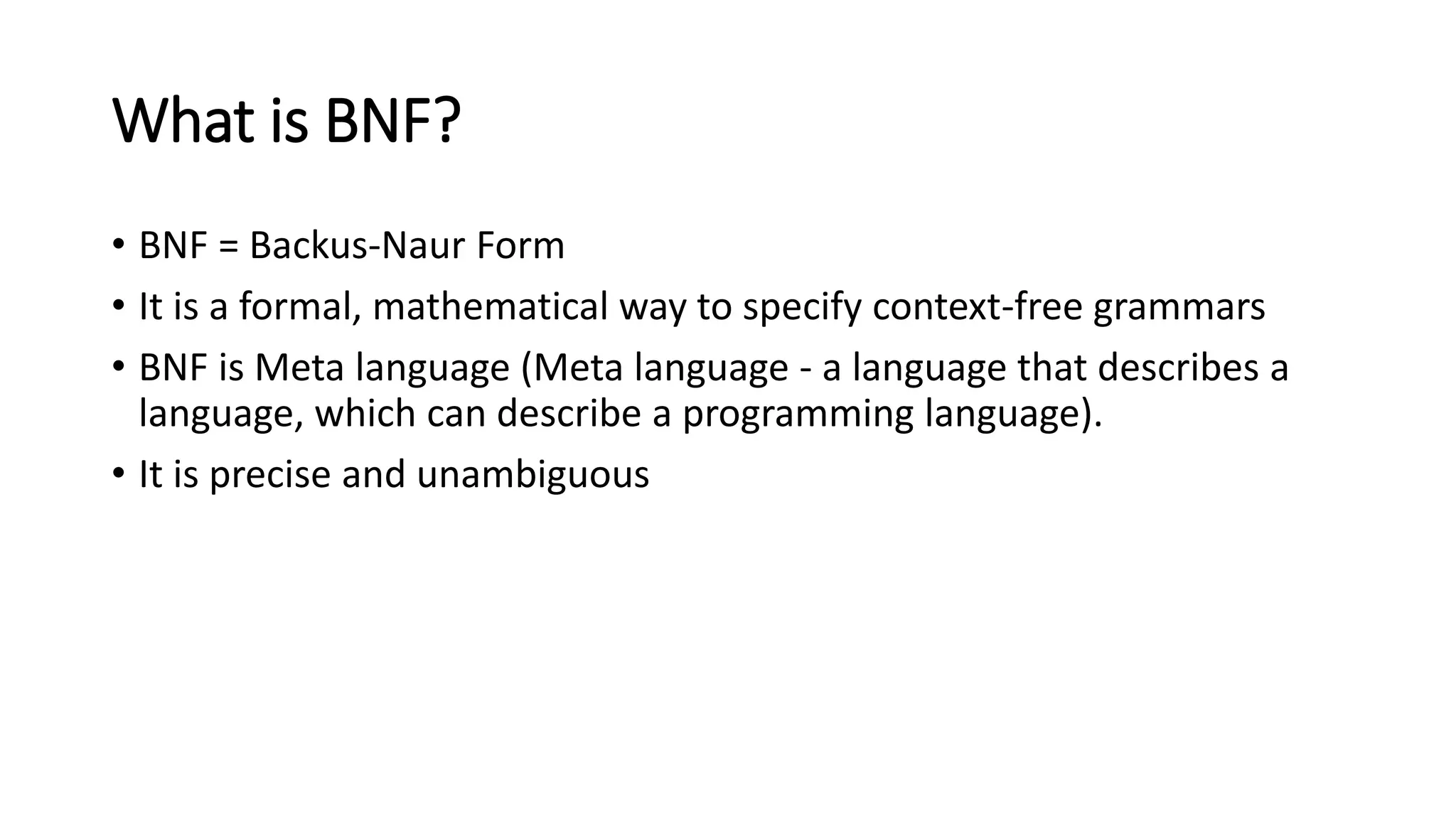
In the intricate world of computer science and software development, precision is paramount. Every line of code, every command, and every data structure must adhere to a strict set of rules to be correctly interpreted and executed. But how do we define these rules in an unambiguous and universally understandable way? This fundamental challenge led to the creation of Backus-Naur Form (BNF), a metasyntax notation that revolutionized how programming languages and communication protocols are described. Far from being a mere academic curiosity, BNF remains a cornerstone of computer science, underpinning much of the software infrastructure we interact with daily.

The Genesis of Language Description
Before the advent of BNF, describing the syntax of programming languages was often an exercise in ambiguity. Natural language descriptions were prone to misinterpretation, leading to inconsistencies in compiler implementations and significant headaches for language designers and users alike. The burgeoning field of computer programming in the 1950s desperately needed a standardized, formal method to define grammar.
A Problem of Precision
Early programming languages like Fortran and Lisp were complex enough to expose the limitations of informal syntax descriptions. As new languages emerged and became more sophisticated, the need for a rigorous, mathematical approach to language definition became critical. Without such a system, ensuring that different compilers for the same language would produce identical results, or even correctly parse valid programs, was an enormous hurdle. The lack of a clear, formal specification often resulted in “dialect” variations between compilers, hindering portability and interoperability. This problem wasn’t just about academic elegance; it had significant practical implications for software development, debugging, and maintenance.
Backus and Naur’s Breakthrough
The breakthrough arrived in the late 1950s, primarily driven by the need to formally define ALGOL 60, one of the most influential early programming languages. John Backus, working for IBM, proposed a notation in 1959 that was subsequently refined and popularized by Peter Naur, who was part of the ALGOL 60 committee. This formalization, initially called “Backus Normal Form” by some and later “Backus-Naur Form” as a tribute to both contributors, provided a concise and unambiguous way to specify context-free grammars. It borrowed concepts from Chomsky’s work on formal grammars and applied them directly to the practical problem of programming language syntax. BNF quickly gained widespread acceptance, becoming the de facto standard for defining language syntax and paving the way for more sophisticated parsing techniques and compiler construction.
Deconstructing the BNF Syntax
At its core, BNF is a set of rules that describe the structure of a language. These rules are expressed using a handful of special symbols that define how various language elements can be combined. Understanding these symbols is key to deciphering any BNF specification.
Basic Components: Terminals and Non-Terminals
Every BNF grammar consists of two fundamental types of symbols:
- Terminals: These are the atomic elements of the language being defined. They are characters or sequences of characters that appear literally in the language. For instance, in a programming language, keywords like
if,else,while, operators like+,-,*,/, and punctuation marks like;,(,)are terminals. They cannot be broken down further by the grammar rules. - Non-Terminals: These represent abstract syntactic categories or constructs within the language. They are placeholders for patterns of terminals and other non-terminals. Non-terminals are typically enclosed in angle brackets, like
<expression>,<statement>,<digit>. They are defined by one or more production rules, explaining how they can be constructed.
The Production Rule
The heart of BNF is the production rule, which defines how a non-terminal can be expanded or “produced” from a sequence of other terminals and non-terminals. A production rule generally takes the form:
<non-terminal> ::= <expression>
Here:
<non-terminal>: The abstract category being defined.::=: Reads as “is defined as” or “can be replaced by.” This is the assignment operator.<expression>: A sequence of terminals, non-terminals, and operators that defines the structure of the non-terminal on the left.
Operators and Their Meanings
BNF uses a minimal set of operators to construct complex grammars:
::=(Is Defined As): As mentioned, this is the fundamental assignment operator, linking a non-terminal to its definition.- Example:
<digit> ::= 0 | 1 | 2 | 3 | 4 | 5 | 6 | 7 | 8 | 9
- Example:
|(OR): This symbol denotes alternatives. If a non-terminal can be formed in several different ways, the|separates these possibilities.- Example:
<arithmetic_op> ::= + | - | * | /(An arithmetic operator can be a plus, minus, multiply, or divide sign).
- Example:
< >(Angle Brackets): These enclose non-terminals. They explicitly distinguish non-terminals from terminals.- Example:
<number>,<variable_name>
- Example:
- Literals (Terminals): Any characters not enclosed in angle brackets are considered terminals and must appear exactly as written.
- Example:
if,else,(,)
- Example:
While classic BNF is quite spartan, many modern interpretations and extensions (like EBNF and ABNF) introduce additional shorthand for common patterns:
*(Zero or More): Indicates that the preceding element can occur zero or more times. (Common in EBNF/ABNF, not standard BNF).+(One or More): Indicates that the preceding element must occur at least once. (Common in EBNF/ABNF, not standard BNF).[ ](Optional): Encloses an element that may or may not be present. (Common in EBNF/ABNF, not standard BNF).{ }(Grouping/Repetition): Used for grouping elements or specifying exact repetitions. (Common in EBNF/ABNF, not standard BNF).
Even with its limited set of symbols, original BNF can define remarkably complex language structures with clarity and precision, laying the groundwork for how computers understand human-readable instructions.
Why BNF Matters in Software Development
BNF’s impact on software development is profound and enduring. It provided the formal bedrock for many fundamental aspects of how we design, implement, and analyze computer languages and systems.
Defining Programming Languages
The primary initial application of BNF was, and largely remains, the formal definition of programming language syntax. When a new programming language is designed, its grammar is typically first specified using a form of BNF. This formal definition serves several critical purposes:
- Unambiguity: It eliminates the vagueness inherent in natural language descriptions, ensuring that every valid program can be uniquely parsed and every invalid program can be unambiguously rejected.
- Consistency: It provides a single, authoritative reference for implementers (compiler writers) and users, fostering consistency across different compilers and tools.
- Language Design Tool: It forces language designers to think rigorously about the structure and rules of their language, helping them identify ambiguities or inconsistencies before implementation begins.
Compiler and Interpreter Construction
For any programming language to be executable, its source code must be translated into machine-readable instructions. This process is handled by compilers or interpreters. BNF is absolutely central to their construction:
- Parsing: The first phase of a compiler or interpreter is parsing, where the source code is analyzed to determine if it conforms to the language’s grammar. Parsing algorithms (like LL or LR parsers) are often directly derived from the BNF specification of the language. BNF productions are translated into rules that guide the parser in constructing a parse tree or abstract syntax tree (AST), which represents the hierarchical structure of the program.
- Error Detection: By comparing the input code against the BNF rules, compilers can precisely identify syntax errors and report them to the programmer, helping in the debugging process.
Communication Protocols and Data Formats
Beyond programming languages, BNF’s utility extends to defining the syntax of communication protocols and data exchange formats. For example:
- HTTP (Hypertext Transfer Protocol): While more modern specifications often use ABNF (Augmented BNF), the spirit and methodology trace directly back to BNF. Defining message structures, headers, and body formats formally ensures that different web servers and clients can understand each other.
- Email Formats (RFCs): The structure of email messages, including headers and content types, is often specified using BNF-like notations, guaranteeing interoperability across various email clients and servers.
- Configuration Files: Complex configuration files for applications or systems can also benefit from a BNF-like definition, providing a clear contract for how options and values should be structured.
Enhancing Clarity and Reducing Ambiguity
In any technical domain, clarity is a significant advantage. BNF brings a level of precision that is invaluable for documentation, education, and collaboration. When a system’s grammar is defined in BNF, it becomes:
- Self-documenting: The grammar itself serves as a compact and authoritative documentation of the language’s structure.
- Easier to learn: Developers can reference the BNF to understand exactly what constitutes a valid construct in a language or protocol.
- A common ground: It provides a universal language for discussing and reasoning about language structure, reducing misunderstandings between different stakeholders in a project.
Evolution and Modern Relevance
While original BNF was revolutionary, practical applications quickly revealed opportunities for enhancement. Its legacy, however, remains firmly embedded in modern computer science.
EBNF and ABNF: Addressing BNF’s Limitations
One of the main “limitations” of original BNF was its verbosity for common patterns like optional elements or repetitions. To address this, various extensions emerged:
- Extended Backus-Naur Form (EBNF): EBNF introduces additional meta-symbols (like
*for zero or more,+for one or more,[ ]for optional elements, and{ }for grouping or repetition) to make grammars more concise and readable. It’s often used in academic contexts and for language specifications. - Augmented Backus-Naur Form (ABNF): Standardized by the IETF (Internet Engineering Task Force), ABNF is widely used for defining Internet protocols (like HTTP, SMTP, FTP). It is a slightly different dialect of EBNF, with its own specific set of meta-symbols and conventions tailored for protocol specifications. These extensions don’t fundamentally change BNF’s principles but provide more expressive power, reducing the number of production rules needed for a complex grammar.
Beyond Programming Languages: Data Description and Configuration
The principles of formal grammar description, rooted in BNF, have found applications far beyond merely defining programming languages. They are instrumental in:
- Schema Definitions: Languages like XML Schema, JSON Schema, and Protocol Buffers, while not directly BNF, use similar formal approaches to define the structure and constraints of data. This ensures data validity and facilitates interoperability between different systems.
- Configuration Languages: Many complex applications use domain-specific configuration languages. Defining their syntax formally ensures that configurations are correctly parsed and applied, preventing errors due to malformed input.
- Domain-Specific Languages (DSLs): For specialized tasks, DSLs are often created. BNF (or EBNF/ABNF) is the ideal tool for precisely defining these languages, enabling robust tooling and parsing.

The Enduring Legacy for Future Tech
Even with the rise of new parsing technologies and language design paradigms, the foundational concepts introduced by BNF remain indispensable. It instilled the idea that language syntax can and should be defined formally, unambiguously, and mathematically. This principle continues to guide:
- Compiler Design: Modern compilers, while employing sophisticated algorithms, still rely on a formal grammar definition, often expressed in an EBNF-like notation, to parse source code.
- API Design: When designing APIs, especially those involving command structures or data payloads, the need for clear, unambiguous syntax leads designers back to the principles of formal grammar.
- Security: Formal grammars can play a role in digital security by precisely defining what constitutes valid input, thus helping to guard against injection attacks or malformed data exploits.
BNF, despite its age, is not an antiquated relic but a living concept whose influence permeates the very fabric of software and digital communication. It’s a testament to the power of formal methods in bringing order, precision, and clarity to the complex world of computing.
aViewFromTheCave is a participant in the Amazon Services LLC Associates Program, an affiliate advertising program designed to provide a means for sites to earn advertising fees by advertising and linking to Amazon.com. Amazon, the Amazon logo, AmazonSupply, and the AmazonSupply logo are trademarks of Amazon.com, Inc. or its affiliates. As an Amazon Associate we earn affiliate commissions from qualifying purchases.