
In the world of finance, few dates carry as much weight or evoke as much visceral reaction as October 19, 1987. Known globally as “Black Monday,” this day marked the largest single-day percentage decline in the history of the U.S. stock market. For modern investors, understanding Black Monday is not just a history lesson; it is a fundamental requirement for navigating the complexities of risk management, market psychology, and the structural integrity of global financial systems.
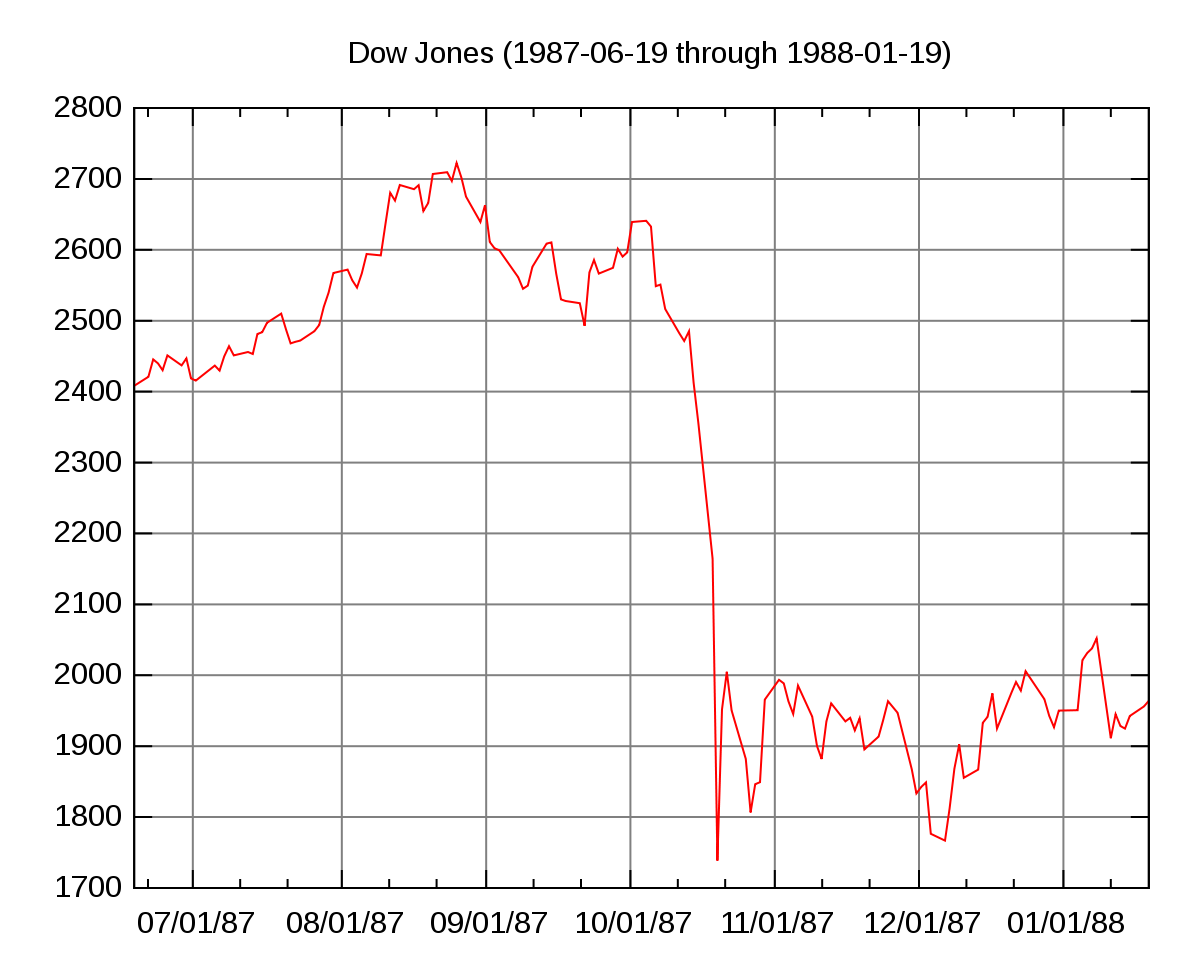
To comprehend the magnitude of the event, one must look past the numbers. While the Dow Jones Industrial Average (DJIA) fell by a staggering 22.6%, the real story lies in the systemic failures, the panic-driven sell-offs, and the permanent changes it forced upon how we trade today.
The Anatomy of a Crash: What Happened on October 19, 1987?
The crash of 1987 was a global phenomenon, but its epicenter was the New York Stock Exchange. The morning of October 19 began with an unusual level of anxiety. Throughout the previous week, the markets had shown signs of weakness, but no one predicted a total collapse.
The Day the Dow Plummeted
As the opening bell rang, a massive wave of sell orders hit the floor. By the end of the trading session, the DJIA had lost 508 points. To put this in perspective, a similar percentage drop today would mean the Dow falling over 8,000 points in a single afternoon. The sheer volume of trading was so high that the ticker tape—the electronic system that reports stock prices—fell hours behind. Investors were flying blind, selling stocks without knowing their current value, which only accelerated the panic.
Global Contagion: A Worldwide Sell-off
Black Monday was not restricted to the United States. Because of the interconnected nature of the global economy, the panic spread like wildfire. Markets in Hong Kong, London, Berlin, and Tokyo followed suit. By the end of October, stock markets in Hong Kong had fallen 45.5%, Australia 41.8%, and the United Kingdom 26.4%. This event proved that in the modern age, financial crises are rarely contained within national borders; they are global contagion events that require a coordinated international response.
The Catalysts of Chaos: Why Did the Market Collapse?
Economists and historians have spent decades debating the exact cause of Black Monday. Unlike the 1929 crash, which was followed by the Great Depression, the 1987 crash happened during a period of relatively strong economic growth. The consensus is that a “perfect storm” of technological, psychological, and macroeconomic factors converged.
Portfolio Insurance and Program Trading
One of the primary culprits identified in the aftermath was “program trading.” In the mid-80s, institutional investors began using computers to execute trades automatically based on specific price triggers. A popular strategy was “portfolio insurance,” which involved selling stock index futures when prices fell to hedge against further losses.
On Black Monday, as prices began to dip, these automated programs triggered massive sell orders. This created a “cascading effect”: the lower the prices went, the more the computers sold, which drove prices even lower. This was the first time the world saw the potential danger of automated financial systems overriding human judgment.
Macroeconomic Tensions and Interest Rates
The backdrop to the crash was a period of rising interest rates and a weakening U.S. dollar. The “Plaza Accord” of 1985 had successfully devalued the dollar to reduce the U.S. trade deficit, but by 1987, investors were worried that the dollar would fall too far, leading to inflation. Additionally, the U.S. was engaged in a trade dispute with West Germany, causing fears that foreign investors would pull their capital out of U.S. markets. These tensions created a brittle environment where any spark could ignite a fire.
Market Liquidity and Psychology
Liquidity refers to the ease with which an asset can be sold without affecting its price. On Black Monday, liquidity vanished. As everyone tried to sell at once, there were no buyers. Market makers on the floor of the exchange were overwhelmed and, in some cases, simply stopped picking up their phones. When investors feel they cannot exit a position, panic sets in. The psychological shift from “greed” (the bull market of the mid-80s) to “survival” happened in a matter of hours.
The Institutional Response: How Regulators Fixed the “Broken” System
The chaos of 1987 revealed deep structural flaws in how markets functioned. If the financial system was to survive future shocks, it needed a “kill switch.” In the years following the crash, the Securities and Exchange Commission (SEC) and the exchanges implemented several safeguards.
The Birth of Circuit Breakers
The most significant outcome of Black Monday was the implementation of “trading curbs” or “circuit breakers.” These are rules that temporarily halt trading on an exchange when prices hit predetermined levels. The logic is to provide a “cooling-off period” so that investors can digest information and prevent a panic-driven downward spiral.
Today, circuit breakers are triggered at three levels:
- Level 1: A 7% drop in the S&P 500 results in a 15-minute halt.
- Level 2: A 13% drop results in another 15-minute halt.
- Level 3: A 20% drop results in the total suspension of trading for the remainder of the day.
Improved Communication and The Fed’s Role
Black Monday also redefined the role of the Federal Reserve as the “lender of last resort.” The morning after the crash, Fed Chairman Alan Greenspan issued a brief but powerful statement: “The Federal Reserve, consistent with its responsibilities as the Nation’s central bank, affirmed today its readiness to serve as a source of liquidity to support the economic and financial system.” By flooding the banking system with liquidity, the Fed prevented a market crash from turning into a banking collapse.
Lessons for the Modern Investor
For those managing their own portfolios or working in finance, Black Monday offers timeless wisdom. While the technology has changed—moving from floor traders to high-frequency algorithms—human nature remains the same.
Risk Management and Diversification
The biggest losers on Black Monday were those who were over-leveraged (trading with borrowed money) or lacked diversification. Many investors learned the hard way that when the market crashes, correlations often go to “one”—meaning almost every asset class falls simultaneously. True diversification involves holding assets that are not strictly tied to the stock market, such as high-quality bonds, cash reserves, and perhaps alternative investments.
The Role of Algorithmic Trading Today
While “portfolio insurance” is a relic of the past, algorithmic and high-frequency trading (HFT) now dominate the markets. Today, over 70% of all trades are executed by computers. While modern systems are more sophisticated, the risk of a “Flash Crash” (like the one seen in May 2010) remains. Modern investors must be aware that price movements can happen faster than human reaction time, making stop-loss orders and position sizing more critical than ever.
Maintaining a Long-Term Perspective
Perhaps the most important lesson from Black Monday is that the market eventually recovers. Despite the 22.6% drop in a single day, the markets actually ended the year 1987 in positive territory. Investors who panicked and sold at the bottom realized permanent losses, while those who stayed the course—or had the courage to buy during the bloodbath—saw their wealth grow significantly in the following decade.
Is Another Black Monday Possible?
In the age of instant information and global connectivity, the question is not if there will be another crash, but when. The 2020 COVID-19 crash, where the market triggered multiple circuit breakers in a single week, proved that extreme volatility is a permanent feature of financial markets.
Flash Crashes vs. Sustained Bear Markets
It is important to distinguish between a “Flash Crash”—a sharp, technical drop followed by a quick recovery—and a sustained bear market like the 2008 Financial Crisis. Black Monday was unique because it was a massive technical and psychological shock that did not result in a long-term economic recession. In today’s market, sophisticated “plunge protection” mechanisms and central bank interventions are designed to prevent a 1987-style total meltdown, but they cannot eliminate volatility entirely.

Preparing Your Portfolio for Volatility
To survive a potential “Black Monday” event, investors should focus on three pillars:
- Liquidity: Always keep enough cash to cover short-term needs so you aren’t forced to sell stocks during a downturn.
- Emotional Discipline: Have a written plan for what to do if the market drops 10%, 20%, or 30%. Deciding your move during a crash is a recipe for disaster.
- Quality Over Hype: Assets with strong fundamentals and real cash flows tend to recover much faster than speculative assets when the dust settles.
In conclusion, Black Monday remains a stark reminder of the fragility of financial markets and the power of human emotion. By studying the mechanics of the 1987 crash, modern investors can better prepare themselves for the inevitable fluctuations of the market, ensuring that when the next “black swan” event arrives, they have the tools and the temperament to weather the storm.
aViewFromTheCave is a participant in the Amazon Services LLC Associates Program, an affiliate advertising program designed to provide a means for sites to earn advertising fees by advertising and linking to Amazon.com. Amazon, the Amazon logo, AmazonSupply, and the AmazonSupply logo are trademarks of Amazon.com, Inc. or its affiliates. As an Amazon Associate we earn affiliate commissions from qualifying purchases.