
The current landscape of home entertainment is dominated by a singular, persistent question: which hardware architecture truly defines the “next-gen” experience? As we move deeper into the lifecycle of the ninth generation of video game consoles, the debate between the Xbox Series X and the PlayStation 5 (PS5) has shifted from mere brand loyalty to a sophisticated comparison of silicon, storage bandwidth, and software optimization. Both Microsoft and Sony have moved away from the proprietary, idiosyncratic architectures of the past, opting instead for highly customized AMD Zen 2 and RDNA 2 components. However, the implementation of these technologies differs significantly, resulting in two distinct approaches to high-performance computing.
Hardware Architecture and Computational Power
To understand which console is “better” from a technical standpoint, one must first look at the raw specifications under the hood. Both consoles are built on a custom SoC (System on a Chip) designed by AMD, but they prioritize different aspects of performance.
The Silicon War: TFLOPS, CPU Clock Speeds, and Throughput
The Xbox Series X is often marketed as the “world’s most powerful console,” and on paper, the numbers support this claim. It features a CPU with 8x Cores @ 3.8 GHz (3.66 GHz with SMT) and a GPU capable of 12.155 TFLOPS across 52 CUs at 1.825 GHz. In contrast, the PlayStation 5 utilizes a variable frequency engine, with its CPU hitting up to 3.5 GHz and its GPU providing 10.28 TFLOPS across 36 CUs at 2.23 GHz.
While the Xbox has a higher raw compute ceiling, the PS5 utilizes a higher clock speed on its smaller GPU. In practical tech terms, this means the Xbox has more “brute force” for high-resolution rendering, while the PS5’s higher clock speeds can lead to greater efficiency in certain rasterization tasks. The Xbox also holds a slight edge in memory bandwidth, featuring 10GB of “optimal” GDDR6 RAM at 560GB/s, whereas the PS5 maintains a uniform 448GB/s across its entire 16GB pool.
Thermal Engineering and Form Factor Design
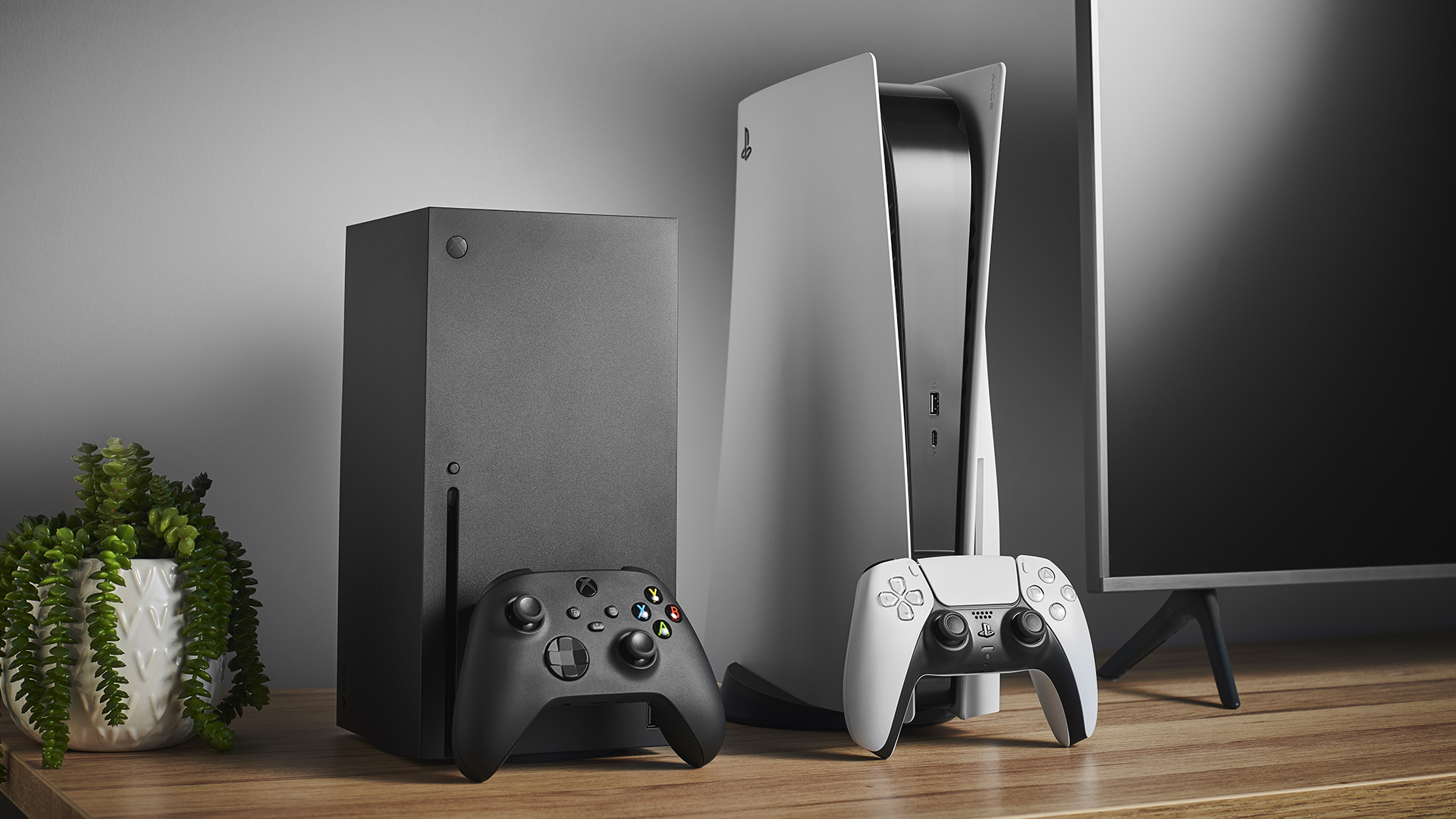
The cooling solutions for these machines represent two different philosophies in industrial design. The Xbox Series X utilizes a “split motherboard” design and a large vapor chamber, topped with a single 130mm axial fan. This allows for a compact, chimney-like form factor that moves a massive volume of air quietly.
The PlayStation 5, conversely, is significantly larger, utilizing a massive internal heatsink and a double-sided intake fan. Sony’s technical breakthrough here was the use of liquid metal as a thermal interface material (TIM) between the SoC and the heatsink. This allows for superior heat transfer compared to traditional thermal paste, enabling the PS5 to maintain its high boost clocks without thermal throttling, though it results in a much larger physical footprint.
The Revolution of Storage: NVMe SSDs and Data Streaming
Perhaps the most significant leap this generation is the transition from mechanical Hard Disk Drives (HDDs) to Solid State Drives (SSDs). This is not just about faster loading screens; it is about fundamentally changing how game engines stream assets into memory.
PlayStation 5’s Custom I/O and Kraken Compression
Sony took a radical approach to storage. The PS5’s custom NVMe SSD is capable of raw data throughput of 5.5GB/s. When paired with its specialized I/O controllers and the “Kraken” hardware decompression block, the effective throughput can reach upwards of 8–9GB/s. This allows the system to load gigabytes of data in less than a second, virtually eliminating “bottlenecking” in open-world games where assets previously had to be duplicated in the storage to account for slow seek times on an HDD.
Xbox Velocity Architecture and Quick Resume
Microsoft’s approach, dubbed the “Xbox Velocity Architecture,” focuses on a holistic integration of hardware and software. While its raw SSD speed is lower at 2.4GB/s (raw) and 4.8GB/s (compressed), it utilizes a feature called Sampler Feedback Streaming (SFS). SFS allows the GPU to load only the specific portions of textures needed for a scene, effectively multiplying the efficiency of its physical memory.
Furthermore, the Xbox utilizes its SSD for “Quick Resume.” This tech feature creates a save state of the system’s RAM onto the SSD, allowing users to switch between multiple active games in seconds, picking up exactly where they left off even after the console has been completely powered down.
Graphical Fidelity and Ecosystem Features
Modern gaming is no longer just about polygons; it is about lighting, reflections, and the fluidity of the image. Both consoles leverage RDNA 2 features to push the boundaries of visual fidelity.
Ray Tracing, 4K Performance, and Variable Refresh Rates (VRR)
Hardware-accelerated Ray Tracing is the hallmark of this generation. Both machines use dedicated intersection engines to calculate realistic light bounces, shadows, and reflections. However, because the Xbox Series X has more Compute Units (CUs), it generally handles ray-traced global illumination at higher resolutions more stably than the PS5.
To combat screen tearing and stutter, both consoles now support Variable Refresh Rate (VRR) via HDMI 2.1. This allows the display to sync its refresh rate to the console’s frame output. While both support this, Microsoft’s implementation (integrated with AMD FreeSync) was available at launch and remains slightly more robust across a wider range of legacy monitors compared to Sony’s more recent firmware updates.
Audio Tech: Tempest 3D vs. Dolby Atmos
On the audio front, the technologies diverge again. Sony developed the “Tempest Engine,” a dedicated hardware block based on an AMD GPU compute unit that handles object-based 3D spatial audio. It is designed to simulate hundreds of sound sources, providing an immersive experience even with standard stereo headphones.
Microsoft opted to support existing industry standards. The Xbox Series X supports Dolby Atmos and DTS:X via hardware acceleration. For tech enthusiasts who have already invested in high-end home theater systems or Dolby Atmos-certified headsets, the Xbox offers a more seamless integration into a pre-existing high-fidelity ecosystem.
Controllers and Haptic Innovation
The interface between the human and the machine is where the most tangible technological differences are felt.
DualSense: Adaptive Triggers and Immersive Feedback
The PS5’s DualSense controller is a masterclass in haptic technology. It replaces traditional rumble motors with dual voice-coil actuators, capable of producing nuanced vibrations that can simulate the feeling of rain or the grit of gravel. Furthermore, it features “Adaptive Triggers,” which use internal motors to provide variable resistance. For instance, a player might feel the trigger tighten as they pull back a bowstring or lock entirely if a weapon jams. This is not just a gimmick; it is a sophisticated use of force-feedback tech that enhances the sensory input of the software.
The Xbox Wireless Controller: Refinement over Reinvention
The Xbox controller takes a more conservative, “if it isn’t broken, don’t fix it” approach. It focuses on low-latency technology (Dynamic Latency Input) and cross-platform compatibility. It uses Bluetooth Low Energy (BTLE) and a proprietary 2.4GHz radio to ensure that the delay between a button press and the on-screen action is minimized to the millisecond. While it lacks the haptic depth of the DualSense, its ergonomic refinement and the inclusion of a share button make it a highly reliable piece of hardware for competitive gaming.
Software Ecosystem and Future-Proofing
The “better” console is often the one that integrates most effectively with the user’s digital life and maintains the value of their existing library.
Backward Compatibility and Cloud Integration
Microsoft has dominated the conversation regarding backward compatibility. Through the use of an advanced hardware emulator and “Heutchy Method” upscaling, the Xbox Series X can run four generations of games, often with Auto HDR and boosted frame rates (FPS Boost) applied at the system level without developer intervention. This is a significant technical achievement in software engineering.
Sony offers robust backward compatibility for the PS4 library, utilizing a “Legacy Mode” within the PS5’s processor to mimic the previous generation’s architecture. While it lacks the deep support for the PS1, PS2, and PS3 eras found on Xbox, its implementation of PS4 Pro “Boost Mode” ensures that most last-gen titles run at their absolute performance ceilings.

Operating Systems and User Experience Design
The Xbox OS is an evolution of the Windows-tethered dashboard, focusing on a unified experience across PC and console. It is feature-rich but can feel cluttered. The PS5 OS, built from the ground up for this generation, features a minimalist 4K UI. It utilizes “Activities” cards, which are metadata links that allow users to jump directly into specific levels or challenges within a game from the home screen, bypassing internal menus. This is made possible by the high-speed I/O communication between the OS and the SSD.
Ultimately, the choice between the Xbox Series X and the PlayStation 5 depends on which technical frontier a user values more. If the goal is raw computational power, Dolby standards, and extensive legacy support, the Xbox Series X is the superior piece of hardware. However, if the user prioritizes revolutionary I/O speeds, innovative haptic feedback, and a bespoke next-gen interface, the PlayStation 5 stands as the more transformative technological leap. Both consoles represent the pinnacle of current consumer-grade computing, ensuring that regardless of the choice, the “next-gen” experience is well within reach.
aViewFromTheCave is a participant in the Amazon Services LLC Associates Program, an affiliate advertising program designed to provide a means for sites to earn advertising fees by advertising and linking to Amazon.com. Amazon, the Amazon logo, AmazonSupply, and the AmazonSupply logo are trademarks of Amazon.com, Inc. or its affiliates. As an Amazon Associate we earn affiliate commissions from qualifying purchases.