
In the realm of digital communication and electronics, the term “baud” is often encountered, yet its precise meaning can sometimes be a source of confusion. While frequently conflated with “bits per second” (bps), baud rate represents a distinct, albeit related, concept that underpins the speed at which data can be transmitted. Understanding baud is crucial for anyone delving into telecommunications, serial communication, networking, or even the inner workings of older computing systems. This article will demystify the concept of baud, explore its historical significance, differentiate it from bits per second, and illustrate its practical applications in the modern technological landscape.
The Genesis of Baud: A Nod to Jean-Maurice Baudot
The term “baud” itself is a tribute to Jean-Maurice Baudot (1845–1903), a pioneering French telegraph engineer. Baudot is credited with developing the Baudot code, an early character encoding system that was instrumental in the advancement of telegraphy and teleprinters. His innovations allowed for more efficient transmission of textual information over telegraph lines. The unit of measurement, baud, was subsequently named in his honor to represent the number of signaling events, or symbols, transmitted per second. This historical context is vital because it highlights that baud originally referred to the physical transmission of signals, a concept that predates the more granular bit-level understanding we often associate with digital data today.
The Baudot Code and Early Telegraphy
Before the widespread adoption of binary encoding (where each symbol represents a single bit), telegraphic communication relied on various codes. The Baudot code, for instance, used a 5-bit system to represent characters. This meant that each character transmitted required a specific sequence of five pulses. The speed at which these pulses could be sent, regardless of how many bits they represented individually, was the fundamental measure of transmission. Baudot’s system was an improvement because it allowed for multiplexing, enabling multiple telegraph operators to share a single line simultaneously by interleaving their transmissions. This efficiency was revolutionary for its time, paving the way for faster and more robust communication networks.
The Evolution of Digital Communication
As technology progressed, particularly with the advent of digital computers and the need to transmit binary data, the understanding of data transmission evolved. While baud rate was a measure of symbol changes, the focus gradually shifted to the number of bits that could be transmitted per second, especially when each symbol directly represented a single bit. This distinction is important and will be further elaborated upon in the following sections. However, the legacy of Baudot’s contribution remains, with the unit “baud” persisting as a measure of symbol rate in certain contexts.
Baud Rate vs. Bits Per Second (bps): A Critical Distinction
The most common point of confusion surrounding baud rate is its relationship with bits per second (bps). While often used interchangeably in casual conversation or in specific technological contexts, they are not always synonymous. Understanding the difference is key to grasping the nuances of data transmission.
Defining Baud Rate: The Symbol Rate
Baud rate measures the number of symbol changes or signaling events that occur on a transmission line per second. A symbol is essentially a discrete electrical or optical state that a communication channel can adopt. In simpler, older systems, one symbol might directly correspond to one bit. For example, a system might use two voltage levels: a high voltage representing a ‘1’ and a low voltage representing a ‘0’. In such a scenario, each symbol change directly corresponds to a bit change, and thus, the baud rate would be equal to the bits per second.
Defining Bits Per Second (bps): The Data Flow Rate
Bits per second (bps), on the other hand, measures the actual number of bits (binary digits, 0s and 1s) that are transmitted or received over a communication channel per second. This is the ultimate measure of digital data throughput. In modern, more complex communication systems, a single symbol can represent more than one bit. This is achieved through various modulation techniques.
The Power of Multi-Bit Symbols
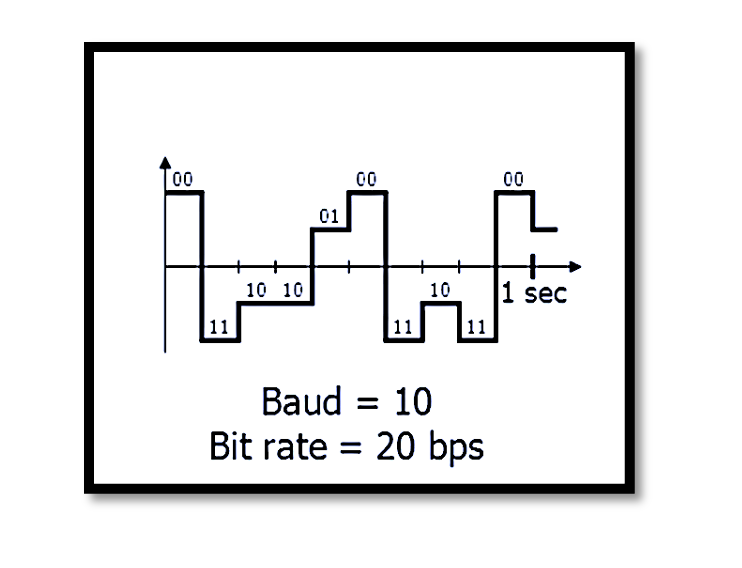
Consider a system that can transmit more than two distinct states (symbols). For instance, a system might have four different voltage levels or signal phases. If each of these unique states represents a unique combination of two bits (e.g., 00, 01, 10, 11), then a single symbol change can convey two bits of information. In this case, the baud rate would be lower than the bits per second rate.
For example, if a modem transmits at 2400 baud, and each symbol represents 2 bits, then the data transfer rate would be 2400 * 2 = 4800 bps. If each symbol represented 4 bits, the bps rate would be 2400 * 4 = 9600 bps. This ability to encode multiple bits into a single symbol is a fundamental principle behind achieving higher data transmission speeds without necessarily increasing the complexity or frequency of the underlying physical signaling.
Historical Context and Modern Usage
Historically, especially in early modems and serial communication interfaces like RS-232, the baud rate was often equal to the bps rate because simple two-state signaling was employed (one symbol = one bit). This is why the terms became so intertwined. However, with the advent of more sophisticated modulation schemes in modern telecommunications – such as those used in DSL, cable modems, Wi-Fi, and fiber optics – a single symbol can represent a much larger number of bits. Therefore, in contemporary high-speed communication, the bps rate is almost always significantly higher than the baud rate. While the term “baud” might still be technically correct when referring to the symbol rate, “bps” is generally the more relevant and understood metric for actual data transfer speeds.

Practical Applications and Relevance of Baud Rate
Despite the shift towards prioritizing bps, the concept of baud rate remains relevant in several technological domains. Its understanding provides insight into the fundamental limitations and design choices in communication systems.
Serial Communication and Microcontrollers
In the world of microcontrollers and embedded systems, Universal Asynchronous Receiver/Transmitter (UART) communication is a common method for serial data exchange. When configuring UART ports on microcontrollers (like those found in Arduino or Raspberry Pi), you will invariably set a “baud rate.” This baud rate dictates the speed at which the microcontroller will send and receive data serially. For two devices to communicate successfully via UART, they must be configured to operate at the same baud rate. Common baud rates include 9600, 19200, 57600, and 115200. In this context, for most standard UART implementations, the baud rate is indeed equivalent to the bps rate, as each symbol (typically a voltage level change) represents a single bit.
Legacy Systems and Modems
Older modem technologies, which were essential for internet access before broadband became ubiquitous, operated at specific baud rates. While the marketing of these modems often highlighted their bps capabilities (e.g., 56k modem), the underlying signaling mechanism operated at a certain baud rate. Understanding this history helps appreciate the engineering challenges and innovations that led to higher data speeds. The progression from early modems operating at a few hundred baud to modern communication systems operating at millions or billions of symbols per second (and consequently, an even higher number of bits per second) is a testament to technological advancement.
Network Infrastructure and Telecommunications
While not always explicitly stated in consumer-facing specifications, baud rate plays a role in the design and operation of network infrastructure. The physical layer of communication networks, which deals with the transmission of raw signals over cables or wireless channels, operates at specific symbol rates. These rates are carefully chosen to maximize data throughput while maintaining signal integrity. For example, in optical fiber communication, the signaling involves modulating the properties of light, and the rate at which these properties can be changed determines the baud rate, which in turn influences the achievable bps.
Understanding System Limitations
Knowing about baud rate can help in troubleshooting or understanding performance limitations. If a serial communication link is failing, a mismatch in baud rate settings between the communicating devices is a common cause. Similarly, in older systems, the maximum achievable baud rate could be a bottleneck for data transfer, necessitating the use of more sophisticated modulation techniques to increase the bps without exceeding the physical limitations of the signaling medium.
The Future of Data Transmission: Beyond Baud and Bits
The landscape of data transmission is continuously evolving, with speeds increasing exponentially. While baud rate remains a fundamental concept, modern communication technologies often operate at such high frequencies and employ such complex modulation schemes that the focus has overwhelmingly shifted to the aggregate data rate in bits per second.
High-Speed Serial Interfaces
Modern high-speed serial interfaces, such as USB 3.0 and beyond, Thunderbolt, and PCIe, achieve their remarkable speeds through a combination of factors. These include advanced encoding schemes (like 8b/10b or 64b/66b encoding), differential signaling, and very high clock frequencies. While these interfaces operate with a defined symbol rate (which could be termed baud rate), the headline specifications are always presented in gigabits per second (Gbps). The underlying engineering ensures that each symbol carries multiple bits, maximizing efficiency.
Fiber Optics and 5G Wireless
The backbone of the internet and modern wireless communication relies on technologies that push the boundaries of data transmission. Fiber optic networks transmit data as pulses of light, with incredibly high symbol rates. Similarly, 5G wireless technology utilizes advanced techniques like massive MIMO and complex modulation schemes (e.g., Quadrature Amplitude Modulation – QAM) to pack multiple bits into each transmitted symbol, leading to multi-gigabit per second download speeds. In these domains, while the concept of symbol rate (baud) is present at the physical layer, the practical discussion revolves around the immense bps figures.

The Enduring Legacy of a Foundational Concept
Despite the rapid advancements, the foundational principles established by pioneers like Jean-Maurice Baudot continue to inform technological development. Baud rate, as a measure of signaling events, helps us understand the physical constraints and the clever engineering required to translate those physical signals into meaningful digital information. While bits per second might be the ultimate benchmark for how much data we can move, baud rate offers a glimpse into the underlying mechanics of that movement, reminding us of the journey from simple telegraphy to the interconnected digital world we inhabit today.
In conclusion, baud rate is a measure of symbol transmission speed, a concept that originated with early telegraphy and continues to be relevant in certain digital communication contexts, particularly serial interfaces. While it is often distinguished from bits per second, especially in modern high-speed systems where one symbol can represent multiple bits, understanding baud provides a deeper appreciation for the evolution and intricacies of data transmission technology.
aViewFromTheCave is a participant in the Amazon Services LLC Associates Program, an affiliate advertising program designed to provide a means for sites to earn advertising fees by advertising and linking to Amazon.com. Amazon, the Amazon logo, AmazonSupply, and the AmazonSupply logo are trademarks of Amazon.com, Inc. or its affiliates. As an Amazon Associate we earn affiliate commissions from qualifying purchases.