
Navigating the world of auto financing can feel like walking through a labyrinth of shifting numbers and complex terminology. For most consumers, the most critical number in this journey is the interest rate. The interest rate on a car loan is not a static figure; it is a dynamic percentage influenced by global economic trends, institutional policies, and personal financial health. Understanding the average interest rate for a car loan is essential for budgeting effectively and ensuring that you are getting a fair deal from lenders.
As of the current economic climate, interest rates have seen significant fluctuations. After years of historic lows, the Federal Reserve’s efforts to curb inflation have pushed borrowing costs higher across the board. This means that “average” today looks very different than it did three or four years ago. To truly understand what you should be paying, you must look beyond a single number and examine the variables that determine your specific offer.
Understanding the Current Landscape of Auto Loan Interest Rates
The “average” interest rate is a composite figure that blends data from borrowers with perfect credit and those with significant financial challenges. Generally, average rates for new cars tend to hover between 6% and 9%, while used car rates are typically higher, ranging from 7% to 14% or more. However, these figures are highly sensitive to the broader economic environment.
The Role of the Federal Reserve and Macroeconomic Factors
The primary driver of interest rates in the United States is the federal funds rate set by the Federal Reserve. When the Fed raises rates to cool down the economy, banks and credit unions must pay more to borrow money themselves. They pass these costs on to consumers in the form of higher Annual Percentage Rates (APRs) on car loans. Consequently, even a borrower with a perfect credit score will find that their “prime” rate is significantly higher during a period of monetary tightening than it would be during an economic stimulus phase.
New vs. Used Car Rates
There is a persistent gap between the interest rates offered for new vehicles versus used ones. Lenders view new cars as lower-risk collateral. They are easier to value, come with manufacturer warranties, and have higher resale predictability. Used cars, on the other hand, carry more risk. Their mechanical history may be uncertain, and their value can fluctuate wildly based on market demand. To compensate for this risk, lenders charge a premium on used car loans, often 2% to 5% higher than new car loans for the same borrower.
The Impact of Loan Terms
The length of your loan—the term—also dictates the interest rate. While it might be tempting to opt for an 84-month loan to keep monthly payments low, longer terms almost always come with higher interest rates. Lenders charge more for longer terms because they are exposed to risk for a greater duration. Additionally, cars depreciate quickly; with a long-term loan, there is a higher probability that the borrower will end up “upside down,” meaning they owe more than the car is worth, which increases the lender’s risk profile.
Key Factors That Determine Your Personal Interest Rate
While market averages provide a baseline, your personal financial profile is the ultimate architect of your interest rate. Lenders use several key metrics to categorize borrowers and assign risk levels.
Credit Scores: The Primary Differentiator
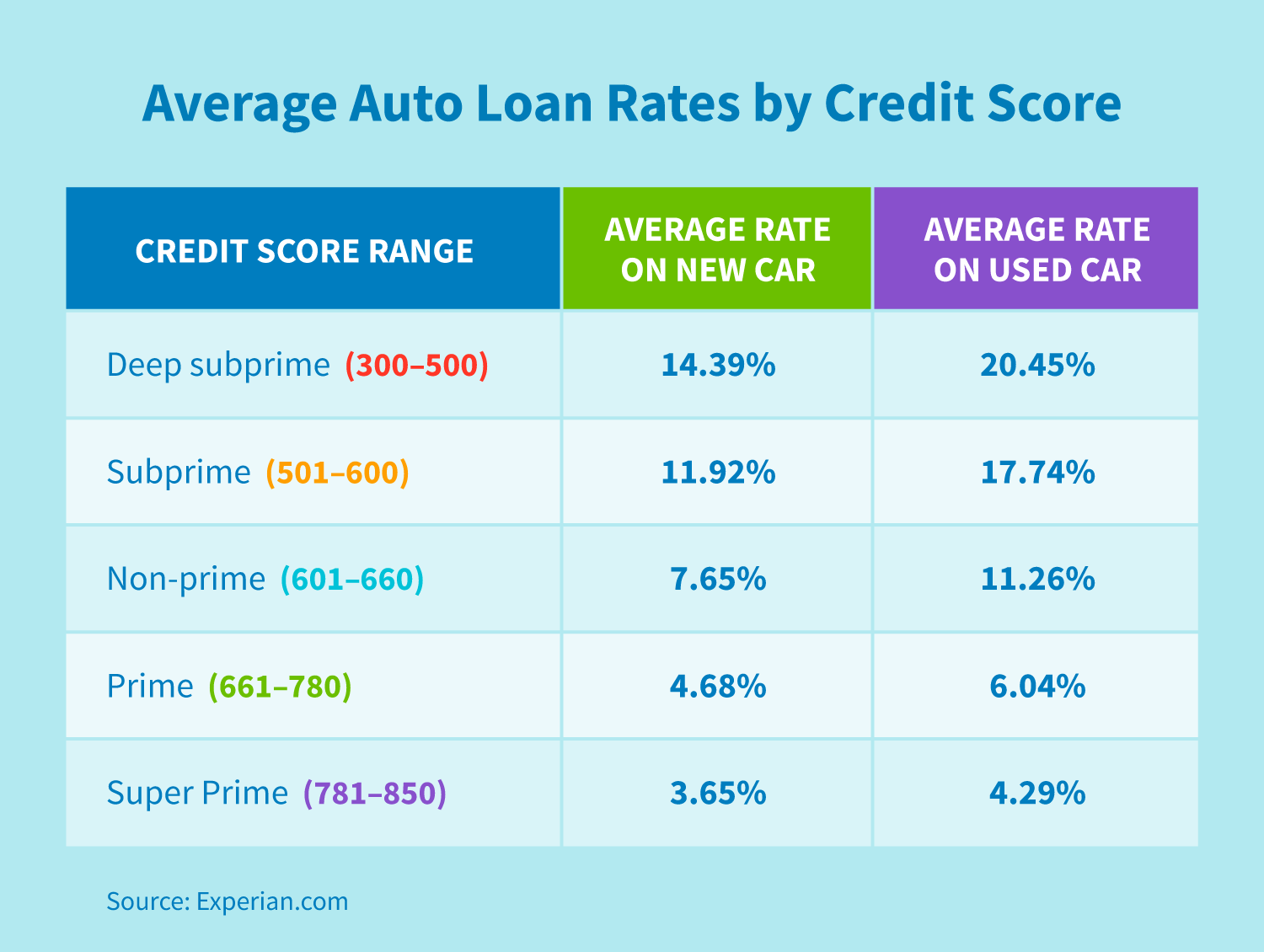
Your credit score is the single most influential factor in determining your car loan rate. Lenders typically categorize borrowers into five tiers:
-
Superprime (781–850): These borrowers receive the lowest possible rates, often several points below the national average. They are viewed as highly reliable.
-
Prime (661–780): Most borrowers fall here. They receive competitive rates that align closely with market averages.
-
Nonprime (601–660): Rates begin to climb significantly here as lenders perceive a moderate risk of default.
-
Subprime (501–600): Borrowers in this tier face high interest rates, often in the double digits, reflecting the increased risk the lender is taking.
-
Deep Subprime (300–500): This tier faces the highest costs, sometimes exceeding 20% APR, if they can secure a loan at all.
For a $40,000 car, the difference between a Superprime rate and a Subprime rate can result in tens of thousands of dollars in additional interest over the life of the loan.
Debt-to-Income Ratio (DTI)
Lenders don’t just look at how well you’ve paid back debt in the past; they look at your capacity to pay it back in the future. Your Debt-to-Income ratio (DTI) is the percentage of your gross monthly income that goes toward paying debts. Even with a high credit score, a high DTI can signal to a lender that you are overextended, which may lead them to offer a slightly higher interest rate to mitigate their risk.
Down Payments and Loan-to-Value (LTV)
The Loan-to-Value (LTV) ratio represents the amount you are borrowing compared to the actual value of the vehicle. If you make a significant down payment—say 20% or more—your LTV ratio decreases. This gives you “skin in the game” and reduces the lender’s potential loss if they have to repossess the vehicle. Lower LTV ratios often result in more favorable interest rate offers because the loan is more secure.

Average Rates by Credit Tier and Vehicle Type
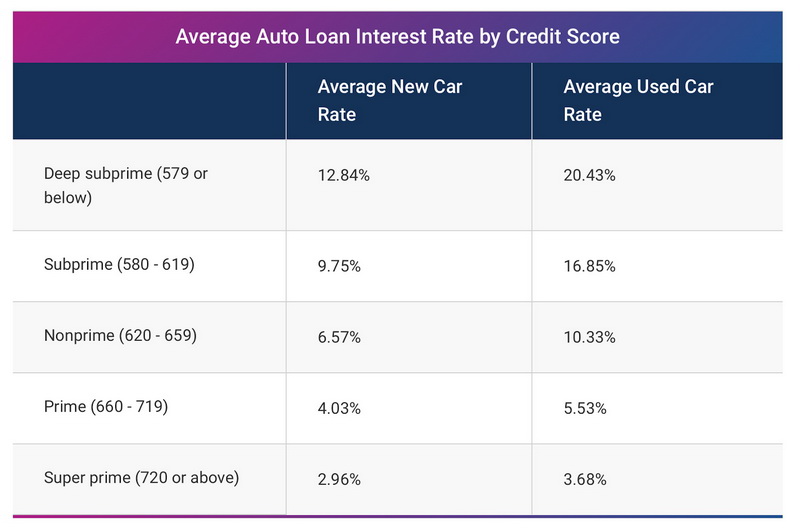
To give a clearer picture of what to expect, it is helpful to look at the data through the lens of credit categories. While these numbers change monthly, the spread between them remains relatively consistent.
Rates for Excellent and Good Credit
Borrowers in the Superprime and Prime categories currently see new car rates ranging from approximately 5.5% to 7.2%. For used cars, these same borrowers might see rates between 7% and 9%. At this level, the focus for the borrower should be on “rate shopping” to find the absolute floor, as banks and credit unions frequently compete for these high-quality customers with promotional offers.
Rates for Average and Fair Credit
The “Nonprime” category (601–660) is where the cost of borrowing begins to bite. New car rates for this group often hover around 9% to 11%, while used car rates can easily jump to 13% or 15%. Borrowers in this tier are often encouraged to shop with credit unions, which frequently offer more capped or regulated rates compared to big-box commercial banks or dealership financing.
Rates for Subprime and Deep Subprime Credit
For those with scores below 600, the “average” rate becomes much higher. New car loans for subprime borrowers often average 14% to 16%, while used car loans can reach staggering averages of 18% to 21%. In these scenarios, the interest often exceeds the principal depreciation in the early years of the loan, making it difficult to build equity in the vehicle.
How to Secure a Lower Interest Rate
Knowing the average is step one; beating the average is step two. You do not have to accept the first rate a dealership offers you. In fact, doing so is often the most expensive way to buy a car.
The Power of Pre-approval
Before you ever step foot on a dealer’s lot, you should seek pre-approval from an independent lender. Check with your local credit union or an online bank. A pre-approval gives you a “blank check” and, more importantly, a baseline interest rate. When the dealership’s finance manager tries to offer you a loan, you can present your pre-approval. If they want your business, they will have to beat that rate. This process effectively turns the dealership into a competitor for your loan, which works in your favor.
Consider Credit Unions over Commercial Banks
Credit unions are member-owned, non-profit entities. Because they don’t have to answer to shareholders demanding maximized profits, they can often return value to members through lower loan rates. On average, credit union auto loan rates are 1% to 2% lower than those of traditional banks.
Shorter Loan Terms
If your budget allows for a higher monthly payment, choosing a 36-month or 48-month term instead of a 60-month or 72-month term can significantly lower your APR. Lenders offer their best “incentivized” rates on shorter terms. Not only do you get a lower rate, but you pay that rate for less time, creating a massive compounding saving on the total cost of the vehicle.
The Long-Term Financial Impact of Interest
The interest rate is not just a percentage; it is a significant portion of your net worth over time. When purchasing a car, it is easy to focus on the monthly payment, but the “Total Cost of Credit” is the figure that truly matters for your financial health.
Total Interest Paid
Consider a $35,000 loan for 60 months. At a 5% interest rate, you would pay approximately $4,600 in total interest. At a 15% interest rate, that same $35,000 loan would cost you nearly $15,000 in interest alone. In the latter scenario, you are essentially paying for nearly half of another car just in interest charges. This illustrates why improving your credit score or waiting to save a larger down payment is often the smartest financial move you can make.
Avoiding the “Upside Down” Trap
High interest rates combined with long loan terms lead to a situation where the car’s value drops faster than the loan balance. This is known as being “upside down” or having negative equity. If you need to sell the car or if it is totaled in an accident, you will owe the bank the difference between the insurance payout and the loan balance. To avoid this, financial experts recommend the “20/4/10” rule: put 20% down, limit the loan to 4 years, and ensure total transportation costs (loan plus insurance) don’t exceed 10% of your gross income.
Refinancing as a Strategy
If you were forced to take a high interest rate due to poor credit at the time of purchase, you aren’t necessarily stuck with it for the duration of the loan. If you make six to twelve months of on-time payments and your credit score improves, you should look into refinancing. Many lenders specialize in auto refinancing and can drop your rate by several percentage points, potentially saving you hundreds of dollars a month and thousands over the life of the loan.
By understanding that the average interest rate is merely a starting point, and by taking proactive steps to manage your credit, shop around, and choose shorter loan terms, you can ensure that your next vehicle purchase is a sound financial decision rather than a long-term burden.
aViewFromTheCave is a participant in the Amazon Services LLC Associates Program, an affiliate advertising program designed to provide a means for sites to earn advertising fees by advertising and linking to Amazon.com. Amazon, the Amazon logo, AmazonSupply, and the AmazonSupply logo are trademarks of Amazon.com, Inc. or its affiliates. As an Amazon Associate we earn affiliate commissions from qualifying purchases.