
In the rapidly evolving landscape of information technology, the infrastructure that powers our digital world often goes unnoticed until it fails. Behind the scenes of global cloud providers, high-frequency trading floors, and massive corporate data centers, a specialized breed of technology keeps data flowing at lightning speeds. At the forefront of this hardware and software revolution is Arista Networks.
When asking “What is Arista?”, the answer transcends a simple list of hardware switches. Arista represents a fundamental shift in how large-scale networks are designed, managed, and scaled. Founded in 2004 by industry veterans Andy Bechtolsheim, David Cheriton, and Kenneth Duda, and led by CEO Jayshree Ullal, Arista was built on a singular premise: that the future of networking lies in software-driven, programmable, and open architectures. This article explores the technical foundations of Arista, its flagship operating system, and how it continues to shape the world of cloud networking and artificial intelligence infrastructure.

The Evolution of Arista Networks: From Startup to Industry Leader
To understand what Arista is today, one must understand the environment in which it was born. In the early 2000s, the networking industry was dominated by proprietary systems. Network administrators were often locked into “black box” hardware where the software and hardware were inseparable, making customization nearly impossible.
Challenging the Status Quo
Arista entered the market by challenging the legacy giants of networking. While competitors focused on selling expensive, proprietary ASICs (Application-Specific Integrated Circuits) with closed-source operating systems, Arista took a different path. They leveraged “merchant silicon”—standard, high-performance chips from providers like Broadcom—and poured their engineering resources into a superior, Linux-based software layer. This allowed them to iterate faster and provide higher bandwidth at a lower cost than traditional vendors.
The Hyperscale Impact
The rise of “hyperscalers”—companies like Google, Meta, and Microsoft—demanded a new type of network. These giants needed to connect hundreds of thousands of servers in a flat, high-performance web. Arista’s focus on 10Gb, 40Gb, and eventually 100Gb and 400Gb Ethernet solutions made them the vendor of choice for the cloud revolution. By providing the plumbing for the modern internet, Arista shifted from a niche challenger to a cornerstone of global digital infrastructure.
Arista EOS: The Heart of the Network
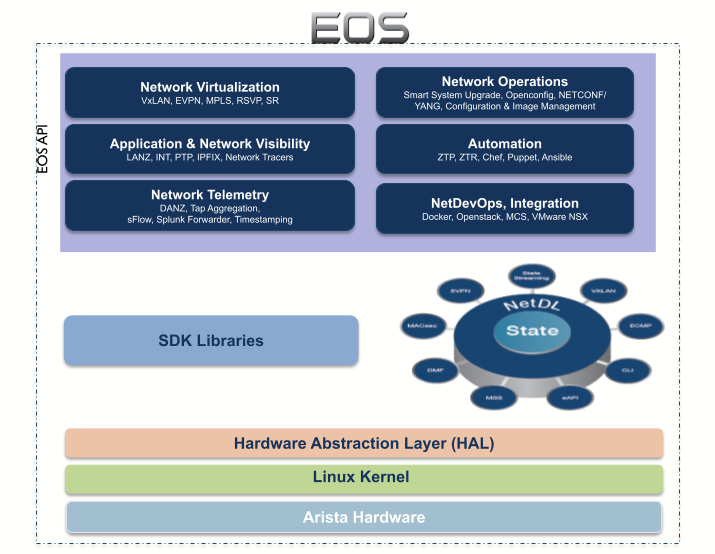
If Arista’s switches are the body, the Extensible Operating System (EOS) is the brain. Unlike traditional networking operating systems that are often bloated and monolithic, EOS was built from the ground up to be modular and resilient.
Modular Architecture and Programmability
The defining characteristic of Arista EOS is its state-sharing architecture. In a traditional switch, if one process (like a routing protocol) fails, the entire system might crash. In EOS, every process runs in its own protected memory space and communicates through a central “Sysdb” (System Database). This modularity means that if a single process fails, it can be restarted independently without interrupting the rest of the switch’s operations.
Furthermore, because EOS is built on an unmodified Linux kernel, it is inherently programmable. Network engineers can run standard Linux tools, write Python scripts directly on the switch, and integrate the network into broader DevOps workflows. This level of openness was revolutionary, transforming the network from a static utility into a dynamic, programmable resource.
Self-Healing and Reliability
In mission-critical environments, downtime is not an option. Arista EOS incorporates “self-healing” properties. Through its state-sharing model, the system can detect anomalies and recover from software faults automatically. Additionally, Arista’s “Smart System Upgrade” (SSU) allows enterprises to upgrade software versions and patches without dropping data packets, a feat that previously required complex redundant hardware setups. This focus on “software-defined” reliability is why Arista is favored by financial institutions where a millisecond of lag can result in millions of dollars in losses.
Arista’s Core Technology Pillars
Arista’s technological reach extends across several domains, each addressing a specific pain point in modern digital architecture. Their portfolio is categorized into three primary pillars: Cloud, Campus, and Routing.
Cloud-Scale Networking
Arista is best known for its “Leaf-Spine” architecture in the data center. Traditional hierarchical networks (Core-Aggregation-Access) were designed for “north-south” traffic—data moving from a user to a server. However, modern cloud applications generate massive amounts of “east-west” traffic—servers talking to other servers. Arista’s high-bandwidth, low-latency switches are designed specifically for these leaf-spine topologies, ensuring that any server can talk to any other server with minimal delay and maximum throughput.
Cognitive Campus and Client-to-Cloud
Recognizing that the “campus” (the office environment) was still stuck in the legacy era, Arista introduced the Cognitive Campus. This initiative applies the principles of cloud networking—automation, telemetry, and simplicity—to the enterprise office. By integrating Wi-Fi 6/6E access points and wired switches under a single management umbrella (CloudVision), Arista provides an end-to-end view of the user experience. If a user in a branch office has a poor Zoom call, Arista’s “Client-to-Cloud” analytics can pinpoint exactly where the bottleneck is, whether it’s the local Wi-Fi, the ISP, or the data center.
Data Center Interconnect (DCI) and Routing
As the boundaries between the data center and the wide area network (WAN) blurred, Arista expanded into the routing space. By using high-density Ethernet chips for routing tasks, Arista disrupted the traditional router market. Their R-Series platforms allow for massive tables and high-speed interconnects between geographically dispersed data centers, enabling “Cloud-Scale Routing” that is more cost-effective than legacy service provider routers.
The Role of AI and Machine Learning in Arista’s Ecosystem
We are currently in the era of the “AI Data Center,” where training large language models (LLMs) requires thousands of GPUs to work in perfect synchronization. Arista has positioned itself as the underlying fabric for this AI revolution.
Autonomous Virtual Assist (AVA)
Arista’s AI strategy is centered around “AVA” (Autonomous Virtual Assist). AVA is a specialized AI entity that monitors network telemetry in real-time. Instead of a human operator sifting through thousands of logs, AVA uses machine learning to identify patterns that precede a failure. For example, it can detect subtle changes in optical signal strength or unusual traffic bursts and alert administrators before the network experiences a brownout.
Predictive Analytics and Network Observability
A network is only as good as its visibility. Arista’s NetDL (Network Data Lake) serves as a centralized repository for all network telemetry. By applying AI to this data lake, Arista provides “predictive analytics.” This allows organizations to move from reactive troubleshooting to proactive optimization. In the context of AI training clusters, where a single congested link can stall a multi-million dollar training job, this observability is not just a feature—it is a technical necessity.
Arista vs. Traditional Networking: Why the Tech Shifts Matter
The transition from legacy networking to Arista’s software-driven model represents a paradigm shift in Information Technology. This shift is characterized by two main factors: operational efficiency and open standards.
Cost Efficiency and OpEx Reduction
In the legacy world, managing a network required a large team of specialists who knew a specific Command Line Interface (CLI). Arista’s use of CloudVision for automation allows a single administrator to manage thousands of devices. This is achieved through “Zero Touch Provisioning” (ZTP), where a new switch can be plugged in, automatically download its configuration and software image, and join the network without human intervention. This reduction in Operating Expenditure (OpEx) is a major driver for tech-forward companies.
Open Standards and Interoperability
Arista has been a vocal proponent of open standards, such as VXLAN for network virtualization and EVPN for control planes. Unlike competitors who often create “proprietary extensions” to keep customers within their ecosystem, Arista’s technology is designed to interoperate with other vendors. For a modern CTO, this provides the flexibility to build a “best-of-breed” stack, choosing the best firewall, the best load balancer, and the best switches without worrying about compatibility issues.

Conclusion
So, what is Arista? It is more than a manufacturer of high-speed switches. It is a software company that happens to build world-class hardware. By prioritizing a modular, programmable operating system (EOS) and embracing the scale of the cloud, Arista has redefined what is possible in networking.
As we move deeper into the age of artificial intelligence and edge computing, the demands on our networks will only increase. With its focus on telemetry, AI-driven automation, and ultra-high-speed throughput, Arista is not just keeping pace with these changes; it is providing the blueprint for the next generation of the internet. For technology professionals and enterprises alike, Arista represents the shift from “managing boxes” to “orchestrating an intelligent fabric,” ensuring that as our digital world expands, the foundation remains solid, scalable, and remarkably fast.
aViewFromTheCave is a participant in the Amazon Services LLC Associates Program, an affiliate advertising program designed to provide a means for sites to earn advertising fees by advertising and linking to Amazon.com. Amazon, the Amazon logo, AmazonSupply, and the AmazonSupply logo are trademarks of Amazon.com, Inc. or its affiliates. As an Amazon Associate we earn affiliate commissions from qualifying purchases.