
When investors and financial analysts ask “what is Apple worth,” they are rarely looking for a single number. While the market capitalization—the total value of all outstanding shares—provides a real-time ticker of the company’s public price tag, the true “worth” of Apple Inc. (AAPL) is a complex tapestry woven from cash flows, ecosystem dominance, and an unprecedented capital return program. As the first company to ever hit a $3 trillion market cap, Apple represents more than just a consumer electronics firm; it is a cornerstone of the global financial system and a benchmark for institutional portfolios.
To understand Apple’s valuation, one must look past the sleek aluminum frames of its hardware and into the engine room of its balance sheet. This analysis explores Apple’s worth through the lens of market capitalization, revenue diversification, financial metrics, and future growth catalysts.
Decoding the Multi-Trillion Dollar Market Capitalization
The most common answer to “what is Apple worth” is its market capitalization. This figure is calculated by multiplying the current share price by the total number of outstanding shares. However, for a company of Apple’s scale, this number is more than a metric—it is a psychological and economic milestone.
The Significance of the $3 Trillion Milestone
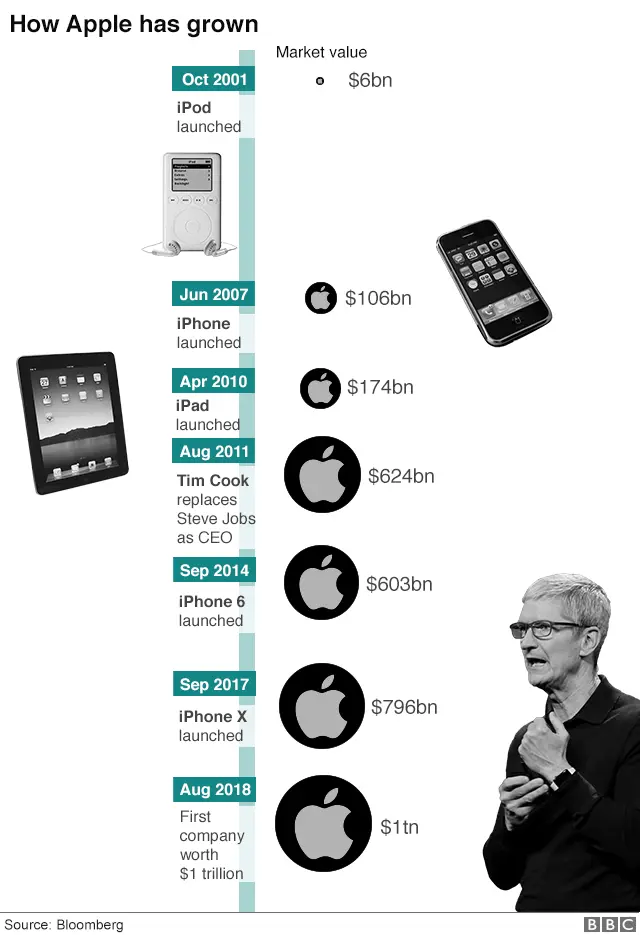
Apple’s journey to a $3 trillion valuation was not a linear ascent but a masterclass in compounding. In 2018, Apple became the first U.S. company to reach $1 trillion. It took 42 years to reach that first trillion and only two additional years to reach $2 trillion. The leap to $3 trillion signaled a shift in how the market views the company: not as a cyclical hardware maker subject to the whims of gadget trends, but as a staple “utility” of the digital age. Investors pay a premium for Apple because its products are integrated into the daily lives of billions, creating a recurring revenue stream that mirrors a subscription model.
Enterprise Value vs. Equity Value
While market cap tells us what the equity is worth, Enterprise Value (EV) provides a more holistic view for serious investors. EV is calculated by taking the market cap, adding total debt, and subtracting cash and cash equivalents. Apple is unique in this regard because of its massive cash pile. Despite having significant debt—used strategically to take advantage of low interest rates—Apple’s “Net Cash Neutral” goal means it carries enough liquidity to pivot into any industry it chooses. When we ask what Apple is worth, we are essentially looking at a company that could, in theory, buy almost any other company in the S&P 500 using only its cash reserves and annual profits.
Revenue Streams: Beyond the iPhone
A company’s worth is fundamentally the present value of its future cash flows. For years, skeptics argued that Apple was “just a phone company,” suggesting its valuation should be lower due to the risks of a hardware-centric business. Apple’s financial evolution over the last decade has effectively dismantled this argument.
The Services Pivot and Margin Expansion
The “Services” segment—which includes the App Store, Apple Pay, iCloud, Apple Music, and Apple TV+—is the crown jewel of Apple’s current valuation. Services are significantly more valuable to investors than hardware for two reasons: predictability and profit margins. While hardware margins typically hover around 35–40%, Services margins often exceed 70%.
By decoupling its growth from the two-year iPhone upgrade cycle, Apple has transformed into a software powerhouse. Every iPhone sold is not just a one-time transaction; it is a “toll booth” that generates high-margin revenue for years to follow. This “ecosystem lock-in” is a primary reason why Apple commands a higher Price-to-Earnings (P/E) ratio than traditional hardware manufacturers.
Wearables and the Ecosystem Moat
Apple’s “Wearables, Home, and Accessories” segment—comprising the Apple Watch, AirPods, and HomePod—now rivals the size of Fortune 500 companies on its own. From a financial perspective, these products serve as “anchors.” Once a consumer owns an iPhone, an Apple Watch, and AirPods, the cost of switching to an Android ecosystem becomes prohibitively high—not just in terms of money, but in terms of data, convenience, and time. This “moat,” a term popularized by Warren Buffett, allows Apple to maintain premium pricing power, which in turn sustains its massive valuation.
Financial Metrics and Valuation Ratios

To determine if Apple is “worth” its current price, investors look at specific financial ratios that compare the stock price to the company’s actual earnings and growth potential.
P/E Ratios and Growth Prospects
The Price-to-Earnings (P/E) ratio is the most scrutinized metric for Apple. Historically, Apple traded at a P/E of 10 to 15, reflecting its status as a hardware company. Today, it often trades between 25 and 30. This expansion suggests that the market now views Apple as a “Quality” or “Growth” stock rather than a “Value” stock.
However, valuation must be balanced against the Price/Earnings to Growth (PEG) ratio. Because Apple is already so large, doubling its revenue is mathematically more difficult than it is for a smaller tech firm. Therefore, Apple’s worth is increasingly tied to its ability to extract more value from its existing user base (ARPU—Average Revenue Per User) rather than simply selling more units.
Cash Flow and the Shareholder Return Machine
Perhaps the most compelling argument for Apple’s high valuation is its Free Cash Flow (FCF). Apple generates more cash than almost any other entity on earth. What it does with that cash is central to its worth. Apple pioneered a massive share buyback program, having spent hundreds of billions of dollars to retire its own shares.
When a company buys back shares, it reduces the total supply, making each remaining share more valuable and increasing Earnings Per Share (EPS) even if total net income remains flat. For the long-term investor, Apple’s worth is anchored by this relentless return of capital. Between dividends and buybacks, Apple has created a “floor” for its stock price that few other companies can match.
Future Growth Catalysts and Market Risks
Valuation is always forward-looking. To justify its multi-trillion dollar status, Apple must prove it can continue to innovate and defend its margins against global headwinds.
The AI Integration and Spatial Computing
The next frontier for Apple’s valuation lies in Artificial Intelligence (AI) and Spatial Computing (via the Vision Pro). While Apple was perceived as a late bloomer in the generative AI race, its financial strength lies in “edge AI”—running AI models directly on the billions of devices already in consumers’ pockets. If Apple can successfully monetize AI through a “Siri 2.0” or an AI-driven App Store, it could trigger a new “super-cycle” of hardware upgrades. Investors are currently baking some of this “AI premium” into the stock price, betting that Apple will once again be the company that successfully commercializes complex technology for the masses.
Regulatory Headwinds and Global Macro Factors
No valuation is without risk. Apple’s worth is currently under threat from global regulators, particularly in the European Union and the United States. Antitrust lawsuits targeting the “Apple Tax” (the 30% commission on the App Store) could potentially slice into the high-margin Services revenue.
Furthermore, Apple’s valuation is heavily tied to its supply chain in China and its ability to maintain sales in the Chinese market. Geopolitical tensions can lead to “valuation discounts,” where investors pay less for a company’s earnings because the risks of disruption are too high. When assessing what Apple is worth, one must subtract a “risk premium” for these regulatory and geopolitical uncertainties.

Conclusion: The Intrinsic Value of a Digital Hegemon
So, what is Apple worth? In the strictest financial sense, it is worth exactly what the market is willing to pay for it on any given trading day—currently oscillating around the $3 trillion mark. But in a broader business sense, Apple is worth the collective trust of its two-billion-plus active device users and the massive cash flows they generate.
Apple has successfully transitioned from a company that sells gadgets to a company that manages a digital lifestyle. Its worth is bolstered by a fortress-like balance sheet, a dominant services business, and a capital return program that is the envy of Wall Street. While regulatory challenges and the law of large numbers pose real threats to future growth, Apple’s ability to maintain high margins and customer loyalty suggests that its valuation is not a bubble, but a reflection of its role as the most successful commercial engine in history. For the investor, Apple remains the ultimate “flight to quality” asset, a company whose worth is defined as much by its stability as by its innovation.
aViewFromTheCave is a participant in the Amazon Services LLC Associates Program, an affiliate advertising program designed to provide a means for sites to earn advertising fees by advertising and linking to Amazon.com. Amazon, the Amazon logo, AmazonSupply, and the AmazonSupply logo are trademarks of Amazon.com, Inc. or its affiliates. As an Amazon Associate we earn affiliate commissions from qualifying purchases.