
In the world of high-stakes finance, business development, and investment, clarity is the ultimate currency. When an entrepreneur presents a business plan or a CFO delivers an annual financial report, they face a delicate balancing act: providing enough detail to establish total transparency while maintaining a narrative that is concise enough to hold the reader’s attention. This is where the appendix becomes an indispensable tool. Far from being a mere “dumping ground” for extra pages, the appendix in professional financial writing serves as the bedrock of credibility, housing the granular data that supports the overarching business thesis.

Defining the Appendix within the Corporate and Financial Ecosystem
In a financial context, an appendix is a supplementary section found at the end of a formal document—such as a business plan, investment prospectus, or quarterly audit—that contains detailed information not essential to the primary narrative but necessary for due diligence. Its primary function is to prevent the main body of the document from becoming bogged down by technical jargon, exhaustive tables, or secondary research.
The Strategic Purpose of Supplemental Documentation
For a venture capitalist or a bank loan officer, the main body of a proposal is about the “vision” and the “logic.” However, the appendix is about the “proof.” The strategic purpose of the appendix is to provide a dedicated space for the “raw ingredients” of a financial argument. By moving complex datasets or legal certifications to an appendix, the writer ensures that the executive summary and core chapters remain persuasive and readable. It allows the reader to choose their level of depth; a high-level executive might skip the appendix entirely, while a technical analyst will spend 80% of their time there.
Distinguishing the Appendix from the Main Body
The main body of a financial document should tell a story: where the company is, where it is going, and how much capital it needs to get there. It should use curated charts and summarized figures. The appendix, by contrast, is purely functional. If the main body says, “Our market research indicates a 20% growth rate,” the appendix should contain the full 50-page industry report or the specific survey methodology used to arrive at that number. This distinction is vital for maintaining professional flow and ensuring that decision-makers are not overwhelmed by “data fatigue” during the initial pitch.
Critical Components of a Financial Appendix
When structuring an appendix for a business or money-focused document, the content must be curated to address the specific concerns of stakeholders. Depending on the nature of the transaction—whether it is a seed-round pitch or a corporate merger—the components of the appendix will vary in complexity and scope.
Comprehensive Financial Statements and Projections
While the main body of a business plan might feature a summarized “Profit and Loss” table, the appendix is the proper home for full-scale financial projections. This includes detailed monthly cash flow statements for the first three to five years, balance sheets, and break-even analyses. In the niche of personal finance or investment writing, this might also include historical performance data of an asset class or exhaustive back-testing results for a particular trading strategy. Providing the “math behind the curtain” builds trust with investors who want to verify the assumptions made in the executive summary.
Legal Agreements and Corporate Governance
In business finance, the appendix often serves as a legal repository. This section typically includes articles of incorporation, patents, trademarks, and copies of existing contracts or leases. For a brand seeking an acquisition, including letters of intent from major distributors or contracts with key suppliers in the appendix proves that the business has a solid operational foundation. This level of detail is crucial during the “Money” phase of a deal, where legal risk is just as important as financial upside.
Market Research Data and Competitive Analysis
To justify a valuation, a business must prove its place in the market. An appendix should house the deep-dive competitive matrices and raw market research data that are too bulky for the core text. This might include demographic studies, customer testimonials, or detailed SWOT (Strengths, Weaknesses, Opportunities, Threats) analyses of every major competitor. By providing this, the author demonstrates that their financial projections are not just optimistic guesses but are rooted in documented market realities.
Enhancing Investor Relations through Appendix Management
The way an appendix is handled can say as much about a management team’s competence as the actual numbers within it. A disorganized appendix suggests a disorganized business. Conversely, a well-structured appendix reflects a culture of transparency and meticulousness—traits that are highly valued in the world of private equity and institutional investing.
Transparency and Due Diligence
In the financial sector, “due diligence” is the process by which a potential investor or buyer audits every aspect of a business. The appendix is essentially a “pre-packaged” due diligence folder. By proactively providing deep-layer data, a company reduces the friction of the investment process. It signals to the “Money” side of the table that the “Brand” side has nothing to hide. This transparency can significantly shorten the time it takes to close a funding round or secure a commercial loan.
Organizing Data for Clarity and Impact
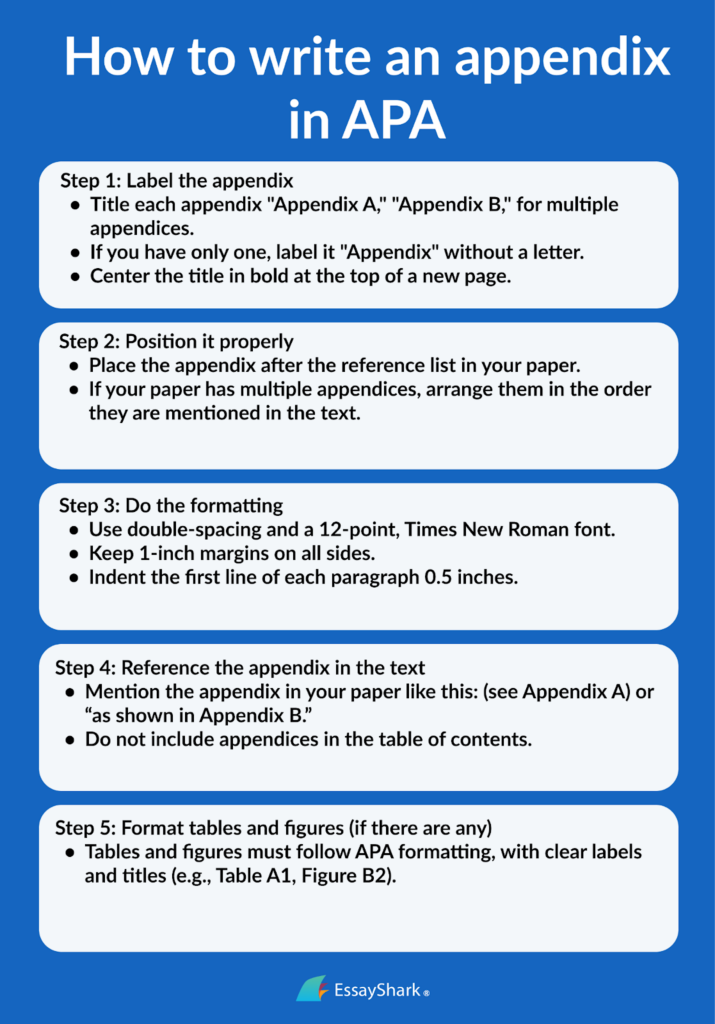
Even though the appendix is for “extra” information, it must be organized with the same rigor as the rest of the document. Each piece of information should be categorized into “Appendix A,” “Appendix B,” and so on. A professional financial appendix should include a separate Table of Contents if it exceeds ten pages. The goal is to make it as easy as possible for a forensic accountant or a skeptical investor to find the exact data point they are looking for without having to hunt through a sea of uncurated PDFs.
Best Practices for Formatting and Cross-Referencing
In professional writing, an appendix is only useful if it is integrated correctly into the rest of the document. If an appendix exists in a vacuum, it is likely to be ignored. Successful financial writers use a system of cross-referencing to pull the reader’s eye toward the supporting evidence at exactly the right moment.
Labeling and Indexing for Accessibility
Every mention of a complex figure in the main text should be accompanied by a parenthetical reference, such as “(See Appendix C for full 2023 Audit).” This creates a roadmap for the reader. Furthermore, the formatting of the appendix should match the corporate identity of the main document. Using consistent fonts, margins, and branding ensures that the supplemental data feels like a cohesive part of the professional package rather than an afterthought.
Digital Accessibility and Hyperlinking in Modern Reporting
In the modern era, most financial documents are consumed digitally. This has transformed the “appendix” into a dynamic tool. In a digital PDF or an interactive investor deck, cross-references should be hyperlinked. If an investor is reading about the company’s intellectual property, they should be able to click a link that takes them instantly to the patent filings in the appendix. This level of digital sophistication enhances the user experience and reinforces the brand’s image as a tech-forward, efficient entity.
The Appendix as a Tool for Risk Management and Compliance
Beyond its role in persuasion and clarity, the appendix is a vital tool for legal and financial compliance. In many jurisdictions, financial reporting for public companies or regulated entities requires the disclosure of specific “notes to the financial statements.”
These notes—often found in the appendix—detail the accounting methods used, the nature of any contingent liabilities, and the specifics of debt obligations. For the reader focused on “Money” and risk, these disclosures are the most important part of the document. They provide the context needed to understand if a company’s profits are sustainable or if they are the result of aggressive accounting practices. In this sense, the appendix is not just “extra” writing; it is a shield against litigation and a cornerstone of ethical financial communication.

Conclusion: The Psychological Weight of the Appendix
Ultimately, the presence of a robust appendix carries significant psychological weight in business writing. It tells the reader: “I have done the work.” It shows that the claims made in the glossy, branded pages of the pitch deck are backed by hard, cold numbers and verified legal documents. Whether you are seeking a side hustle investment, managing a corporate budget, or writing a white paper on new financial tools, the appendix is your ultimate tool for establishing authority. By mastering the art of the appendix, you ensure that your writing is not just a narrative, but a comprehensive, professional, and audit-ready asset.
aViewFromTheCave is a participant in the Amazon Services LLC Associates Program, an affiliate advertising program designed to provide a means for sites to earn advertising fees by advertising and linking to Amazon.com. Amazon, the Amazon logo, AmazonSupply, and the AmazonSupply logo are trademarks of Amazon.com, Inc. or its affiliates. As an Amazon Associate we earn affiliate commissions from qualifying purchases.