
Understanding the mechanics of a credit card is the single most important step toward financial independence. Among the various terms, conditions, and fees found in your cardholder agreement, none is more critical than the Annual Percentage Rate, or APR. While many consumers view their credit card as a convenient tool for daily purchases, it is, in reality, a high-interest loan product. To manage your debt effectively and avoid unnecessary interest charges, you must master the concept of the APR and how it dictates the cost of borrowing.
Defining the APR: The True Cost of Borrowing
At its core, the APR represents the annual cost of funds expressed as a percentage. When you borrow money using a credit card, the issuer charges you interest for the privilege of carrying a balance from one billing cycle to the next. The APR is the standardized way for financial institutions to express this interest rate, allowing consumers to compare the cost of borrowing across different credit products.
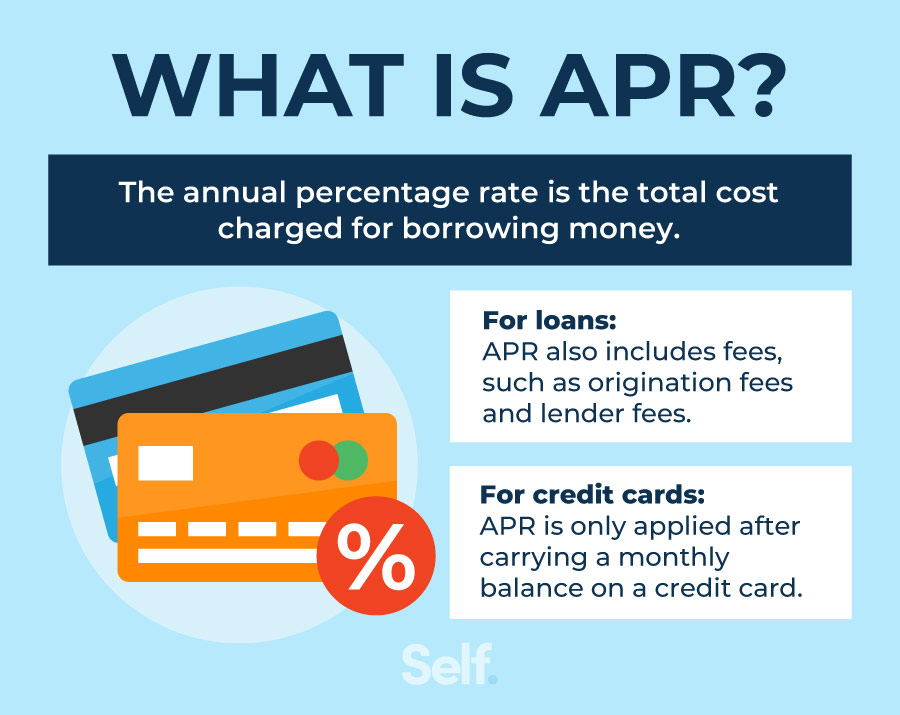
It is vital to distinguish between a simple interest rate and the APR. While the interest rate is the base cost of borrowing, the APR provides a more comprehensive view of the cost by factoring in other charges that might be associated with the credit account, such as annual fees or transaction fees, depending on the regulatory context. However, for most credit cards, the APR functions as the annualized interest rate applied to your outstanding balance.
Why APR Matters for Your Wallet
The APR dictates how much you pay if you do not pay off your statement balance in full by the due date. Because credit card interest typically compounds daily, a high APR can cause a small balance to balloon into a significant financial burden over a matter of months. Understanding your specific APR allows you to calculate exactly how much a purchase will cost you if you decide to pay it off over several months rather than immediately.
The Grace Period Exception
There is one primary way to circumvent the APR entirely: the grace period. Most credit card issuers offer a window—usually 21 to 25 days—between the end of your billing cycle and the payment due date. If you pay your statement balance in full before the deadline, most issuers will not charge you interest on your purchases. In this scenario, your APR, while still technically relevant, has zero impact on your financial health. Once you carry a balance, however, the grace period is usually forfeited, and interest begins to accrue immediately.
Different Types of APRs on a Single Card
One common misconception is that a credit card has a single, static APR. In reality, modern credit card agreements often outline multiple APRs that apply to different types of transactions. Knowing which rate applies to which activity is essential for avoiding surprise fees.
Purchase APR
This is the standard rate applied to the goods and services you buy using your credit card. It is the most common APR that consumers encounter and is typically the rate advertised when you apply for a new card. If you use your card for everyday expenses and carry a balance, this is the percentage that will be applied to your average daily balance.
Cash Advance APR
When you use your credit card to withdraw cash from an ATM or get a cash-like transaction, you are entering the territory of a cash advance. This is almost universally more expensive than your standard purchase APR. Furthermore, cash advances usually do not enjoy a grace period, meaning interest begins to accrue the very second the money is withdrawn. Many cards also charge a flat fee or a percentage of the cash amount on top of the higher interest rate.
Penalty APR
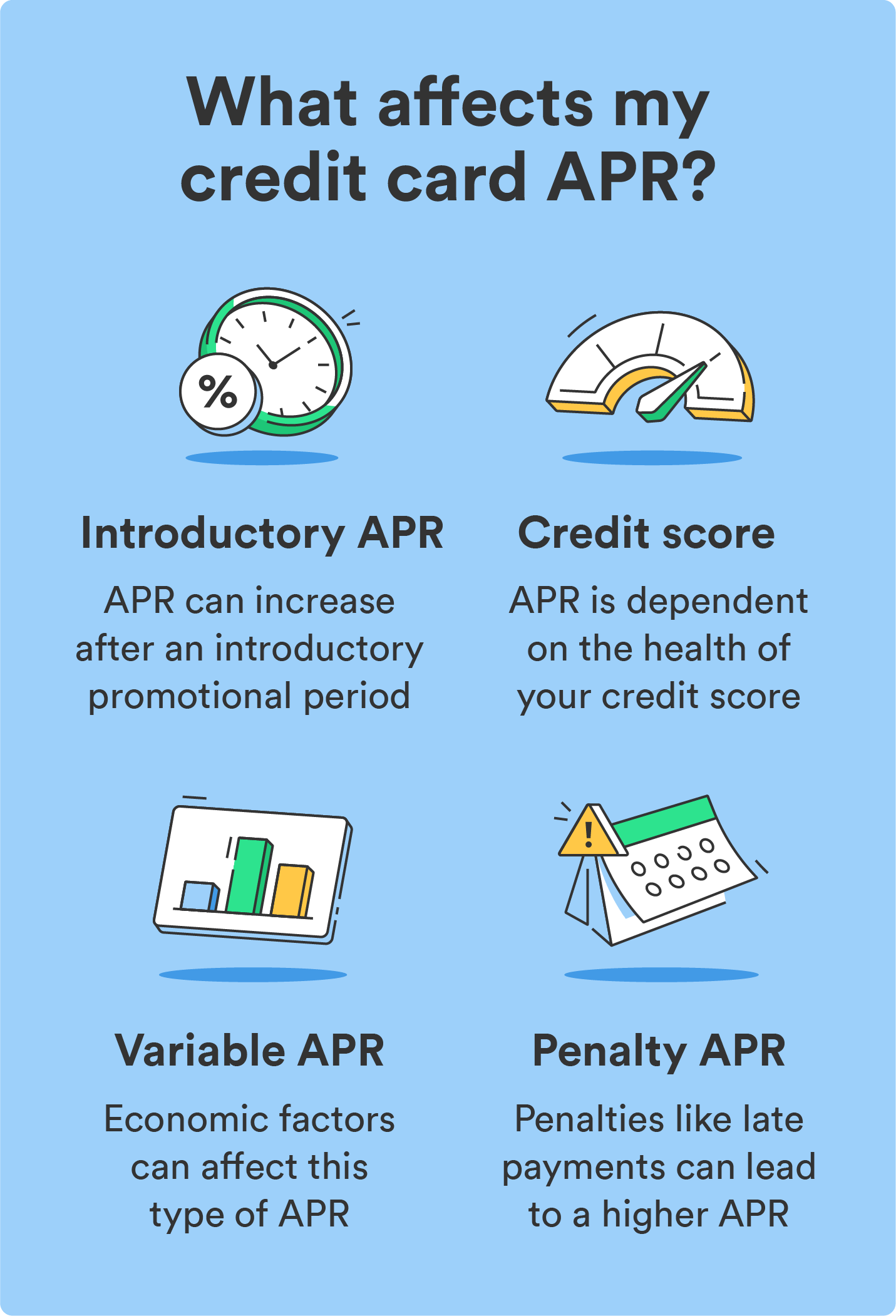
If you fail to make a payment by the due date, your issuer may trigger a Penalty APR. This is a significantly higher interest rate—often reaching 29.99%—that is applied to your balance as a consequence of poor payment behavior. Depending on the card issuer’s terms, the Penalty APR could remain in effect for several months or even indefinitely, making it a severe financial setback.
Introductory APRs
Many credit cards feature “0% Intro APR” offers to entice new customers. These promotional rates allow you to carry a balance on new purchases or balance transfers without accruing interest for a set period, usually ranging from 6 to 18 months. While these are powerful tools for managing debt or financing large purchases, they require strict adherence to the payment schedule to be effective. Once the introductory period expires, the standard purchase APR kicks in on any remaining balance.
How APR Is Calculated and Applied
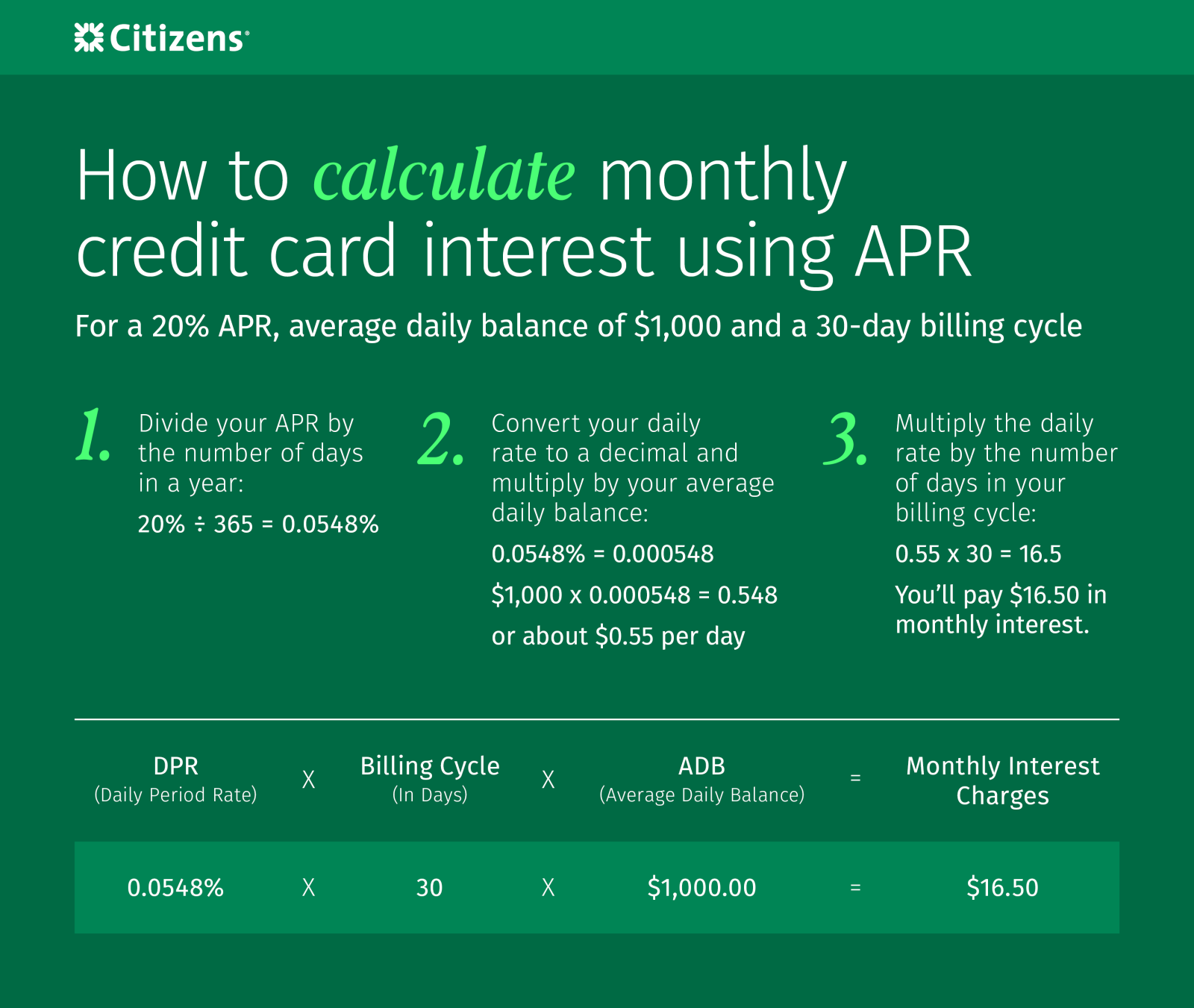
The APR is a yearly figure, but credit card companies do not wait a year to charge you. Instead, they translate the annual percentage into a daily rate and apply it to your account balance every single day. This process is known as daily periodic rate calculation.
The Daily Periodic Rate
To find your daily rate, the issuer divides your APR by 365 (or 360 in some banking systems). For example, if your purchase APR is 20%, the math looks like this: 0.20 divided by 365 equals approximately 0.000547. This number is your daily periodic rate.
Every day, the issuer multiplies your current outstanding balance by this daily rate. At the end of the billing cycle, all those daily interest charges are added together and posted to your account as a single interest charge. Because of the way this compounds—interest is charged on the original purchase plus the previously accrued interest—the effective annual yield on a credit card balance can actually be higher than the stated APR.
Variable vs. Fixed APRs
Most credit cards today carry a variable APR. This means the rate is tied to an external benchmark, most commonly the U.S. Prime Rate as published in the Wall Street Journal. When the Federal Reserve raises or lowers the federal funds rate, the Prime Rate moves, and your credit card APR moves in tandem. While a “fixed” APR card exists, the issuer can still change the rate at any time, provided they give you proper legal notice. Never assume that a fixed APR means the rate will never change over the life of the card.
Strategies for Managing Your APR
Since interest costs are the primary way credit card companies generate revenue, they are designed to make carrying a balance lucrative for them and expensive for you. To protect your personal finance goals, you must treat the APR as a warning sign.
Always Prioritize Full Payments
The most effective strategy for dealing with credit card APR is to avoid paying interest altogether. By automating your payments or setting calendar reminders to pay your full statement balance before the due date, you effectively reduce the cost of your credit card to zero, regardless of how high your APR might be.
The Debt Avalanche Method
If you are already carrying debt across multiple cards, you should employ the “Debt Avalanche” method. This involves identifying the card with the highest APR and focusing all your extra cash flow toward paying it off, while making only minimum payments on your other cards. Once the highest-interest card is cleared, move to the card with the next highest APR. This strategy minimizes the total interest you pay over the life of your debt, allowing you to get out of the red faster.
Negotiate Your Rate
It is a little-known fact that you can sometimes negotiate your APR. If you have a long history of on-time payments and a strong credit score, you can call your issuer’s customer service department and request a lower interest rate. Simply explaining that you are a loyal customer and are considering switching to a card with a lower rate can sometimes be enough to trigger a retention offer or a permanent reduction in your APR.
Mastering the mechanics of the APR is not just about understanding math; it is about reclaiming control over your financial future. By staying informed about the different types of interest charges, avoiding the traps of penalty rates, and paying your balance in full, you can leverage credit cards as the powerful financial instruments they were meant to be, rather than falling victim to the high costs of revolving debt.
aViewFromTheCave is a participant in the Amazon Services LLC Associates Program, an affiliate advertising program designed to provide a means for sites to earn advertising fees by advertising and linking to Amazon.com. Amazon, the Amazon logo, AmazonSupply, and the AmazonSupply logo are trademarks of Amazon.com, Inc. or its affiliates. As an Amazon Associate we earn affiliate commissions from qualifying purchases.