
The S&P 500, often referred to simply as “the S&P,” stands as one of the most widely recognized and influential financial benchmarks in the world. Far more than just a list of companies, it serves as a critical indicator of the health of the U.S. economy, a yardstick for investment performance, and a cornerstone for countless investment strategies. For seasoned investors and novices alike, understanding the S&P 500 is fundamental to navigating the complexities of the stock market and making informed financial decisions.
At its core, the S&P 500 is a stock market index that represents the performance of 500 of the largest publicly traded companies in the United States. These companies are selected by a committee at S&P Dow Jones Indices based on a range of criteria, ensuring they are truly representative of the broad market. Unlike some other indices that use simple averages or price-weighting, the S&P 500 is a market-capitalization-weighted index. This means that companies with larger market values (share price multiplied by the number of outstanding shares) have a greater impact on the index’s overall movement than smaller companies within the index.

The journey to its current prominence began in 1957, building upon earlier indices. Today, it encapsulates a vast spectrum of industries, from technology giants and financial institutions to healthcare leaders and consumer staples providers. Its comprehensive nature and rigorous selection process make it an unparalleled barometer for the American equity market, reflecting not just the fortunes of individual corporations but also broader economic trends, investor sentiment, and global financial currents. Delving deeper into its structure, purpose, and accessibility can demystify this powerful financial instrument and empower individuals to harness its potential within their own investment portfolios.
Understanding the S&P 500: A Core Financial Benchmark
To truly grasp the significance of the S&P 500, one must first understand its foundational elements. It’s not merely an arbitrary collection of 500 firms but a carefully constructed representation designed to provide a broad and accurate measure of large-cap U.S. equities. This methodological approach is what lends it its credibility and pervasive use across the financial industry.
A Basket of America’s Largest Companies
The “500” in S&P 500 refers to the approximate number of individual companies included in the index. While the exact number can fluctuate slightly due to mergers, acquisitions, or adjustments by the index committee, the core principle remains: these are the dominant players in the American corporate landscape. These companies span across all major economic sectors, ensuring that the index isn’t overly concentrated in one industry. From Apple and Microsoft in technology to Berkshire Hathaway in finance, Johnson & Johnson in healthcare, and ExxonMobil in energy, the S&P 500 encompasses the titans that drive the U.S. economy. Inclusion criteria are stringent, typically requiring a market capitalization of at least $14.6 billion (though this threshold changes), adequate liquidity, and a significant portion of shares available for public trading (float). Companies must also demonstrate consistent profitability, typically for the most recent quarter and the sum of the trailing four quarters. These requirements ensure that only established, financially sound, and widely traded companies make it into this prestigious group.
Market-Cap Weighting: Why Size Matters
A crucial characteristic of the S&P 500 is its market-capitalization weighting. This means that a company’s influence on the index’s movement is directly proportional to its total market value. For instance, if Apple, with its trillion-dollar-plus market cap, sees a 1% stock price change, it will have a much more significant impact on the S&P 500’s overall performance than a 1% change in a company with a market cap of, say, $20 billion, even if both are part of the index. This weighting methodology ensures that the index accurately reflects the true economic weight of its constituent companies within the broader market. It naturally emphasizes the performance of the largest and most influential corporations, reflecting how the aggregate wealth of investors is distributed across these firms. While it provides a realistic picture of the market, it also means that a handful of mega-cap companies can, at times, disproportionately drive the index’s direction.
The Role of S&P Dow Jones Indices
The S&P 500 is not a government-run entity nor a directly managed investment fund. Instead, it is maintained by S&P Dow Jones Indices, a joint venture between S&P Global and CME Group. This independent entity is responsible for the methodology, selection, and ongoing maintenance of the index. An index committee at S&P Dow Jones Indices regularly reviews and makes adjustments to the list of companies, adding or removing them based on predefined quantitative and qualitative criteria. This rigorous oversight ensures that the index remains relevant, reflective of the large-cap U.S. equity market, and adheres to its stated methodology. Their role is pivotal in preserving the integrity and reliability of the S&P 500 as a benchmark for investors and analysts worldwide.
The Significance and Purpose of the S&P 500
Beyond its technical construction, the S&P 500 holds immense practical significance in the financial world. Its omnipresence in financial news and investment discourse is a testament to its multifaceted utility. Understanding its purpose illuminates why it is such a critical component of financial literacy and strategic investing.
A Barometer for the U.S. Economy
Perhaps the most frequently cited role of the S&P 500 is its function as a leading economic indicator. Because it comprises 500 of the largest and most influential companies, their collective performance offers a window into the health and direction of the broader U.S. economy. When the S&P 500 is rising, it often signals investor confidence, corporate profitability, and economic expansion. Conversely, a sustained decline can be a harbinger of economic slowdowns, recessions, or significant market distress. Analysts, economists, policymakers, and individual investors all scrutinize its movements for clues about consumer spending, corporate earnings, and general market sentiment. While not the sole indicator, its breadth across sectors makes it a more comprehensive and reliable economic barometer than narrower indices.
A Benchmark for Investment Performance
For professional money managers and individual investors alike, the S&P 500 serves as a crucial benchmark against which to measure investment performance. If a mutual fund manager claims to be a top performer in U.S. large-cap equities, their fund’s returns are often compared to the S&P 500’s returns over the same period. Beating the S&P 500 is generally considered a strong performance, while underperforming it suggests that the manager’s active stock-picking strategy may not be adding sufficient value to justify their fees. For individuals, investing in an S&P 500 index fund provides a straightforward way to track the broad market, and their personal portfolio’s returns can be benchmarked against it to assess their own investment prowess or the effectiveness of their chosen strategies. This benchmarking function fosters transparency and accountability across the investment industry.
Reflecting Sectoral Diversity
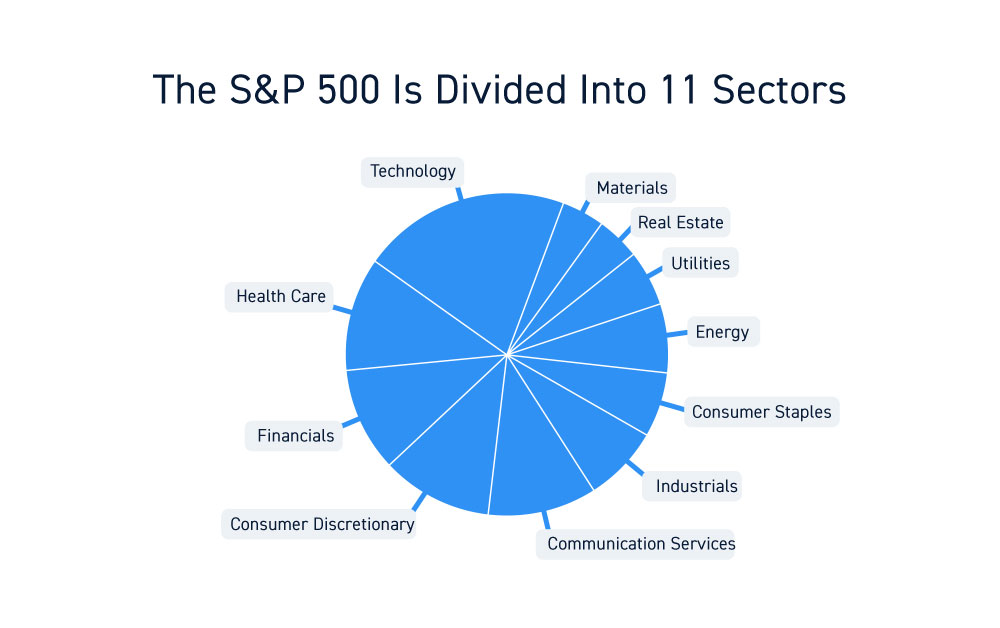
The S&P 500 is meticulously constructed to offer broad sectoral representation. It is divided into 11 main Global Industry Classification Standard (GICS) sectors: Communication Services, Consumer Discretionary, Consumer Staples, Energy, Financials, Healthcare, Industrials, Information Technology, Materials, Real Estate, and Utilities. This diversification means that the index is not overly reliant on the performance of a single industry. While certain sectors, like Information Technology, have grown to command a larger weighting over time due to the rise of tech giants, the overall structure aims to provide a balanced reflection of the various engines driving the U.S. economy. This sectoral diversity is crucial for its role as an economic barometer, as it captures trends and shifts across the entire corporate landscape rather than just a segment of it.
How to Invest in the S&P 500
One of the most appealing aspects of the S&P 500 is its accessibility. While you cannot directly “buy” the index itself, there are several highly efficient and cost-effective ways for individual investors to gain exposure to its performance, embodying a strategy often referred to as passive investing.
Index Funds: The Direct Approach
The most traditional way to invest in the S&P 500 is through an index mutual fund. These funds are designed specifically to mimic the performance of the S&P 500 by holding, in roughly the same proportions, all the stocks that make up the index. When you invest in an S&P 500 index fund, you are effectively buying a tiny fractional ownership in all 500 (or so) companies within the index, without having to purchase each stock individually. These funds are typically managed passively, meaning there’s no active stock-picking by a fund manager trying to beat the market. Their goal is simply to match the index’s return, minus a very small management fee. This passive approach often results in significantly lower expense ratios compared to actively managed mutual funds, making them a very attractive option for long-term investors.

Exchange-Traded Funds (ETFs): Flexibility and Liquidity
Exchange-Traded Funds (ETFs) offer another popular and often more flexible way to invest in the S&P 500. Like index mutual funds, S&P 500 ETFs are designed to track the performance of the index. The key difference lies in how they are traded. ETFs are bought and sold on stock exchanges throughout the day, much like individual stocks. This offers investors greater liquidity, allowing them to enter or exit positions at current market prices during trading hours. Popular S&P 500 ETFs include SPY (SPDR S&P 500 ETF Trust), IVV (iShares Core S&P 500), and VOO (Vanguard S&P 500 ETF). They also tend to have very low expense ratios, similar to index mutual funds, making them highly cost-efficient vehicles for broad market exposure. Their flexibility makes them suitable for a wide range of investors, from those making regular contributions to those employing more active trading strategies.
Individual Stock Picking vs. Index Investing
While some investors enjoy the challenge and potential rewards of picking individual stocks, investing in an S&P 500 index fund or ETF offers a fundamentally different approach with distinct advantages. For most individual investors, especially those without the time, expertise, or desire to conduct extensive research, index investing provides superior diversification and simplifies the investment process. Historically, a vast majority of actively managed funds struggle to consistently outperform the S&P 500 over long periods, especially after accounting for higher fees. By investing in the S&P 500, you are essentially betting on the long-term growth and innovation of America’s largest companies as a whole, rather than the success or failure of any single company. This approach inherently reduces single-stock risk and aligns with a strategy focused on broad market returns.
Advantages and Considerations for S&P 500 Investors
Investing in the S&P 500 offers a compelling proposition for many, but it’s essential to understand both its benefits and the inherent risks associated with equity markets.
Diversification at Your Fingertips
One of the most significant advantages of investing in the S&P 500 is the instant diversification it provides. Rather than putting all your eggs in one basket by investing in a single company, you gain exposure to 500 different companies across various sectors. This broad diversification significantly reduces company-specific risk. If one company in the index performs poorly or even goes bankrupt, its impact on your overall investment is minimal because it’s buffered by the performance of hundreds of other companies. This inherent risk mitigation is a cornerstone of prudent investing and is readily achieved through S&P 500 index funds or ETFs.
Lower Costs and Passive Management
S&P 500 index funds and ETFs are characterized by their passive management style. Unlike actively managed funds that employ teams of analysts and portfolio managers making constant buy and sell decisions, passive funds simply aim to replicate the index. This results in significantly lower operating costs, which are passed on to investors in the form of very low expense ratios (often less than 0.10% annually). Over decades, these small differences in fees can translate into tens or even hundreds of thousands of dollars in additional returns for investors, thanks to the power of compounding. This cost efficiency makes S&P 500 investing a financially smart choice for long-term wealth accumulation.
Long-Term Growth Potential
Historically, the S&P 500 has demonstrated impressive long-term growth potential. While past performance is no guarantee of future results, the index has delivered an average annual return of approximately 10-12% over various multi-decade periods. This growth is driven by the collective innovation, profitability, and expansion of America’s leading corporations, alongside the country’s economic development. For investors with a long time horizon (10 years or more), investing in the S&P 500 can be a powerful engine for wealth creation, leveraging the consistent upward trend of the equity market over extended periods, despite short-term fluctuations.
Market Volatility and Risk
Despite its long-term growth trajectory, it’s crucial to remember that investing in the S&P 500 is not without risk. As an equity investment, it is subject to market volatility. Stock prices can and do go down, sometimes significantly, during economic downturns, market corrections, or periods of uncertainty. While diversification mitigates company-specific risk, it does not eliminate systemic market risk. Investors should be prepared for fluctuations and potential drawdowns, understanding that short-term losses are a normal part of investing in the stock market. A long-term perspective and the ability to ride out market downturns are essential for success with S&P 500 investing.
Beyond the Basics: Common Misconceptions and Nuances
While the S&P 500 is widely understood, some common misconceptions persist, and a deeper dive reveals certain nuances essential for a complete understanding.
The S&P 500 is Not Just 500 Companies (Exactly)
While the name implies exactly 500 companies, the actual number can fluctuate slightly around that figure. The S&P Dow Jones Indices committee maintains a target of 500, but due to corporate actions like mergers and acquisitions, the number of distinct entities might temporarily be a bit higher or lower. For example, if two S&P 500 companies merge, the resulting entity effectively takes up one spot, potentially reducing the count. The spirit of the index, however, remains to capture the performance of approximately 500 of the largest U.S. publicly traded companies.
Not All Stocks are Equal in the Index
Reiterating the market-cap weighting, it’s important to internalize that not all companies within the S&P 500 have the same influence. A company like Apple or Microsoft, due to its massive market capitalization, will impact the index far more than a smaller company within the index. This means that the index’s performance is heavily skewed towards the performance of its largest constituents. While this accurately reflects how wealth is distributed in the market, it also means that the overall index can be significantly influenced by the fortunes of a relatively small number of mega-cap stocks.
S&P 500 vs. Dow Jones Industrial Average vs. Nasdaq
The S&P 500 is often discussed alongside other prominent indices, leading to confusion.
- Dow Jones Industrial Average (DJIA): The Dow is much narrower, comprising only 30 large, established U.S. companies. It’s also a price-weighted index, meaning companies with higher share prices have a greater impact, regardless of their total market cap. This makes it less representative of the broader market than the S&P 500.
- Nasdaq Composite: This index includes virtually all stocks listed on the Nasdaq stock exchange. While it has a heavy concentration of technology and growth companies, it also includes many smaller and mid-cap companies. The Nasdaq 100, a subset of the Composite, tracks the 100 largest non-financial companies listed on the Nasdaq and is also market-cap weighted but with a sectoral tilt towards technology.
The S&P 500 stands out for its comprehensive yet refined representation of large-cap U.S. equities, offering a middle ground between the narrowness of the Dow and the breadth of the full Nasdaq Composite.
Conclusion
The S&P 500 is far more than a mere number; it is a meticulously constructed financial instrument that serves as a cornerstone of modern investing and economic analysis. Representing 500 of the largest U.S. companies and weighted by market capitalization, it offers an unparalleled window into the health of the American economy and the performance of its leading corporate entities.
For investors, the S&P 500 provides a highly accessible, diversified, and cost-effective pathway to participate in the long-term growth of the U.S. stock market through index funds and ETFs. Its inherent diversification mitigates company-specific risks, while its passive management leads to significantly lower fees, which can substantially boost long-term returns through the power of compounding. While it is subject to market volatility and does not eliminate investment risk, a patient, long-term approach to S&P 500 investing has historically proven to be a robust strategy for wealth accumulation.
Understanding the S&P 500’s structure, its role as a benchmark, and the various ways to invest in it empowers individuals to make more informed financial decisions, simplify their investment strategy, and align their portfolios with the collective strength of America’s corporate giants. In a world of complex financial instruments, the S&P 500 stands as a testament to the power of broad-market, passive investing for sustainable financial growth.
aViewFromTheCave is a participant in the Amazon Services LLC Associates Program, an affiliate advertising program designed to provide a means for sites to earn advertising fees by advertising and linking to Amazon.com. Amazon, the Amazon logo, AmazonSupply, and the AmazonSupply logo are trademarks of Amazon.com, Inc. or its affiliates. As an Amazon Associate we earn affiliate commissions from qualifying purchases.