
In the vast landscape of modern technology, where precision, safety, and operational integrity are paramount, the concept of an “interlock” stands as a fundamental pillar. Far more than a simple latch or a switch, an interlock is a sophisticated mechanism, device, or system designed with a singular, crucial purpose: to prevent certain actions from occurring unless specific conditions are met. It acts as an intelligent gatekeeper, ensuring sequential operation, preventing mutual interference, and, most critically, safeguarding personnel, equipment, and data. From the complex machinery of industrial plants to the intricate algorithms governing software applications, interlocks are indispensable for reliable and secure technological operation.
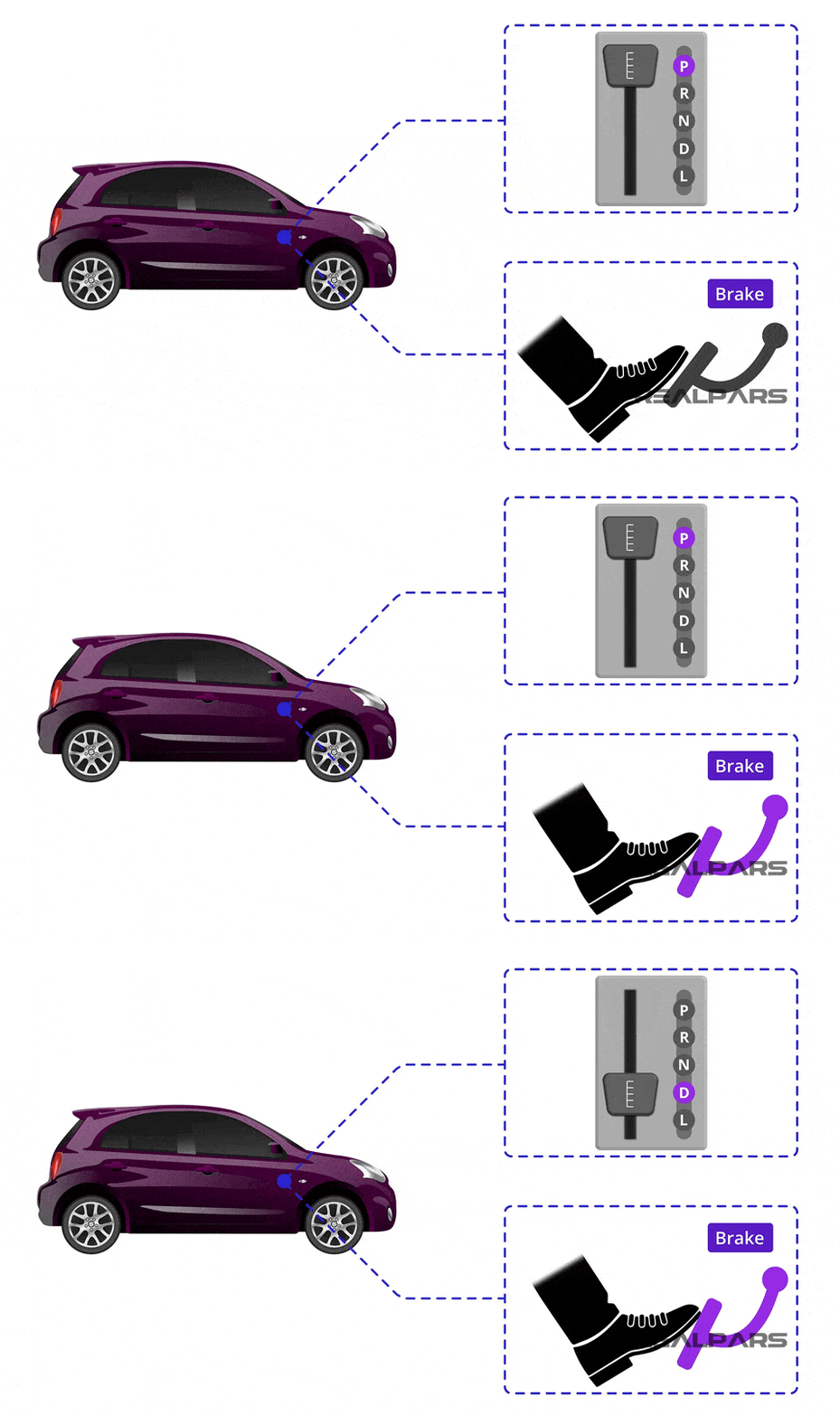
The Fundamental Concept of an Interlock
At its core, an interlock enforces a conditional dependency. It dictates that action ‘B’ cannot happen unless action ‘A’ has either completed, is in a specific state, or another predefined criterion has been satisfied. This principle is not merely about control; it’s about preventative measures, error reduction, and risk mitigation. Think of it as a logical precondition built into the very fabric of a system. Without interlocks, the potential for catastrophic failures, equipment damage, operational inefficiencies, and safety hazards would dramatically increase across virtually every technological domain. Their purpose ranges from ensuring the safe closure of a microwave oven door before heating can begin, to preventing two high-voltage power lines from connecting simultaneously, or even managing concurrent access to a shared resource within a complex software program.
Categories and Technological Implementations
The versatility of interlocks is evident in their diverse forms and applications, spanning mechanical, electrical, and software realms, often converging into integrated safety systems. Each type addresses specific challenges but adheres to the same core principle of conditional enablement or disablement.
Mechanical Interlocks: Physical Constraints for Safety
Mechanical interlocks represent the most tangible form of this concept, relying on physical design to enforce conditions. These devices create physical barriers or require specific positioning of components before an operation can proceed. Their robustness makes them ideal for environments where direct physical interaction and clear visual indication are essential for safety.
- Description: These involve physical components like keys, latches, bolts, or guards that physically prevent an action until a preceding condition is met. They often utilize a “key exchange” principle, where a key can only be released when a certain state is achieved, and that key is then required to enable a subsequent action.
- Examples: Machine guards that prevent access to moving parts unless the machine is powered off, or specialized key interlocks used in high-voltage switchgear where a key must be removed from an isolator (proving it’s open) before it can be inserted into a circuit breaker (allowing it to be closed). In everyday gadgets, a washing machine door latch that prevents the cycle from starting if the door isn’t properly shut is a simple yet effective mechanical interlock.
- Technology Aspect: While seemingly rudimentary, the engineering behind robust mechanical interlocks can be quite sophisticated, involving precision-machined parts, wear-resistant materials, and tamper-proof designs to ensure reliability in harsh environments.
Electrical Interlocks: Preventing Power Conflicts and Hazards
Electrical interlocks use electrical circuits to enforce operational sequences and prevent dangerous power configurations. They are critical in power distribution, motor control, and any system where precise control over electrical current is necessary.
- Description: These systems employ relays, contactors, circuit breakers, and other electrical components to create logic that prevents simultaneous operation of conflicting electrical devices or ensures a specific power-up or power-down sequence. They can also prevent energizing a circuit if safety covers are open or if an emergency stop button is pressed.
- Examples: In industrial motor control centers, an electrical interlock might prevent a motor from starting in reverse direction while it’s still spinning forward. Another common example is in uninterruptible power supply (UPS) systems, where electrical interlocks prevent the main utility power and the UPS inverter from feeding power to the load simultaneously, avoiding damaging short circuits.
- Technology Aspect: Modern electrical interlocks often incorporate programmable logic controllers (PLCs) or microcontrollers for more complex logic and integration with wider control systems. Their design prioritizes insulation coordination, fault tolerance, and rapid response times to ensure electrical safety and system stability.
Software and Digital Interlocks: Orchestrating Complex Processes
In the digital realm, interlocks are logical conditions implemented within software to manage resource access, ensure data integrity, and enforce operational sequences in computer systems and networks. They are invisible yet fundamental to the reliable operation of nearly all modern applications.
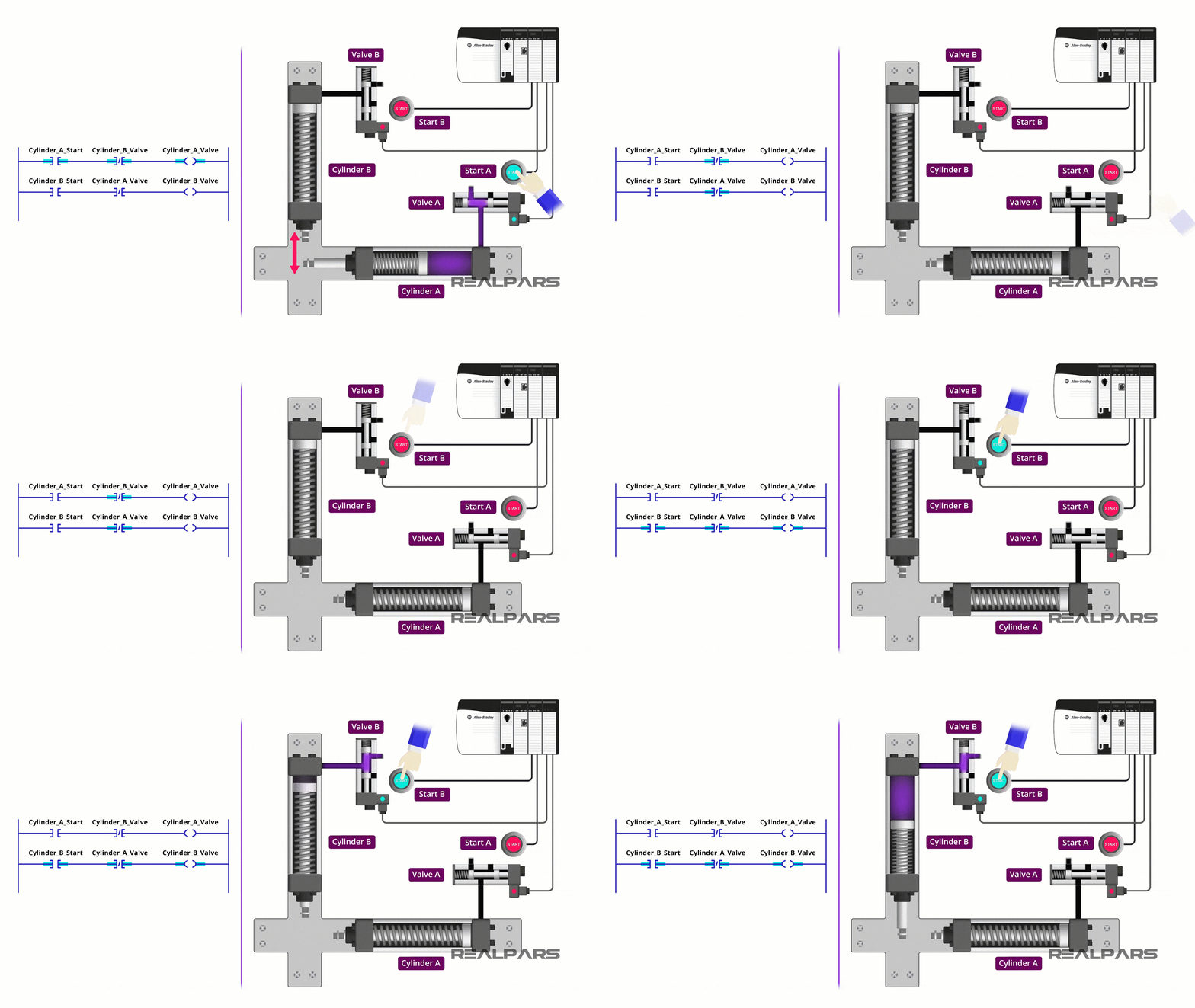
- Description: These are algorithms and programming constructs that manage access to shared resources (like memory, files, or network connections) or dictate the flow of operations within a program. They prevent “race conditions” where multiple processes try to modify the same data simultaneously, leading to unpredictable outcomes.
- Examples: In operating systems, mutexes (mutual exclusions) and semaphores are prime examples of software interlocks, preventing multiple threads from accessing a critical section of code concurrently. Database management systems use transaction locks to ensure data consistency during simultaneous read/write operations. Cybersecurity features like multi-factor authentication sequences (where the second factor cannot be requested until the first is validated) or secure boot processes (where the operating system won’t load if the boot chain is compromised) also function as digital interlocks. API rate limiting, which prevents overuse of a service, is another form of software interlock.
- Technology Aspect: Implementing robust software interlocks requires deep understanding of concurrency control, distributed systems, and potential deadlock scenarios. Modern programming languages and frameworks provide built-in primitives and libraries to facilitate their creation, but their effective use remains a critical skill for software engineers.
Integrated Safety Interlock Systems: The Convergent Approach
Many critical applications today rely on integrated safety interlock systems that combine mechanical, electrical, and software components to create comprehensive, multi-layered protection. These systems are prevalent in industrial automation, robotics, and any environment where human safety is at risk.
- Description: These systems bring together various interlock types to form a holistic safety architecture. They often involve sensors (e.g., proximity sensors, light curtains, pressure mats) that detect unsafe conditions, logic controllers (PLCs, safety relays) that process these inputs, and actuators (e.g., contactors, hydraulic valves) that initiate safety actions like machine shutdowns or emergency stops.
- Examples: An industrial robot might have a light curtain interlock that immediately stops its operation if a human enters its work envelope. An emergency stop system is an integrated interlock; pressing the button triggers an electrical interlock, which cuts power (electrical) and might also activate pneumatic brakes (mechanical) to halt machinery. Vehicle ignition interlock devices, common in drunk driving prevention, require a breath alcohol test to be passed (sensor input) before the engine can be started (electrical interlock).
- Technology Aspect: These systems leverage advanced sensor technology, fail-safe logic, redundant components, and robust communication protocols to achieve high levels of safety integrity. The design and implementation often adhere to stringent international safety standards (e.g., ISO 13849, IEC 62061) to minimize risks to an acceptable level.
The Critical Role of Interlocks in Modern Technology and Digital Security
The pervasive nature of interlocks underscores their critical importance in the technological landscape. They are not merely add-ons but foundational elements that enable complexity, ensure reliability, and uphold safety.
Enhancing Reliability and Preventing Catastrophes
Interlocks are paramount in preventing equipment damage and operational errors. By enforcing correct sequences and preventing conflicting actions, they significantly enhance the reliability and longevity of machinery and systems. In high-stakes environments, such as nuclear power plants, aerospace, or chemical processing, a single interlock failure could lead to catastrophic outcomes, underscoring the necessity for robust, often redundant, interlock designs. They act as guardians against human error and system malfunctions, contributing directly to preventative maintenance strategies by averting conditions that could lead to wear or breakdown.
Interlocks in Digital Security and Data Integrity
In the realm of digital security, software interlocks are fundamental. They prevent unauthorized access to critical data or system functions by enforcing complex authentication flows. They are essential for maintaining data integrity by preventing race conditions, ensuring that only one process can modify a piece of data at a time, or ensuring that transactions are atomic. The entire concept of secure operating environments, from isolated virtual machines to cryptographically protected data stores, relies on sophisticated interlock mechanisms to control access and flow. Without these digital gatekeepers, the risk of data corruption, system breaches, and privacy violations would be unmanageable.

Evolution and Future Trends: Smart Interlocks and AI Integration
As technology advances, so too do interlock systems. The integration of the Internet of Things (IoT), artificial intelligence (AI), and machine learning (ML) is paving the way for “smart interlocks.” These next-generation systems will not only react to predefined conditions but will also anticipate potential failures, adapt to changing environments, and learn from operational data.
- Predictive Maintenance: AI-driven interlocks could analyze sensor data to predict equipment failure before it occurs, initiating preventative shutdowns or rerouting operations automatically.
- Adaptive Safety: In dynamic environments like smart cities or autonomous vehicle networks, interlocks could adapt their logic based on real-time traffic, weather, or crowd conditions, optimizing safety and efficiency.
- Human-Machine Collaboration: AI could facilitate more intuitive and safer human-machine interaction, with intelligent interlocks preventing accidents by understanding human intent and machine state more comprehensively.
The evolution of interlocks reflects the broader technological trajectory: towards systems that are not only safer and more reliable but also more intelligent, adaptive, and seamlessly integrated into the fabric of our digital and physical worlds.
aViewFromTheCave is a participant in the Amazon Services LLC Associates Program, an affiliate advertising program designed to provide a means for sites to earn advertising fees by advertising and linking to Amazon.com. Amazon, the Amazon logo, AmazonSupply, and the AmazonSupply logo are trademarks of Amazon.com, Inc. or its affiliates. As an Amazon Associate we earn affiliate commissions from qualifying purchases.