
In the intricate world of finance and economics, costs are not always as straightforward as they appear on a ledger. While explicit costs represent the tangible, out-of-pocket expenses that are easily identifiable and recorded, there exists a more subtle, yet equally powerful, category of costs that profoundly influences our decisions and financial outcomes: implicit costs. Understanding these hidden sacrifices is not merely an academic exercise; it is a critical skill for anyone seeking to make truly informed choices, whether in personal finance, business, or investment.
Implicit costs, at their heart, are the opportunity costs associated with the use of a resource that the company or individual already owns, for which no direct payment is made. They represent the value of the best alternative forgone when a choice is made. Unlike explicit costs, which involve a monetary transaction, implicit costs are non-monetary and are often overlooked in conventional accounting. Yet, for economic decision-making, particularly when evaluating the true profitability of an endeavor or the real cost of a personal choice, implicit costs hold immense sway. By delving into the nature of implicit costs, their distinction from explicit costs, and their pervasive impact, we can unlock a deeper understanding of financial intelligence and strategic decision-making.
Understanding Implicit Costs: The Unseen Sacrifice
The concept of implicit cost is fundamental to economic analysis, offering a lens through which to view the true economic cost of actions. It forces us to consider not just what we pay, but what we give up.
Definition and Core Concept
An implicit cost is an opportunity cost. It refers to the benefit that a firm or individual foregoes by choosing one alternative over another, without any direct cash outflow. For instance, if you own a building and use it for your business, the implicit cost is the rent you could have earned by leasing that building to someone else. There’s no cash changing hands for the use of the building within your business, but there is a clear economic cost in terms of lost potential income. Similarly, the time an entrepreneur dedicates to their startup is an implicit cost because they could have been earning a salary at another job.
This concept is rooted in the principle of scarcity, which dictates that resources are limited, and every decision to use a resource for one purpose means foregoing its use for another. The value of that forgone alternative is the implicit cost. It’s often referred to as the “invisible” or “hidden” cost because it doesn’t appear on standard financial statements like income statements or balance sheets, which are primarily concerned with explicit transactions.
Implicit vs. Explicit Costs: A Critical Distinction
To fully grasp implicit costs, it’s essential to differentiate them from their more visible counterparts: explicit costs. This distinction is paramount in economic analysis, particularly when assessing true profitability.
-
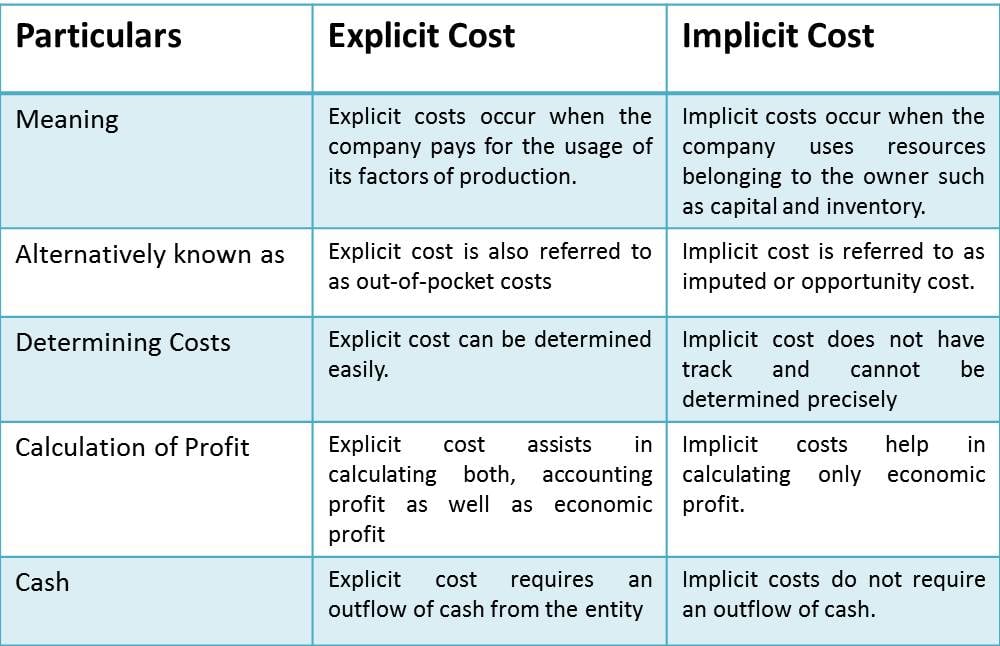
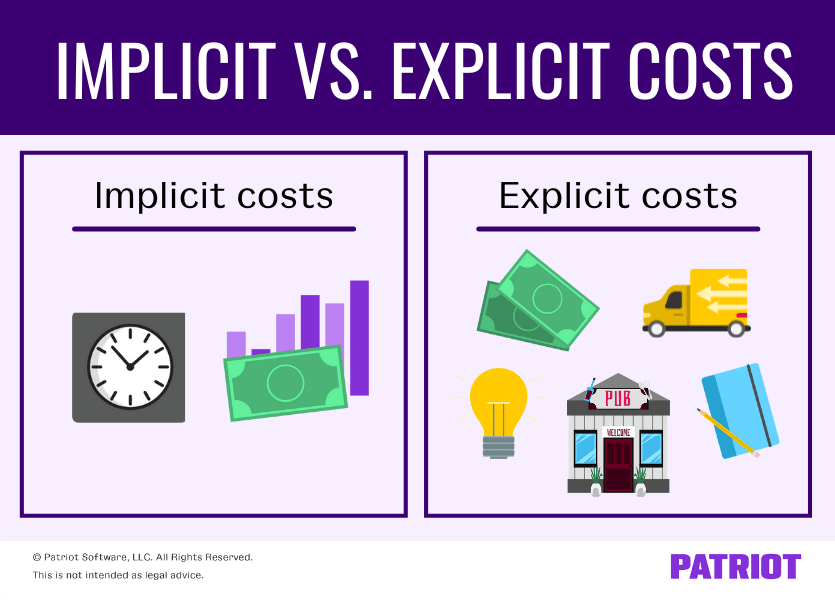
Explicit Costs: These are the direct, out-of-pocket expenses for resources used in production or operations. They involve a clear monetary payment to an external party. Examples include wages paid to employees, rent paid for office space, raw material purchases, utility bills, and interest payments on loans. Explicit costs are recorded in accounting books and directly impact a firm’s accounting profit.
-
Implicit Costs: These are the opportunity costs of using resources already owned by the firm or individual, for which no direct monetary payment is made. They do not involve a cash transaction. Examples include the owner’s time and effort, the use of owner-supplied capital (e.g., the interest that could have been earned on funds invested in the business), or the use of owner-owned property (e.g., foregone rental income). Implicit costs are not recorded in traditional accounting statements but are crucial for determining economic profit.
The primary difference lies in the presence or absence of a cash outflow and their treatment in financial reporting. Accounting profit is calculated as total revenue minus explicit costs. Economic profit, on the other hand, considers both explicit and implicit costs, calculated as total revenue minus (explicit costs + implicit costs). A business might show an accounting profit but an economic loss if its implicit costs are high enough to outweigh the accounting profit. This distinction helps decision-makers understand the true viability and opportunity cost of their ventures.
The Nature of Opportunity
The concept of opportunity is central to understanding implicit costs. Every choice made inherently means foregoing an alternative. The “opportunity” in opportunity cost refers to the best alternative use of a resource that was not chosen. For example, when a college student chooses to attend university, the implicit cost includes the income they could have earned had they worked full-time instead. For a small business owner, using personal savings to fund their venture incurs an implicit cost in the form of the interest they could have earned by investing those savings elsewhere.
This fundamental economic principle highlights that resources are not free, even if they are already owned. They always have an alternative use, and the value of that next best alternative is the true “cost” in an economic sense. Recognizing the nature of opportunity helps individuals and businesses make more rational and economically sound decisions, pushing them beyond mere cash flow considerations to a more holistic assessment of value.
Implicit Costs in Action: Real-World Scenarios
Understanding implicit costs moves beyond theory when we see their profound impact across various financial domains. From personal life choices to corporate strategies, these unseen costs shape outcomes.
Personal Finance Examples
Implicit costs frequently influence personal financial decisions, though they are rarely quantified explicitly by individuals.
-
Career Choice: When someone chooses to pursue a passion project or a low-paying job that offers great personal satisfaction over a high-paying corporate role, the implicit cost is the higher salary and benefits foregone. While the chosen path may offer non-monetary benefits, the financial sacrifice is a significant implicit cost.
-
DIY Projects: Deciding to renovate your home yourself rather than hiring professionals seems like a cost-saving measure. The explicit costs are just materials. However, the implicit cost includes the income you could have earned during the hours spent on renovation, or the leisure time you sacrificed. If your hourly wage is high, the implicit cost of your time might make the “DIY saving” less significant than it appears.
-
Education and Skill Development: Pursuing higher education or acquiring a new skill involves significant explicit costs (tuition, books). But the implicit cost includes the income you could have earned if you were working instead of studying, often for several years. This is a substantial investment that can only be justified by the expected future benefits (higher earning potential, better job opportunities).
-
Saving vs. Spending: Choosing to save money instead of spending it today has an implicit cost: the immediate gratification or utility you could have derived from that spending. Conversely, spending money today incurs an implicit cost in terms of the future returns that money could have earned if invested.
Business Applications
For businesses, considering implicit costs is crucial for accurate profitability assessment and strategic decision-making.
-
Owner’s Labor: In many small businesses, the owner actively participates in daily operations, often without drawing a formal salary commensurate with their effort or market rates. The implicit cost here is the salary the owner could have earned working for another company, or the market value of their labor if they were paid as an employee. Ignoring this overstates the business’s profitability.
-
Owner-Supplied Capital: When an owner invests their personal savings into their business, there’s no interest payment required for the use of these funds. However, the implicit cost is the interest or returns these funds could have earned if invested in a safe alternative, such as a high-yield savings account or a diversified stock portfolio.
-
Foregone Rental Income: If a business operates out of a building it owns, it avoids explicit rent payments. However, the implicit cost is the rent it could have earned by leasing that property to another entity. This is a real economic cost that must be considered when evaluating the building’s optimal use.
-
Using Existing Equipment: A company might use old equipment it fully owns, incurring no new purchase cost. But if newer, more efficient equipment would significantly reduce operating costs or increase output, the implicit cost of using the old equipment is the lost efficiency or profit potential that the new equipment could have provided.
Investment Decisions

Implicit costs also play a pivotal role in investment analysis, guiding choices about asset allocation and project evaluation.
-
Holding Undeveloped Land: An investor might own a plot of land that is not generating income. The explicit costs might be low (property taxes). However, the implicit cost is the income or returns that could have been generated if the land were sold and the capital invested elsewhere, or if it were developed for commercial or residential use.
-
Passive vs. Active Management: Choosing to manage investments yourself saves explicit fees paid to financial advisors or fund managers. However, the implicit cost could be lower returns due to lack of expertise, missed opportunities, or excessive time spent that could have been used for income-generating activities.
-
Opportunity Cost of Capital: When a company undertakes a new project, it commits capital. The implicit cost of this capital is the return that could have been earned on the next best alternative investment project with similar risk. This is often reflected in the “hurdle rate” or “cost of capital” used in financial modeling.
Measuring the Immeasurable: Quantifying Implicit Costs
One of the significant challenges with implicit costs is their quantification. Unlike explicit costs that come with invoices and receipts, implicit costs require estimation and careful judgment.
Challenges in Quantification
The subjective nature of implicit costs makes precise measurement difficult.
-
Lack of Direct Transactions: By definition, implicit costs don’t involve a monetary exchange, meaning there are no direct records or objective market prices to refer to.
-
Subjectivity of Alternatives: Identifying the “best alternative forgone” can be subjective. What is the true value of an entrepreneur’s time? Is it their previous salary, or the market rate for a CEO in a similar startup? The choice of alternative significantly impacts the estimated implicit cost.
-
Non-Monetary Benefits: Many decisions that incur implicit costs also offer non-monetary benefits (e.g., job satisfaction, work-life balance). While these benefits are real, they are hard to quantify in monetary terms and often complicate the direct comparison with a purely financial alternative.
-
Future Uncertainty: Estimating foregone profits or returns for future periods involves assumptions about market conditions, interest rates, and other variables that are inherently uncertain.
Proxy Measures and Estimation
Despite the challenges, various methods and proxy measures can be used to estimate implicit costs, providing valuable insights for decision-making.
-
Market Rates: For owner-provided labor or capital, market rates serve as excellent proxies. For instance, the implicit cost of an owner’s labor can be estimated by what they could earn as an employee in a similar role with similar skills and experience in the job market. For owner-supplied capital, the interest rate on a low-risk investment (like a government bond or a high-yield savings account) can be used as the foregone return.
-
Rental Values: For owner-occupied property, the prevailing market rental rate for similar properties in the area can serve as the implicit cost of using that property.
-
Foregone Profit/Revenue: In cases of choosing between alternative projects, the estimated profit or revenue from the next best project serves as the implicit cost of the chosen one. This requires detailed financial forecasting and analysis of both options.
-
Expert Opinion: In complex situations, consulting industry experts or financial advisors can help in arriving at reasonable estimates for implicit costs, especially when market data is scarce or the alternatives are highly specialized.
Qualitative vs. Quantitative Assessment
While ideally, implicit costs should be quantified for robust financial analysis, there are situations where a qualitative assessment is also valuable.
-
Qualitative Assessment: This involves acknowledging and discussing the existence and potential impact of implicit costs even if a precise monetary value cannot be assigned. For example, a startup founder might acknowledge that their low salary is an implicit cost, but justify it by the high potential for future equity gains and the satisfaction of building something new. This approach ensures that the decision-maker is at least aware of the non-financial sacrifices made.
-
Quantitative Assessment: This is the preferred approach for economic decision-making, aiming to assign a monetary value to implicit costs. By converting these hidden sacrifices into numbers, they can be directly compared with explicit costs and revenues, leading to a more accurate calculation of economic profit and a clearer understanding of the true cost-benefit analysis. Even an imperfect quantitative estimate is often better than no estimate at all, as it forces consideration of these hidden factors.
Leveraging Implicit Cost Awareness for Better Financial Decisions
The ability to recognize and factor in implicit costs is a hallmark of sophisticated financial thinking. It moves individuals and businesses beyond superficial accounting profits to a deeper understanding of economic realities.
Strategic Decision-Making
Awareness of implicit costs significantly enhances strategic decision-making by providing a more complete picture of the alternatives.
-
True Profitability Analysis: For businesses, understanding implicit costs allows for the calculation of economic profit, which is a more accurate measure of a venture’s success than accounting profit alone. A project might be accounting profitable but economically loss-making if the resources used could have generated higher returns elsewhere. This insight is crucial for resource allocation, diversification decisions, and even whether to continue operating a specific business unit.
-
Capital Allocation: By identifying the implicit cost of capital (the return foregone on the next best investment), businesses can set appropriate hurdle rates for new projects. Only projects that are expected to generate returns higher than this implicit cost should be undertaken, ensuring that capital is deployed in its most productive use.
-
Risk Assessment: Implicit costs can also highlight hidden risks. For instance, relying heavily on owner’s unpaid labor might appear to reduce costs, but the implicit cost of potential burnout or the owner’s foregone alternative opportunities represents a risk to the business’s long-term sustainability.
-
Personal Life Choices: For individuals, considering implicit costs can lead to more fulfilling life choices. For example, choosing a career path that offers lower explicit income but higher job satisfaction might make sense if the non-monetary benefits outweigh the implicit cost of foregone salary. Conversely, a decision that seems “cheap” might have a very high implicit cost in terms of time, effort, or lost future opportunities.
Avoiding Hidden Pitfalls
Ignoring implicit costs is a common mistake that can lead to misinformed decisions and unexpected financial underperformance.
-
Overestimating Profitability: Businesses that only consider explicit costs can easily overestimate their true profitability, leading to complacency or misguided expansion plans. They might believe they are doing well when, from an economic perspective, they are barely breaking even or even losing money.
-
Inefficient Resource Use: Without accounting for the opportunity cost of owned resources, a business might continue to use assets sub-optimally. For example, keeping an old, fully depreciated machine might seem cost-effective, but the implicit cost of lost efficiency or higher maintenance compared to a new machine could be significant.
-
Poor Investment Choices: Individuals might invest in ventures that offer seemingly good returns but ignore the implicit cost of other, potentially higher-returning, or safer investment alternatives. This can lead to underperformance of their overall investment portfolio.
-
Burnout and Unsustainability: For entrepreneurs, constantly working without a market-rate salary can lead to burnout. The implicit cost of foregone leisure, family time, or alternative career paths can make the venture unsustainable in the long run, even if it appears to be financially solvent based on explicit costs.
Long-Term Wealth Building
Integrating implicit cost awareness into financial planning is a powerful tool for long-term wealth building.
-
Optimizing Personal Investments: Recognizing the implicit cost of holding cash or underperforming assets encourages individuals to constantly seek better investment opportunities that align with their risk tolerance and financial goals, thereby maximizing their long-term returns.
-
Smart Business Growth: Businesses that actively evaluate implicit costs are more likely to make strategic investments, expand into profitable ventures, and divest from underperforming assets, all of which contribute to sustainable growth and long-term value creation for shareholders.
-
Informed Lifestyle Choices: From choosing where to live to how to spend free time, understanding implicit costs allows individuals to make choices that maximize their overall utility and well-being, balancing monetary gains with quality of life. For instance, choosing to live closer to work might incur a higher explicit rent cost, but the implicit cost saved in commuting time and stress could be invaluable.
In conclusion, implicit costs are the silent architects of financial reality. They represent the unseen sacrifices, the alternatives foregone, and the true economic cost of every decision. While they may not appear on a balance sheet, their impact on profitability, resource allocation, and overall financial well-being is undeniable. By cultivating an awareness of these hidden costs, individuals and businesses can transcend superficial accounting figures, make more rational choices, and ultimately steer themselves towards greater financial success and sustainable growth. Embracing the concept of implicit cost is not just about crunching numbers; it’s about developing a deeper, more insightful understanding of value and opportunity in a world of finite resources.
aViewFromTheCave is a participant in the Amazon Services LLC Associates Program, an affiliate advertising program designed to provide a means for sites to earn advertising fees by advertising and linking to Amazon.com. Amazon, the Amazon logo, AmazonSupply, and the AmazonSupply logo are trademarks of Amazon.com, Inc. or its affiliates. As an Amazon Associate we earn affiliate commissions from qualifying purchases.