
An Ethernet patch cable is a fundamental component in modern networking, serving as the physical conduit that connects devices within a local area network (LAN) to facilitate data exchange. Often recognized by its characteristic RJ45 connectors on either end, it is an essential piece of hardware for establishing reliable, high-speed wired connections between computers, routers, switches, modems, gaming consoles, smart TVs, and various other network-enabled devices. Unlike the generic term “Ethernet cable,” a “patch cable” specifically refers to a relatively short length of cable (typically less than 100 meters) designed for connecting network hardware over short distances within a structured cabling system or directly between devices. Its primary function is to transmit data packets efficiently and reliably, forming the backbone of many home and office networks where stability and speed are paramount.
The Anatomy and Function of an Ethernet Patch Cable
Understanding what an Ethernet patch cable is begins with dissecting its physical composition and the principles behind its operation. These cables are engineered for specific data transmission tasks, employing a design optimized for signal integrity and performance.
Physical Components
At its core, an Ethernet patch cable is a sophisticated assembly of several key components:
- Twisted Pair Wires: The most crucial element consists of multiple pairs of insulated copper wires twisted around each other. This twisting is not merely for structural integrity; it’s a critical design feature that reduces electromagnetic interference (EMI) and crosstalk between adjacent wire pairs, thereby improving signal quality over distance. Standard Ethernet cables typically contain four such twisted pairs, totaling eight individual wires.
- Insulation: Each individual copper wire is encased in a protective layer of insulating material, usually polyethylene or PVC, to prevent electrical short circuits and maintain signal separation.
- Outer Jacket: All the twisted pairs are bundled together and encased within a durable outer jacket, commonly made of PVC (Polyvinyl Chloride) or LSZH (Low Smoke Zero Halogen) material. This jacket provides protection against physical damage, environmental factors, and further electromagnetic interference, depending on the cable type.
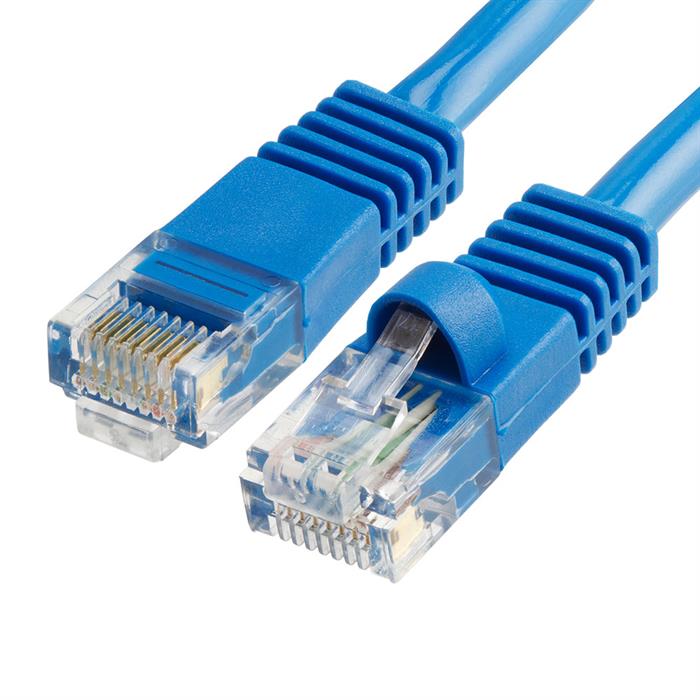
- RJ45 Connectors: At each end of the cable is an 8P8C (8 Position, 8 Contact) modular connector, universally known as an RJ45 (Registered Jack 45) connector. These connectors house eight metal pins, each making contact with one of the eight wires in the cable. The RJ45 features a locking tab that secures the cable into the port of a network device, ensuring a stable physical and electrical connection. The precise arrangement (pinout) of the wires within the RJ45 connector follows specific wiring standards, typically T568A or T568B, which dictate how the twisted pairs are terminated to ensure compatibility and correct signal transmission.
- Shielding (Optional): Some Ethernet patch cables incorporate additional shielding to further protect against EMI. Unshielded Twisted Pair (UTP) cables are the most common and lack this extra layer. Shielded Twisted Pair (STP) cables, however, feature a foil or braid shield wrapped around the twisted pairs, or even individual shielding around each pair (S/FTP), offering enhanced protection in environments prone to high electrical noise.
How it Works
When an Ethernet patch cable connects two network devices, it establishes a physical link for data transmission. Digital data, in the form of electrical signals, travels across the copper wires. The twisted pair design mitigates signal degradation caused by external noise and internal crosstalk, ensuring that the data arrives at its destination accurately. Modern Ethernet connections typically operate in full-duplex mode, meaning data can be sent and received simultaneously over different wire pairs within the same cable, dramatically increasing communication efficiency. The cable effectively acts as a dedicated pathway for data packets, allowing devices to communicate directly and continuously with minimal latency, which is a significant advantage over wireless alternatives in many applications.
Understanding Ethernet Cable Categories and Performance
The performance capabilities of Ethernet patch cables are not uniform; they are categorized based on their ability to support specific data transfer speeds and bandwidths. These categories, standardized by organizations like TIA/EIA, dictate the cable’s construction and signal characteristics, influencing its suitability for various networking demands.
Evolution of Standards (Cat5e, Cat6, Cat6a, Cat7, Cat8)
As network technologies have evolved, so too have Ethernet cable standards, each iteration designed to support faster speeds and higher frequencies:
- Cat5e (Category 5 enhanced): This was an improvement over the original Cat5 standard, capable of supporting Gigabit Ethernet (1000 Mbps or 1 Gbps) over distances up to 100 meters. It operates at a frequency of up to 100 MHz and is still widely used in many home and small office networks due to its cost-effectiveness and sufficient performance for many everyday tasks.
- Cat6 (Category 6): Cat6 cables offer enhanced performance over Cat5e, supporting 1 Gbps up to 100 meters and even 10 Gigabit Ethernet (10 Gbps) over shorter distances (up to 55 meters, depending on the environment). They operate at frequencies up to 250 MHz and feature stricter specifications for crosstalk and system noise, often incorporating a spline (a central separator) to keep the twisted pairs more isolated.
- Cat6a (Category 6 augmented): Designed specifically for 10 Gigabit Ethernet, Cat6a cables can support 10 Gbps over the full 100-meter distance. They operate at frequencies up to 500 MHz and typically have a thicker jacket and sometimes shielding to further reduce alien crosstalk (noise from adjacent cables), making them ideal for high-bandwidth applications and data centers.
- Cat7 (Category 7): While not as widely adopted as Cat6a, Cat7 cables were designed for 10 Gigabit Ethernet and future 100 Gigabit Ethernet applications, supporting frequencies up to 600 MHz. Cat7 cables are typically fully shielded (S/FTP) with individual shielding around each twisted pair and an overall braid shield. They use GG45 or TERA connectors, though they can be terminated with RJ45 for backward compatibility.
- Cat7a (Category 7 augmented): An enhancement to Cat7, supporting frequencies up to 1000 MHz.
- Cat8 (Category 8): The latest standard, Cat8 cables are designed for 25 Gigabit Ethernet (25GBASE-T) and 40 Gigabit Ethernet (40GBASE-T) over short distances (up to 30 meters). They operate at an impressive frequency of up to 2000 MHz and are invariably shielded, making them suitable for data centers and server-to-switch connections where ultra-high speeds are critical.
Shielded vs. Unshielded Cables

The choice between shielded and unshielded Ethernet patch cables significantly impacts their performance in different environments:
- Unshielded Twisted Pair (UTP): These are the most common and least expensive types of Ethernet cables. They rely solely on the twisting of pairs to cancel out electromagnetic interference. UTP cables are perfectly suitable for most residential and office environments where EMI is minimal.
- Shielded Twisted Pair (STP): STP cables incorporate an additional layer of shielding, typically a foil or braided mesh, around the twisted pairs or even each individual pair. This shielding acts as a barrier against external electromagnetic interference from power lines, fluorescent lights, or heavy machinery. STP cables are preferred in industrial settings, areas with significant electrical noise, or for outdoor applications where environmental factors could degrade signal quality. While they offer superior noise reduction, STP cables are thicker, less flexible, more expensive, and require proper grounding to be effective.
Applications and Practical Considerations
Ethernet patch cables are ubiquitous in both professional and personal networking environments due to their reliability, speed, and security advantages over wireless alternatives for certain tasks.
Common Use Cases
The versatility of Ethernet patch cables makes them indispensable for a wide array of applications:
- Connecting End Devices to Network Equipment: The most common use is linking computers, laptops, printers, IP phones, and security cameras directly to routers, modems, or network switches. This provides a stable and often faster connection than Wi-Fi.
- Home Entertainment and Gaming: Smart TVs, streaming devices, and gaming consoles benefit greatly from wired connections, ensuring minimal latency, consistent bandwidth for 4K streaming, and uninterrupted online gaming experiences.
- Data Centers and Server Racks: In enterprise environments and data centers, patch cables are crucial for connecting servers, storage area networks (SANs), and switches. High-performance Cat6a, Cat7, or Cat8 cables are standard here to handle immense data traffic and ensure rapid processing.
- Power over Ethernet (PoE) Applications: Many modern devices, such as IP cameras, VoIP phones, and wireless access points, can receive both data and electrical power over a single Ethernet cable. This simplifies installation by eliminating the need for separate power outlets, making patch cables vital for these deployments.
- Testing and Troubleshooting: Technicians frequently use patch cables to establish temporary connections, test network segments, or isolate issues within a larger network infrastructure.
Choosing the Right Cable
Selecting the appropriate Ethernet patch cable involves several considerations to match it with specific networking needs:
- Speed Requirements: For typical home use with internet speeds up to 1 Gbps, Cat5e or Cat6 cables are usually sufficient. For 10 Gbps networks, especially over longer runs, Cat6a is the minimum requirement, while Cat7 and Cat8 are reserved for specialized, ultra-high-speed applications.
- Environment: In environments with high electromagnetic interference (e.g., near heavy machinery, power cables), shielded (STP) cables are preferable. For standard office or home settings, UTP cables are generally adequate and more cost-effective.
- Length: While patch cables are typically short, Ethernet standards define maximum effective lengths (e.g., 100 meters for most categories at their rated speeds). Exceeding these limits can lead to signal degradation and performance loss.
- Flexibility and Durability: For applications requiring frequent movement or tight bends, a more flexible cable jacket (e.g., PVC) might be preferred. For outdoor use or harsh environments, cables with enhanced UV resistance or tougher jackets are necessary.
- Future-Proofing: Investing in a higher-category cable (e.g., Cat6a over Cat5e) can provide a longer lifespan for your network infrastructure, accommodating future upgrades in internet speed or network hardware without needing to re-cable.
Cable Management and Best Practices
Proper cable management is crucial for maintaining network performance, simplifying troubleshooting, and ensuring the longevity of your patch cables:
- Avoid Kinks and Sharp Bends: Bending an Ethernet cable too sharply can damage the internal twisted pairs, leading to signal loss or degraded performance. Always maintain gentle curves.
- Labeling: Labeling both ends of patch cables helps identify connections quickly, especially in complex network setups, reducing downtime during maintenance or troubleshooting.
- Segregation: Whenever possible, run Ethernet cables separately from power cables to minimize electromagnetic interference.
- Secure Routing: Use cable ties, Velcro straps, and cable management trays to keep cables organized and prevent them from being stepped on, pinched, or damaged, which could lead to intermittent connectivity or complete network failure.
- Appropriate Lengths: Use patch cables of the shortest necessary length to minimize clutter and potential signal loss, but ensure they are not stretched taut.
The Future of Wired Networking
Despite the pervasive growth of wireless technologies like Wi-Fi 6 and Wi-Fi 7, Ethernet patch cables and wired networking remain a cornerstone of reliable, high-performance data communication. For applications demanding maximum speed, minimal latency, and robust security, a wired connection is often superior. Data centers, professional gaming setups, high-definition video editing studios, and critical business infrastructure overwhelmingly rely on Ethernet for its stability and guaranteed bandwidth.
Innovations in Ethernet technology continue to push the boundaries of speed and efficiency. The introduction of Cat8 cables capable of 25 Gbps and 40 Gbps over short distances highlights the ongoing demand for faster physical layer connectivity. Furthermore, the expansion of Power over Ethernet (PoE) capabilities is simplifying deployments for smart buildings, IoT devices, and security systems, making Ethernet cables more versatile than ever. As data consumption continues its exponential growth, the fundamental role of the Ethernet patch cable as a reliable, high-speed conduit for information flow is assured, adapting and evolving to meet the ever-increasing demands of the digital world.
aViewFromTheCave is a participant in the Amazon Services LLC Associates Program, an affiliate advertising program designed to provide a means for sites to earn advertising fees by advertising and linking to Amazon.com. Amazon, the Amazon logo, AmazonSupply, and the AmazonSupply logo are trademarks of Amazon.com, Inc. or its affiliates. As an Amazon Associate we earn affiliate commissions from qualifying purchases.