
The rapid advancement of Artificial Intelligence (AI) has brought forth a diverse range of roles and specializations within the tech landscape. Among these emerging professions, the “AI Trainer” stands out as a crucial, yet often misunderstood, figure. Far from the stereotypical image of someone teaching robots to walk or talk in a sci-fi movie, an AI Trainer is a professional deeply involved in the practical, data-driven development and refinement of AI systems. Their work is foundational to ensuring that AI models perform accurately, ethically, and effectively across a multitude of applications.
The core function of an AI Trainer revolves around the acquisition, preparation, and annotation of data, which serves as the “food” for AI algorithms. Without high-quality, relevant, and meticulously labeled data, even the most sophisticated AI models would struggle to learn, adapt, and ultimately provide useful outputs. This process is iterative and demanding, requiring a unique blend of technical understanding, domain expertise, and attention to detail. As AI systems become more integrated into our daily lives, from personalized recommendations to autonomous vehicles, the role of the AI Trainer grows in significance, bridging the gap between raw data and intelligent functionality.

The Crucial Role of Data in AI Development
At the heart of every AI system lies data. AI models learn by identifying patterns, correlations, and anomalies within vast datasets. The quality, quantity, and diversity of this data directly dictate the performance and reliability of the AI. Imagine teaching a child to identify different animals: you’d show them numerous pictures of cats, dogs, birds, etc., pointing out their distinct features. AI training works on a similar principle, but on a colossal scale.
Data Acquisition and Preparation
The initial stage of AI training involves acquiring the necessary data. This can come from a multitude of sources, including existing databases, sensor readings, user-generated content, or purpose-built data collection efforts. Once acquired, the data often needs significant preparation. This might involve cleaning it to remove errors, inconsistencies, or irrelevant information. For instance, in image recognition, photos might need to be resized, color-corrected, or have backgrounds removed. In natural language processing, text might need to be tokenized (broken down into individual words or sub-word units) and standardized. The goal is to transform raw, messy data into a structured and usable format that AI algorithms can process efficiently.
Data Annotation and Labeling: The Foundation of Supervised Learning
A significant portion of an AI Trainer’s work falls under data annotation and labeling. This is particularly critical for supervised learning, where AI models are trained on datasets where the correct “answer” or label is already provided. For example, to train an AI to detect cars in images, an AI Trainer would meticulously draw bounding boxes around every car in thousands of images and assign the label “car.” For text, this might involve identifying sentiment (positive, negative, neutral), named entities (people, organizations, locations), or categorizing documents.
The accuracy of these labels is paramount. A single mislabeled data point can introduce bias or inaccuracies into the AI model, leading to flawed predictions or behaviors. This requires a deep understanding of the task the AI is being trained for and a keen eye for detail. Different types of annotation exist, including:
- Image Annotation: This includes bounding boxes, polygons, keypoints, segmentation masks, and classifying images. This is vital for computer vision tasks like object detection, facial recognition, and medical imaging analysis.
- Text Annotation: This involves sentiment analysis, named entity recognition, text classification, intent recognition, and part-of-speech tagging. It’s essential for natural language processing (NLP) applications like chatbots, translation services, and content moderation.
- Audio Annotation: This includes transcribing speech, identifying speakers, and classifying sounds. This is used in voice assistants, speech recognition software, and audio analysis tools.
- Video Annotation: Similar to image annotation but applied across frames of a video, often involving tracking objects over time. This is crucial for autonomous driving systems and video surveillance analysis.
The Skillset and Responsibilities of an AI Trainer
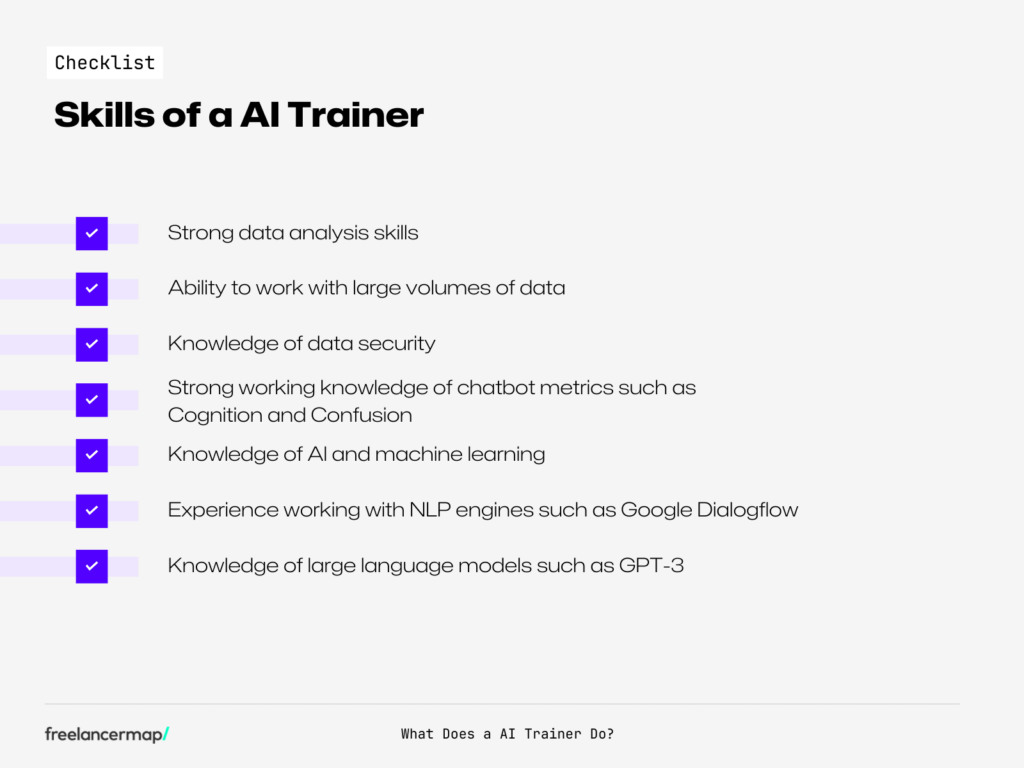
Becoming an effective AI Trainer requires more than just basic computer literacy. It demands a specific set of skills and a commitment to ongoing learning, given the dynamic nature of AI technology.
Technical Aptitude and Understanding
While AI Trainers may not be building AI models from scratch, they need a solid understanding of how these models work and what kind of data they require. This includes grasping fundamental concepts like machine learning algorithms, neural networks, and the data pipelines involved in AI development. They must be comfortable with various data formats, data management tools, and potentially scripting languages (like Python) for data manipulation. An understanding of the specific domain the AI is being developed for – be it healthcare, finance, or e-commerce – is also highly beneficial. This domain knowledge allows them to make informed decisions about data labeling and to identify nuances that a general annotator might miss.
Domain Expertise and Contextual Understanding
The value of an AI Trainer is significantly amplified by their domain expertise. An AI Trainer working on a medical imaging AI will need a different set of skills and knowledge than one working on a legal document analysis AI. For example, a medical AI Trainer might need to understand different types of medical scans, anatomical structures, and common pathologies. This allows them to accurately label abnormalities and provide contextual information that the AI can learn from. Similarly, an AI Trainer for a financial fraud detection system would need to understand financial transactions, account types, and common fraud patterns. This contextual understanding ensures that the labels are not just accurate but also semantically rich, leading to more robust and intelligent AI.
Attention to Detail and Quality Assurance
Accuracy is the cornerstone of an AI Trainer’s work. Even minor errors in data labeling can have significant downstream consequences, leading to biased outcomes, incorrect predictions, or even safety risks. Therefore, AI Trainers must possess an exceptional level of attention to detail. They are responsible for ensuring the quality and consistency of the annotated data. This often involves developing and adhering to strict labeling guidelines, performing self-checks, and participating in peer reviews or quality assurance processes. They act as the first line of defense against data errors, safeguarding the integrity of the AI model’s learning process.
Collaboration and Communication
AI Trainers rarely work in isolation. They are an integral part of a larger AI development team, which typically includes data scientists, machine learning engineers, and project managers. Effective collaboration and communication are essential. AI Trainers need to be able to clearly articulate any challenges they encounter during the annotation process, ask clarifying questions about labeling requirements, and provide feedback on the AI model’s performance based on their data expertise. This bidirectional communication ensures that the data annotation efforts are aligned with the overall project goals and that any issues with the data or the AI’s learning can be quickly addressed.
The Evolution of AI Training: From Manual Labor to Sophisticated Tools
The role of an AI Trainer has evolved significantly as AI technology has matured. Initially, much of the data annotation was a labor-intensive, manual process. However, with the increasing demand for data and the drive for efficiency, sophisticated tools and methodologies have emerged.
Traditional Data Annotation Processes
In the early days of AI development, data annotation was often performed by dedicated teams using spreadsheets, basic drawing tools, or custom-built interfaces. This involved individuals meticulously reviewing data points and assigning labels based on predefined criteria. While effective, this approach was time-consuming and could be prone to human error and inconsistencies, especially for large-scale projects. The scalability of these traditional methods was a major limitation as AI projects grew in complexity and data volume.
AI-Assisted Annotation and Active Learning
To address the limitations of purely manual annotation, AI-assisted annotation tools have become commonplace. These tools leverage pre-trained AI models to suggest labels or identify data points that are likely to be most informative for training. For instance, an AI model might pre-label a batch of images, and the human AI Trainer’s role then shifts to reviewing and correcting these suggestions. This significantly speeds up the process and allows trainers to focus on more complex or ambiguous cases.
Active learning is another advanced technique where the AI system intelligently selects the most valuable data points to be labeled by humans, thereby optimizing the training process. This “smart” data selection ensures that the AI learns from the most impactful examples, rather than passively consuming vast amounts of data. The AI Trainer plays a crucial role in guiding and validating the active learning process, ensuring that the selected data truly contributes to improved model performance.

The Future of AI Training: Specialization and Ethics
As AI continues to permeate more aspects of our lives, the role of the AI Trainer is likely to become even more specialized and critically important. We can anticipate:
- Increased demand for specialized domain experts: As AI tackles increasingly complex problems, the need for trainers with deep knowledge in niche fields (e.g., astrophysics, molecular biology, quantum computing) will grow.
- Emphasis on ethical AI training: With growing concerns about AI bias and fairness, AI Trainers will be at the forefront of ensuring that training data is representative, inclusive, and free from discriminatory patterns. This will involve developing new strategies for bias detection and mitigation.
- Development of AI Trainer tools and platforms: The market for sophisticated AI training platforms is expanding, offering integrated solutions for data management, annotation, quality control, and collaboration, further empowering AI Trainers.
- Bridging the gap with AI ethics specialists: AI Trainers will work more closely with AI ethics specialists to identify and address potential ethical pitfalls embedded within datasets and labeling practices.
In conclusion, the AI Trainer is an indispensable professional in the modern technological ecosystem. They are the meticulous architects of the data that breathes intelligence into AI systems, ensuring that these powerful tools are not only functional but also accurate, reliable, and aligned with human values. Their role, while often behind the scenes, is fundamental to unlocking the true potential of artificial intelligence.
aViewFromTheCave is a participant in the Amazon Services LLC Associates Program, an affiliate advertising program designed to provide a means for sites to earn advertising fees by advertising and linking to Amazon.com. Amazon, the Amazon logo, AmazonSupply, and the AmazonSupply logo are trademarks of Amazon.com, Inc. or its affiliates. As an Amazon Associate we earn affiliate commissions from qualifying purchases.