
In the dynamic landscape of digital communication, where every word, phrase, and sentence carries weight, understanding the nuances of language is paramount. For professionals navigating the tech industry, whether crafting compelling marketing copy, optimizing website content for search engines, or even developing AI-driven language models, a firm grasp of grammatical structures is not just a matter of correctness, but a strategic advantage. Among these structures, adverbial clauses play a crucial role in adding depth, clarity, and specificity to our written and spoken words. This article delves into the essence of adverbial clauses, exploring their function, types, and indispensable role in contemporary tech-focused communication and AI development.
The Foundational Role of Adverbial Clauses in Adding Context
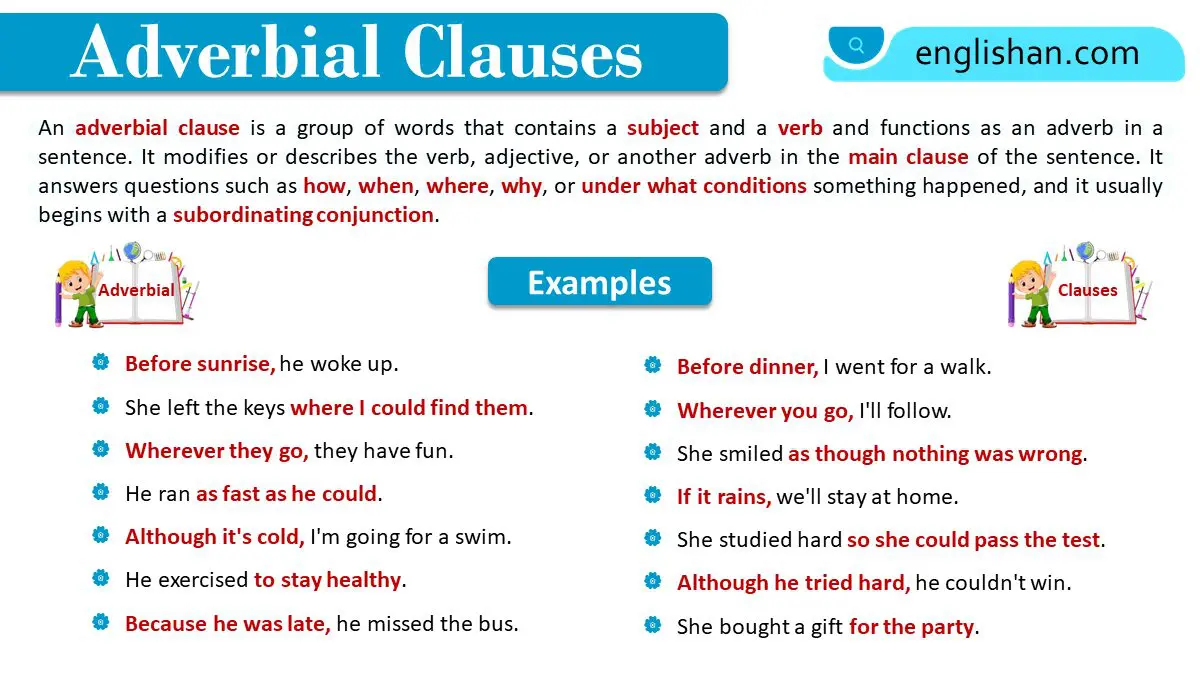
At its core, an adverbial clause is a dependent clause that functions as an adverb. This means it modifies a verb, an adjective, or another adverb in the main clause, providing additional information about how, when, where, why, to what extent, or under what condition an action or state occurs. Unlike single adverbs, which are single words, adverbial clauses are groups of words that include a subject and a verb, but they cannot stand alone as a complete sentence. Their dependent nature means they rely on an independent clause to make complete sense.
Think of the independent clause as the main message, the core idea you want to convey. The adverbial clause then acts as a crucial supporting actor, enriching that message with vital context. In the fast-paced world of technology, where information needs to be precise and impactful, mastering the use of adverbial clauses allows for more sophisticated and effective communication. This precision is vital for everything from crafting user-friendly interfaces that guide users with clear instructions to developing algorithms that interpret and generate human-like text.
Distinguishing Adverbial Clauses from Other Clauses
Before diving deeper into adverbial clauses, it’s helpful to differentiate them from other types of dependent clauses. Noun clauses, for instance, function as nouns within a sentence, often acting as the subject, object, or complement. Adjective clauses (or relative clauses) function as adjectives, modifying nouns or pronouns. Adverbial clauses, by contrast, are exclusively adverbial in their function. They answer the same questions that single adverbs do, thereby providing temporal, causal, conditional, or concessive information.
For example, consider the sentence: “The software update will be released when it is fully tested.” Here, “when it is fully tested” is an adverbial clause because it tells us when the software update will be released. It modifies the verb “will be released.” If we were to say, “The software update that is fully tested will be released,” then “that is fully tested” would be an adjective clause modifying “software update.” Understanding this distinction is critical for structuring clear and unambiguous sentences, especially when dealing with technical documentation or product descriptions.
The Structural Components of an Adverbial Clause
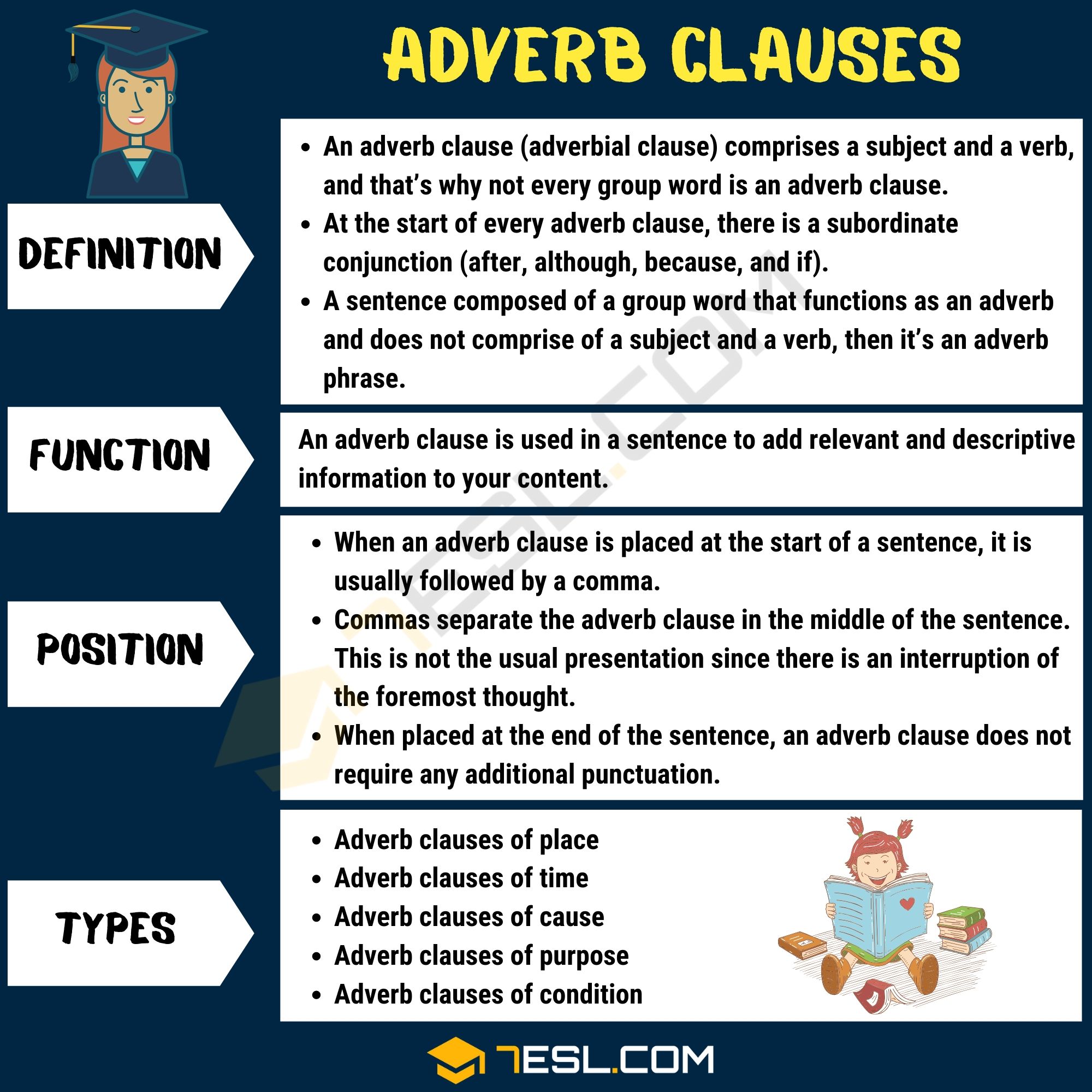
Every adverbial clause, despite its variety, is built upon a fundamental structure:
- Subordinating Conjunction: This is the key element that introduces the adverbial clause and signals its dependent status. Common subordinating conjunctions include when, while, since, before, after, until, if, unless, although, even though, because, so that, where, wherever.
- Subject: The clause will have its own subject, performing the action of the verb.
- Verb: The clause will contain a verb, expressing the action or state of being.
For instance, in the clause “Because the server was overloaded,” we have:
- Subordinating Conjunction: Because
- Subject: the server
- Verb: was overloaded
This clause cannot stand alone; it needs an independent clause to complete its meaning, such as “The website experienced slow loading times.” When combined, “Because the server was overloaded, the website experienced slow loading times,” the adverbial clause effectively explains why the website was slow.
Exploring the Diverse Functions of Adverbial Clauses
The true power of adverbial clauses lies in their ability to express a wide range of relationships, adding layers of meaning and sophistication to sentences. Recognizing these different types is essential for both effective writing and for understanding how information is structured in complex systems, such as those processed by AI.
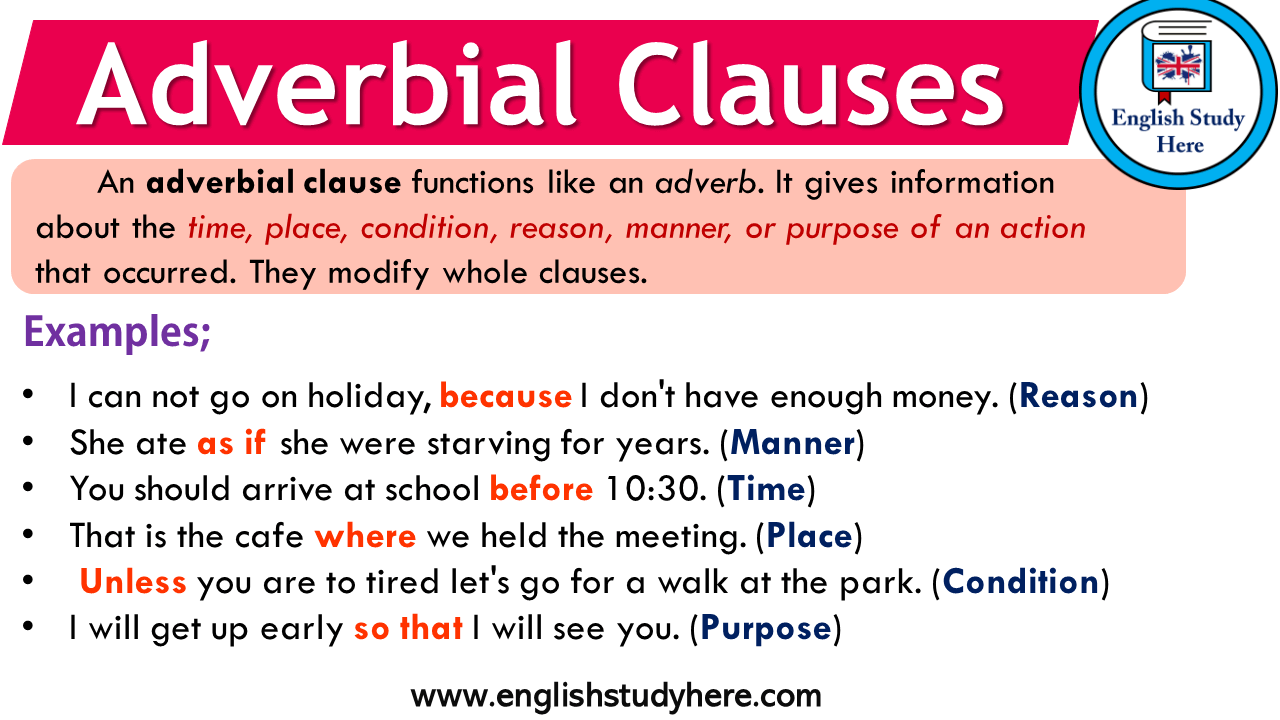
Clauses of Time: When and How Long
Adverbial clauses of time specify the temporal relationship between the action in the independent clause and the action in the dependent clause. They answer the question “When?” or “How long?”.
- Examples:
- “Before you launch the application, make sure to back up your data.” (Modifies “make sure” – specifies when)
- “The system will continue to monitor the network until the anomaly is resolved.” (Modifies “will continue to monitor” – specifies until when)
- “While the engineers are debugging the code, the marketing team is preparing the launch announcement.” (Modifies “is preparing” – specifies during what time)
- “We have been developing this feature since last quarter.” (Modifies “have been developing” – specifies how long)
In tech, clarity about timelines is critical. Whether it’s setting expectations for software releases, defining service level agreements (SLAs), or sequencing operational procedures, adverbial clauses of time provide the necessary precision. For AI, understanding temporal cues is fundamental for event sequencing, understanding narratives, and predicting future events.
Clauses of Place: Where and How Far
These clauses specify the location or direction of an action, answering the question “Where?”.
- Examples:
- “You can find the user manual wherever the software is installed.” (Modifies “can find” – specifies where)
- “The data will be stored wherever our security protocols dictate.” (Modifies “will be stored” – specifies where)
- “Place the new server wherever there is adequate ventilation.” (Modifies “Place” – specifies where)
Precise location information is vital in many tech applications, from geographical data processing and location-based services to network infrastructure management. AI systems that deal with spatial data rely heavily on understanding these locational relationships.
Clauses of Reason or Cause: Why
Adverbial clauses of reason explain the cause or purpose behind the action in the independent clause, answering the question “Why?”.
- Examples:
- “Because the algorithm proved inefficient, we are implementing a new machine learning model.” (Modifies “are implementing” – specifies why)
- “The system experienced a critical error since the database was corrupted.” (Modifies “experienced” – specifies why)
- “Users are encouraged to update their profiles so that they can receive personalized recommendations.” (Modifies “are encouraged to update” – specifies for what purpose)
Understanding cause and effect is a cornerstone of problem-solving in technology. From diagnosing bugs to optimizing performance, identifying the reasons behind an issue is paramount. In AI, causal reasoning is a highly sought-after capability.
Clauses of Condition: Under What Circumstances
These clauses set the conditions under which the action in the independent clause will occur or not occur, answering the question “Under what condition?”.
- Examples:
- “If the performance metrics improve, we will proceed with the product launch.” (Modifies “will proceed” – specifies the condition)
- “The security system will trigger an alert unless unauthorized access is detected.” (Modifies “will trigger” – specifies the condition for not triggering)
- “Even though the market is competitive, our innovative features give us an edge.” (Modifies “give us an edge” – specifies a concession, a type of condition)
Conditional logic is fundamental to programming and AI. From decision trees and rule-based systems to complex probabilistic models, understanding how to express conditions is critical for building intelligent and responsive systems.
Clauses of Concession: Despite What
These clauses introduce a contrast or a concession, indicating something that is true despite a potential counter-argument. They often begin with conjunctions like although, even though, though, while.
- Examples:
- “Although the initial development was challenging, the final product exceeded our expectations.” (Modifies “exceeded” – indicates a contrast)
- “The system is highly robust, even though it operates on legacy hardware.” (Modifies “is highly robust” – highlights resilience despite a challenge)
Concessive clauses add nuance and a sophisticated level of argumentation, important for detailed technical reports, comparative analyses, or persuasive technical writing.
Clauses of Purpose: For What Goal
These clauses indicate the purpose or goal of the action in the independent clause. They often begin with conjunctions like so that, in order that.
- Examples:
- “The developers are optimizing the code so that the application runs faster.” (Modifies “are optimizing” – states the purpose)
- “We implemented strict access controls in order that sensitive data remains secure.” (Modifies “implemented” – states the purpose)
Purpose-driven language is essential in technical specifications, project proposals, and any communication aimed at guiding action or explaining intent.
The Indispensable Value of Adverbial Clauses in the Tech Ecosystem
The application of adverbial clauses extends far beyond simple grammatical correctness; they are vital tools for effective communication and functionality within the tech industry. Their ability to add detail, qualify statements, and establish complex relationships makes them invaluable in a variety of tech-related contexts.
Enhancing Technical Documentation and User Guides
For any software, hardware, or service, clear and comprehensive documentation is non-negotiable. Adverbial clauses are instrumental in providing users with precise instructions, warnings, and explanations. They help to clarify when an action should be taken, why a particular setting is important, or under what conditions a feature will behave in a certain way.
- Example: “Press the power button after the system has fully booted to avoid data corruption.” Here, the adverbial clause “after the system has fully booted” provides a crucial temporal condition that prevents a user error. Without it, the instruction would be less precise and potentially lead to problems.
Optimizing Content for Search Engines (SEO)
Search engine optimization (SEO) relies heavily on understanding user intent and providing relevant, detailed information. Adverbial clauses, by adding context and answering the implicit questions users have, can significantly enhance the searchability of web content. When content naturally incorporates clauses that explain how, when, why, and where something is relevant, it signals to search engines a deeper understanding of the topic, potentially leading to higher rankings.
For instance, a blog post discussing a new AI tool would benefit from sentences like: “This AI tool can automate tasks when specific keywords are detected in documents,” or “Users can achieve faster results if they provide structured input data.” These clauses provide specific scenarios and conditions that potential users might be searching for.
Powering AI and Natural Language Processing (NLP)
The development and deployment of Artificial Intelligence, particularly in the field of Natural Language Processing (NLP), are heavily reliant on the ability to parse, understand, and generate human language. Adverbial clauses are fundamental building blocks that AI systems must recognize to grasp the full meaning of sentences.
- Understanding Nuance: AI needs to understand temporal relationships, causal links, conditional statements, and concessions to interpret context accurately. For example, differentiating between “He succeeded because he worked hard” (reason) and “Even though he worked hard, he didn’t succeed” (concession) requires the AI to correctly identify and process the introductory conjunctions and the overall structure of adverbial clauses.
- Generating Coherent Text: When AI systems generate text, they must employ adverbial clauses to create coherent, nuanced, and informative responses. The ability to add temporal, causal, or conditional information makes AI-generated content more human-like and useful. For instance, an AI chatbot might respond, “Because you mentioned the login error, I will guide you through the troubleshooting steps now.” This use of an adverbial clause establishes a clear connection between the user’s query and the AI’s response.
- Discourse Analysis: In complex applications like sentiment analysis, topic modeling, or summarization, understanding the relationships established by adverbial clauses is critical for accurate interpretation of longer texts.
Streamlining Software Development and Logic
The principles behind adverbial clauses are mirrored in software development. Conditional statements (if-then-else), loops that run for a specific duration (while loops), and event-driven programming all embody the concept of clauses modifying the execution or behavior of other parts of the program based on certain conditions, times, or reasons. Understanding grammatical clauses can even offer a different perspective on how to structure logical flows within code.
Mastering Adverbial Clauses for a Competitive Edge
In the competitive tech landscape, precision in communication and a sophisticated understanding of information structure are not optional; they are essential for success. Adverbial clauses, though a grammatical concept, play a vital role in achieving this precision, whether you are crafting user manuals, optimizing web content, or developing the next generation of AI.
By diligently learning to identify, construct, and effectively employ adverbial clauses, professionals in the tech industry can elevate their communication, improve the clarity and effectiveness of their digital assets, and contribute to the advancement of intelligent systems. The ability to convey nuanced meaning – the “how,” “when,” “where,” “why,” and “under what condition” – is a hallmark of sophisticated technical communication and a fundamental component of intelligent language processing. As technology continues to evolve, so too does the importance of mastering the language that powers it.
aViewFromTheCave is a participant in the Amazon Services LLC Associates Program, an affiliate advertising program designed to provide a means for sites to earn advertising fees by advertising and linking to Amazon.com. Amazon, the Amazon logo, AmazonSupply, and the AmazonSupply logo are trademarks of Amazon.com, Inc. or its affiliates. As an Amazon Associate we earn affiliate commissions from qualifying purchases.