
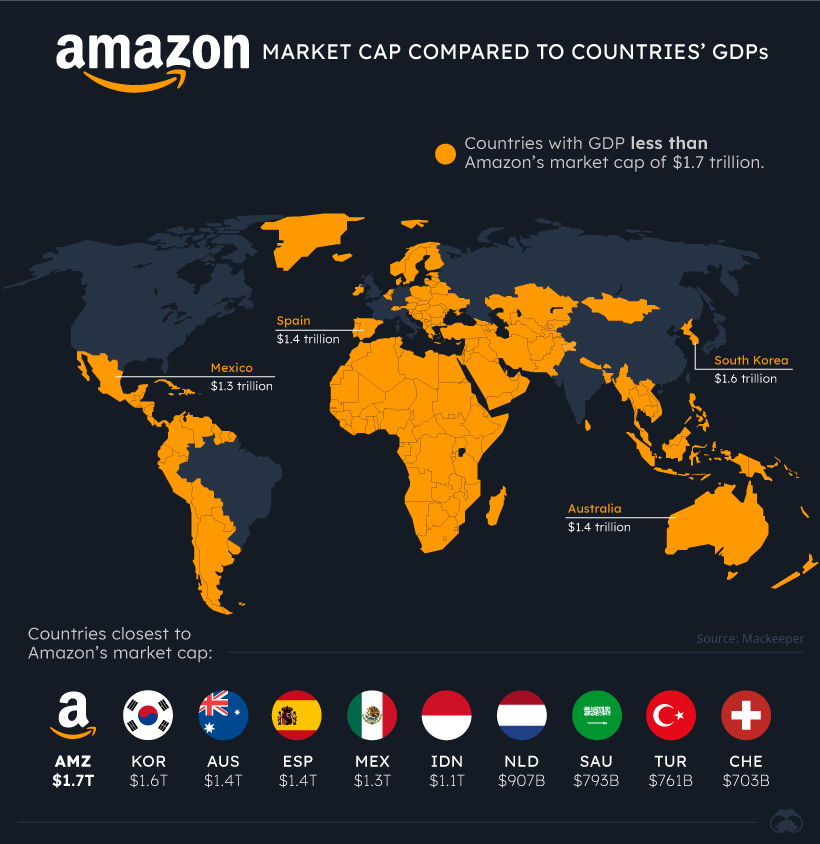
In the world of global finance and retail, few metrics are as scrutinized as market capitalization. For Amazon.com, Inc., market capitalization is more than just a number on a ticker tape; it is a reflection of investor confidence, a benchmark of corporate scale, and a primary indicator of the company’s dominance across multiple industries. As one of the elite members of the “trillion-dollar club,” Amazon’s market cap serves as a barometer for the broader tech sector and the health of the global consumer economy. To understand what Amazon’s market cap truly represents, one must look beyond the current stock price and examine the intricate mechanics of valuation, business segment performance, and the macroeconomic forces that dictate how much the world’s largest online retailer is worth.
Defining Market Capitalization: The Core Metric of Corporate Value
Market capitalization, or “market cap,” is the total dollar market value of a company’s outstanding shares of stock. It is the most common method used by the investment community to determine a company’s size as opposed to using total sales or total asset figures. For a behemoth like Amazon, this figure is calculated by multiplying the current market price of one share by the total number of outstanding shares.
The Calculation Formula and Investor Perception
The formula is deceptively simple: Market Cap = Current Share Price × Total Number of Shares Outstanding. However, the implications of this number are vast. Investors use market cap to categorize companies into different tiers: large-cap, mid-cap, and small-cap. Amazon falls into the “mega-cap” category, representing companies with a market value of $200 billion or more.
Being a mega-cap stock changes how Amazon is treated in the financial markets. It is a staple in major indices like the S&P 500 and the Nasdaq-100. This means that when institutional investors or exchange-traded funds (ETFs) buy into these indices, they are automatically buying large portions of Amazon, providing a level of liquidity and stability that smaller companies rarely enjoy. The market cap reflects the collective “wisdom of the crowd,” factoring in everything from quarterly earnings to long-term growth prospects.
Why Market Cap Matters to the Individual Investor
For the individual investor, Amazon’s market cap is a tool for risk assessment and portfolio diversification. Generally, mega-cap companies are seen as more stable and less volatile than smaller firms, though they may offer slower growth rates compared to high-risk startups. However, Amazon has consistently defied this “slow growth” stereotype, maintaining double-digit growth rates long after reaching a trillion-dollar valuation. Understanding the market cap helps an investor understand how much “room” a company has to grow. If a company already has a market cap of $2 trillion, doubling its value requires a massive amount of capital and innovation, a feat much harder than a $2 billion company doubling its size.
Analyzing Amazon’s Financial Evolution and Valuation Trajectory
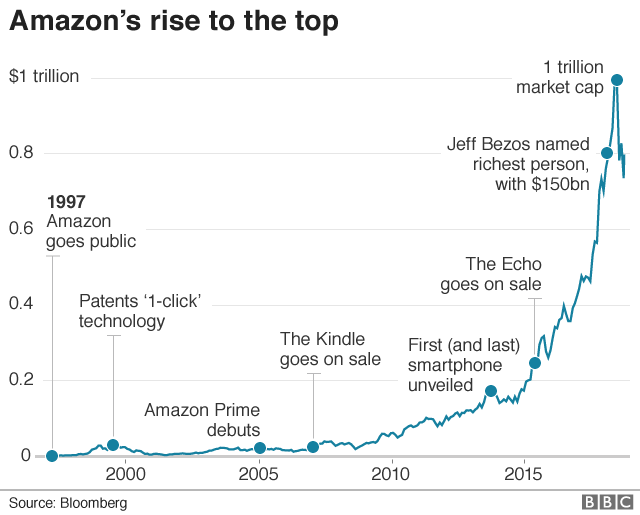
Amazon’s journey to its current market cap is one of the most storied transformations in business history. Starting as an online bookstore in 1894, the company went public in 1997 with a market cap of roughly $438 million. Today, that figure has grown by thousands of percentage points, driven by a relentless pursuit of “Day 1” philosophy—a mindset of constant innovation and customer obsession.
From Online Bookstore to Global Infrastructure
The growth of Amazon’s market cap can be mapped to its diversification. In the early 2000s, the market cap reflected its potential as a dominant e-commerce player. As it introduced Amazon Prime, the market began to price in the value of recurring revenue and customer loyalty. The “Prime Effect” locked consumers into an ecosystem, making Amazon’s revenue streams more predictable and, consequently, more valuable to investors. This predictability often results in a higher Price-to-Earnings (P/E) ratio, further inflating the market cap compared to traditional retailers like Walmart or Target.
The Role of AWS in Driving Market Value
Perhaps the most significant driver of Amazon’s trillion-dollar valuation is Amazon Web Services (AWS). While the retail side of the business generates the most revenue, AWS generates the lion’s share of the operating profit. Investors value cloud computing revenue differently than retail revenue because the margins in the cloud are significantly higher.
When analysts look at Amazon’s market cap, they often use a “sum-of-the-parts” valuation. They might value the retail business at a certain multiple of sales and the AWS business at a much higher multiple of earnings. Because AWS is a leader in the global cloud infrastructure market, it provides a “valuation floor” for Amazon. Even during periods of retail stagnation, the growth and profitability of AWS have historically supported or propelled the company’s total market capitalization.
Factors That Influence Amazon’s Market Cap Fluctuations

Amazon’s market cap is not a static figure; it fluctuates every second the stock market is open. These movements are dictated by a complex interplay of internal performance and external economic factors.
Quarterly Earnings and Revenue Guidance
The most immediate impact on market cap comes from quarterly earnings reports. Investors look at Key Performance Indicators (KPIs) such as Net Sales, Operating Income, and Free Cash Flow. If Amazon beats analyst expectations for revenue or provides “bullish” (optimistic) guidance for the upcoming quarter, the stock price usually rises, instantly adding billions of dollars to the market cap. Conversely, even if the company is profitable, a slowdown in the growth rate of AWS or a dip in consumer spending can lead to a “sell-off,” erasing significant market value in a single day.
Macroeconomic Trends and Interest Rates
As a growth-oriented tech giant, Amazon is highly sensitive to interest rates set by the Federal Reserve. When interest rates rise, the “discount rate” applied to future cash flows also rises. Since a large portion of Amazon’s valuation is based on profits expected years into the future, higher rates make those future dollars less valuable today. This is why many tech stocks, including Amazon, saw their market caps contract during the inflationary periods of 2022 and 2023. Additionally, as a global retailer, Amazon’s valuation is tied to the strength of the U.S. dollar and global supply chain stability.
Competitive Positioning and Regulatory Scrutiny
The market also prices in “regulatory risk.” Amazon’s massive market cap makes it a target for antitrust investigations in the United States and the European Union. Concerns about the company’s dominance in third-party marketplaces or its data collection practices can act as a “drag” on the market cap. Investors must weigh the company’s growth potential against the possibility of fines or forced divestitures.
Market Cap vs. Enterprise Value: A Deeper Dive for Investors
While market cap is the most popular metric, sophisticated investors often look at Enterprise Value (EV) to get a more accurate picture of what it would cost to “buy” the company. Enterprise Value is calculated as Market Cap + Total Debt – Cash and Cash Equivalents.
Assessing Debt and Cash Reserves
Amazon carries a significant amount of debt, often used to fund its massive logistics network and data centers. However, it also maintains substantial cash reserves. By looking at the relationship between market cap and enterprise value, investors can determine if the company is over-leveraged. For Amazon, the market cap usually represents the majority of its enterprise value, indicating that the market values its equity much more highly than its debt obligations.
Identifying “Fair Value”
Market cap alone doesn’t tell an investor if a stock is cheap or expensive. To determine that, investors compare market cap to other fundamentals. For instance, the Market Cap-to-Sales ratio or the Market Cap-to-Free Cash Flow ratio. Amazon has historically traded at a high Market Cap-to-Earnings ratio because the company chooses to reinvest its profits back into the business rather than showing high net income. This strategy of “delayed profitability” has been a hallmark of Amazon’s financial identity, asking investors to value the company based on its future scale rather than current dividends.
Future Outlook: What Will Drive Amazon’s Next Valuation Milestone?
As Amazon looks toward the future, its market cap will likely be influenced by its ability to integrate new technologies and penetrate untapped markets. The company is no longer just a “store”; it is a logistics company, an advertising giant, and an AI powerhouse.
Artificial Intelligence and the Next Cloud Frontier
Generative AI represents the next major catalyst for AWS. As businesses seek to build their own AI models, they require the massive computing power that only a few companies, including Amazon, can provide. If Amazon can position AWS as the preferred infrastructure for the AI revolution, its market cap could see a significant expansion, similar to the growth seen during the initial shift to the cloud in the early 2010s.
Expansion into Healthcare and Physical Logistics
Amazon’s ventures into healthcare (via Amazon Clinic and One Medical) and its continued expansion into third-party logistics (offering its delivery network to non-Amazon shippers) represent new avenues for revenue. Each of these sectors has a “Total Addressable Market” (TAM) in the trillions of dollars. If Amazon can successfully capture even a small percentage of these markets, the resulting revenue growth will be reflected in an ever-increasing market capitalization.
In conclusion, Amazon’s market cap is a multifaceted indicator that encapsulates the company’s historical success, its current operational efficiency, and its future potential. For anyone involved in the world of money and investing, monitoring this figure is essential. It is not just a measure of how big Amazon is today, but a moving target that reflects the global economy’s transition toward a digital-first, AI-driven future. Whether you are a retail investor or a financial analyst, understanding the components that build and break this valuation is key to navigating the modern financial landscape.
aViewFromTheCave is a participant in the Amazon Services LLC Associates Program, an affiliate advertising program designed to provide a means for sites to earn advertising fees by advertising and linking to Amazon.com. Amazon, the Amazon logo, AmazonSupply, and the AmazonSupply logo are trademarks of Amazon.com, Inc. or its affiliates. As an Amazon Associate we earn affiliate commissions from qualifying purchases.