
In the world of global finance, few tickers command as much attention as AMZN. For investors, the question of Amazon’s current stock price is never just about a singular numerical value displayed on a trading terminal; it is a complex reflection of global consumer health, the progression of cloud computing, and the shifting landscape of artificial intelligence. Understanding where Amazon stands today requires a multifaceted look at its historical trajectory, its fundamental valuation metrics, and the macroeconomic forces that dictate its daily fluctuations.
As of the current market cycle, Amazon remains a cornerstone of the “Magnificent Seven,” a group of high-performing tech and growth stocks that drive much of the S&P 500’s momentum. However, unlike the early days of the dot-com era, Amazon’s stock price today is anchored by massive cash flows and a diversified ecosystem that spans far beyond its original identity as an online bookstore.

The Anatomy of Amazon’s Market Value
The nominal price of an Amazon share is a snapshot of collective investor sentiment. To understand this price, one must first look at the 20-for-1 stock split that occurred in mid-2022. Before this split, a single share of Amazon traded in the thousands of dollars, making it inaccessible to many retail investors without the use of fractional shares. The split brought the price down to a more “digestible” range, significantly increasing liquidity and making it easier for individual investors to participate in the company’s growth.
Real-Time Fluctuations and Market Sentiment
Stock prices are driven by the constant tug-of-war between bulls and bears. When you observe Amazon’s current price, you are seeing the market’s immediate reaction to a variety of signals. This includes quarterly earnings reports, changes in consumer spending habits, and even broader geopolitical stability. For a company of Amazon’s scale, even a minor change in the Federal Reserve’s interest rate policy can cause a multi-billion dollar swing in market capitalization. Because growth stocks are valued based on the present value of future cash flows, higher interest rates often act as a gravity-like force on the stock price, while cooling inflation and lower rates tend to act as a catalyst for price appreciation.
The Significance of Market Capitalization
While the share price tells you the cost of one unit of ownership, the market capitalization tells you the total value the market assigns to the entire enterprise. Amazon consistently sits in the elite trillion-dollar club. For investors, monitoring the stock price in relation to this market cap is vital. It helps in assessing whether the company is overvalued or undervalued relative to its peers like Microsoft, Alphabet, and Walmart.
Core Pillars Driving the Stock’s Performance
To understand why Amazon’s stock price is at its current level, we must dissect the business units that generate its revenue. The price is not merely a reflection of retail sales; it is a weighted average of three distinct, yet interconnected, business engines.
Amazon Web Services (AWS) as a Profit Engine
AWS is arguably the most significant factor in Amazon’s valuation. As the world’s leading cloud infrastructure provider, AWS accounts for a disproportionate share of the company’s operating income. Investors watch AWS growth rates with a microscope. If AWS shows signs of acceleration, the stock price usually responds with a bullish move. This is because cloud services offer high margins and recurring revenue—qualities that investors are willing to pay a premium for. In the current environment, the integration of Generative AI into AWS services has become a primary driver for the stock, as enterprises look to Amazon to provide the computing power necessary for the next technological revolution.
E-commerce Resilience and Logistics Optimization
The retail segment remains the face of the company. However, the market’s view of Amazon retail has shifted from “growth at any cost” to “efficiency and profitability.” Following a massive expansion of its fulfillment network during the pandemic, Amazon has spent the last several years refining its logistics to lower the “cost to serve.” When the stock price rises despite a cooling economy, it is often because Amazon has demonstrated an ability to improve its retail margins through automation and regionalization of its shipping hubs.
The Growing Dominance of Digital Advertising
A relatively new but powerful contributor to the stock price is Amazon’s advertising business. By leveraging its vast repository of first-party consumer data, Amazon has built an advertising juggernaut that rivals Google and Meta. Because advertising carries significantly higher margins than selling physical goods, this segment has become a favorite metric for Wall Street analysts. A robust growth rate in ad revenue often justifies a higher Price-to-Earnings (P/E) ratio, pushing the current stock price higher.
Financial Metrics: Beyond the Share Price
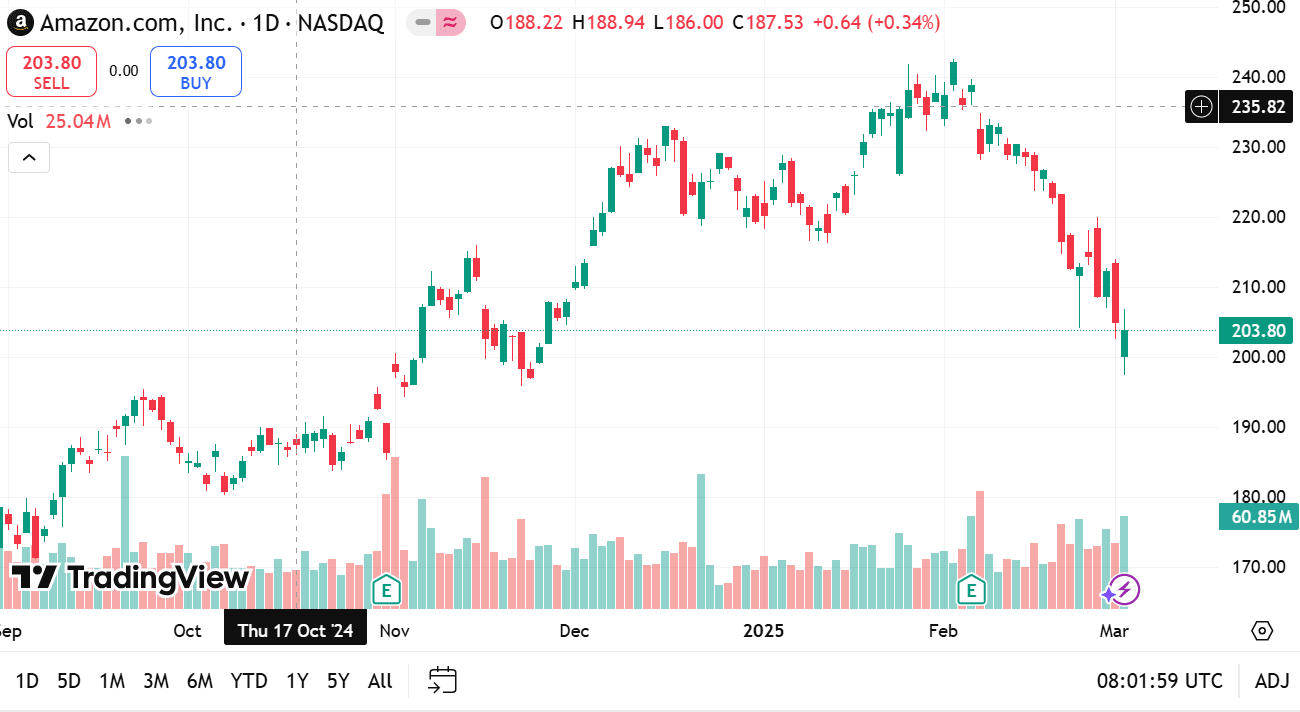
An informed investor looks past the ticker symbol and into the balance sheet. To determine if the current stock price represents a “buy” or a “sell,” several key financial metrics must be considered.
Analyzing the Price-to-Earnings (P/E) Ratio
Amazon has historically traded at a high P/E ratio compared to the broader market. This is because the company aggressively reinvests its profits back into the business, which keeps the “earnings” portion of the ratio lower than it otherwise would be. However, as the company matures, investors are beginning to look for more traditional earnings growth. Monitoring the forward P/E ratio allows investors to see how much they are paying for every dollar of expected future profit.
Free Cash Flow: The Ultimate Health Indicator
For many years, founder Jeff Bezos emphasized that “free cash flow per share” was the most important metric for the company. This remains true today. Free cash flow (FCF) is the cash a company generates after accounting for cash outflows to support operations and maintain its capital assets. A stock price that rises alongside growing FCF is generally considered a sustainable trend. Conversely, if the stock price rises while FCF is shrinking, it may be a sign of a speculative bubble.
Operating Margins and Revenue Growth
In the “Money” niche, we focus on the efficiency of capital. Amazon’s ability to expand its operating margins—especially in its North American and International retail segments—is a major catalyst for share price appreciation. Revenue growth is also a key metric, but in the current market, “quality of revenue” often matters more than top-line numbers. High-margin revenue from services and subscriptions is valued more highly than low-margin revenue from direct product sales.
Strategic Outlook: Why the Stock Price Moves
The current price of Amazon is never static because the future is never certain. Investors are constantly pricing in what they believe will happen six to twelve months from now.
The AI Arms Race and Generative Integration
The current buzz in the financial markets is centered on Artificial Intelligence. Amazon’s stock price is heavily influenced by how well the market perceives its AI strategy. From Bedrock to custom-designed chips like Trainium and Inferentia, Amazon is positioning itself as the “picks and shovels” provider for the AI era. If Amazon can prove it is not falling behind competitors like Microsoft and Google in the AI race, its stock price is likely to maintain a premium valuation.
Macroeconomic Headwinds and Regulatory Challenges
No analysis of Amazon’s stock price is complete without considering the risks. Antitrust scrutiny from the FTC and international regulatory bodies remains a persistent “overhang” on the stock. Any news suggesting a potential breakup of the company or significant changes to its business model can lead to immediate price volatility. Furthermore, as a consumer-facing company, Amazon is sensitive to inflation. When the cost of goods and labor rises, it can squeeze margins, leading to a downward revision of the stock’s value.
Investing in Amazon: Practical Strategies for the Modern Portfolio
For those looking at the current stock price with an eye toward investing, strategy is paramount. Amazon is often viewed as a “core” holding, but how one enters the position matters.
Long-term Growth vs. Short-term Volatility
Amazon is rarely a “get rich quick” trade in the modern era. Instead, it is a long-term compounder. Investors who focus on the daily price movements often fall prey to emotional trading. Professional wealth managers often suggest looking at the stock in three-to-five-year horizons. The current price may seem high today, but in the context of a decade of growth, it may appear as a reasonable entry point.

Dollar-Cost Averaging (DCA) and Fractional Shares
Because Amazon’s stock price can still be significant for some budgets, Dollar-Cost Averaging is a popular strategy. By investing a fixed dollar amount at regular intervals, an investor buys more shares when the price is low and fewer when the price is high. This mitigates the risk of “timing the market” poorly. With the advent of modern brokerage tools, even investors with small amounts of capital can own a piece of Amazon through fractional shares, allowing them to build a position regardless of the nominal stock price.
In conclusion, while the question “what is Amazon’s current stock price” can be answered with a quick search, the meaning behind that price is found in the company’s ability to innovate, its dominance in cloud computing, and its relentless pursuit of operational efficiency. For the disciplined investor, the current price is simply a starting point for a deeper conversation about value, growth, and the future of the global economy.
aViewFromTheCave is a participant in the Amazon Services LLC Associates Program, an affiliate advertising program designed to provide a means for sites to earn advertising fees by advertising and linking to Amazon.com. Amazon, the Amazon logo, AmazonSupply, and the AmazonSupply logo are trademarks of Amazon.com, Inc. or its affiliates. As an Amazon Associate we earn affiliate commissions from qualifying purchases.