
Amazon.com Inc. (AMZN) is more than just an e-commerce giant; it’s a multifaceted technology and logistics behemoth whose stock price is a constant subject of fascination for investors worldwide. As one of the most prominent components of the S&P 500 and Nasdaq 100 indices, Amazon’s share performance offers a microcosm of broader market trends, technological innovation, and consumer behavior. Understanding “what is Amazon stock price” goes beyond merely checking a ticker; it requires delving into the company’s vast operations, financial health, market sentiment, and the macroeconomic forces that shape its valuation.
At any given moment, Amazon’s stock price reflects the collective sentiment and expectations of millions of investors regarding the company’s future earnings and growth prospects. It’s a dynamic figure, fluctuating second by second during trading hours, influenced by a torrent of news, analyst reports, economic data, and even algorithmic trading. For both seasoned institutional investors and individual retail traders, comprehending the drivers behind AMZN’s valuation is crucial for informed decision-making.
Understanding Amazon (AMZN) Stock: A Market Giant
Amazon’s journey from an online bookseller to a global powerhouse is one of the most compelling narratives in modern business history. Its stock price reflects this incredible growth trajectory, representing a piece of a company that has redefined multiple industries.
Amazon’s Business Model and Dominance
Amazon’s vast enterprise is underpinned by several core business segments, each contributing significantly to its revenue and profitability. The primary drivers are:
- E-commerce: Its foundational segment, encompassing online retail sales, third-party seller services, and subscriptions (like Amazon Prime). This segment continues to leverage vast logistics networks and customer loyalty.
- Amazon Web Services (AWS): The world’s leading cloud computing platform, providing on-demand cloud services to individuals, companies, and governments. AWS is a high-margin business segment and a significant profit engine for Amazon.
- Advertising: Amazon has rapidly grown into a major player in digital advertising, leveraging its vast trove of customer shopping data to offer highly targeted ad placements on its e-commerce platform and beyond.
- Other Ventures: This includes emerging areas like healthcare (Amazon Pharmacy, One Medical), satellite internet (Project Kuiper), physical stores (Whole Foods Market, Amazon Go), and entertainment (Prime Video, Amazon Music, Twitch).
This diversified and interconnected business model provides multiple avenues for growth, but also exposes the company to various competitive pressures and regulatory scrutiny. The market constantly assesses how well Amazon is executing across these segments and innovating for future expansion, directly impacting its stock price.
Historical Performance at a Glance
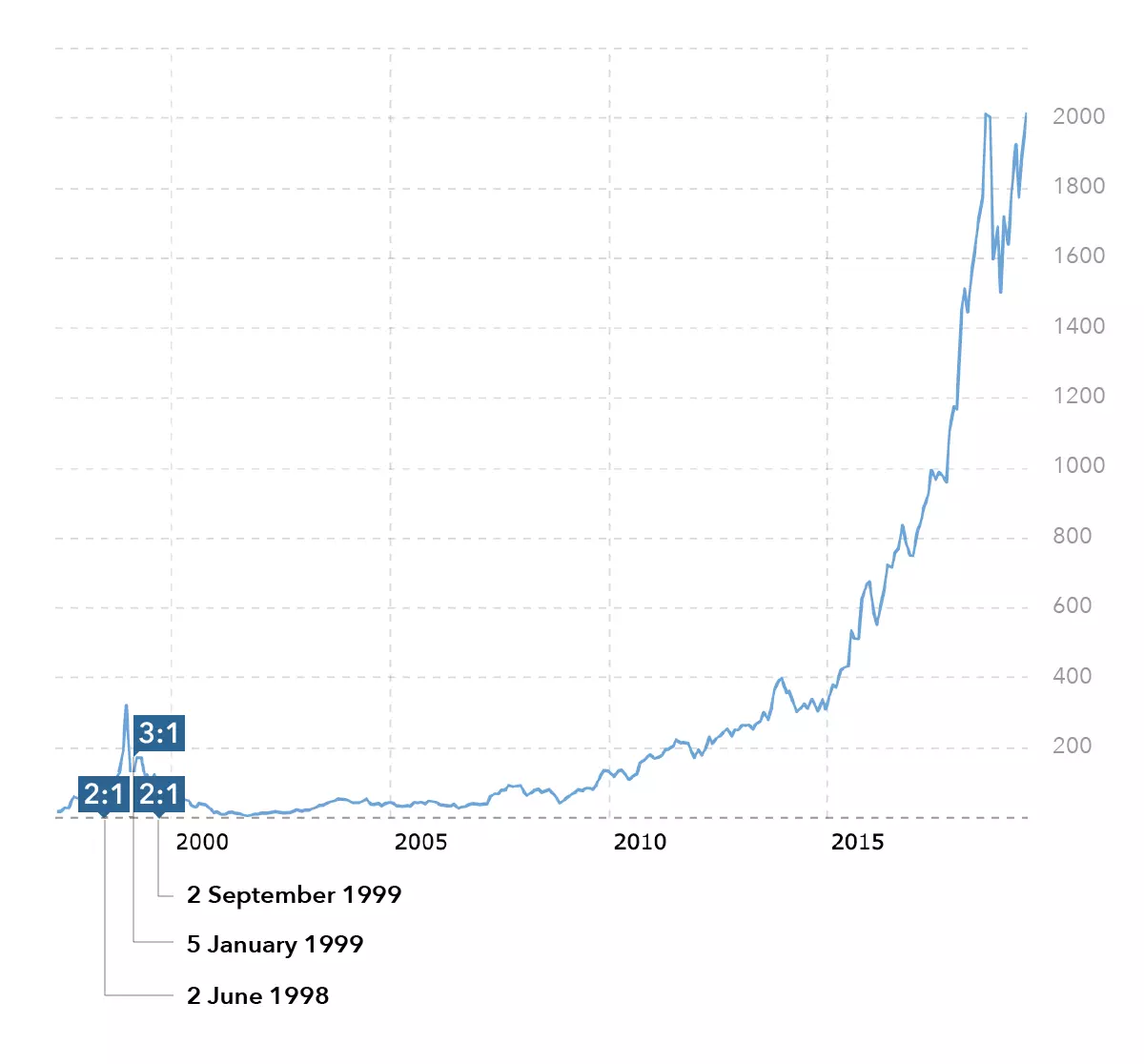
Amazon’s stock has been a phenomenal performer over the long term, creating immense wealth for early investors. Since its IPO in 1997 at $18 per share (pre-splits), AMZN has undergone multiple stock splits, making direct historical comparisons complex without adjustment. However, its overall trajectory has been upward, driven by relentless innovation, market dominance, and strategic investments. Periods of rapid ascent have often been followed by consolidations or pullbacks, characteristic of high-growth technology stocks. These fluctuations are influenced by economic cycles, competitive dynamics, and investor sentiment shifts. Understanding this historical volatility is essential for new investors to set realistic expectations.
Key Factors Influencing AMZN’s Value
Many variables converge to determine Amazon’s stock price at any given moment. These can broadly be categorized into internal (company-specific) and external (market/macroeconomic) factors.
Internally, factors such as quarterly earnings reports, revenue growth in key segments like AWS and advertising, profitability margins, new product launches, strategic acquisitions, and leadership changes can significantly move the stock. Externally, interest rate changes, inflation data, consumer spending trends, unemployment rates, regulatory developments, and broader market sentiment towards technology stocks all play a role. Investors are continuously weighing these factors to project Amazon’s future cash flows and inherent value.
Decoding the Dynamics of AMZN’s Stock Price
The daily ebb and flow of Amazon’s stock price are a consequence of complex interactions between micro and macroeconomic forces. Understanding these dynamics is key to anticipating potential movements and evaluating investment opportunities.
Macroeconomic Influences
Broader economic conditions exert significant pressure on Amazon’s valuation.
- Interest Rates and Inflation: Higher interest rates generally make future earnings less valuable in present terms, often negatively impacting growth stocks like Amazon, which derive much of their valuation from projected future growth. Inflation can impact consumer spending power and increase Amazon’s operational costs.
- Consumer Spending and Economic Growth: As a dominant retailer, Amazon’s performance is closely tied to consumer health. Strong economic growth and robust consumer spending typically translate to higher sales for Amazon’s e-commerce and advertising segments. Conversely, economic slowdowns or recessions can lead to reduced discretionary spending and impact the stock.
- Global Supply Chains: Amazon’s vast logistical network makes it particularly sensitive to global supply chain disruptions. Issues like port congestion, labor shortages, or geopolitical events can increase costs, delay deliveries, and impact profitability, thereby affecting the stock price.
Company-Specific Catalysts and Headwinds
Beyond the macro landscape, specific events and developments within Amazon itself are potent drivers of its stock price.
- Earnings Reports and Guidance: Quarterly earnings announcements are perhaps the most significant short-term catalyst. Exceeding or missing analyst expectations for revenue, earnings per share (EPS), and future guidance can lead to dramatic stock movements. Investors scrutinize not just headline numbers but also segment-specific performance (e.g., AWS growth) and profitability trends.
- New Product/Service Launches: Innovations like new Alexa devices, advancements in Prime benefits, or expansion into new market segments (e.g., healthcare) can generate excitement and positively impact the stock by signaling future growth avenues.
- Regulatory Scrutiny and Antitrust Concerns: Given its market dominance, Amazon faces ongoing regulatory challenges globally. Potential antitrust actions, new data privacy laws, or increased taxation could pose significant headwinds by limiting growth or increasing operational costs.
- Executive Leadership and Strategic Shifts: Changes in top leadership or significant shifts in corporate strategy can also influence investor confidence and, consequently, the stock price.
Sector Trends and Competitive Landscape
Amazon operates in highly competitive sectors. Its stock price is influenced by how it stacks up against rivals and broader industry trends.
- E-commerce Competition: While dominant, Amazon faces fierce competition from Walmart, Target, eBay, and a myriad of specialized online retailers. The ability to maintain market share and innovate in delivery, pricing, and customer experience is critical.
- Cloud Computing Rivalry: AWS, while a leader, competes vigorously with Microsoft Azure, Google Cloud, and other providers. Its growth rate and profitability relative to competitors are closely watched.
- Advertising Market Share: Amazon’s advertising business competes with Google and Meta for digital ad spend. Its continued expansion in this area is a significant growth driver.
- Technological Shifts: Amazon’s ability to adapt to and lead technological shifts (e.g., AI integration, autonomous delivery) is crucial for its long-term viability and stock performance.
How Investors Track and Analyze AMZN Stock
For anyone looking to invest in or understand Amazon stock, various analytical approaches are employed to assess its value and predict future movements.

Fundamental Analysis: Earnings, Revenue, and Profitability
Fundamental analysis involves evaluating a company’s financial health, management, and industry to determine its intrinsic value. For Amazon, this includes:
- Revenue Growth: Examining sales across its diverse segments, particularly the high-margin AWS and advertising units. Consistent, strong revenue growth is a hallmark of a thriving company.
- Profitability Metrics: Analyzing net income, operating income, and profit margins. Despite its growth focus, Amazon’s increasing profitability, especially from AWS, is a key indicator of its maturing business model.
- Cash Flow: Assessing free cash flow (FCF) provides insight into how much cash the company generates after covering capital expenditures. Positive and growing FCF is vital for reinvestment, debt repayment, and potential shareholder returns (though Amazon currently does not pay a dividend).
- Balance Sheet Health: Reviewing assets, liabilities, and equity to understand the company’s financial stability and leverage.
- Valuation Ratios: Comparing Amazon’s price-to-earnings (P/E), price-to-sales (P/S), and enterprise value-to-EBITDA (EV/EBITDA) ratios against its historical averages and industry peers. Given Amazon’s historical growth profile, traditional P/E ratios have often been high, requiring investors to consider growth-adjusted metrics like PEG ratios.
Technical Analysis: Chart Patterns and Indicators
Technical analysis focuses on historical price and volume data to predict future price movements. While fundamentalists focus on “what” to buy, technical analysts focus on “when” to buy or sell. For AMZN stock, this might involve:
- Support and Resistance Levels: Identifying price points where buying or selling pressure historically tends to emerge.
- Moving Averages: Using simple or exponential moving averages to identify trends and potential buy/sell signals.
- Volume Analysis: Examining trading volume to confirm the strength of price movements.
- Chart Patterns: Recognizing patterns like head and shoulders, double tops/bottoms, or triangles that may suggest future price direction.
- Oscillators: Using indicators like the Relative Strength Index (RSI) or MACD (Moving Average Convergence Divergence) to gauge momentum and identify overbought or oversold conditions.
Analyst Ratings and Market Sentiment
Wall Street analysts extensively cover Amazon, issuing ratings (buy, hold, sell) and price targets. While these shouldn’t be the sole basis for investment decisions, they provide a snapshot of professional sentiment. A consensus of “strong buy” from a large number of reputable analysts can indicate positive market sentiment, whereas downgrades or lowered price targets can signal emerging concerns. Furthermore, broader market sentiment towards growth stocks or the technology sector as a whole significantly influences how AMZN stock is perceived and valued. Investor fear or greed, often amplified by news cycles, can lead to irrational short-term price swings.
Investing in Amazon: Strategies and Considerations
Investing in a high-profile, high-growth stock like Amazon requires a well-thought-out strategy, especially given its historical volatility.
Long-Term Growth vs. Short-Term Volatility
Amazon has historically been a long-term growth story. Investors often buy AMZN shares with the expectation of significant capital appreciation over many years, betting on its continued innovation, market expansion, and dominance in cloud computing and e-commerce. However, this growth trajectory is often accompanied by substantial short-term volatility. The stock can experience significant drawdowns during market corrections or periods of company-specific news. Short-term traders might attempt to profit from these fluctuations, but long-term investors typically ride out the volatility, focusing on the company’s underlying business fundamentals.
Diversification and Risk Management
Even for a seemingly robust company like Amazon, prudent investing dictates the importance of diversification. Allocating a disproportionately large percentage of a portfolio to a single stock, no matter how strong, exposes an investor to concentration risk. A sudden, unforeseen event impacting Amazon could severely damage an undiversified portfolio. Integrating AMZN into a broader portfolio that includes other sectors, asset classes, and geographies helps mitigate this risk. Investors should also carefully consider their personal risk tolerance before allocating capital to growth stocks known for their volatility.
Dividend Policy and Shareholder Returns
As of late 2023, Amazon does not pay a regular dividend. The company has historically chosen to reinvest all its earnings back into the business to fuel further growth and expansion. This strategy has been highly successful in creating shareholder value through capital appreciation rather than recurring income. For income-focused investors, this means AMZN might not be suitable unless capital gains are their primary objective. This contrasts with many mature companies that pay dividends, often indicating a shift from hyper-growth to returning capital to shareholders.
The Future Outlook for Amazon Stock
The trajectory of Amazon’s stock price in the coming years will hinge on several critical factors, including its ability to sustain growth, manage competition, and navigate an evolving regulatory landscape.
Growth Drivers: Cloud, Advertising, and New Ventures
Amazon’s future growth is increasingly diversifying beyond core e-commerce. AWS remains a powerhouse, with immense potential for continued expansion as businesses globally migrate to cloud infrastructure and adopt more advanced cloud services like AI and machine learning. The advertising segment is another high-growth, high-margin area, poised to capture a larger share of the digital ad market by leveraging Amazon’s unique first-party data. Furthermore, Amazon’s investments in healthcare, satellite internet, and other ambitious projects represent potential future growth engines, albeit with higher inherent risks and longer gestation periods. Success in these new ventures will be key to sustaining investor confidence and driving the stock higher.
Potential Risks and Challenges
Despite its strengths, Amazon faces significant risks. Regulatory scrutiny over antitrust concerns, data privacy, and labor practices could lead to fines, forced divestitures, or restrictions on its business operations. Intensifying competition across all its segments (e-commerce, cloud, advertising) means Amazon must continuously innovate and execute flawlessly to maintain its competitive edge. Economic downturns or sustained periods of high inflation could impact consumer spending, leading to slower growth in its core retail segment. Additionally, reliance on a global supply chain makes it vulnerable to geopolitical events and logistical disruptions. Cybersecurity threats and data breaches also represent ongoing risks that could erode customer trust and financial performance.
Expert Projections and Valuations
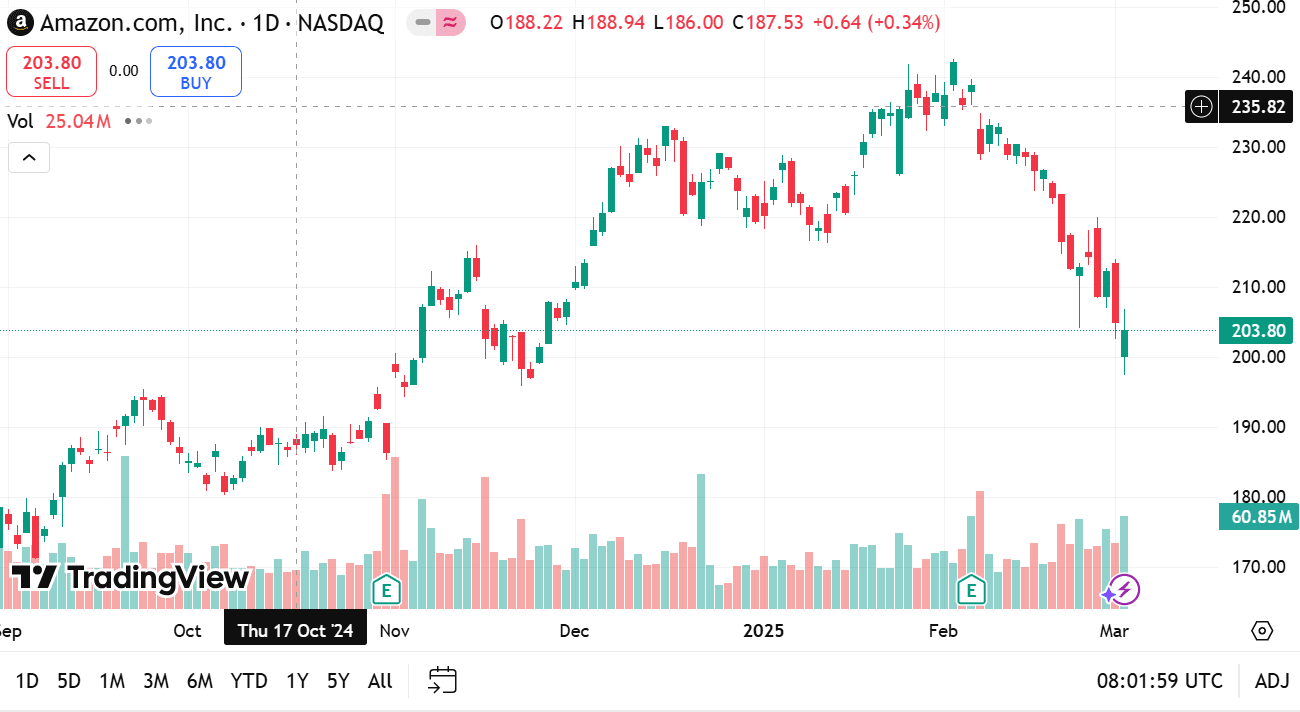
Analyst projections for Amazon’s stock price vary widely, reflecting different assumptions about future growth, profitability, and market conditions. These projections often incorporate discounted cash flow (DCF) models, comparative analysis, and sum-of-the-parts valuations to account for Amazon’s diverse business segments. While many experts remain bullish on Amazon’s long-term prospects, their price targets often reflect a balance between its formidable growth engines and the inherent risks associated with its vast scale and regulatory environment. Investors should consider a range of expert opinions and conduct their own due diligence, rather than relying solely on a single projection, as market conditions and company fundamentals can change rapidly. The current Amazon stock price, therefore, is not just a number, but a living reflection of these complex forces and future expectations.
aViewFromTheCave is a participant in the Amazon Services LLC Associates Program, an affiliate advertising program designed to provide a means for sites to earn advertising fees by advertising and linking to Amazon.com. Amazon, the Amazon logo, AmazonSupply, and the AmazonSupply logo are trademarks of Amazon.com, Inc. or its affiliates. As an Amazon Associate we earn affiliate commissions from qualifying purchases.