
The realm of medicine, like many advanced fields, relies heavily on precise terminology. For healthcare professionals, this means an intricate vocabulary encompassing diseases, treatments, and diagnostic tools. For patients and their families, it can often feel like a foreign language, filled with acronyms and abbreviations that obscure understanding. One such abbreviation that frequently surfaces, particularly in discussions of treatment efficacy and patient outcomes, is “ABX.” While seemingly straightforward, understanding what ABX signifies is crucial for navigating medical conversations and appreciating the advancements in healthcare technology. This article delves into the meaning of ABX within the medical context, exploring its implications for diagnosis, treatment, and the burgeoning role of technology in interpreting and utilizing this critical information.

The Fundamental Meaning of ABX in Medicine
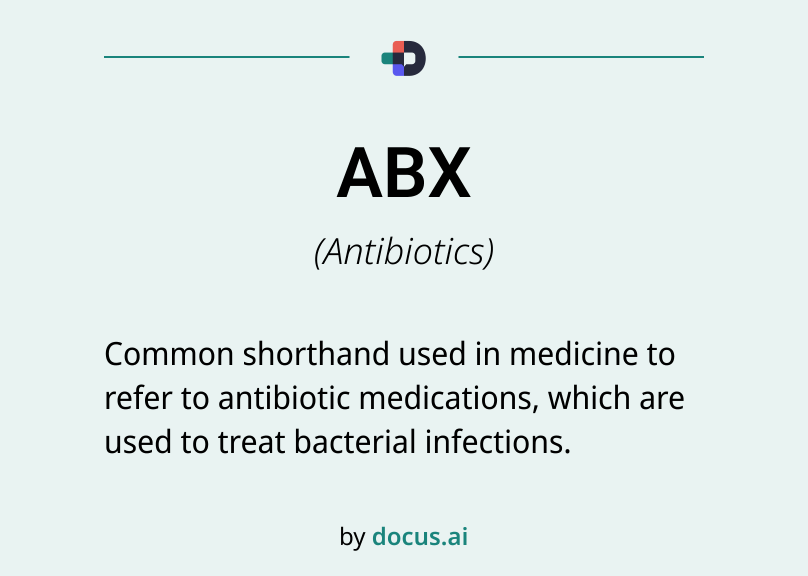
At its core, the medical abbreviation “ABX” serves as a shorthand for antibiotics. This distinction is paramount. Antibiotics are a class of drugs used to treat infections caused by bacteria. They work by killing bacteria or inhibiting their growth, thereby allowing the body’s immune system to clear the infection. It is crucial to note that antibiotics are ineffective against viral infections, such as the common cold or influenza, a common misconception that contributes to antibiotic resistance.
The use of “ABX” as an abbreviation for antibiotics is widespread in clinical settings. It appears in electronic health records (EHRs), physician’s notes, prescriptions, and research papers. This shorthand allows for rapid communication and documentation, especially in fast-paced environments where time is of the essence. However, for those outside the medical profession, this abbreviation can be a source of confusion, prompting the very question: “What is ABX?”
Understanding the Scope of Antibiotic Use
The significance of ABX extends beyond a simple definition. It represents a cornerstone of modern medicine, enabling the treatment of previously life-threatening bacterial infections. From pneumonia and sepsis to urinary tract infections and skin infections, antibiotics have dramatically improved human health and longevity. However, their efficacy is not absolute and is increasingly challenged by the phenomenon of antibiotic resistance.
Antibiotic Resistance: This is a critical public health concern where bacteria evolve to withstand the effects of antibiotics. Overuse and misuse of antibiotics are primary drivers of this resistance. When bacteria are exposed to an antibiotic, susceptible bacteria are killed, but any that have a resistance mechanism survive and multiply. This leads to infections that are harder to treat and require more toxic or expensive drugs. The abbreviation “ABX” in a medical context implicitly refers to this powerful, yet increasingly vulnerable, class of medications.
Spectrum of Activity: Another important consideration tied to ABX is the spectrum of activity of different antibiotics. This refers to the range of bacteria that a particular antibiotic can effectively target. Some antibiotics are broad-spectrum, meaning they work against a wide variety of bacteria, while others are narrow-spectrum, effective against only a limited number. Decisions about which ABX to prescribe are based on the suspected or confirmed causative agent, the patient’s condition, and the potential for resistance.
The Role of Technology in Antibiotic Management
The advent and rapid evolution of technology have profoundly impacted how ABX are prescribed, monitored, and understood. From diagnostic tools that help identify the specific bacteria causing an infection to sophisticated data analytics that track antibiotic resistance patterns, technology plays a vital role in optimizing the use of these critical medications.
Advanced Diagnostics and Identification
Traditionally, identifying the specific bacterium responsible for an infection could be a time-consuming process, often involving laboratory cultures that take days to yield results. This delay sometimes necessitated the empirical use of broad-spectrum ABX, increasing the risk of resistance development. However, technological advancements are revolutionizing this landscape:
- Rapid Diagnostic Tests: Point-of-care diagnostic devices can now detect the presence of specific bacterial pathogens and even identify key resistance genes much faster than traditional methods. This allows clinicians to make more informed decisions about ABX selection sooner, potentially shifting from broad-spectrum to targeted therapies.
- Molecular Diagnostics (PCR): Polymerase Chain Reaction (PCR) and other molecular techniques can amplify tiny amounts of bacterial DNA from a sample, enabling rapid and sensitive detection of pathogens and their resistance mechanisms. This is particularly useful for difficult-to-culture bacteria or in situations where early identification is critical for patient outcomes.
- Mass Spectrometry: Technologies like Matrix-Assisted Laser Desorption/Ionization-Time of Flight (MALDI-TOF) mass spectrometry can rapidly identify bacterial species from colonies grown on culture plates, significantly reducing the time to identification.
These diagnostic technologies, often powered by advanced algorithms and miniaturized hardware, directly influence the “ABX” decisions made in clinical practice. They move the field away from guesswork and towards precision medicine.
Data Analytics and Resistance Surveillance
The growing problem of antibiotic resistance necessitates robust surveillance systems. Technology is central to collecting, analyzing, and disseminating data on antibiotic resistance patterns, both locally and globally.
- Electronic Health Records (EHRs) and Data Mining: EHR systems are repositories of vast amounts of patient data, including prescription history, laboratory results, and clinical outcomes. Sophisticated data mining techniques, often employing artificial intelligence (AI) and machine learning (ML), can analyze this data to identify trends in antibiotic prescribing, track resistance patterns over time, and even predict outbreaks.
- Antimicrobial Stewardship Programs (ASPs): Technology is instrumental in supporting ASPs, which are designed to promote the optimal selection, dosing, route, and duration of antimicrobial therapy. EHRs can be integrated with clinical decision support systems that alert physicians to potential issues, such as the use of broad-spectrum ABX when a narrower one might suffice or flag patients at higher risk of harboring resistant organisms.
- Genomic Surveillance: Advances in DNA sequencing technology allow for the rapid sequencing of bacterial genomes. This genomic information can be used to track the evolution and spread of resistance genes, identify novel resistance mechanisms, and understand the transmission dynamics of infectious agents. This data is crucial for informing public health strategies and drug development.
The intelligent use of data, facilitated by technology, transforms the understanding of ABX from a static concept into a dynamic, evolving challenge that requires continuous monitoring and adaptation.
Navigating ABX in the Digital Healthcare Landscape
The increasing digitization of healthcare means that information about ABX is more accessible than ever before, but it also brings new challenges and opportunities for patients and providers alike.
Patient Empowerment Through Information Access
For patients, understanding the term “ABX” and its implications can lead to more informed conversations with their healthcare providers. Access to reliable information online, while a double-edged sword, allows individuals to:
- Ask Pertinent Questions: Knowing that ABX refers to antibiotics, patients can proactively inquire about the necessity of a prescription, the specific type of antibiotic being prescribed, potential side effects, and the importance of completing the full course of treatment.
- Understand Treatment Rationale: Understanding that ABX are for bacterial infections, patients can better comprehend why a doctor might be hesitant to prescribe them for viral illnesses, thus mitigating the risk of contributing to resistance.
- Engage with Health Apps and Portals: Many healthcare systems now offer patient portals and mobile apps that provide access to medical records, including prescription histories. This transparency allows individuals to track their antibiotic use and discuss patterns with their physicians.

The Future of Antibiotic Therapy: AI and Beyond
The future of managing ABX is inextricably linked to further technological innovation. Artificial intelligence (AI) is poised to play an increasingly significant role in optimizing antibiotic use and combating resistance.
- AI-Powered Prescription Guidance: AI algorithms can analyze a patient’s medical history, current symptoms, local resistance data, and even real-time genomic information to recommend the most appropriate ABX, dosage, and duration of treatment. This could lead to more personalized and effective antibiotic prescribing.
- Predictive Analytics for Outbreaks: AI can be used to predict potential outbreaks of antibiotic-resistant infections by analyzing various data streams, allowing for preemptive public health interventions.
- Drug Discovery and Development: AI is accelerating the process of discovering new antibiotics by analyzing vast chemical libraries and predicting which compounds are most likely to be effective against target bacteria, a critical step in replenishing our dwindling arsenal against resistant pathogens.
- Personalized Treatment Regimens: Beyond just prescribing the right drug, AI could help tailor the entire treatment regimen, including supportive care and monitoring strategies, to optimize patient outcomes and minimize the risk of complications.
As technology continues to advance, the interpretation and utilization of medical terms like ABX will become more sophisticated. The goal remains the same: to harness the power of antibiotics effectively and responsibly, ensuring their efficacy for generations to come, all while empowering patients with knowledge in an increasingly digital healthcare landscape. Understanding “ABX” is more than just knowing a definition; it’s grasping a fundamental concept in modern medicine that is constantly being reshaped by technological innovation.
aViewFromTheCave is a participant in the Amazon Services LLC Associates Program, an affiliate advertising program designed to provide a means for sites to earn advertising fees by advertising and linking to Amazon.com. Amazon, the Amazon logo, AmazonSupply, and the AmazonSupply logo are trademarks of Amazon.com, Inc. or its affiliates. As an Amazon Associate we earn affiliate commissions from qualifying purchases.