
In the rapidly evolving landscape of distributed ledger technology, the “wallet address” serves as the fundamental point of interaction between a user and a blockchain. While often compared to an email address or a bank account number, the technical reality of a wallet address is significantly more complex. It is the product of sophisticated cryptographic functions designed to ensure security, ownership, and transparency in a decentralized ecosystem. To truly understand what a wallet address is, one must look beneath the surface of the alphanumeric string and explore the underlying software architecture, cryptographic protocols, and data structures that make digital sovereignty possible.

The Architecture of a Wallet Address: Public and Private Keys
At its core, a wallet address is a technical representation of a public key, derived through a series of mathematical transformations. To understand the address, we must first understand the relationship between private keys and public keys within the framework of Asymmetric Cryptography.
The Cryptographic Foundation
Most modern blockchains utilize Elliptic Curve Cryptography (ECC) to secure assets. Unlike traditional encryption that might use large prime numbers, ECC relies on the algebraic structure of elliptic curves over finite fields. In this tech stack, a “Private Key” is a randomly generated 256-bit number. This key is the ultimate source of truth; whoever possesses it has total control over the assets associated with it. From this private key, a software algorithm—most commonly the Elliptic Curve Digital Signature Algorithm (ECDSA)—generates a corresponding “Public Key.”
Asymmetric Encryption Explained
The “asymmetric” nature of this technology means that while a public key can be easily derived from a private key, it is mathematically impossible (with current computing power) to reverse the process. This one-way street is the bedrock of digital security. However, a raw public key is often quite long and cumbersome. To make it more functional for network use and to add an extra layer of security, the public key undergoes further technical processing to become the “wallet address” we see in our apps.
The Role of Hashing in Address Generation
A wallet address is not the public key itself, but rather a “hash” of the public key. When a public key is generated, it is passed through a hashing algorithm, such as SHA-256 (used in Bitcoin) or Keccak-256 (used in Ethereum). Hashing takes an input of any length and produces a fixed-length string of characters. This process serves two technical purposes: it shortens the identifier for easier transmission and adds a layer of protection. By the time a user sees an address, the original public key has been obfuscated, providing a “privacy buffer” until the moment a transaction is actually signed and broadcast to the network.
How Wallet Addresses Differ Across Blockchains
While the concept of a wallet address remains constant, the technical implementation—including syntax, format, and checksums—varies significantly depending on the blockchain protocol. These differences are not merely aesthetic; they reflect the specific software engineering choices of the developers who built the network.
Format and Syntax: Bitcoin vs. Ethereum vs. Solana
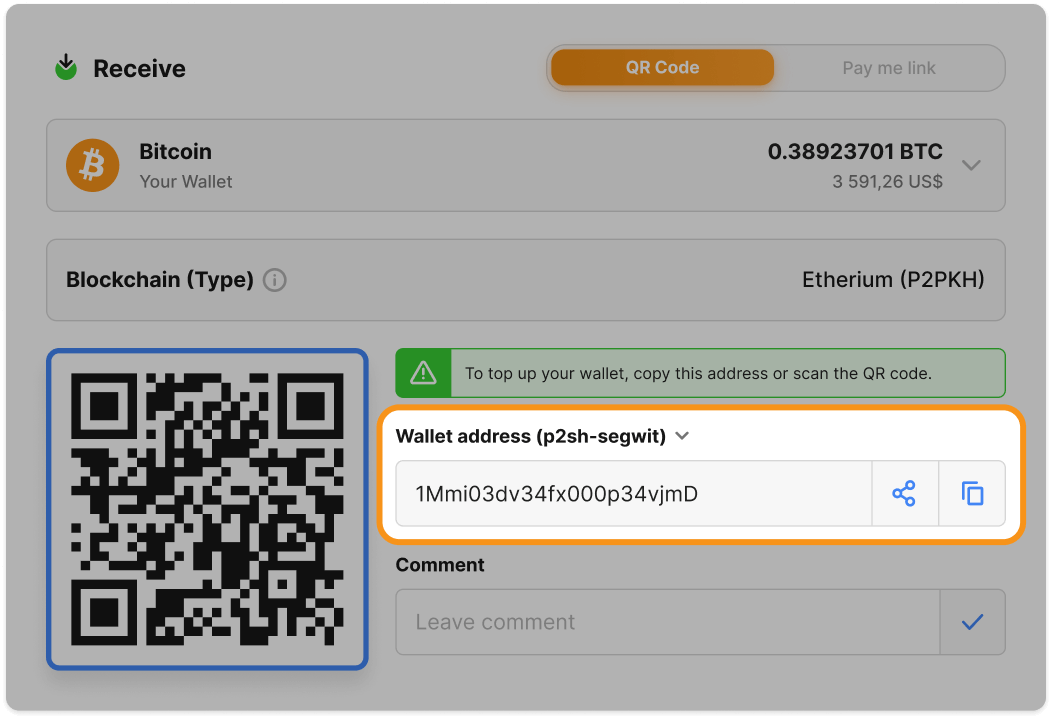
A Bitcoin address usually begins with a 1, 3, or bc1, depending on whether it is a legacy address or a modern SegWit (Segregated Witness) address. Bitcoin’s Bech32 format (starting with bc1) was specifically designed to be more efficient and to reduce human error by using a specific character set that excludes easily confused letters like ‘O’ and ‘I’.
In contrast, Ethereum addresses always follow a hexadecimal format, beginning with 0x and followed by 40 characters. This format is a direct derivative of the Keccak-256 hash of the public key. Solana addresses use a completely different encoding system called Base58, resulting in longer strings that include both uppercase and lowercase letters, reflecting its high-performance architectural requirements.
The Significance of the Prefix
The prefix of a wallet address acts as a technical indicator for the software processing the transaction. For example, the 0x in Ethereum tells the Virtual Machine (EVM) that the following characters are hexadecimal. In the case of Bitcoin’s Bech32, the bc prefix identifies the “human-readable part,” indicating the network (Bitcoin Mainnet). These prefixes are essential for wallet software to perform “address validation,” ensuring that a user does not accidentally attempt to send assets to a string of text that does not conform to the network’s technical standards.
Interoperability and Cross-Chain Challenges
One of the most significant technical hurdles in current blockchain tech is the lack of native interoperability between different address formats. Because a Bitcoin address is generated using a different hashing algorithm and curve parameters than an Ethereum address, they are technically incompatible. Sending assets from an Ethereum 0x address directly to a Bitcoin bc1 address without a bridge or a centralized intermediary results in a permanent loss of data. Modern software developers are currently working on “cross-chain” protocols and “abstracted” wallets that attempt to hide these technical frictions from the end-user.
The Lifecycle of a Transaction: How Addresses Interact
A wallet address is not a static “folder” where coins are kept; instead, it is a pointer to a set of entries on a distributed ledger. When you “send” digital assets, you are actually using your software to broadcast a digital signature that reassigns ownership of a specific data entry from your address to another.
The Hashing Process and Data Integrity
When a transaction is initiated, the software creates a data packet containing the sender’s address, the receiver’s address, the amount, and a digital signature. This signature is created using the sender’s private key. The network nodes then use the sender’s public key (which is revealed during the transaction) to verify that the signature is valid. This technical handshake ensures that only the rightful owner of an address can authorize a transfer, all without ever revealing the underlying private key.
Confirmations and the Mempool
Once a transaction is signed, it enters the “Mempool” (Memory Pool), a technical waiting room for unconfirmed transactions. Miners or validators pick these transactions based on the associated fees. During this stage, the wallet address serves as the unique identifier that allows the network to track the “UTXO” (Unspent Transaction Output) or the “Account Balance.” Once a miner includes the transaction in a block, the ledger is updated, and the software reflects a new balance for the recipient’s address.
Preventing Errors: Checksums and Validations
To prevent the catastrophic loss of funds due to a single typo, many address formats include a “checksum.” This is a technical feature where the last few characters of the address are calculated based on the preceding characters. When you paste an address into a modern wallet app, the software runs the checksum algorithm. If even one character is wrong, the checksum won’t match, and the software will throw a technical error, preventing the transaction from being broadcast.
Securing Your Digital Footprint: Privacy and Safety Protocols
From a digital security perspective, the wallet address is the most exposed part of a user’s technical profile. Because blockchains are public ledgers, an address provides a transparent window into a user’s transaction history.
Anonymity vs. Pseudonymity
It is a common misconception that wallet addresses are anonymous. Technically, they are “pseudonymous.” While an address like 0x71C... does not have your name attached to it on the blockchain, all its technical interactions are logged forever. If that address is ever linked to a real-world identity (for example, through a Know Your Customer or KYC process at an exchange), the entire history of that address becomes deanonymized. Tech-savvy users often use “HD Wallets” (Hierarchical Deterministic wallets), which generate a new address for every transaction to enhance technical privacy.
Hardware Wallets vs. Software Wallets
The “location” of where these keys and addresses are managed is a critical technical distinction. A software wallet (hot wallet) stores the private keys in an encrypted file on an internet-connected device. This makes the keys vulnerable to software-based attacks like malware or keyloggers. A hardware wallet (cold storage) keeps the private keys inside a secure element—a specialized microcontroller. The hardware wallet signs the transaction internally and only sends the completed signature to the computer. This ensures that the sensitive cryptographic data never leaves the physical device.
Best Practices for Address Management
To maintain digital security, users must understand the technical finality of blockchain transactions. Unlike traditional software systems, there is no “undo” button or “forgot password” feature for the underlying tech. Users should leverage technical tools like “Whitelisting,” where a wallet is configured to only allow outgoing transfers to verified, known addresses. Furthermore, utilizing “Multi-Sig” (Multi-Signature) addresses adds an extra layer of security, requiring two or more private keys to authorize a single transaction from a specific address, effectively decentralizing the risk of a single point of failure.
In conclusion, a wallet address is much more than a simple identifier; it is a sophisticated piece of cryptographic engineering. By understanding the relationship between keys, the nuances of different blockchain formats, and the mechanics of transaction verification, users can better navigate the complexities of digital security and the broader technological landscape of the decentralized web.
aViewFromTheCave is a participant in the Amazon Services LLC Associates Program, an affiliate advertising program designed to provide a means for sites to earn advertising fees by advertising and linking to Amazon.com. Amazon, the Amazon logo, AmazonSupply, and the AmazonSupply logo are trademarks of Amazon.com, Inc. or its affiliates. As an Amazon Associate we earn affiliate commissions from qualifying purchases.