
In the contemporary financial landscape, the definition of an “investment” has expanded far beyond the traditional confines of stocks, bonds, and real estate. One of the most resilient and high-performing alternative asset classes to emerge over the last decade is the secondary fashion market, specifically centered on the vintage dress. To the uninitiated, a vintage dress is simply a garment from a bygone era. However, from a financial and business perspective, a vintage dress is a high-yield physical asset characterized by scarcity, historical provenance, and significant appreciation potential.
Understanding what constitutes a vintage dress requires moving past aesthetic appreciation and into the realms of market cycles, valuation metrics, and the circular economy. As the global resale market is projected to reach hundreds of billions of dollars by the end of the decade, the vintage dress has transitioned from a niche hobby into a serious pillar of personal finance and business strategy.
1. Defining the Asset: Age, Provenance, and Valuation
In the financial sector, an asset is defined by its ability to retain or increase in value over time. For a garment to be classified as “vintage” rather than merely “used,” it must meet specific criteria that justify its premium price point.
The 20-Year Rule and Market Maturation
The standard industry benchmark for a vintage dress is a minimum age of 20 years. In terms of market economics, this time frame is significant because it represents a “generational cycle.” Fashion tends to operate on a 20-year loop; as a generation reaches peak spending power, they often seek out the aesthetics of their youth, driving up demand for original pieces from that era. Currently, dresses from the 1990s and early 2000s (Y2K) are seeing the highest rate of appreciation, as they have officially crossed the threshold from “outdated” to “vintage.”
Distinguishing Vintage from Retro and Antique
From a valuation standpoint, it is vital to distinguish between vintage, retro, and antique.
- Antique dresses are those over 100 years old. These are often treated as museum-grade artifacts or “blue-chip” collectibles, often too fragile for wear but highly valuable for archival purposes.
- Retro refers to new garments designed to mimic the style of a previous era. In the context of money and investing, retro items typically have zero resale appreciation because they lack the scarcity of original production.
- Vintage occupies the “sweet spot” of the market—durable enough to be worn (utilitarian value) and rare enough to appreciate (investment value).
The Role of Condition in Asset Value
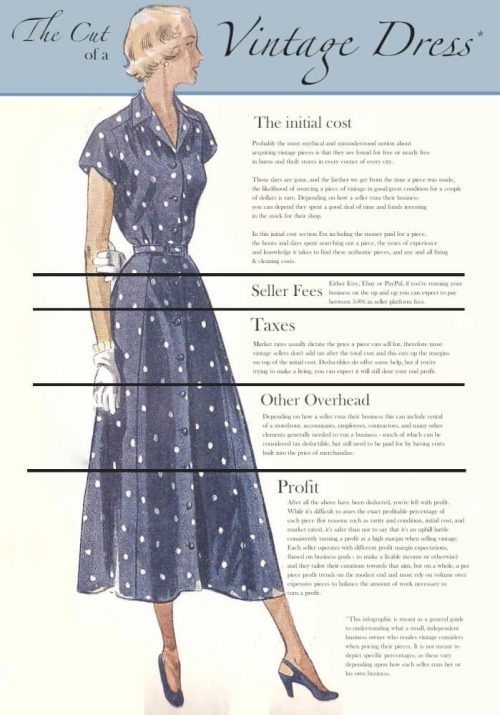
Much like a vintage car or a rare coin, the “grade” of a vintage dress determines its ROI (Return on Investment). A dress in “Deadstock” or “Mint” condition—meaning it has never been worn and potentially still has original tags—can command a 500% premium over a “Fair” condition item of the same designer. Financial collectors must account for restoration costs, as professional textile conservation can be an expensive overhead that eats into profit margins.
2. The Economics of the Resale Market
The vintage dress market is a textbook example of supply and demand dynamics. Unlike modern fast fashion, where supply is nearly infinite, the supply of authentic vintage dresses is fixed and diminishing.
Supply and Demand Cycles
Every time a vintage dress is damaged, discarded, or lost, the remaining pool of that specific item becomes more valuable. This inherent scarcity creates a “seller’s market.” High demand is currently driven by a demographic shift toward “Conscious Consumerism.” Investors are seeing a massive influx of capital from Gen Z and Millennial buyers who view the purchase of a vintage dress as both a hedge against inflation and a rejection of the environmental costs associated with primary-market retail.
The Impact of Sustainability on Pricing
Sustainability has become a fundamental driver of business finance in the fashion industry. Companies that focus on the circular economy—the process of keeping products in use for longer—are attracting significant venture capital. For the individual investor or side-hustler, this means that a vintage dress is no longer just a piece of clothing; it is a “green asset.” The social capital associated with sustainability allows for higher markups and “green premiums” in the resale market.
Platform Fees and ROI Analysis
When treating vintage dresses as a source of online income, one must calculate the Net Present Value (NPV) of their inventory. Selling via third-party platforms like The RealReal, Vestiaire Collective, or 1stDibs involves a complex structure of commission fees ranging from 15% to 50%. A professional seller must balance these fees against the speed of liquidity. While a private sale might yield a 100% margin, an established platform provides the trust and global reach necessary to move high-ticket items quickly.
3. Vintage Dresses as Alternative Investments

For those looking to diversify a portfolio beyond the S&P 500, “wearable investments” offer a tangible alternative. A vintage dress from a prestigious fashion house can outperform traditional gold or silver during certain economic cycles.
Blue-Chip Designer Labels
In the world of vintage finance, certain brands are considered “Blue-Chip.” Names like Chanel, Yves Saint Laurent, Dior, and Alexander McQueen consistently hold their value. For example, a 1950s Christian Dior “New Look” dress is not just a garment; it is a historical asset. These items often appear at major auction houses like Sotheby’s or Christie’s, where they are treated with the same financial rigor as fine art.
Portfolio Diversification and Hedging
Vintage dresses often show a low correlation with traditional stock markets. During a recession, while luxury retail may see a dip in new sales, the vintage market often thrives as consumers look for “value” and “intrinsic worth.” Investors use vintage items as a hedge against currency devaluation. A physical asset that exists outside the digital banking system has an inherent utility that can be liquidated in various global markets.
Risk Mitigation and Authentication
The primary risk in the vintage dress market is the “Counterfeit Risk.” As the value of vintage items rises, so does the prevalence of high-quality fakes. Professional investors mitigate this risk through rigorous authentication processes, checking “provenance” (the history of ownership), stitch density, zipper brands, and fabric composition. Investing in an unauthenticated “designer” vintage dress is a high-risk gamble; conversely, an authenticated piece with a documented history is a secure asset.
4. Building a Profitable Business in Vintage Fashion
For entrepreneurs, the “vintage dress” represents a high-margin business model with relatively low barriers to entry. Whether as a side hustle or a corporate enterprise, the business of vintage is about information asymmetry.
Sourcing Strategies for Maximum Margin
The profit in the vintage business is made at the “buy,” not the “sell.” Professional sourcers look for undervalued assets in “low-information” environments, such as estate sales, regional auctions, or thrift stores in non-metropolitan areas. By identifying a rare 1970s Diane von Furstenberg wrap dress at a fraction of its market value, an entrepreneur can realize a 1000% return on investment once the item is cleaned, photographed, and listed in a “high-information” environment (like a specialized luxury boutique).
Scalability in the Circular Economy
The challenge of the vintage business is scalability. Unlike a software company, you cannot “copy and paste” a 1920s flapper dress. Growth requires building a robust supply chain of “pickers” and scouts. Successful businesses in this niche often pivot toward a “curated” model, where the brand’s expertise in selection becomes the value proposition, allowing them to charge a premium for the labor of sourcing and authentication.
Marketing for Maximum Margin
In the vintage world, storytelling is the primary driver of financial markup. A dress isn’t just sold as “silk and lace”; it is sold as “A 1960s cocktail dress from the peak of the Space Age aesthetic.” By contextualizing the item within fashion history, sellers can move the product from the “commodity” category to the “collectible” category. This transition is where the most significant profit margins are realized.
5. Future Trends: The Digitization of Physical Assets
The intersection of finance and vintage is currently being revolutionized by technology, specifically regarding how we track the value of physical goods.
Blockchain and Digital Passports
The future of the vintage dress as an investment lies in “Digital Passports.” By using blockchain technology, a vintage dress can have a permanent, unalterable record of its ownership, condition, and authenticity. This reduces the risk for investors and increases the liquidity of the asset, as buyers can verify the “pedigree” of a garment instantly.
The Growth of Luxury Resale as a Corporate Strategy
Major luxury brands are no longer ignoring the vintage market; they are entering it. Brands like Gucci and Oscar de la Renta have launched their own vintage resale programs. This is a strategic move to capture a share of the secondary market’s revenue and to control the “brand equity” of their older products. For the individual investor, this corporate entry validates the vintage dress as a permanent and respected category of the global financial market.
In conclusion, a vintage dress is far more than a stylistic choice. It is a sophisticated asset class that requires an understanding of history, market demand, and financial valuation. Whether you are looking for a side hustle to generate online income or a way to diversify a high-net-worth portfolio, the vintage market offers a unique intersection of aesthetic beauty and rigorous economic potential. As the world moves toward more sustainable and circular financial models, the value of the “vintage dress” is poised for continued and significant growth.
aViewFromTheCave is a participant in the Amazon Services LLC Associates Program, an affiliate advertising program designed to provide a means for sites to earn advertising fees by advertising and linking to Amazon.com. Amazon, the Amazon logo, AmazonSupply, and the AmazonSupply logo are trademarks of Amazon.com, Inc. or its affiliates. As an Amazon Associate we earn affiliate commissions from qualifying purchases.