
In a world increasingly driven by visual communication, the ability to translate three-dimensional reality onto a two-dimensional surface is not merely an artistic flourish but a fundamental skill with profound implications across technology, branding, and finance. Among the various methods of achieving this illusion of depth, two-point perspective drawing stands out as a powerful and versatile technique. It allows artists, designers, architects, and creators of all stripes to render objects and environments with a compelling sense of realism, dynamism, and spatial accuracy. Unlike its simpler one-point counterpart, which typically depicts objects head-on with a single vanishing point, two-point perspective introduces a more complex and often more naturalistic view by employing two vanishing points along the horizon line, creating a sense of objects receding at an angle. This nuanced approach captures the way we naturally perceive the world, where few lines remain perfectly parallel to our gaze, making it an indispensable tool for everything from sketching a building exterior to designing intricate product mockups or crafting immersive digital environments.

This article will delve into the core principles that define two-point perspective, unraveling the mechanics behind its convincing illusions of depth and dimension. Beyond its foundational artistic value, we will explore how this timeless technique has been revolutionized and amplified by modern technology, from digital design software to emerging AI tools, enhancing productivity and creative possibilities. Furthermore, we will examine the critical role two-point perspective plays in brand strategy and marketing, demonstrating how it helps businesses craft compelling visual narratives and forge stronger connections with their audience. Finally, we’ll uncover the significant financial opportunities and career pathways that hinge on mastering this skill, highlighting its direct impact on professional success and online income generation in today’s visually competitive landscape. Understanding two-point perspective is therefore not just about drawing; it’s about seeing, communicating, and succeeding in a multi-dimensional world.
The Core Principles of Two-Point Perspective
At its heart, two-point perspective drawing is a methodical system for creating the illusion of three-dimensional space on a flat surface, mimicking how our eyes perceive objects receding into the distance. It’s a leap beyond simpler forms of projection, offering a more naturalistic and dynamic representation that makes it invaluable for rendering architectural structures, complex objects, and environments where multiple sides are visible. To truly harness its power, one must grasp its foundational elements, which collectively orchestrate the convincing visual narrative of depth.
Defining Depth and Dimension
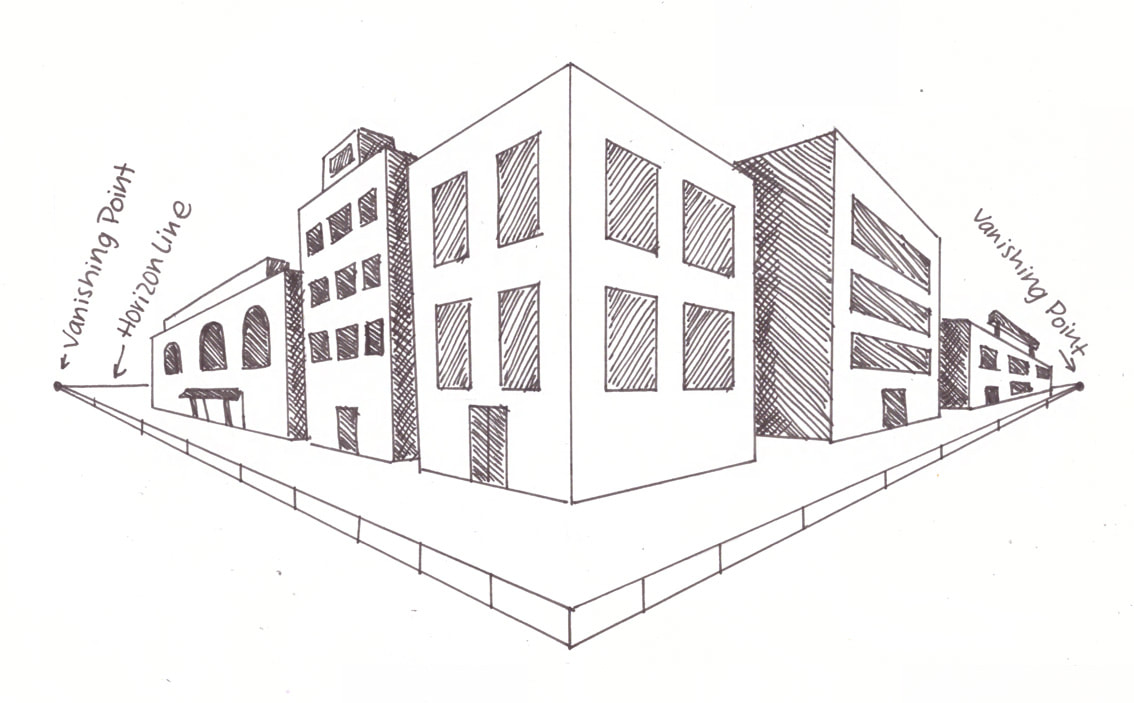
The primary objective of two-point perspective is to depict objects as they would appear in real life, with sides receding away from the viewer towards distant points. Unlike one-point perspective, which often places the viewer directly in front of one face of an object, two-point perspective typically positions the viewer at an angle, allowing two primary faces of an object to be visible and appear to recede simultaneously. This creates a much richer sense of spatial depth and dynamism. Imagine standing at a street corner looking down two intersecting streets – the buildings along both streets would appear to converge towards different points on the horizon. This is precisely the scenario two-point perspective aims to replicate, making it ideal for exterior views, cityscapes, furniture design, and any scene where multiple planes are angled relative to the viewer. The technique adds a compelling sense of volume and solidity, making drawings feel more substantial and real.
The Horizon Line and Vanishing Points
The entire construct of two-point perspective hinges on two critical components: the horizon line and its two vanishing points.
-
The Horizon Line: This is arguably the most important reference line in any perspective drawing. It represents the eye level of the viewer. Everything above the horizon line will be viewed from below, everything below it will be viewed from above, and anything crossing it will appear at eye level. Its placement dictates the overall ‘camera angle’ of your drawing – a high horizon line suggests a bird’s-eye view, while a low one implies a worm’s-eye view. Maintaining a consistent horizon line across your drawing is crucial for visual coherence.
-
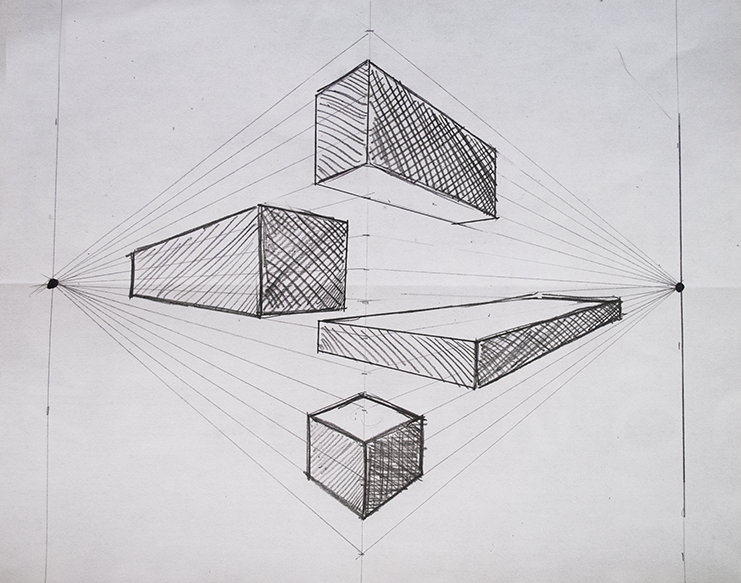
Vanishing Points (VPs): In two-point perspective, you place two vanishing points on the horizon line. These are the imaginary points where all parallel lines that are not parallel to the picture plane (i.e., lines that are receding away from the viewer) appear to converge. For instance, if you are drawing a cube, the lines forming the top and bottom edges of the left face will recede to the left vanishing point, while the lines forming the top and bottom edges of the right face will recede to the right vanishing point. The further apart the vanishing points are, the less extreme the perspective distortion will be, resulting in a more subtle and natural appearance. Conversely, placing them closer together creates a more dramatic, wide-angle effect.
-
Orthogonal Lines: These are the lines that recede towards the vanishing points. They provide the framework for the depth of the object or scene. All parallel lines in reality that are not vertical or parallel to the picture plane will converge to one of the two vanishing points.
-
Vertical Lines: Unlike orthogonal lines, all vertical lines in two-point perspective remain perpendicular to the horizon line and parallel to each other. They do not converge. This holds true as long as the viewer is looking straight ahead and not looking up or down (which would introduce a third vanishing point for vertical lines, moving into three-point perspective).
Mastering the interaction of these elements allows for the construction of incredibly accurate and convincing spatial representations. Artists often start with a simple box method, using these principles to establish the basic form of an object or building before adding details, ensuring that the entire composition remains true to the rules of perspective. This foundational understanding is what empowers creators to build believable worlds, whether on paper or in pixels.
Leveraging Technology in Two-Point Perspective
While two-point perspective has ancient roots in Renaissance art, its application and possibilities have been dramatically transformed by the advent of modern technology. From basic digital drawing aids to sophisticated 3D modeling and cutting-edge AI, technology has not only streamlined the creation process but also expanded the very definition of what perspective drawing can achieve. In today’s fast-paced creative industries, embracing these digital tools is no longer optional but essential for efficiency, precision, and innovation.
Digital Tools for Creation and Visualization
The shift from paper and pencil to digital tablets and software has been a game-changer for perspective drawing. These tools offer unparalleled flexibility, precision, and a host of features that traditional methods simply cannot match, significantly boosting productivity.
-
2D Digital Drawing Software: Programs like Adobe Photoshop, Procreate (for iPad), Clip Studio Paint, and Krita have become indispensable for artists and designers. They provide virtual rulers, perspective grid tools that automatically generate and snap lines to vanishing points, and layering capabilities that allow for iterative design without destroying previous work. The ability to undo mistakes instantly, experiment with colors and textures, and easily share files for feedback accelerates the workflow immensely. For instance, a graphic designer creating an advertisement with a product rendered in two-point perspective can quickly adjust angles, lighting, and reflections, achieving a level of polish that would be painstaking with traditional media. These tools democratize access to sophisticated drawing techniques, offering intuitive interfaces for both beginners and seasoned professionals.
-
3D Modeling Software: For tasks requiring extreme precision, complex forms, or virtual exploration, 3D modeling software is paramount. Applications like SketchUp, Blender, AutoCAD, Revit, and 3ds Max inherently generate objects and environments in perfect perspective. When you build a 3D model, the software automatically handles all the vanishing points and orthogonal lines, allowing designers to focus on form and function rather than manual perspective construction.
- Architects and Interior Designers use Revit and AutoCAD to create precise blueprints and realistic renderings of buildings, allowing clients to virtually walk through spaces before construction begins. The software ensures that every element, from a window frame to a furniture arrangement, adheres to perfect two-point perspective from any chosen camera angle.
- Industrial Designers leverage tools like SolidWorks or Fusion 360 to visualize product prototypes from multiple angles, ensuring aesthetic appeal and functional ergonomics are communicated effectively to manufacturers and marketing teams.
- Game Developers and Animators use Blender or Maya to construct immersive game worlds and animate characters within believable spatial contexts, where every background element and character movement respects the rules of perspective.
These platforms offer dynamic viewpoints, allowing users to rotate, pan, and zoom around their creations, experiencing them from every conceivable two-point perspective. This level of visualization is invaluable for identifying design flaws, making informed decisions, and presenting concepts with crystal clarity.
-
Hardware: Complementing the software are specialized hardware tools like graphics tablets (e.g., Wacom, Huion) and pen displays (e.g., Wacom Cintiq, XP-Pen). These devices offer precise control and a natural drawing experience, mimicking the feel of pen on paper while granting access to all the digital advantages. For immersive visualization, virtual reality (VR) and augmented reality (AR) headsets are beginning to offer designers new ways to experience and interact with their perspective drawings as fully dimensional environments, providing unprecedented levels of immersion for clients and creators alike.
The Role of AI in Perspective Design
Artificial intelligence is rapidly emerging as a transformative force in the realm of perspective drawing, pushing the boundaries of what’s possible and further enhancing efficiency. While still evolving, AI tools are beginning to act as intelligent assistants, automating complex tasks and generating new creative possibilities.
- AI-Powered Drawing Assistants: AI can analyze rough sketches and automatically generate clean perspective grids, extrapolate missing lines, or even suggest optimal camera angles for a particular scene. Tools like Midjourney, DALL-E, or Stable Diffusion, when prompted correctly, can generate incredibly detailed concept art and architectural renderings that inherently understand perspective rules. This can significantly reduce the initial drafting time, allowing artists to jump straight to refining concepts.
- Automated Rendering and Texturing: AI can take a basic wireframe perspective drawing and apply realistic textures, lighting, and shadows, simulating different materials and environmental conditions. This capability is particularly valuable in architectural visualization and product design, where generating multiple realistic renders under various conditions can be incredibly time-consuming. AI algorithms can also perform tasks like perspective correction on photographs or even generate entire 3D models from a series of 2D perspective sketches, bridging the gap between traditional drawing and advanced 3D modeling.
- Enhancing Productivity and Innovation: The ultimate promise of AI in perspective design lies in its ability to democratize complex visualization skills and supercharge productivity. It enables individuals and small teams to produce high-quality, perspectively accurate visuals that once required extensive manual effort or specialized expertise. Furthermore, AI can act as a creative partner, offering unexpected design solutions or stylistic variations based on input, pushing the boundaries of traditional design thinking and fostering innovation in how we conceptualize and draw in two-point perspective. As AI continues to advance, its integration into design workflows will undoubtedly make the creation of complex, perspectively accurate visuals faster, more accessible, and more creatively liberating than ever before.
Two-Point Perspective as a Branding and Marketing Powerhouse
In today’s visually saturated marketplace, a strong brand identity and effective marketing are paramount for success. Two-point perspective drawing, far from being just a technical drawing skill, emerges as a powerful strategic tool in this arena. Its ability to create engaging, realistic, and spatially convincing visuals directly impacts how brands communicate their value, connect with their audience, and ultimately, drive sales.
Crafting Compelling Brand Narratives Visually
Brands thrive on storytelling, and two-point perspective provides a crucial visual vocabulary for these narratives, especially when depicting physical spaces or tangible products.
- Architectural Visualization for Brand Experiences: For businesses with physical locations – retail stores, corporate headquarters, hotels, or experience centers – two-point perspective renderings are indispensable. They allow brands to pre-visualize and refine how their spaces will look and feel, ensuring they align perfectly with the corporate identity and brand strategy. Imagine a luxury fashion brand designing a new boutique: high-quality two-point perspective drawings can convey the expansive layout, the strategic placement of display cases, and the overall ambiance, creating aspirational views that excite investors and future customers. This level of detailed pre-visualization helps ensure that the physical manifestation of the brand is consistent, impactful, and provides a seamless customer journey, ultimately enhancing brand perception and reputation.
- Product Design and Marketing: From cutting-edge gadgets to designer furniture, showcasing products in a realistic and appealing manner is vital for marketing. Two-point perspective allows industrial designers and marketers to create compelling mockups and visualizations that highlight a product’s features, form, and texture from various angles. A well-executed perspective drawing of a new smartphone or car can convey its sleek lines, ergonomic design, and sophisticated engineering, stirring desire and trust in potential buyers. These visuals are critical for product launches, investor presentations, and building anticipation, effectively communicating the brand’s innovation and quality before a physical prototype even exists.
- Corporate Identity Through Spatial Design: Beyond individual products, the consistent application of design principles, including perspective, can reinforce a broader corporate identity. Think of how certain tech companies use open, minimalist office spaces to convey transparency and innovation, or how luxury brands employ grand, symmetrical architectures for an air of exclusivity. Two-point perspective helps architects and interior designers translate these abstract brand values into tangible, physical environments that employees and customers interact with, creating memorable brand touchpoints that contribute to a cohesive corporate image.
Enhancing Marketing Materials and Customer Engagement
The direct impact of strong perspective visuals on marketing materials cannot be overstated. They grab attention, convey information efficiently, and foster a deeper level of engagement with the audience.
- Impactful Advertisements: In print, digital, and even video advertisements, two-point perspective is frequently used to create dynamic and engaging visuals. By drawing viewers into a scene or presenting a product with striking depth, ads become more memorable and persuasive. A real estate advertisement featuring a beautifully rendered two-point perspective of a new home can evoke a sense of aspiration and belonging far more effectively than a flat, schematic drawing. The illusion of depth makes the depicted scene feel more tangible and inviting, increasing the likelihood of viewer interaction.
- Website Design and UI/UX: While website interfaces are typically flat, designers often incorporate elements with implied perspective or use rendered product images that leverage two-point perspective to create visual hierarchy and interactive experiences. High-quality perspective drawings of products for e-commerce sites provide customers with a detailed and realistic view, helping them make informed purchasing decisions and reducing return rates. The perceived realism fosters trust and enhances the online shopping experience.
- Social Media and Content Marketing: In the highly visual landscape of social media, posts with stunning, perspectively accurate visuals tend to stand out. Brands can use two-point perspective drawings and renderings for compelling infographics, product reveals, behind-the-scenes glimpses of design processes, and engaging storytelling. Sharing the journey of a product from initial concept sketches (often in perspective) to final rendering can build a loyal following and amplify brand reputation through authentic content. The ability to quickly generate multiple views or scenarios with modern digital tools makes it easy for brands to maintain a fresh and engaging content calendar. Ultimately, two-point perspective drawing is not just about aesthetics; it’s a strategic investment in visual communication that builds stronger brands, drives marketing effectiveness, and fosters deeper customer engagement.
Financial Opportunities and Skill Investment in Perspective Drawing
The mastery of two-point perspective drawing is far more than an artistic pursuit; it’s a highly valuable professional skill that unlocks significant financial opportunities across numerous industries. In an economy increasingly reliant on visual communication and digital content, individuals proficient in rendering believable three-dimensional spaces and objects are in high demand, transforming this traditional art form into a lucrative investment in one’s career and creative toolkit.
Lucrative Careers and Freelance Ventures
The ability to create compelling perspective drawings is a foundational skill for a wide array of well-paying professions and offers fertile ground for entrepreneurial ventures.
- Architecture & Interior Design: This is perhaps the most direct and obvious application. Architects and interior designers rely heavily on two-point perspective for conceptualizing, planning, and presenting their designs. High-quality architectural renderings in perspective are crucial for client presentations, securing project bids, and communicating complex spatial ideas to construction teams. Architectural visualization specialists, who often command high fees, use advanced software to create hyper-realistic renderings that help sell multi-million dollar properties and developments. Mastering perspective here directly correlates with project success and financial gain.
- Industrial and Product Design: Designers tasked with creating everything from consumer electronics to automobiles and furniture use two-point perspective to visualize product concepts, demonstrate functionality, and convey aesthetic appeal. Accurate perspective drawings are essential for communicating design intent to engineers, marketing teams, and potential investors. Companies invest heavily in skilled industrial designers who can effectively translate abstract ideas into tangible, desirable products through sophisticated visualizations.
- Game Development & Animation: The creation of immersive digital worlds in video games and animated films hinges on a deep understanding of perspective. Environment artists, concept artists, and animators use two-point perspective to design believable landscapes, interior spaces, and ensure characters move convincingly within these 3D environments. This field offers diverse roles, from designing initial concept art to building detailed 3D models and backgrounds, all underpinned by perspective principles.
- Illustration & Concept Art: For illustrators working in publishing, advertising, or entertainment, two-point perspective is vital for creating believable scenes and characters within them. Concept artists for films and games use it to rapidly sketch out environments and key moments, establishing the visual language of an entire production.
- Freelancing and Online Income: Beyond traditional employment, the demand for skilled perspective artists fuels a robust freelance market. Individuals can offer services in:
- Architectural Rendering: Providing visualization services for architects, real estate developers, and construction companies.
- Product Visualization: Creating marketing visuals for product launches, e-commerce, and patent applications.
- Teaching Online Courses: Developing and selling online tutorials and courses on perspective drawing on platforms like Udemy, Skillshare, or via their own websites.
- Selling Digital Assets: Creating and selling perspective grids, brushes, 3D models, or drawing templates on marketplaces like Gumroad or ArtStation.
The flexibility and global reach of the internet mean that talent in perspective drawing can be leveraged into multiple streams of online income, offering significant financial independence.
Investing in Your Creative and Professional Toolkit
Viewing the acquisition of perspective drawing skills as an investment is a pragmatic approach that yields substantial returns. It’s not just about learning “how to draw”; it’s about adding a powerful communication tool to your professional arsenal.
- The Value of Foundational Skills: In a rapidly evolving technological landscape, foundational skills often prove to be the most enduring. While software changes and AI tools advance, the underlying principles of perspective remain constant. Mastering two-point perspective provides a deep understanding of spatial relationships that enhances your ability to use any 2D or 3D design software more effectively. This makes you more adaptable and valuable in the long term.
- ROI on Learning and Tools: Investing time and resources into learning perspective drawing, whether through online courses, workshops, or self-study, has a high return on investment. The cost of drawing tablets, software licenses, or comprehensive tutorials is often quickly recouped through higher earning potential, successful project bids, and expanded career opportunities. For a minimal outlay, you gain a skill that directly translates into increased marketability and earning power.
- Demand for Visual Communicators: In virtually every industry, there’s an increasing demand for individuals who can visually communicate complex ideas clearly and convincingly. Strong visualization skills, particularly those enhanced by perspective drawing, differentiate professionals in competitive fields. They enable you to articulate concepts more effectively to clients, stakeholders, and team members, leading to better project outcomes and career advancement.
In essence, investing in the mastery of two-point perspective drawing is investing in a universal language of visual communication. It equips individuals with the capacity to create, innovate, and succeed across technological advancements, brand strategies, and myriad financial ventures, making it an indispensable asset in the modern professional landscape.
Conclusion
Two-point perspective drawing, a technique born from the artistic ingenuity of the Renaissance, remains as relevant and powerful today as it ever was, if not more so. We’ve journeyed through its core principles, understanding how the meticulous placement of a horizon line and two vanishing points can conjure compelling illusions of depth and realism on a flat surface. This foundational understanding is the bedrock upon which countless creative endeavors are built, allowing us to accurately depict the three-dimensional world we inhabit and envision.
Beyond its artistic merit, we have seen how two-point perspective has been dramatically amplified and integrated into the digital age. Modern technology, from sophisticated 2D and 3D design software to the burgeoning capabilities of artificial intelligence, has not only streamlined the creation process but also expanded the very frontiers of what’s possible. These digital tools enhance precision, boost productivity, and empower creators to generate visuals with unprecedented speed and realism, making complex visualizations accessible to a wider audience.
Furthermore, the strategic importance of two-point perspective extends deeply into the realms of branding and marketing. It is a critical instrument for crafting compelling visual narratives, designing impactful brand experiences, and creating marketing materials that capture attention and foster engagement. Brands leverage its power to communicate their values, showcase products, and connect with customers on a deeper, more aspirational level, proving that effective visual communication is a cornerstone of commercial success.
Finally, the financial opportunities stemming from proficiency in two-point perspective are undeniable. It serves as an invaluable skill in lucrative careers spanning architecture, industrial design, game development, and illustration, while also opening doors to diverse freelance ventures and online income streams. Investing in the mastery of this technique is not just investing in an artistic skill; it’s investing in a versatile professional toolkit that offers significant returns in a visually driven global economy.
In an increasingly complex and interconnected world, the ability to clearly and realistically communicate spatial ideas is paramount. Two-point perspective drawing stands as an indispensable skill for anyone looking to create, innovate, and thrive. As technology continues to evolve, the methods of application may change, but the timeless principles of perspective will remain a cornerstone of effective visual communication, ensuring its enduring legacy and continued relevance for generations to come.
aViewFromTheCave is a participant in the Amazon Services LLC Associates Program, an affiliate advertising program designed to provide a means for sites to earn advertising fees by advertising and linking to Amazon.com. Amazon, the Amazon logo, AmazonSupply, and the AmazonSupply logo are trademarks of Amazon.com, Inc. or its affiliates. As an Amazon Associate we earn affiliate commissions from qualifying purchases.