
The automotive world is replete with acronyms that signify critical technologies designed to enhance safety, performance, and efficiency. Among these, TPMS stands out as a vital component directly influencing one of the most fundamental aspects of driving: tire health. TPMS, or Tire Pressure Monitoring System, is an electronic system integrated into modern vehicles that monitors the air pressure inside pneumatic tires. Its primary purpose is to alert the driver when tire pressure falls to an unsafe level, preventing potential hazards and optimizing vehicle operation.
The implementation of TPMS became widespread after the TREAD Act (Transportation Recall Enhancement, Accountability and Documentation) was passed in the United States in 2000, spurred by concerns over tire-related accidents. This legislation mandated that all new passenger vehicles sold in the U.S. beginning in 2007 (phased in from 2005) include a TPMS capable of detecting a significant under-inflation condition. Similar regulations followed in other regions, including the European Union and South Korea, cementing TPMS as a global standard for automotive safety technology.

The Foundation of Tire Safety: Understanding TPMS
At its core, TPMS is a proactive safety feature. Tires are the sole point of contact between a vehicle and the road, and their proper inflation is paramount to maintaining control, ensuring effective braking, and distributing vehicle weight correctly. Underinflated tires are a leading cause of tire failure, leading to blowouts, reduced fuel economy, increased tire wear, and compromised handling characteristics. Conversely, overinflated tires can also be dangerous, leading to a smaller contact patch, reduced grip, and a harsher ride.
Before TPMS became standard, drivers relied solely on manual checks with a pressure gauge – a task often overlooked by many. The genius of TPMS lies in its ability to continuously monitor tire pressure in real-time or near real-time, providing immediate feedback to the driver via a dashboard warning light. This early warning system allows drivers to address tire pressure issues promptly, significantly mitigating risks and extending tire lifespan. Understanding the various types of TPMS and their operational mechanisms is key to appreciating this technology’s contribution to modern driving safety.
How TPMS Works: Direct vs. Indirect Systems
TPMS technology primarily manifests in two distinct forms: Direct TPMS (dTPMS) and Indirect TPMS (iTPMS). While both aim to alert drivers to low tire pressure, they employ fundamentally different approaches to achieve this goal.
Direct TPMS (dTPMS)
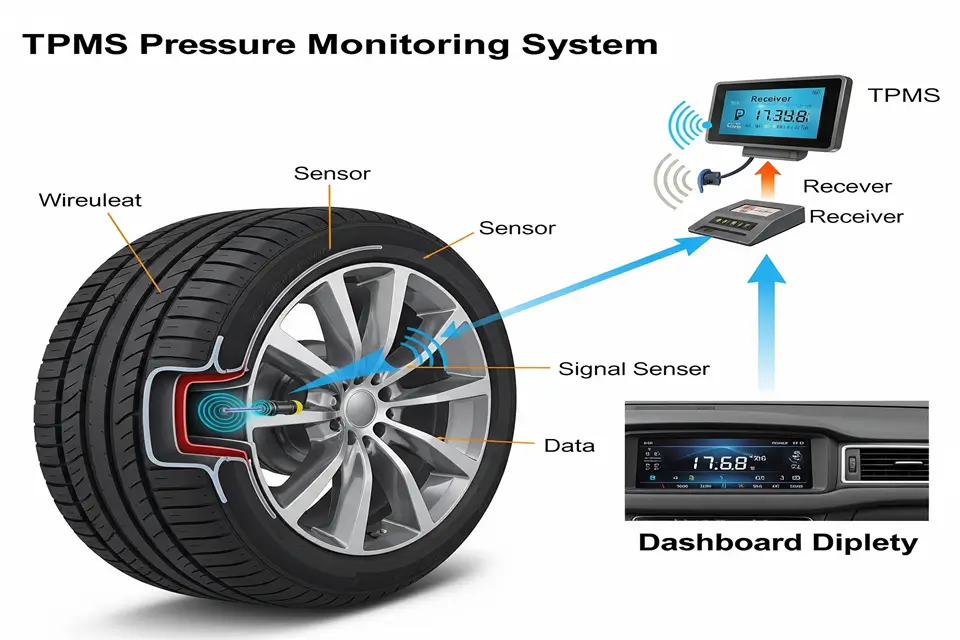
Direct TPMS is the more prevalent and generally more accurate system. It utilizes individual pressure sensors mounted inside each tire, typically integrated into the valve stem or strapped to the wheel inside the tire. These sensors are powered by small, long-lasting batteries and are engineered to withstand the harsh conditions inside a tire, including centrifugal forces, temperature fluctuations, and moisture.
Each sensor directly measures the exact air pressure and, in some advanced systems, the temperature within its respective tire. This data is then wirelessly transmitted, usually via radio frequency, to the vehicle’s onboard computer (ECU) or a dedicated TPMS receiver. The ECU processes this information and displays the pressure readings for each tire on the dashboard or infotainment screen. If any tire’s pressure deviates below a pre-set safe threshold (typically 25% below the manufacturer’s recommended cold inflation pressure), a warning light illuminates on the dashboard, often accompanied by an audible alert.
The advantages of dTPMS include its high accuracy, the ability to provide real-time pressure readings for each individual tire, and its capacity to detect both fast leaks and slow pressure loss. However, dTPMS also comes with considerations: the sensors are individual components that can be damaged during tire service, their batteries have a finite life (typically 5-10 years), and replacing or servicing them often requires specialized tools and reprogramming to communicate with the vehicle’s system.
Indirect TPMS (iTPMS)
Indirect TPMS takes a different, less hardware-intensive approach. Instead of using dedicated pressure sensors, iTPMS leverages existing components of the vehicle, specifically the Anti-lock Braking System (ABS) and Electronic Stability Control (ESC) wheel speed sensors. These sensors are already in place to monitor the rotational speed of each wheel.
The principle behind iTPMS is based on the physical property that an underinflated tire will have a slightly smaller circumference than a properly inflated tire. Consequently, an underinflated tire will rotate at a slightly faster rate to cover the same distance as its correctly inflated counterparts. The iTPMS software continuously monitors and compares the rotational speeds of the wheels. If it detects a significant difference in speed between one or more wheels, it infers that a tire is underinflated and triggers the TPMS warning light on the dashboard.
The key benefits of iTPMS are its lower cost, simpler design, and the absence of battery-powered sensors within the tires, which eliminates the need for sensor replacement or reprogramming during tire changes. However, iTPMS has its limitations. It does not measure actual tire pressure and therefore cannot provide individual tire pressure readings. It is also generally less accurate and slower to detect pressure changes compared to dTPMS. Furthermore, iTPMS may not function optimally if all four tires lose pressure uniformly (e.g., due to a prolonged period of neglect) or if tires are of different sizes. Drivers must typically “recalibrate” the iTPMS after inflating tires or rotating them to ensure accurate baselining.
Why TPMS Matters: Safety, Performance, and Economy

The integration of TPMS into modern vehicles represents a significant leap forward in automotive technology, yielding substantial benefits across multiple critical areas.
Enhanced Safety
The most compelling reason for TPMS’s existence is its profound impact on driving safety. Underinflated tires are a major contributing factor to vehicle accidents. They can lead to:
- Reduced Braking Performance: Insufficient pressure increases braking distance, especially in emergency stops.
- Compromised Handling and Stability: The vehicle may feel “mushy” or unresponsive, increasing the risk of loss of control, particularly during turns or evasive maneuvers.
- Increased Risk of Tire Failure: Underinflation causes excessive flexing and heat buildup within the tire, which can lead to tread separation, blowouts, or rapid deflation at high speeds – all potentially catastrophic events. By alerting drivers to low pressure proactively, TPMS dramatically reduces these risks, giving drivers time to address the issue before it escalates into a dangerous situation.
Optimized Vehicle Performance
Correct tire pressure is not just about safety; it’s fundamental to a vehicle’s optimal performance characteristics. Proper inflation ensures that the tire’s entire contact patch (the portion of the tire touching the road) is maximized and evenly distributed. This leads to:
- Improved Grip and Traction: Essential for acceleration, braking, and cornering, especially in adverse weather conditions.
- Better Steering Response: A properly inflated tire maintains its intended shape, allowing for more precise and predictable steering.
- Enhanced Ride Comfort: While subtle, correct pressure contributes to the suspension system’s ability to absorb road imperfections, leading to a smoother ride.
Fuel Efficiency and Tire Longevity
Beyond safety and performance, TPMS plays a significant role in a vehicle’s operational economy and environmental footprint.
- Increased Fuel Efficiency: Underinflated tires increase rolling resistance. When a tire is soft, more of its surface deforms and contacts the road, requiring the engine to work harder to maintain speed. This translates directly to higher fuel consumption. Studies have shown that even a modest drop in tire pressure can significantly impact fuel economy. By ensuring tires are always at their optimal pressure, TPMS helps maintain the vehicle’s designed fuel efficiency, saving money at the pump.
- Extended Tire Lifespan: Improper tire pressure, whether too low or too high, leads to uneven wear patterns. Underinflated tires tend to wear more quickly on the outer edges, while overinflated tires wear primarily in the center. Even wear ensures that the entire tread depth is utilized uniformly, extending the overall life of the tires. Since tires are a significant maintenance expense, TPMS contributes to long-term cost savings by maximizing their usable life.
- Environmental Benefits: By improving fuel efficiency and extending tire life, TPMS indirectly contributes to environmental sustainability by reducing fuel consumption and the frequency of tire disposal, thereby lowering carbon emissions and waste.
Living with TPMS: Maintenance, Calibration, and Troubleshooting
While TPMS is largely an automatic system, understanding its maintenance requirements and common issues is crucial for maximizing its benefits and ensuring continuous safety.
Regular Checks and Maintenance
Even with a TPMS, manual tire pressure checks with a reliable gauge remain a good practice. TPMS typically alerts at a significant pressure drop (e.g., 25%), meaning a tire could still be somewhat underinflated before the warning illuminates. Regular manual checks allow for minor adjustments and provide an opportunity to visually inspect tires for damage or uneven wear.
For direct TPMS, sensor battery life is a key consideration. When a sensor battery dies, the TPMS warning light will likely illuminate, indicating a system fault rather than low pressure. Sensor batteries are usually sealed and non-replaceable, meaning the entire sensor unit must be replaced. This typically occurs during tire replacement or when the battery completely fails. After any tire rotation or replacement of a direct TPMS sensor, the system usually requires a “relearn” or reprogramming procedure to recognize the sensor’s new location or identity. This can often be done by a professional tire technician using specialized diagnostic tools.
Common Issues and Troubleshooting
The most common issue drivers encounter with TPMS is the illumination of the warning light. While often signaling genuine low pressure, it can also indicate other problems:
- Sensor Malfunction: A direct TPMS sensor might fail due to damage, corrosion, or a dead battery.
- TPMS Module Failure: Less common, but the vehicle’s central TPMS receiving module can malfunction.
- Extreme Temperature Changes: Significant drops in ambient temperature can cause tire pressure to fall, triggering the alert, even if the tires were properly inflated previously.
- Incorrect Calibration (iTPMS): If an indirect TPMS isn’t properly recalibrated after tire inflation or rotation, it might give false alarms or fail to detect actual low pressure.
Troubleshooting usually begins with manually checking all tire pressures. If they are correct, and the warning light persists, professional diagnosis is recommended to identify sensor or system faults.
Future of TPMS Technology
TPMS technology continues to evolve. Future advancements are likely to include:
- Enhanced Integration with ADAS: More seamless communication with Advanced Driver-Assistance Systems (ADAS) to provide proactive warnings or even automatically adjust vehicle dynamics in response to tire conditions.
- Predictive Maintenance: Sensors may become sophisticated enough to predict potential tire failures or indicate when a tire needs to be rotated or replaced based on wear patterns and structural integrity.
- Over-the-Air (OTA) Updates: Allowing TPMS software and calibration to be updated remotely, similar to other vehicle systems.
- Smart Tire Technology: Tires with embedded sensors that not only monitor pressure and temperature but also tread depth, road conditions, and even identify specific road hazards, transmitting this data directly to the driver or vehicle’s autonomous systems.
In conclusion, TPMS is a foundational technology that silently contributes to a safer, more efficient, and more economical driving experience. By continuously monitoring tire pressure and alerting drivers to critical changes, it empowers them to maintain optimal tire health, preventing accidents and extending the life of their tires and vehicle. As automotive technology progresses, TPMS will undoubtedly continue to integrate and innovate, further solidifying its role as an indispensable safety and performance feature.
aViewFromTheCave is a participant in the Amazon Services LLC Associates Program, an affiliate advertising program designed to provide a means for sites to earn advertising fees by advertising and linking to Amazon.com. Amazon, the Amazon logo, AmazonSupply, and the AmazonSupply logo are trademarks of Amazon.com, Inc. or its affiliates. As an Amazon Associate we earn affiliate commissions from qualifying purchases.