
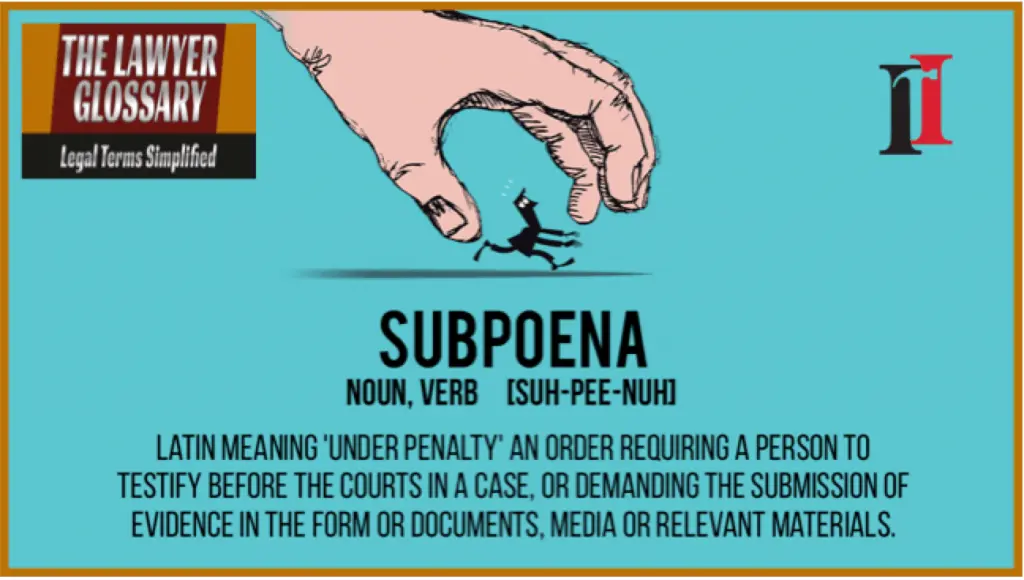
In the modern digital landscape, the concept of a “subpoena” has transitioned from dusty file cabinets and physical paper trails to high-speed data packets and encrypted cloud servers. In legal terms, a subpoena is a formal written order issued by a court or government agency that requires a person or entity to testify or produce evidence. However, when applied to the technology sector, the subpoena becomes a complex intersection of software architecture, digital security, and constitutional law.
For tech giants, SaaS startups, and digital security experts, understanding the mechanics of a subpoena is not just a legal necessity—it is a cornerstone of product design and user trust. This article explores the technical nuances of subpoenas, how the industry responds to data requests, and the evolving role of AI and encryption in legal compliance.
The Mechanics of a Tech Subpoena: When Law Meets Code
At its core, a subpoena is a tool of “discovery.” In the tech niche, it serves as the primary mechanism through which law enforcement and civil litigants gain access to the vast repositories of data generated by users every second.
Subpoena Ad Testificandum vs. Subpoena Duces Tecum in the Digital Era
Traditionally, subpoenas are divided into two categories. A subpoena ad testificandum commands an individual to testify—for a tech company, this might mean a Chief Technology Officer (CTO) explaining an algorithm in court. However, the most common type in technology is the subpoena duces tecum.
In a digital context, this is an order to “produce the records.” This doesn’t mean printing out emails; it means exporting metadata, logs, IP addresses, and private communications. The technical challenge lies in the scope. A poorly defined subpoena might ask for “all user data,” but a tech-literate legal team must negotiate the parameters to ensure only “responsive” data—that which is legally relevant—is extracted from the database.
The Electronic Communications Privacy Act (ECPA) Framework
For any technology professional, the Electronic Communications Privacy Act of 1986 is the foundational text. Despite being decades old, it dictates how subpoenas interact with digital security. Under ECPA, there is a “sliding scale” of digital privacy.
Basic subscriber information—such as a user’s name, IP address, and length of service—can often be obtained with a simple administrative subpoena. However, as the request moves toward “content” (the body of an email or a private message), the legal threshold rises. Tech companies often push back against subpoenas that attempt to bypass the Fourth Amendment, insisting that content requires a search warrant based on probable cause rather than a standard subpoena.
How Major Platforms Handle Data Requests
When a subpoena hits the legal department of a company like Google, Apple, or Meta, it triggers a sophisticated technical and legal workflow. These companies have moved beyond manual processing, building entire software ecosystems dedicated to “Legal Response Management.”
Transparency Reports: A Look Inside Legal Response Teams
Transparency reports are the tech industry’s way of showing the public how often they are subpoenaed. These reports categorize requests into “Subpoenas,” “Court Orders,” and “Search Warrants.” For example, Google’s transparency reports show a consistent year-over-year increase in global requests for user data.
The technical process involves “data geofencing” and “query isolation.” When a subpoena is verified as valid, engineers must run precise queries against their data lakes to isolate the specific user’s information without compromising the privacy of millions of other users. This process requires a deep integration between the company’s legal team and its database administrators.
The Role of End-to-End Encryption in Thwarting Subpoenas
Perhaps the most significant tech trend impacting subpoenas is the rise of End-to-End Encryption (E2EE). Platforms like Signal or WhatsApp have built architectures where the service provider does not hold the decryption keys.
When a tech company receives a subpoena for E2EE messages, their response is technically simple but legally profound: “We cannot comply because we do not possess the data.” This has led to a “going dark” debate between tech companies and law enforcement. From a digital security perspective, E2EE acts as a mathematical shield against subpoenas, forcing legal entities to seek data from the “endpoints” (the users’ physical devices) rather than the central servers.

Data Security and Compliance for SaaS Founders
For smaller tech companies and SaaS founders, a subpoena can be a logistical nightmare. Unlike Big Tech, startups often lack the infrastructure to handle high volumes of legal requests, making “Compliance by Design” a critical strategy.
Implementing “Privacy by Design” to Mitigate Legal Risk
One of the most effective ways for a tech company to handle subpoenas is to store less data. This is the “Data Minimization” principle of the GDPR and CCPA. If a company does not log IP addresses or deletes logs every 24 hours, it has nothing to produce when a subpoena arrives.
Founders are increasingly adopting “Zero-Knowledge” architectures. By designing software where the platform never sees the user’s unencrypted data, the company effectively inoculates itself against the burden of subpoenas. This is not about evading the law; it is about building a product that prioritizes digital security and reduces the “attack surface” for both hackers and legal overreach.
Automating Legal Responses: AI Tools for E-Discovery
The field of E-Discovery (Electronic Discovery) has been revolutionized by AI and Machine Learning. When a tech company is hit with a broad subpoena requiring the review of millions of documents, manual review is impossible.
Modern E-Discovery software uses Natural Language Processing (NLP) to identify relevant documents and redact sensitive information automatically. These AI tools can distinguish between a user’s personal chat and “privileged” information that should not be handed over to the government. For a tech company, investing in these software tools is essential for maintaining operational efficiency during a legal dispute.
The Future of Digital Evidence: AI and Cross-Border Subpoenas
As data becomes more decentralized and AI becomes more integrated into our lives, the nature of the subpoena is changing. We are entering an era where the data being subpoenaed may not even have been created by a human.
The CLOUD Act and International Data Disputes
In the past, tech companies could argue that they couldn’t comply with a U.S. subpoena if the data was stored on a server in Ireland or Singapore. This changed with the Clarifying Lawful Overseas Use of Data (CLOUD) Act.
The CLOUD Act allows U.S. law enforcement to subpoena data regardless of where it is physically stored, as long as the provider is under U.S. jurisdiction. This has massive implications for cloud providers like AWS and Azure. Tech professionals must now understand international law, as a subpoena in one country can trigger a data breach or privacy violation in another, especially under the strict regulations of the European Union.
Can AI Be Subpoenaed? The Next Frontier of Legal Tech
As Large Language Models (LLMs) and generative AI become ubiquitous, a new question arises: Can you subpoena the “memory” of an AI? If a user uses an AI assistant to plan a crime or a corporate fraud, the training logs and “inference data” of that AI could be subject to a subpoena.
The technical challenge here is “AI Interpretability.” Extracting a specific “thought” or “input” from a neural network is vastly more difficult than pulling a row from a SQL database. The tech industry is currently grappling with how to make AI systems “auditable” for legal purposes without destroying the proprietary nature of the algorithms. This represents the next great frontier where digital security, software engineering, and the law will collide.

Conclusion
In the tech world, a subpoena is more than a legal document; it is a stress test for a company’s data architecture and privacy commitments. From the way databases are queried to the way encryption protocols are written, the looming reality of legal requests shapes every layer of the modern tech stack.
As we move forward, the companies that thrive will be those that integrate legal compliance into their technical DNA. By leveraging AI-driven E-discovery, adopting privacy-by-design, and advocating for clear digital boundaries, the tech industry can navigate the complexities of the law while still protecting the digital security of its users. The subpoena, once a relic of the courtroom, is now a fundamental variable in the code that runs our world.
aViewFromTheCave is a participant in the Amazon Services LLC Associates Program, an affiliate advertising program designed to provide a means for sites to earn advertising fees by advertising and linking to Amazon.com. Amazon, the Amazon logo, AmazonSupply, and the AmazonSupply logo are trademarks of Amazon.com, Inc. or its affiliates. As an Amazon Associate we earn affiliate commissions from qualifying purchases.