
Space Exploration Technologies Corp., more commonly known as SpaceX, is not merely a rocket company; it is the most significant technological disruptor of the 21st century. Founded in 2002 by Elon Musk, the company was born from a radical premise: that the cost of space exploration could be reduced by several orders of magnitude through the application of modern software engineering principles to aerospace hardware. In the decades since its inception, SpaceX has transitioned from a risky startup to a dominant force in global aerospace, fundamentally changing how humanity accesses and utilizes the orbital environment.
To understand “what is a SpaceX,” one must look beyond the spectacle of fiery launches and focus on the technical innovations that have rendered traditional expendable rocketry obsolete. From the perfection of vertical landing to the deployment of the world’s largest satellite constellation, SpaceX represents a fusion of advanced materials science, autonomous systems, and high-frequency manufacturing.
The Technological Foundation: Reusability and the Falcon Architecture
The core technological breakthrough that defines SpaceX is the concept of rapid reusability. For sixty years, the aerospace industry operated on an “expendable” model, where multi-million dollar rockets were discarded into the ocean after a single use. SpaceX viewed this as the primary barrier to becoming a multi-planetary species.
The Engineering Logic of Vertical Landing
The Falcon 9, the company’s workhorse orbital-class rocket, was the first to successfully land its first stage back on Earth. This feat required solving complex problems in guidance, navigation, and control (GNC). During atmospheric reentry, the booster must perform a “boostback burn” to steer itself toward a landing zone, followed by an “entry burn” to protect the engines from the heat of friction.
The final “landing burn” utilizes cold-gas thrusters for orientation and grid fins—waffle-like aerodynamic surfaces—to steer the vehicle with precision through the atmosphere. The integration of these autonomous systems allows the rocket to land on a robotic droneship in the middle of the ocean, a feat often compared to balancing a pencil on its eraser in a windstorm.
Merlin and Raptor: The Power Behind the Propulsion
SpaceX’s dominance is also rooted in its engine technology. The Merlin 1D engine, which powers the Falcon 9, is one of the most efficient and reliable liquid oxygen (LOX) and rocket-grade kerosene (RP-1) engines ever built. It boasts a world-record thrust-to-weight ratio, allowing for the high performance necessary for both lift-off and landing.
However, the company’s latest development, the Raptor engine, represents a massive leap forward. Unlike the Merlin, the Raptor utilizes a “full-flow staged combustion” cycle, an incredibly complex design that maximizes every ounce of energy from its propellants: liquid methane and liquid oxygen (methalox). This tech choice is strategic; methane can be synthesized on Mars, aligning with the company’s long-term goal of interplanetary refueling.
Starlink: Satellite Internet and the Future of Connectivity
While rockets are the delivery mechanism, Starlink is perhaps SpaceX’s most ambitious technological application. Starlink is a “megaconstellation” of thousands of small satellites in Low Earth Orbit (LEO) designed to provide high-speed, low-latency internet to every corner of the globe.
Megaconstellations and Orbital Mechanics
Traditional satellite internet relies on large, expensive satellites in Geostationary Orbit (GEO), approximately 35,000 kilometers above Earth. Because of the vast distance, signal latency is high, making real-time applications like video calls or gaming nearly impossible. SpaceX solved this by placing Starlink satellites in LEO, just 550 kilometers up.
This proximity reduces latency to levels comparable to terrestrial fiber-optic cables. However, because LEO satellites move rapidly across the sky, a “constellation” is required. SpaceX has mastered the mass production of these satellites, launching up to 60 at a time on a single Falcon 9. Each satellite features a flat-panel design with krypton-powered ion thrusters for station-keeping and autonomous collision avoidance systems that utilize a database of space debris to steer clear of potential impacts.

Optical Inter-Satellite Links (Laser Links)
The latest generation of Starlink satellites utilizes “space lasers” to communicate with one another. These optical inter-satellite links allow data to be transferred between satellites without the need to constantly relay signals to a ground station on Earth. Because light travels faster in the vacuum of space than through glass fiber cables, Starlink has the potential to provide the fastest long-distance data transfer on the planet, a technological edge that has massive implications for global finance and military communications.
Starship: The Pinnacle of Modern Rocketry
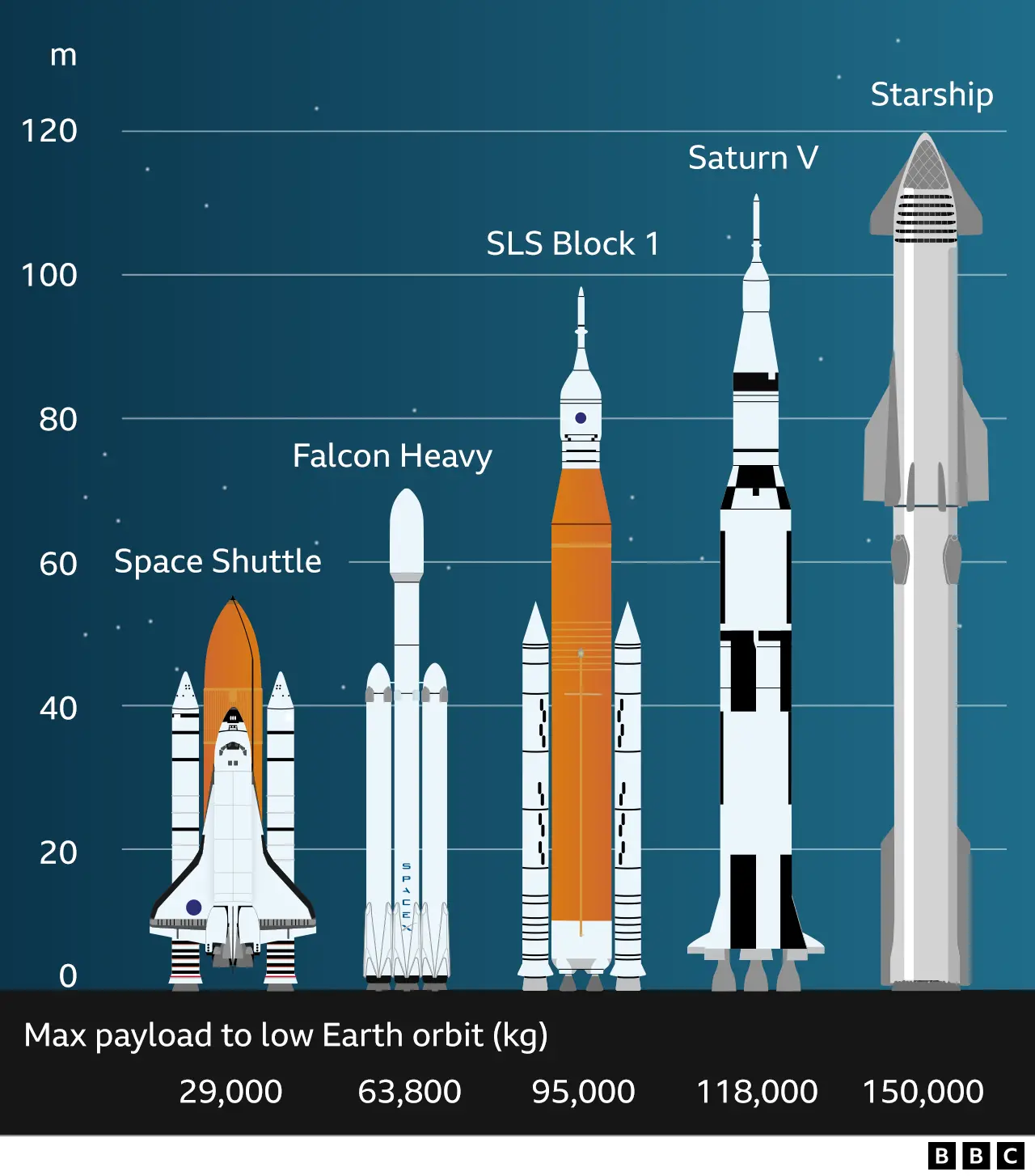
If Falcon 9 proved that reusability is possible, Starship is designed to prove that it can be total. Starship is the fully reusable, two-stage-to-orbit heavy-lift launch vehicle currently under development at the company’s “Starbase” facility in Texas. It is the largest and most powerful flying machine ever constructed.
Full Reusability and Heavy-Lift Capabilities
Unlike the Falcon 9, where only the first stage is recovered, both the “Super Heavy” booster and the “Starship” spacecraft are designed to return to the launch site. The most radical aspect of this design is the “catch” mechanism—using giant mechanical arms on the launch tower (affectionately known as “Mechazilla”) to grab the booster out of the air.
This eliminates the weight of landing legs and allows for an almost immediate turnaround. From a tech perspective, Starship’s hull is constructed from 304L stainless steel rather than expensive carbon fiber. While heavier, steel’s high melting point and strength at cryogenic temperatures make it ideal for the extreme heat of reentry, reducing the need for heavy thermal shielding.
Preparing for Interplanetary Life on Mars
Starship is designed to carry over 100 tons of cargo to LEO, or even to the Moon and Mars. To achieve this, SpaceX is developing “in-orbit refilling.” This involves two Starship vehicles docking in space to transfer propellant. Mastering this technology is the “holy grail” of deep-space exploration, as it allows a ship to leave Earth’s gravity well, refill its tanks, and then have enough fuel to travel to other planets. This is not just a dream; it is a rigorous engineering roadmap that SpaceX iterates on daily through “rapid prototyping”—building, testing, failing, and fixing at a speed the aerospace world has never seen.
Disrupting the Aerospace Industry Through Vertical Integration
The reason SpaceX can innovate faster than its competitors is its commitment to vertical integration. In a traditional tech or aerospace company, parts are outsourced to thousands of subcontractors, leading to delays and inflated costs. SpaceX does the opposite.
Rapid Iteration and Agile Development in Hardware
SpaceX manufactures approximately 70% to 80% of its rockets, engines, and electronics in-house. This includes everything from the flight computers and circuit boards to the specialized valves and heat-shield tiles. By controlling the supply chain, engineers can make design changes on the fly. If a test flight reveals a flaw in a sensor, the team can redesign, print, and install a new version within days, rather than waiting months for a supplier to update a component.
This “Agile” approach, borrowed from software development, is the engine of SpaceX’s success. They embrace “fast failure,” meaning they are willing to blow up prototypes to gather data, knowing that the telemetry gained from a failure is more valuable than a year of theoretical simulations.
Reducing the Cost of Access to Space
The ultimate result of this technological suite—reusability, vertical integration, and advanced propulsion—is the radical reduction of launch costs. Before SpaceX, launching a kilogram of payload into space cost roughly $10,000 to $20,000. With the Falcon 9, that cost dropped to below $3,000. If Starship achieves its design goals, that cost could drop to under $100 per kilogram.
This change in the “cost-to-orbit” is the catalyst for a new tech revolution. It makes things like space-based manufacturing, orbital hotels, and asteroid mining technically and economically feasible. When you ask “what is a SpaceX,” the answer is that it is the infrastructure provider for the future of the human race. It is the company that turned the vacuum of space from a prohibitively expensive barrier into an accessible domain for innovation.
By blending the audacity of science fiction with the rigors of high-performance engineering, SpaceX has moved the needle of human capability further in twenty years than the previous fifty combined. Its legacy is not just the rockets it builds, but the path it has paved for a future where space is a routine destination, not a distant dream.
aViewFromTheCave is a participant in the Amazon Services LLC Associates Program, an affiliate advertising program designed to provide a means for sites to earn advertising fees by advertising and linking to Amazon.com. Amazon, the Amazon logo, AmazonSupply, and the AmazonSupply logo are trademarks of Amazon.com, Inc. or its affiliates. As an Amazon Associate we earn affiliate commissions from qualifying purchases.