
The seemingly simple question, “What is a size 41 in US?”, belies a complex and often frustrating reality for global consumers navigating the world of footwear. For many, the ideal pair of shoes remains just out of reach, not due to a lack of desire or financial means, but due to the labyrinthine nature of international sizing conventions. This article aims to demystify the conversion between European (EU) and US shoe sizes, with a specific focus on EU size 41, providing clarity for those seeking to confidently purchase footwear regardless of its origin. We will delve into the nuances of this conversion, explore the implications for different genders and footwear types, and offer practical advice for ensuring a perfect fit.

Understanding the Fundamentals of Shoe Sizing
The discrepancy in shoe sizing across different regions stems from historical and regional differences in measurement systems and manufacturing standards. The US system, for instance, is based on a barleycorn unit, with a full size increment representing one-third of an inch. The EU system, on the other hand, is generally based on the Paris point, where one point is equivalent to two-thirds of a centimeter. This fundamental difference in measurement creates the need for conversion charts and a degree of educated guesswork for consumers.
The European Sizing System: A Numerical Framework
European shoe sizes, often denoted by “EU,” are characterized by a continuous numerical scale. Unlike the US system, which often includes half-sizes and broader width designations, EU sizing tends to be more uniform in its increments. A common misconception is that EU sizes correspond directly to centimeter measurements. While there’s a correlation, it’s not a one-to-one match. EU sizes represent the internal length of the shoe last (the mold used to create the shoe) in Paris points. This means that a size 41 EU shoe will accommodate a foot of a specific length, but the shoe itself will be slightly larger to allow for comfort and movement.
The US Sizing System: A More Granular Approach
The US shoe sizing system is notoriously more granular and can be more confusing. It utilizes both whole and half sizes, and often incorporates width designations like “narrow” (N), “medium” (M), “wide” (W), and “extra wide” (XW). For men’s and women’s footwear, the starting points and progression of sizes differ significantly. For instance, a men’s size 9 US is not directly equivalent to a women’s size 9 US in terms of foot length. This inherent complexity makes understanding the conversion from an EU size to its US counterpart a crucial step in the purchasing process.
The Importance of Accurate Measurement
Before diving into specific conversions, it’s paramount to emphasize the importance of accurate foot measurement. Shoe sizing can vary between brands and even between different styles within the same brand. Therefore, relying solely on a general conversion chart can sometimes lead to disappointment. The most reliable method is to measure your foot length in centimeters or inches and then consult the specific brand’s sizing guide.
To measure your foot accurately:
- Stand on a piece of paper: Place a piece of paper on a hard, flat surface. Stand on the paper with your heel against a wall.
- Mark your longest toe: Have someone else mark the longest point of your foot, typically your longest toe, while you are standing.
- Measure the length: Measure the distance from the edge of the paper where your heel was against the wall to the mark you made.
- Measure both feet: It’s common for one foot to be slightly larger than the other. Measure both feet and use the measurement of the larger foot for sizing.
Converting EU Size 41 to US Sizing: A Detailed Analysis
When a consumer encounters an EU size 41 shoe, the immediate challenge is to determine its equivalent in the US system. This conversion is not a fixed mathematical equation but rather a range, influenced by whether the footwear is intended for men or women, and the specific manufacturer’s sizing standards.
EU 41 for Women: Bridging the Gap
For women’s footwear, EU size 41 generally translates to a US size of 9.5 to 10. This range exists because different brands adopt slightly different conversion points. Some manufacturers might align EU 41 with a US 9.5, while others will stretch it to a US 10. The subtle differences in foot width and volume can also play a role. A foot that is slightly wider might find a US 10 more comfortable than a US 9.5, even if the length is an exact match. It’s essential to consider the intended fit – a snug athletic shoe will require a different approach than a relaxed casual loafer.
- The 9.5 US Women’s Anchor: Many brands consider EU 41 to be a US 9.5. This is often a good starting point for many women.
- The 10 US Women’s Extension: For those who prefer a little more room or have slightly wider feet, US 10 becomes the relevant conversion. This is particularly common for brands that run slightly smaller or for styles that are designed to be worn with thicker socks.
- Brand-Specific Variations: It cannot be stressed enough that consulting the specific brand’s sizing chart is the most reliable method. A quick look at a brand’s website will often clarify their EU to US conversion. For example, one brand might state “EU 41 = US 9.5,” while another might list “EU 41 = US 10.”
EU 41 for Men: A Different Landscape
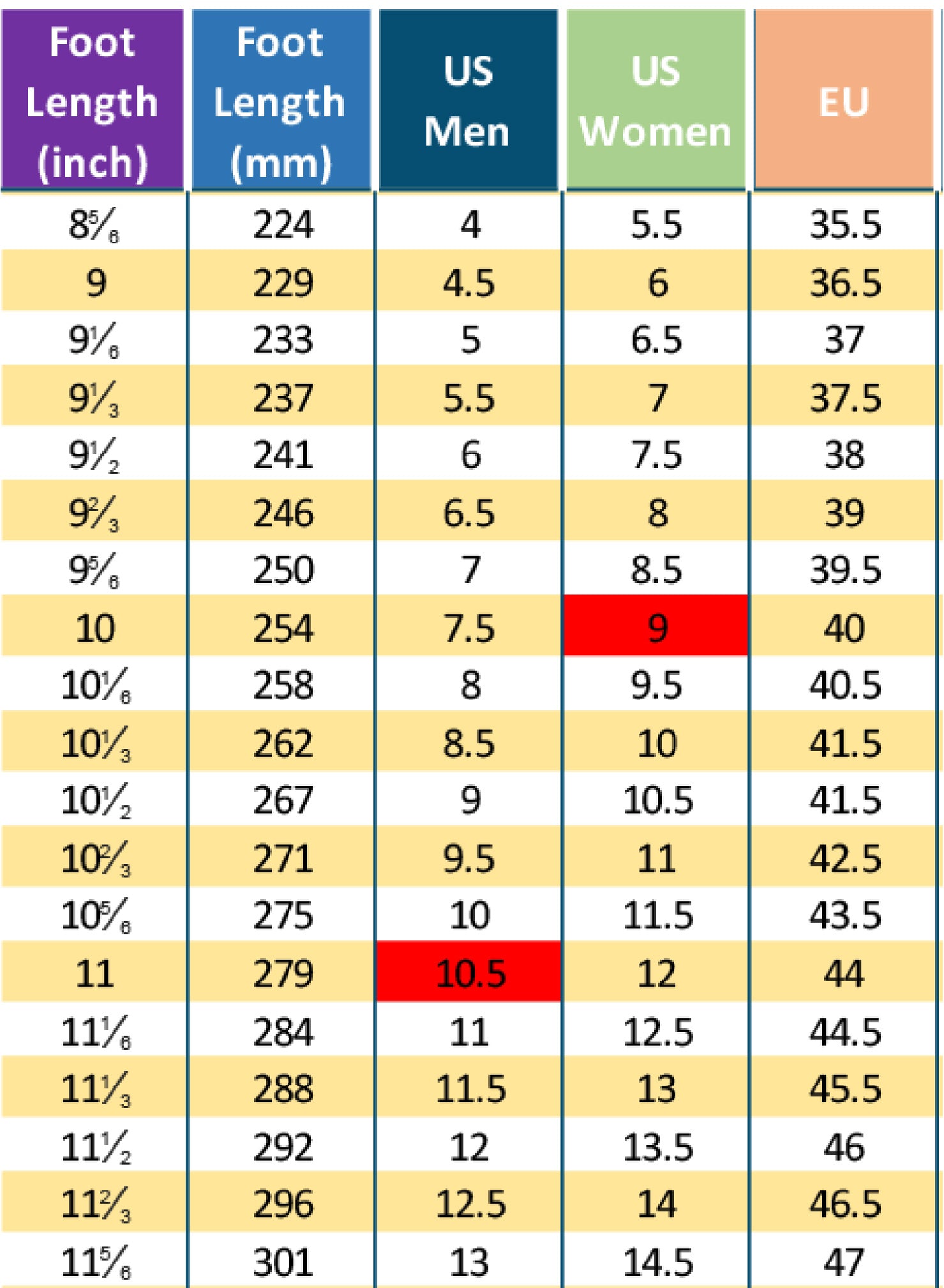
The conversion for men’s footwear is distinct. EU size 41, when applied to men’s shoes, typically aligns with a US size of 8 to 8.5. The reasoning behind this difference lies in the general anatomical distinctions between male and female feet. Men’s feet tend to be longer and narrower on average compared to women’s feet of the same numerical size. Therefore, the same EU measurement will correspond to a smaller US size for men.
- The 8 US Men’s Benchmark: A common conversion for EU 41 men’s shoes is US size 8. This is often the starting point for men seeking to understand the US equivalent.
- The 8.5 US Men’s Consideration: Similar to women’s sizing, some men might find a US 8.5 to be a more comfortable fit with EU 41, especially if they have slightly wider feet or prefer a bit more toe room.
- The Impact of Width: While EU sizing doesn’t explicitly denote width, the US system does. If an EU 41 men’s shoe feels a bit snug width-wise, it might be worth exploring options in a US men’s size 8.5 W (wide), if available, or considering a different brand with a slightly wider last.
Footwear Type: An Influential Factor
Beyond gender, the type of footwear significantly influences how a size 41 EU translates to a US size. The intended use and design of a shoe dictate the amount of “wiggle room” and overall fit desired.
- Athletic Shoes and Boots: For performance-oriented footwear like running shoes, hiking boots, or even casual sneakers, a precise fit is often crucial. This means that the conversion from EU 41 might lean towards the smaller end of the US range (e.g., US 9.5 women’s, US 8 men’s) to ensure stability and prevent slippage. The desire for a snug fit is paramount to avoid blisters and injuries during activity.
- Dress Shoes and Heels: In contrast, dress shoes, pumps, or sandals might offer a bit more flexibility in sizing. A US 10 women’s or US 8.5 men’s conversion for EU 41 might be more appropriate, especially if the shoe is meant to be worn for extended periods or with lighter socks. The goal here is comfort and a slightly less constrictive fit.
- Socks and Insoles: The thickness of the socks you intend to wear can also impact the fit. If you typically wear thick wool socks with your boots, you might want to size up slightly. Similarly, if you plan to use custom insoles, factor this into your conversion.
Strategies for Ensuring a Perfect Fit
Navigating the world of international shoe sizing can be a challenge, but with the right strategies, the frustration of ill-fitting footwear can be significantly minimized. The key lies in preparation, diligent research, and a willingness to engage with the available resources.
Leveraging Brand Sizing Charts and Fit Guides
As reiterated throughout this article, the most invaluable tool at your disposal is the brand’s official sizing chart. Most reputable footwear brands provide detailed conversion charts on their websites, often broken down by gender and sometimes even by specific product lines. These charts are typically based on extensive customer feedback and internal testing, making them the most accurate guide available.
- Locate the Sizing Information: Before making any purchase, navigate to the “Size Guide,” “Fit Information,” or “Sizing Help” section on the brand’s website.
- Cross-Reference Measurements: If you have measured your foot in centimeters or inches, directly cross-reference this measurement with the brand’s chart. This is far more reliable than relying on a general conversion.
- Read Customer Reviews: Many online retailers and brand websites feature customer reviews. Pay close attention to comments regarding sizing. Customers often share whether a particular shoe runs true to size, small, or large, providing real-world insights that can supplement the sizing chart.
The Role of Fit Technologies and Virtual Try-Ons
The evolution of e-commerce has brought forth innovative technologies designed to bridge the gap between online shopping and the inability to physically try on shoes. While not universally available, these tools can be incredibly helpful.
- Virtual Try-On Apps: Some brands and retailers are implementing augmented reality (AR) powered virtual try-on applications. These apps use your device’s camera to overlay a digital representation of the shoe onto your foot, giving you a visual approximation of the fit and style.
- AI-Powered Fit Predictors: More advanced systems employ artificial intelligence to analyze your past purchases, stated preferences, and even scanned foot measurements to recommend the most suitable size. These tools are becoming increasingly sophisticated and can offer a personalized sizing recommendation.
The Timeless Value of Trying On
Despite the advancements in technology, the most foolproof method for ensuring a perfect fit remains the classic act of trying on the shoes. When purchasing from a physical store, dedicate ample time to this process.
- Try on Later in the Day: Your feet tend to swell slightly throughout the day. Trying on shoes in the afternoon or evening will provide a more accurate representation of how they will fit during normal wear.
- Wear Appropriate Socks: If you intend to wear the shoes with specific types of socks, bring those socks with you to the store for the try-on.
- Walk Around: Don’t just stand still. Walk around the store, go up and down stairs if possible, and pay attention to any pressure points, rubbing, or slippage. The shoe should feel comfortable from the moment you put it on, with no significant break-in period required.
- Check the Toe Box: Ensure there is adequate space for your toes to wiggle freely. You should have about a thumb’s width of space between your longest toe and the front of the shoe.
Conclusion: Navigating Sizing with Confidence
The question “What is a size 41 in US?” is more than a simple conversion; it’s an invitation to understand the intricacies of global footwear sizing. By recognizing the differences between EU and US systems, considering the influence of gender and shoe type, and employing effective strategies for measurement and research, consumers can approach footwear purchases with newfound confidence. While the journey to a perfect fit may require a little extra effort, the reward of comfortable, stylish, and well-fitting shoes is well worth the investment in understanding these often-overlooked details. Always prioritize accurate measurement, consult brand-specific guides, and when in doubt, try before you buy. This proactive approach ensures that your shoe size is a descriptor of your style, not a barrier to it.
aViewFromTheCave is a participant in the Amazon Services LLC Associates Program, an affiliate advertising program designed to provide a means for sites to earn advertising fees by advertising and linking to Amazon.com. Amazon, the Amazon logo, AmazonSupply, and the AmazonSupply logo are trademarks of Amazon.com, Inc. or its affiliates. As an Amazon Associate we earn affiliate commissions from qualifying purchases.