
In the intricate world of construction management, large-scale commercial real estate development, and complex project finance, maintaining a precise pulse on capital flow is essential. For general contractors, subcontractors, and property owners, the financial health of a project hinges on a document known as the Schedule of Values (SOV). While it may sound like a bureaucratic formality, the SOV is the bedrock of payment applications, cash flow projections, and project transparency. It is the primary instrument that bridges the gap between completed physical work and the disbursement of funds.
The Core Definition and Purpose of the Schedule of Values
At its simplest level, a Schedule of Values is an itemized document that lists the individual components of a construction project and assigns a specific dollar amount to each. This list represents the total contract sum, broken down into manageable tasks or trade scopes, which, when added together, equal the entire cost of the contract.
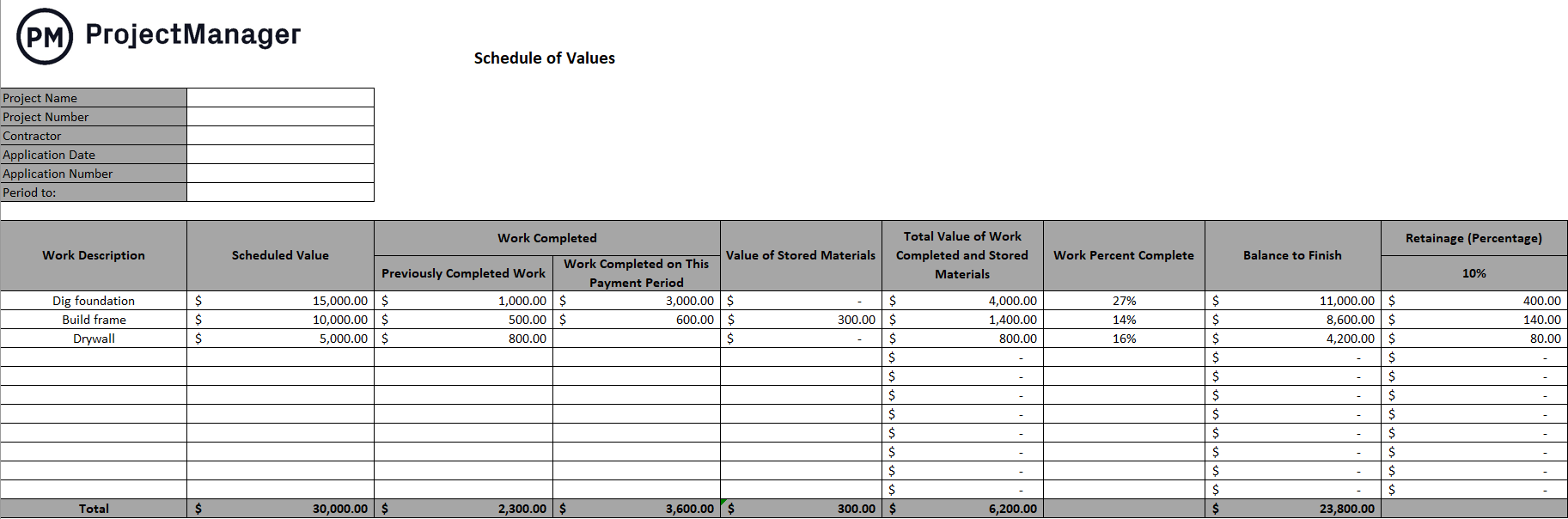
The SOV serves as the foundational “budget map” for the project. By breaking a multi-million-dollar contract into smaller, measurable segments—such as site preparation, foundation work, structural steel, electrical rough-in, and finishing—all stakeholders can speak the same language regarding project progress. Instead of debating whether a project is “half-finished” in a subjective sense, the SOV allows the team to look at the line items and calculate exactly what percentage of the scope has been completed based on the predetermined valuations.
The Mechanism of Payment Applications
The primary utility of the SOV is its role in the monthly application for payment (often filed via forms like the AIA G702 and G703). When a contractor performs work, they do not simply bill for the total amount; they bill based on the progress recorded against the items in the SOV. This structure prevents overbilling and ensures that the client is only paying for work that has been verified as complete. It provides a clear audit trail that links every dollar requested to a specific, measurable phase of the project, significantly reducing financial disputes between the owner and the contractor.
Facilitating Cash Flow Management
For a general contractor, cash flow is the lifeblood of a business. Without a well-structured SOV, managing the timing of payments to dozens of subcontractors becomes an operational nightmare. The SOV allows the project manager to track the “burn rate” of the budget against the physical timeline. It helps the contractor understand when they need to front-load capital for materials and when they can expect cash inflows from the project owner. In this sense, the SOV is as much a strategic financial tool as it is a reporting requirement.
Structuring the Schedule of Values for Maximum Efficacy
Creating an effective Schedule of Values is not merely a data-entry task; it is a strategic exercise. A poorly constructed SOV can lead to cash flow gaps, funding shortages during the middle of a project, and increased risk of liens. Conversely, a well-optimized SOV provides a smooth, predictable financial runway for the duration of the build.
Categorization and Scope Definition
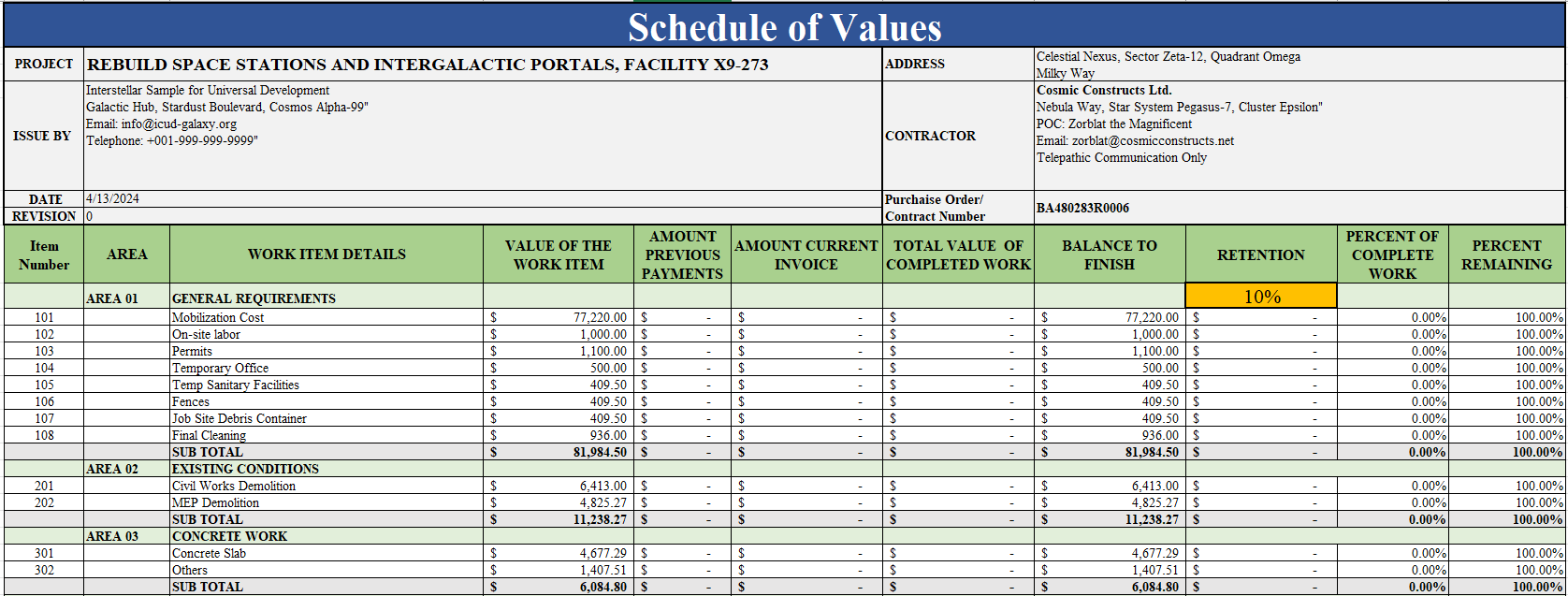
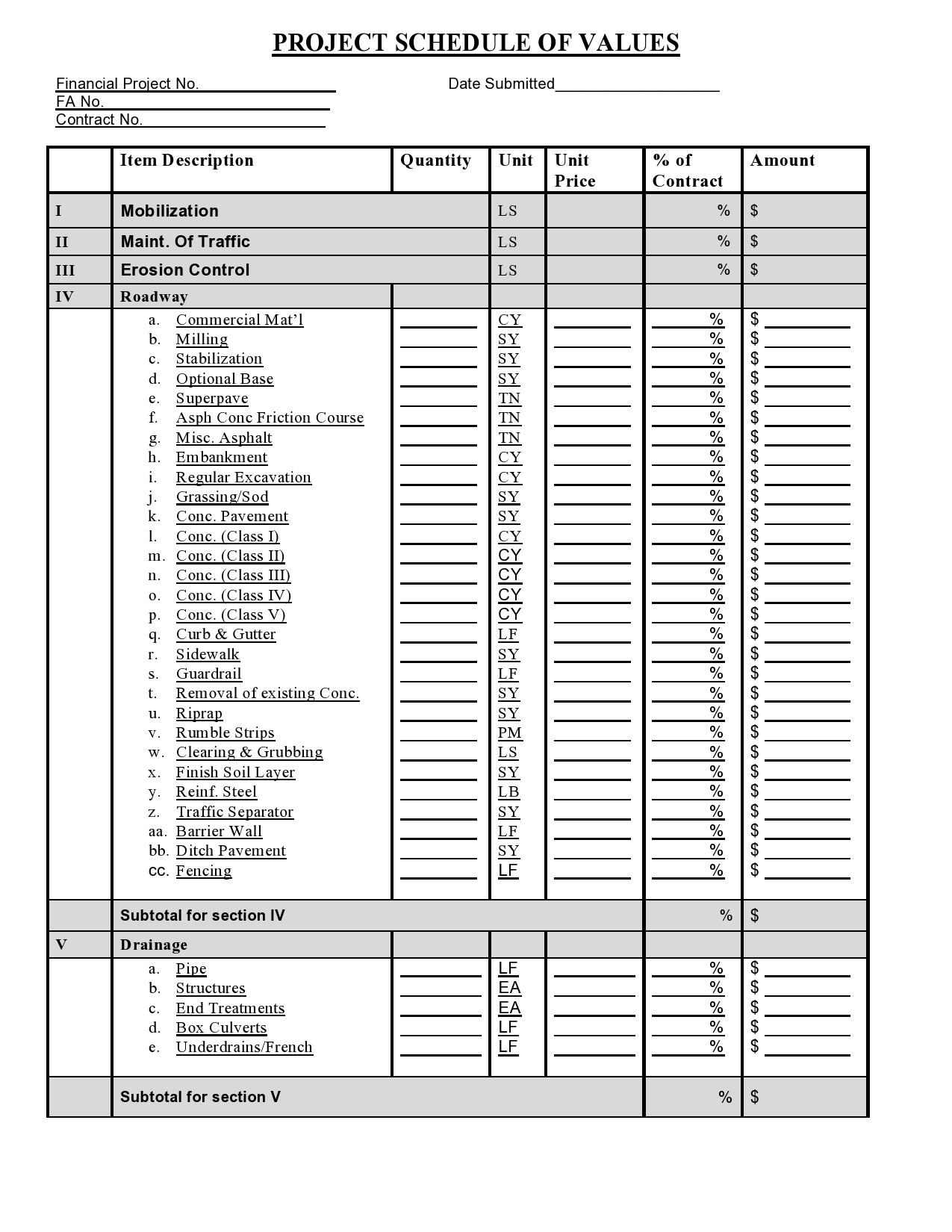
The most effective SOVs mirror the project’s actual construction sequence. Generally, the line items should follow the MasterFormat divisions, which categorize work by trade or system (e.g., Concrete, Metals, Wood, Thermal and Moisture Protection, etc.). By aligning the SOV with these standard industry categories, project managers can easily compare the budget to subcontractor bids and purchase orders.
It is also vital to include non-construction items. A comprehensive SOV should account for mobilization, general conditions, insurance, permits, and retainage. If these indirect costs are ignored or lumped into construction line items, it becomes difficult to track the true cost of project overhead, leading to inaccurate forecasting.
Avoiding the “Front-Loading” Trap
“Front-loading” is a common practice where contractors assign higher values to early-stage work (such as demolition or excavation) to ensure they receive more cash early in the project. While this can help a contractor maintain liquidity, it is often viewed with suspicion by project owners and lenders. An aggressive SOV can lead to a situation where the remaining balance of the contract does not cover the costs of the final, most expensive phases of the build.
When drafting an SOV, professionals should aim for a balanced distribution that reflects the actual labor and material costs associated with each phase. Lenders and owners typically review the SOV closely during the initial contract phase; a balanced, defensible SOV builds trust, whereas an obviously manipulated one can lead to project delays or even contract termination.
The Role of the SOV in Stakeholder Transparency and Risk Mitigation
Construction projects are inherently risky. When thousands of moving parts, multiple tiers of subcontractors, and millions of dollars are involved, disputes are common. The Schedule of Values acts as the neutral arbiter of truth in these scenarios.
Mitigating Payment Disputes
When a subcontractor finishes their work, they want to be paid immediately. The SOV provides the definitive line item against which that work is measured. If there is a dispute regarding the value of the work performed, the parties can return to the original SOV to determine the agreed-upon value. This reduces subjectivity and keeps the project moving forward without stopping the flow of capital to the trades that have fulfilled their obligations.
Assisting Lenders and Property Owners
If the project is financed, the bank or lender will require an approved SOV before releasing any funds. They need to see a detailed, transparent breakdown to verify that the project is being managed professionally. By providing a clear line-item view, the contractor gives the lender confidence that the project is on track and that the loan is being used for the intended scope. For the property owner, the SOV provides a bird’s-eye view of how much of their investment has been converted into tangible assets, allowing them to manage their own interest payments and financial planning with greater precision.
Accounting for Retainage
Retainage—the portion of the contract price withheld from a contractor until the project is substantially complete—is usually tracked directly within the SOV. This ensures that the owner has financial protection against poor workmanship or unfinished tasks. The SOV makes this deduction transparent, showing both the gross value earned and the net amount payable after retainage is accounted for. This level of clarity prevents accounting errors and ensures that all parties understand the exact balance remaining on the project, including the “close-out” money held back for final punch-list items.
Evolving Best Practices: Digital Transformation of the SOV
In the modern construction environment, the days of static Excel spreadsheets for managing the Schedule of Values are rapidly fading. While spreadsheets have served the industry for decades, they are prone to human error, lack real-time integration with accounting software, and make it difficult to manage complex change orders.
Today, project management software suites are revolutionizing how the SOV is handled. By integrating the SOV into a cloud-based platform, contractors can link payment applications directly to field progress reports. When a field supervisor verifies that a task is complete via a mobile app, the SOV can be updated in real-time, triggering automated notifications for the accounting department. This level of synchronization reduces the “payment gap”—the time between submitting an application and receiving the funds—which can significantly improve a contractor’s ability to pay subcontractors on time and maintain healthy credit relationships.
Furthermore, digital tools allow for more robust change-order management. In a traditional spreadsheet, adding a change order to an SOV can be messy, often leading to broken formulas or misaligned line items. Modern platforms allow for seamless revisions, maintaining the integrity of the original contract values while clearly documenting the impact of additions or deductions. This creates a living document that stays relevant from the groundbreaking ceremony to the final handover.
Ultimately, the Schedule of Values is more than just a list of numbers. It is a communication tool, a financial safeguard, and a project management roadmap. For anyone involved in the business of construction, mastering the art and science of the SOV is essential for scaling operations, ensuring financial stability, and fostering the professional trust required to complete complex, multi-million-dollar developments. By treating the SOV with the rigor it deserves, stakeholders ensure that their projects remain financially sound from start to finish.
aViewFromTheCave is a participant in the Amazon Services LLC Associates Program, an affiliate advertising program designed to provide a means for sites to earn advertising fees by advertising and linking to Amazon.com. Amazon, the Amazon logo, AmazonSupply, and the AmazonSupply logo are trademarks of Amazon.com, Inc. or its affiliates. As an Amazon Associate we earn affiliate commissions from qualifying purchases.