
In the landscape of American retirement planning, the 401(k) remains the gold standard for private-sector savings. However, for many small to mid-sized business owners, managing a traditional 401(k) can be a regulatory minefield. The Internal Revenue Service (IRS) mandates strict rules to ensure that retirement plans do not unfairly favor owners and high-income executives over rank-and-file employees. This is where the Safe Harbor 401(k) comes into play.
A Safe Harbor 401(k) is a specific type of retirement plan designed to simplify administration and guarantee compliance with federal non-discrimination laws. By committing to certain employer contribution structures, a company can bypass the complex annual testing that often limits how much top earners can save. For the business owner, it offers peace of mind and higher personal contribution limits; for the employee, it guarantees a meaningful employer contribution and immediate ownership of those funds.
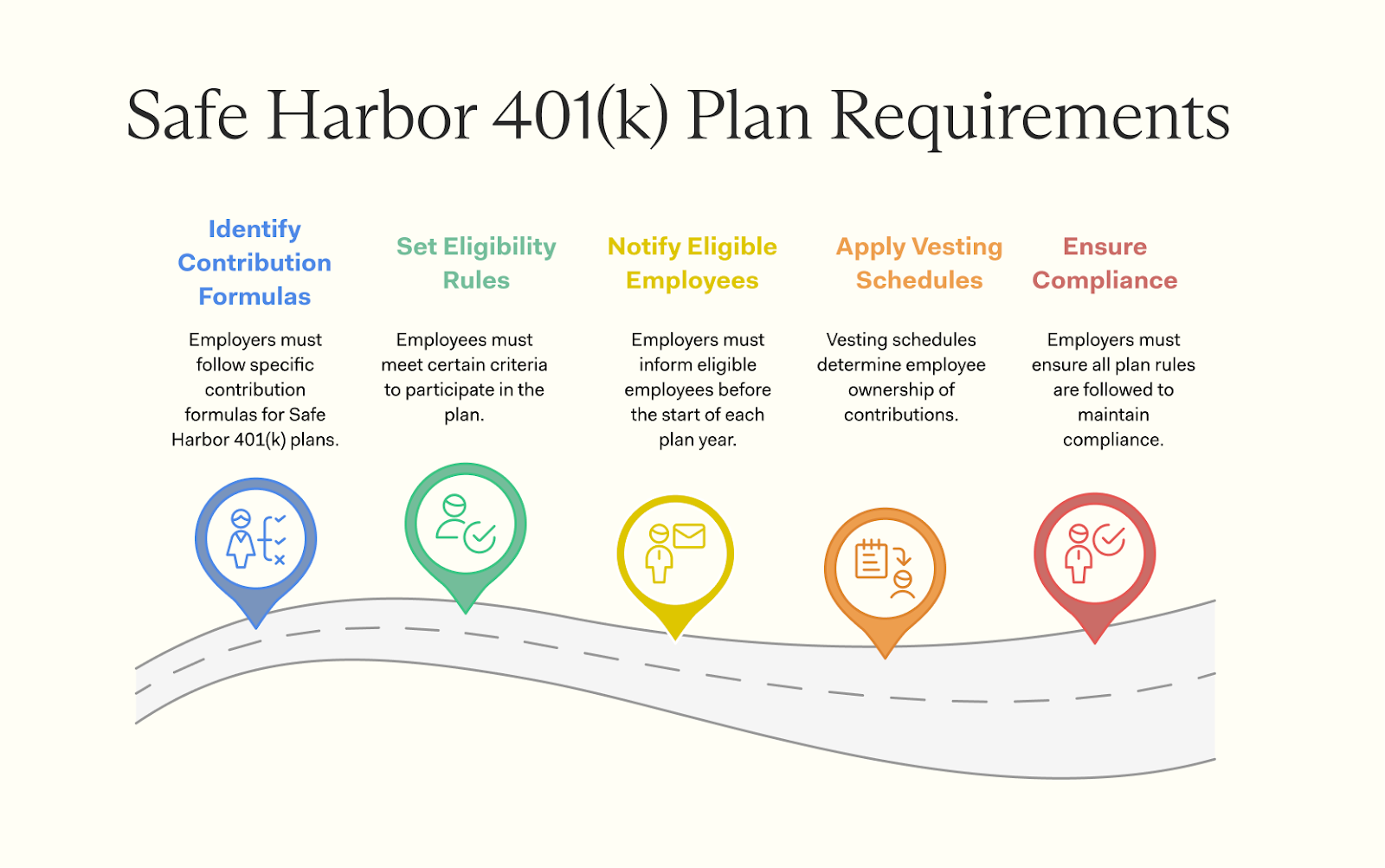
The Fundamentals of Safe Harbor 401(k) Plans
To understand the Safe Harbor 401(k), one must first understand the problem it was created to solve. In a traditional 401(k), the plan must prove every year that it serves all employees equitably. If the “rank-and-file” employees do not participate at a high enough rate, the amount that “Highly Compensated Employees” (HCEs) can contribute is legally restricted.
What Defines a Safe Harbor Plan?
At its core, a Safe Harbor 401(k) is a plan that includes a required employer contribution that is 100% vested at the time it is made. In exchange for providing this guaranteed contribution to employees, the IRS allows the employer to automatically pass the annual non-discrimination tests. These tests—specifically the Actual Deferral Percentage (ADP) and Actual Contribution Percentage (ACP) tests—are the primary regulatory hurdles that traditional plans face.
By choosing a Safe Harbor design, the employer “sails into a safe harbor,” protected from the risk of failing these tests. This structure ensures that as long as the employer follows the contribution rules and provides proper notice to staff, the plan is deemed compliant by default.
Why the “Safe Harbor” Designation Matters
For a business owner or a Highly Compensated Employee, the Safe Harbor designation is a gateway to maximizing personal wealth. In a traditional plan that fails its non-discrimination tests, HCEs might be forced to take “corrective distributions”—meaning the money they put into their 401(k) is returned to them as taxable income, and they lose the tax-deferred growth potential.
The Safe Harbor provision eliminates this uncertainty. It allows owners and key employees to contribute the maximum amount allowed by law (currently $23,000 for 2024, or $30,500 for those over 50) regardless of how much their staff chooses to save. This makes it an essential tool for high-earning professionals looking to reduce their taxable income while aggressively building a retirement nest egg.
Navigating Non-Discrimination Testing and Compliance
Compliance is the “why” behind the Safe Harbor 401(k). The IRS is fundamentally concerned with fairness; they do not want retirement plans to function as tax shelters exclusively for the wealthy. To prevent this, they established rigorous annual checkpoints.
The ADP and ACP Tests Explained
The Actual Deferral Percentage (ADP) test compares the average percentage of salary that HCEs (defined generally as those owning more than 5% of the business or earning more than $155,000 in 2024) defer into the plan versus the average percentage deferred by non-HCEs. Generally, the HCE group cannot exceed the non-HCE group’s average by more than two percentage points.
The Actual Contribution Percentage (ACP) test is similar but focuses on the employer matching contributions and any after-tax contributions. Additionally, there is the “Top-Heavy” test, which ensures that more than 60% of the plan’s total assets are not held by “key employees.” For a growing business where the owners are the primary savers, failing these tests is almost an inevitability without the Safe Harbor provision.
How Safe Harbor Provisions Bypass Compliance Hurdles
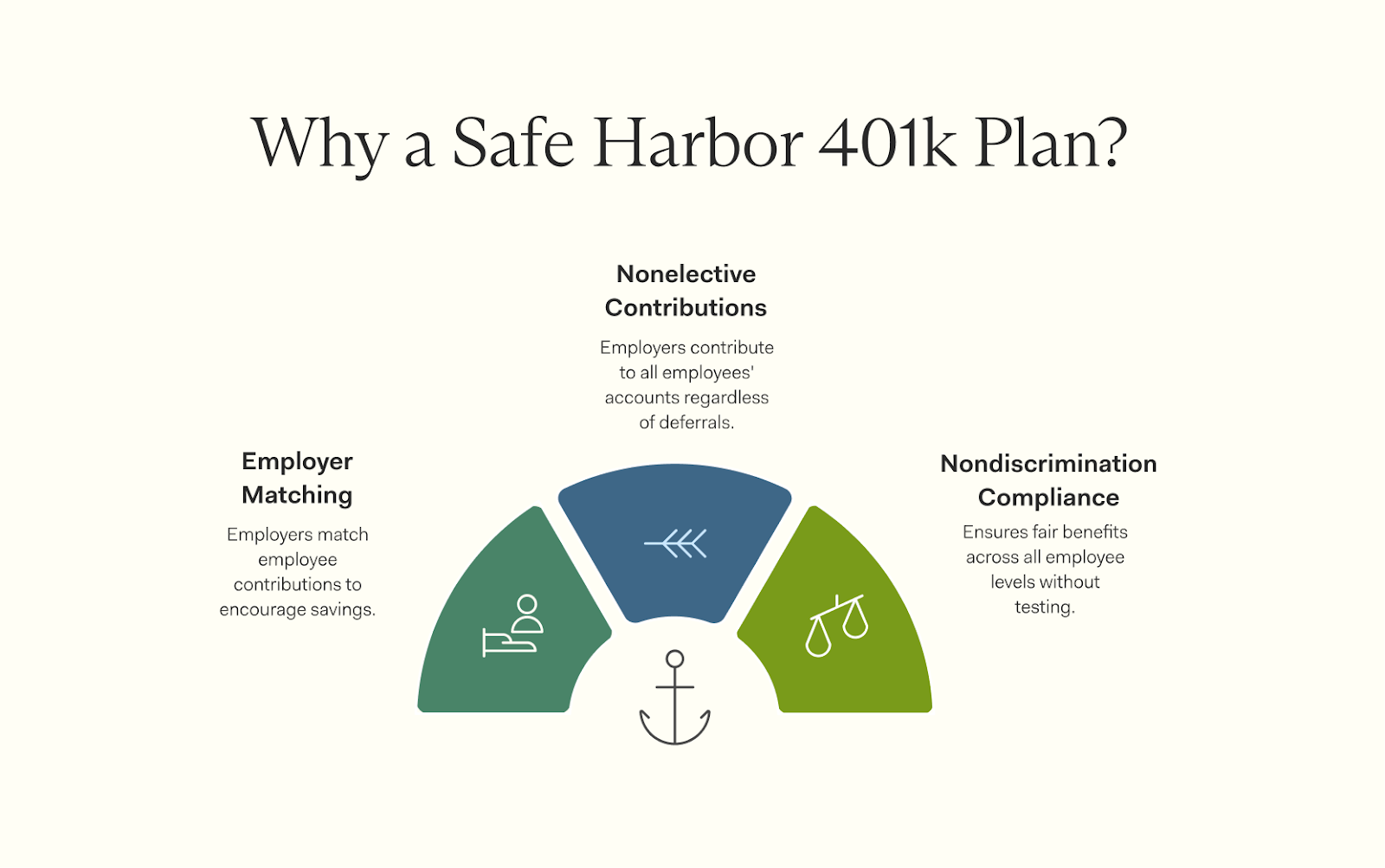
When a company adopts a Safe Harbor 401(k), the IRS waives the ADP and ACP tests. Because the employer has already committed to a significant, fully-vested contribution for all eligible employees, the government assumes the plan is sufficiently “fair.”
This bypass saves the company significant administrative time and money. Traditional plans require detailed annual audits and data collection to perform these tests. By moving to a Safe Harbor model, a business can reduce the overhead costs associated with plan administration and eliminate the stress of potential year-end corrections. It provides a predictable regulatory environment where the rules of participation are clear from day one.
Employer Contribution Options and Requirements
To earn the “Safe Harbor” status, an employer must choose one of several IRS-approved contribution formulas. These contributions are the “price” the employer pays to avoid non-discrimination testing.
Basic Match vs. Enhanced Match
The most common way to satisfy Safe Harbor requirements is through a matching contribution. There are two primary variations:
- Basic Safe Harbor Match: The employer matches 100% of the first 3% of an employee’s compensation, plus 50% of the next 2% of compensation. Effectively, if an employee contributes 5% of their salary, the employer contributes 4%.
- Enhanced Safe Harbor Match: This must be at least as generous as the basic match at every level. A common version is a 100% match on the first 4% of compensation.

Matching contributions only go to employees who choose to defer part of their own paycheck into the 401(k). If an employee doesn’t contribute, the employer doesn’t pay.
The Non-Elective Contribution Model
A different approach is the “Non-Elective” contribution. Under this model, the employer contributes at least 3% of compensation to every eligible employee’s account, regardless of whether the employee contributes their own money.
While this may seem more expensive, it is often preferred by businesses with low employee participation. It ensures that every team member receives a retirement benefit, which can be a powerful recruitment and retention tool. From a business perspective, it is a “set it and forget it” model that guarantees compliance regardless of employee behavior.
Vesting Schedules: The Immediate Ownership Rule
One of the most significant differences between a traditional 401(k) and a Safe Harbor 401(k) is the vesting schedule. In a traditional plan, employers can use a “vesting schedule” to encourage loyalty, where an employee might have to stay for five or six years before they fully own the employer’s matching contributions.
In a Safe Harbor plan, all Safe Harbor contributions—whether matching or non-elective—must be 100% vested immediately. This means the moment the money hits the employee’s account, it belongs to them. If the employee quits the next day, they take that money with them. This is a major benefit for employees and makes the plan a highly competitive part of a total compensation package.
Strategic Benefits for Small Businesses and High Earners
The Safe Harbor 401(k) is not just a compliance tool; it is a strategic financial instrument. For small businesses, startups, and professional practices (like law firms or medical groups), the benefits extend far beyond avoiding IRS paperwork.
Maximizing Contributions for Highly Compensated Employees (HCEs)
In many small businesses, the owners are the ones most motivated to save for retirement. If they have a traditional 401(k) and their staff isn’t participating, the owners might find themselves capped at a 1% or 2% contribution rate to pass the ADP test.
By implementing a Safe Harbor 401(k), the owners can contribute the full IRS maximum. If they are over 50, they can also make catch-up contributions. For a business owner in a high tax bracket, the ability to put away an extra $20,000+ per year in tax-deferred accounts can result in thousands of dollars in annual tax savings.
Reducing Administrative Overhead and Risk
Running a business is complicated enough without the fear of an IRS audit or the headache of “testing season.” Traditional 401(k) plans require constant monitoring of participation rates. If a few high-saving employees join the company or a few low-saving employees leave, the plan’s compliance status can shift.
Safe Harbor plans provide a level of administrative “insulation.” Because the plan is exempt from the most rigorous tests, the record-keeping is simpler, and the risk of unexpected plan failures is virtually eliminated. This allows business owners to focus on growth rather than retirement plan forensics.
Implementation and Key Deadlines
Transitioning to a Safe Harbor 401(k) requires careful timing and adherence to specific IRS communication rules. It is not a change that can be made overnight.
Setting Up a New Plan or Converting an Existing One
For a new business, a Safe Harbor 401(k) must generally be established by October 1st to be effective for that calendar year. This allows for the minimum three months of participation required by the IRS.
For an existing traditional 401(k), the conversion to a Safe Harbor plan usually happens at the start of a new plan year (January 1st for calendar-year plans). However, recent legislative changes (such as the SECURE Act) have made it easier to add a 3% non-elective Safe Harbor provision mid-year, or even a 4% non-elective provision as late as the end of the following year, providing employers with more flexibility than ever before.
Important Notice Requirements for Employees
Transparency is a hallmark of the Safe Harbor framework. Employers are required to provide a “Safe Harbor Notice” to all eligible employees. This document must be distributed 30 to 90 days before the start of each plan year.
The notice explains the employees’ rights under the plan, the formula the employer has chosen for contributions, and how employees can make their own deferrals. Failure to provide this notice can disqualify the plan’s Safe Harbor status for the year, forcing the company back into the world of non-discrimination testing. Therefore, maintaining a strict calendar for these communications is vital for the plan’s success.
In conclusion, the Safe Harbor 401(k) represents a “win-win” in the world of business finance. While it requires a financial commitment from the employer in the form of guaranteed, immediately-vested contributions, the rewards—compliance simplicity, maximized savings for high earners, and a robust benefit for the workforce—make it one of the most effective retirement vehicles available today. For any business owner looking to balance corporate responsibility with personal financial growth, the Safe Harbor 401(k) is an option that warrants serious consideration.
aViewFromTheCave is a participant in the Amazon Services LLC Associates Program, an affiliate advertising program designed to provide a means for sites to earn advertising fees by advertising and linking to Amazon.com. Amazon, the Amazon logo, AmazonSupply, and the AmazonSupply logo are trademarks of Amazon.com, Inc. or its affiliates. As an Amazon Associate we earn affiliate commissions from qualifying purchases.