
In the intricate landscape of modern software architecture, where applications are no longer monolithic giants but rather constellations of interconnected services, the ability to communicate efficiently and reliably between these components is paramount. At the heart of this communication lies a powerful and often unsung hero: the Message Queue, or MQ.
A Message Queue is more than just a temporary holding area for data; it’s a fundamental architectural pattern that enables asynchronous communication and decoupling between different parts of a system. From massive enterprise applications handling millions of transactions per second to nimble microservices powering the latest web applications, MQs provide the resilience, scalability, and flexibility necessary for today’s complex digital ecosystems. Understanding what an MQ is, how it works, and why it’s so vital is essential for any developer, architect, or technology leader navigating the challenges of distributed computing.

The Fundamental Concept of Message Queues
At its core, a Message Queue is a communication mechanism that allows different software applications or components to exchange information. It acts as an intermediary, storing messages until they can be processed by their intended recipient. This simple concept belies a profound impact on system design, primarily through its ability to facilitate asynchronous communication and strong decoupling.
Decoupling and Asynchronous Communication
Imagine a restaurant kitchen. If every order had to be fulfilled immediately and directly by the chef who took it, the system would quickly grind to a halt during peak hours. Instead, orders are written down and placed in a queue for the kitchen staff to pick up when they are ready. This is the essence of a Message Queue.
-
Decoupling: In software, decoupling means that two components can operate independently without needing to know the immediate state or existence of the other. With an MQ, a “producer” application can send a message to a queue without needing to know if a “consumer” application is currently active or how it will process the message. The producer simply “drops off” the message and moves on to other tasks. This reduces dependencies, making systems easier to develop, deploy, and maintain. If one component fails, it doesn’t necessarily bring down the entire system.
-
Asynchronous Communication: Traditional, synchronous communication (like an HTTP API call) requires the sender to wait for a response from the receiver before proceeding. This can block processes and introduce latency. Asynchronous communication, facilitated by MQs, allows the sender to send a message and continue its work immediately, without waiting for the message to be processed. The receiver will pick up and process the message at its own pace. This non-blocking nature significantly improves system responsiveness and throughput.
The Role of Messages and Queues
The two primary elements in an MQ system are “messages” and “queues.”
-
Messages: A message is a packet of data that a producer sends to a queue. It can be anything from a simple string to a complex JSON object representing an event (e.g., “user registered,” “order placed,” “email sent”). Messages typically contain a payload (the actual data) and metadata (like timestamps, sender ID, or routing information).
-
Queues: A queue is a linear data structure that holds messages in the order they were received. Think of it as a waiting line. Messages are added to the back of the queue by producers and removed from the front by consumers. Most MQ systems provide mechanisms for message persistence, meaning messages are stored on disk and survive system restarts, ensuring data is not lost even if a server crashes. This is critical for reliability.
Why Message Queues are Indispensable in Modern Architecture
The benefits of incorporating Message Queues into a system architecture extend far beyond mere communication, touching upon critical aspects of system design like scalability, reliability, and performance.
Enhancing Scalability and Reliability
Modern applications often experience unpredictable loads. A sudden surge in user activity, an unexpected marketing campaign, or a seasonal peak can quickly overwhelm system resources if not properly managed.
-
Handling Load Spikes: MQs act as a buffer. When a producer generates messages faster than a consumer can process them, the queue simply grows. This allows the system to absorb traffic spikes without collapsing. As the load subsides, consumers can gradually catch up. You can also add more consumer instances to process messages concurrently, scaling processing capacity horizontally.
-
Retries and Failure Isolation: If a consumer fails while processing a message, many MQ systems allow the message to be returned to the queue, making it available for another consumer (or the same one after recovery) to retry processing. This mechanism, combined with Dead-Letter Queues (DLQs) for unprocessable messages, greatly enhances the reliability of message delivery and processing. Furthermore, because components are decoupled, a failure in one consumer does not cascade and affect other parts of the system.
Facilitating Microservices and Event-Driven Architectures
The rise of microservices, where large applications are broken down into small, independent, and loosely coupled services, has made Message Queues an architectural cornerstone.
-
Inter-Service Communication: In a microservices ecosystem, services often need to communicate with each other without direct HTTP calls to maintain independence. MQs provide an elegant solution. A service can publish an event (as a message) to a queue, and any number of other services interested in that event can consume it. This enables both point-to-point communication and more complex publish/subscribe patterns.
-
Event-Driven Architectures: MQs are central to event-driven architectures (EDAs), where the flow of an application is determined by events. When an event occurs (e.g., a new user signs up), a message is sent to a queue. This message triggers actions in various services (e.g., send welcome email, create user profile, update analytics dashboard), all asynchronously and independently. This promotes responsiveness and makes systems highly adaptable to changes.
Improving Performance and User Experience
By offloading computationally intensive tasks and enabling faster responses, MQs directly contribute to a better user experience.
-
Offloading Tasks: Imagine an e-commerce website where placing an order triggers several backend processes: updating inventory, sending a confirmation email, notifying the warehouse, and processing payment. If all these were synchronous, the user would have to wait a long time. With MQs, the order service can quickly send a “order placed” message to a queue and immediately respond to the user with a confirmation, allowing them to continue browsing. The other tasks are then processed asynchronously in the background.
-
Faster Response Times: By converting synchronous operations into asynchronous ones, MQs reduce the immediate workload on critical paths, allowing user-facing services to respond much faster. This leads to a smoother, more responsive application and a more satisfied user.
Key Characteristics and Components of an MQ System
While specific implementations vary, most Message Queue systems share common components and characteristics that define their operation.
Producers, Consumers, and Brokers
These are the fundamental actors in an MQ system:
-
Producers: Applications or services that create and send messages to a queue. They are responsible for formatting the message and ensuring it reaches the queue.
-
Consumers: Applications or services that retrieve and process messages from a queue. They subscribe to queues and execute specific logic when a message arrives.
-
Broker (or Message Broker): The central component of an MQ system. It’s the server that manages the queues, stores messages, routes them to the correct destinations, and handles communication between producers and consumers. Examples include RabbitMQ, Apache Kafka, and AWS SQS.
Message Persistence and Durability
A critical feature for reliable systems is ensuring messages are not lost.
-
Persistence: Many MQ systems can store messages on disk rather than just in memory. This means that if the message broker crashes or restarts, the messages in the queues are not lost and will be available for processing once the broker comes back online. This guarantees “at-least-once” delivery semantics, where a message is guaranteed to be delivered at least once, even if failures occur.
-
Durability: Refers to the queue’s ability to survive broker restarts. A durable queue will persist across outages, retaining its messages and configurations.
Acknowledgment Mechanisms
To ensure messages are successfully processed, MQ systems employ acknowledgment (ACK) mechanisms.
-
When a consumer successfully processes a message, it sends an acknowledgment back to the broker.
-
Upon receiving the ACK, the broker removes the message from the queue.
-
If a consumer fails before acknowledging a message, or if a negative acknowledgment (NACK) is sent, the message can be redelivered to another consumer (or the same one) after a certain timeout, preventing data loss due to transient consumer failures.
Publish/Subscribe vs. Point-to-Point Messaging
These are the two primary communication patterns facilitated by MQs:
-
Point-to-Point Messaging (Queues): In this model, messages are sent to a specific queue, and only one consumer receives and processes each message. Once a message is consumed, it’s removed from the queue. This is ideal for task distribution, where multiple workers can process a backlog of tasks.
-
Publish/Subscribe Messaging (Topics): In this model, producers publish messages to a “topic” (or “exchange”), and multiple consumers (subscribers) can receive a copy of that same message. This is perfect for broadcasting events to multiple interested parties simultaneously, such as sending notifications to different services when a user profile is updated.
Popular Message Queue Technologies and Their Applications
The market offers a variety of Message Queue technologies, each with its strengths, weaknesses, and ideal use cases.
RabbitMQ: The Robust Open-Source Option
-
Technology: Built on Erlang, implements the Advanced Message Queuing Protocol (AMQP).
-
Strengths: Highly reliable, flexible routing capabilities, excellent developer tooling, mature and widely adopted. Supports both point-to-point and publish/subscribe.
-
Applications: General-purpose messaging, task queues, web hooks, real-time messaging, IoT device communication. It’s a solid choice for microservices architectures that need flexible message routing and guaranteed delivery.
Apache Kafka: High-Throughput Stream Processing
-
Technology: Distributed streaming platform, designed as a distributed commit log.
-
Strengths: Extremely high throughput, fault-tolerant, horizontally scalable, ideal for real-time data streams and event sourcing. Messages are not removed after consumption, allowing multiple consumers to read the same message stream independently.
-
Applications: Real-time analytics, log aggregation, event sourcing, stream processing pipelines, big data integration, highly scalable messaging for critical business processes.
Amazon SQS/SNS: Cloud-Native Simplicity
-
Technology: Fully managed, highly scalable, and reliable cloud-based messaging services from AWS.
-
Strengths: Zero operational overhead (no servers to manage), seamless integration with other AWS services, high scalability and availability, cost-effective. SQS (Simple Queue Service) for point-to-point, SNS (Simple Notification Service) for publish/subscribe.
-
Applications: Decoupling microservices in AWS, fan-out messaging, distributed queues for batch jobs, mobile push notifications (SNS). Ideal for cloud-native applications seeking minimal management.
IBM MQ: Enterprise-Grade Reliability
-
Technology: A traditional, commercial messaging middleware.
-
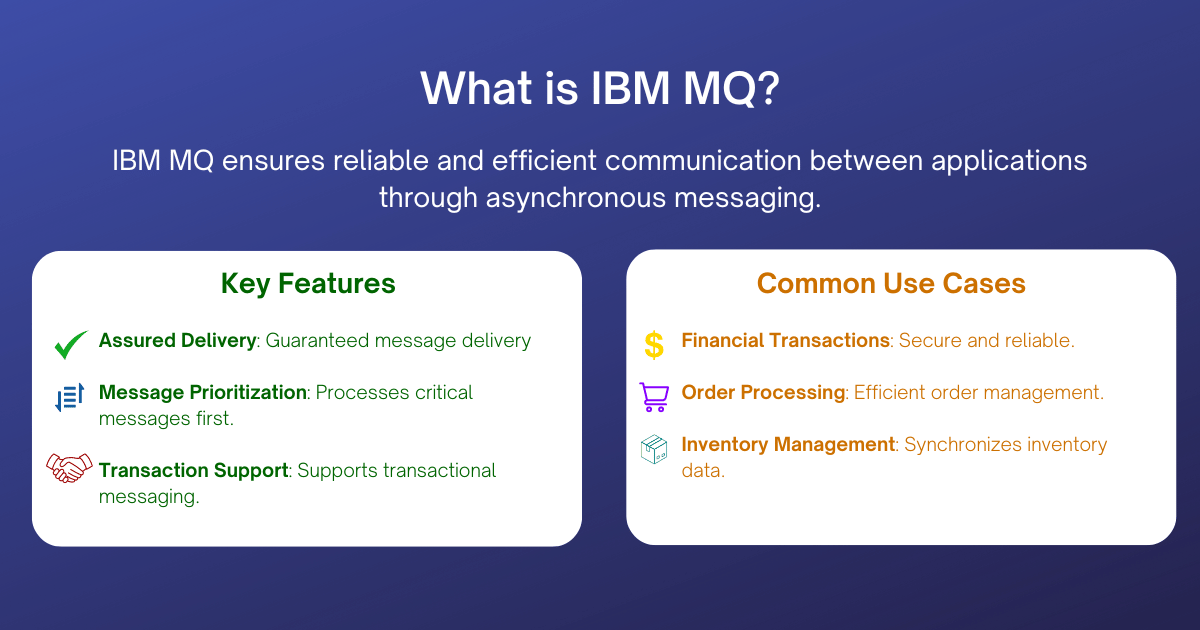
Strengths: Unrivaled reliability, robust security features, extensive transactional support, widely used in financial services and other mission-critical enterprise environments.
-
Applications: Enterprise application integration, financial transactions, payment processing, guaranteed message delivery for critical business operations, often used in hybrid cloud scenarios.
Implementing and Best Practices for Message Queues
Successfully integrating MQs into your architecture requires careful planning and adherence to best practices.
Choosing the Right MQ for Your Needs
The choice of MQ depends heavily on your specific requirements:
-
Scale and Throughput: For extremely high throughput and real-time data streams, Kafka is often preferred. For more moderate loads with complex routing, RabbitMQ might be better.
-
Latency: Consider whether you need ultra-low latency or if some buffering is acceptable.
-
Features: Do you need advanced routing, publish/subscribe, stream processing, or simply basic queuing?
-
Operational Overhead: Managed services like AWS SQS/SNS reduce operational burden, while self-hosted options like RabbitMQ or Kafka offer more control but require more expertise.
-
Cost: Licensing, infrastructure, and management costs can vary significantly.
Designing for Idempotency and Error Handling
Even with reliable MQs, messages can sometimes be delivered more than once (e.g., due to retries).
-
Idempotency: Design your consumers to be idempotent, meaning processing the same message multiple times has the same effect as processing it once. This is crucial for avoiding data corruption or duplicate actions.
-
Dead-Letter Queues (DLQs): Configure DLQs to capture messages that cannot be processed after a certain number of retries. This allows for manual inspection, debugging, and eventual reprocessing of problematic messages, preventing them from blocking the main queue.
-
Circuit Breakers and Retries: Implement circuit breaker patterns and exponential backoff for consumer retries to prevent overwhelming downstream services and to allow transient failures to resolve.
Monitoring and Management
An MQ system is a critical component and requires diligent monitoring.
-
Visibility: Monitor queue sizes, message rates (in/out), consumer lag, error rates, and resource utilization (CPU, memory, disk I/O) of your broker.
-
Alerting: Set up alerts for anomalies like rapidly growing queues (indicating a consumer bottleneck), high error rates, or broker downtime.
-
Tooling: Utilize the management dashboards and APIs provided by your chosen MQ technology to gain insights and troubleshoot issues.

Conclusion
Message Queues have evolved from a niche enterprise tool into an indispensable component of modern, distributed, and scalable software architectures. By enabling asynchronous communication and decoupling, they provide the resilience, flexibility, and performance necessary to build robust applications that can withstand high loads and adapt to change. Whether you’re building microservices, processing real-time data streams, or simply need to reliably distribute tasks across a distributed system, understanding and effectively leveraging Message Queues is a fundamental skill in today’s technology landscape. As systems continue to grow in complexity and distributed patterns become the norm, the role of the MQ will only become more central to crafting elegant, high-performing, and maintainable software solutions.
aViewFromTheCave is a participant in the Amazon Services LLC Associates Program, an affiliate advertising program designed to provide a means for sites to earn advertising fees by advertising and linking to Amazon.com. Amazon, the Amazon logo, AmazonSupply, and the AmazonSupply logo are trademarks of Amazon.com, Inc. or its affiliates. As an Amazon Associate we earn affiliate commissions from qualifying purchases.