
In the intricate landscape of corporate retirement planning, employers are presented with a diverse array of options to help their employees save for the future. Among these, the Money Purchase Plan stands as a specific type of defined contribution retirement plan, characterized by its unique structure and mandatory employer contributions. While perhaps less ubiquitous than the 401(k) in today’s financial lexicon, understanding the mechanics, advantages, and disadvantages of a Money Purchase Plan is crucial for both employers considering their retirement offerings and employees seeking to comprehend their benefits. This article delves deep into the essence of Money Purchase Plans, illuminating their operational framework, regulatory context, and their position within the broader spectrum of retirement savings vehicles.
Understanding Defined Contribution Plans
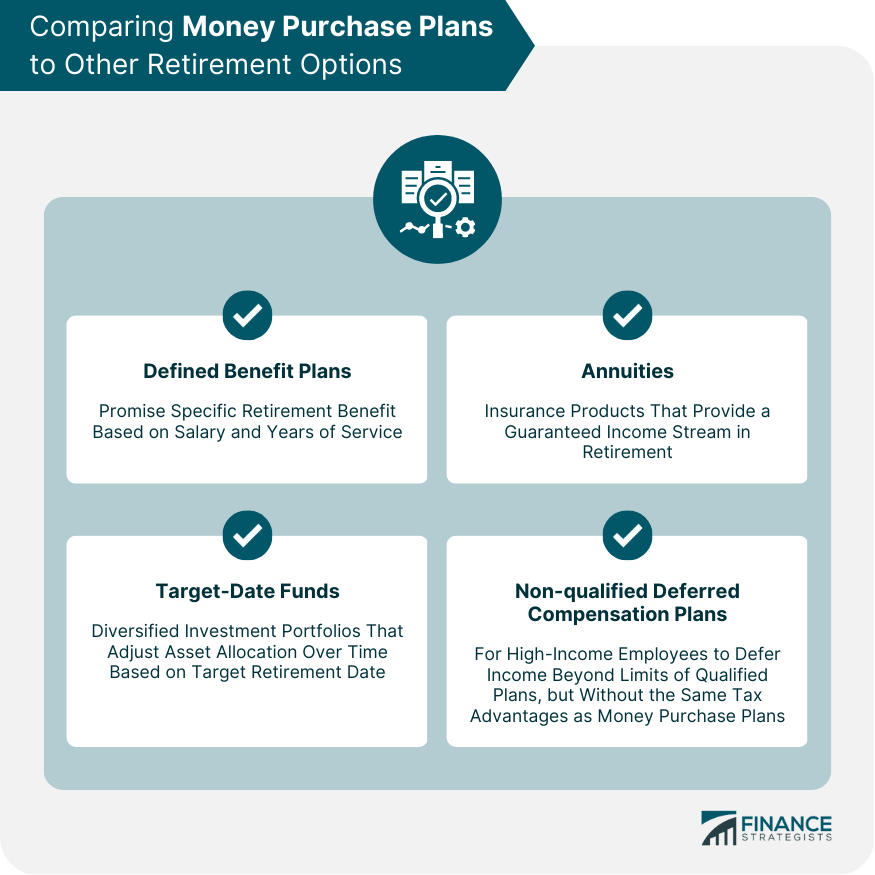
To fully grasp what a Money Purchase Plan entails, it’s essential to first establish its foundational category: defined contribution plans. Unlike defined benefit plans, which promise a specific payout at retirement based on a formula (like traditional pensions), defined contribution plans focus on the contributions made to an individual’s account. The eventual retirement benefit depends on the total contributions, plus or minus investment gains or losses over time.
The Core Concept of Money Purchase Plans
A Money Purchase Plan is a type of qualified defined contribution retirement plan that requires employers to make mandatory, fixed contributions to each eligible employee’s retirement account every year. The “money purchase” aspect refers to the commitment an employer makes to “purchase” a share of an employee’s future retirement security through these regular contributions. This fixed contribution is typically expressed as a percentage of the employee’s compensation, as stipulated in the plan document. For example, a plan might dictate that the employer contributes 10% of an employee’s annual salary, regardless of company profitability or individual performance.
Key Characteristics and Distinctions
Several features set Money Purchase Plans apart from other retirement vehicles. The most defining characteristic is the mandatory nature of employer contributions. Once a Money Purchase Plan is established, the employer is legally obligated to make the predetermined contributions annually. This differs significantly from discretionary plans where contributions might fluctuate based on business performance or be optional.
Another key feature is the individual investment accounts. Each employee has a separate account where contributions are deposited and invested. The employee typically has some level of control over how these funds are invested, choosing from a menu of options provided by the plan administrator, similar to a 401(k).
Contribution limits for Money Purchase Plans are set by the IRS and can be quite generous, often allowing for higher contributions than some other plan types, though they must adhere to specific annual maximums for both employer contributions and the total amount (employer plus any voluntary employee contributions).
Comparison with Other Retirement Plans (401(k), Profit-Sharing)
Understanding how Money Purchase Plans stack up against more common alternatives is vital:
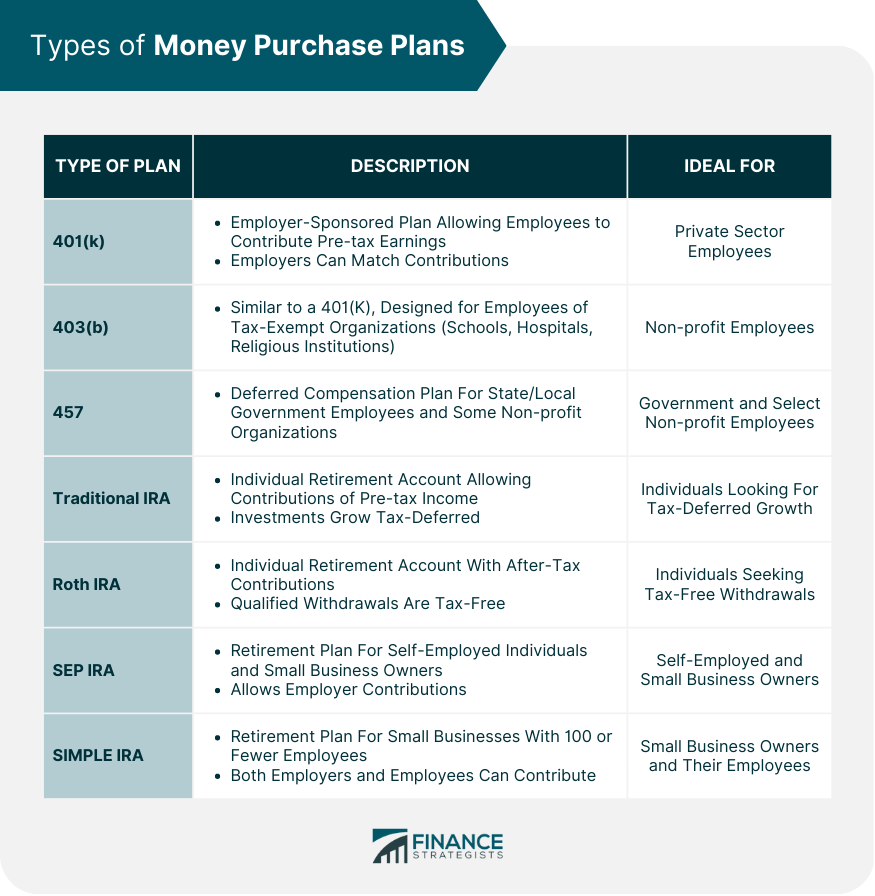
- 401(k) Plans: While 401(k)s are also defined contribution plans, they are primarily employee-driven. Employees contribute pre-tax dollars from their salaries, and employers may offer matching or non-matching contributions, which are typically discretionary. The mandatory employer contribution of a Money Purchase Plan is its primary differentiator from a typical 401(k).
- Profit-Sharing Plans: These plans offer maximum flexibility for employers. Contributions are entirely discretionary and usually depend on the company’s profitability. An employer might contribute a large sum in a good year and nothing in a lean year. This contrasts sharply with the fixed, mandatory nature of a Money Purchase Plan.
- SEP IRAs and SIMPLE IRAs: These are generally simpler, less administrative plans often used by small businesses. SEP IRAs are funded solely by employer contributions (which are discretionary), while SIMPLE IRAs involve both employee and mandatory employer contributions but have lower contribution limits than Money Purchase Plans.
In essence, a Money Purchase Plan occupies a niche between the strict pension model and the flexible profit-sharing model, offering a predictable, robust employer-funded benefit.
How Money Purchase Plans Work
The operational mechanics of a Money Purchase Plan involve a structured commitment from the employer and a clear pathway for employee benefit accumulation. The plan document, a comprehensive legal agreement, outlines all the critical details, from eligibility to distribution rules.
Employer Contribution Requirements
The most salient feature is the employer’s unyielding obligation to contribute. The plan document specifies the contribution formula, typically as a fixed percentage of each eligible employee’s compensation (e.g., 5%, 10%, or 25%). This percentage is legally binding and must be consistently applied to all eligible participants, regardless of the company’s financial performance. Failing to make these contributions can result in penalties from the IRS. This mandatory aspect provides employees with a predictable and reliable stream of retirement savings contributions directly from their employer.
Employee Vesting Schedules
Vesting refers to an employee’s ownership of the employer contributions. While the money is contributed to an employee’s account, they don’t necessarily have full ownership immediately. Money Purchase Plans typically employ a vesting schedule, which can be “cliff vesting” or “graded vesting.”
- Cliff Vesting: An employee becomes 100% vested after a certain number of years of service (e.g., 3 years). Before that point, they own 0% of the employer contributions.
- Graded Vesting: An employee becomes gradually vested over several years (e.g., 20% after 2 years, 40% after 3 years, etc., reaching 100% after 6 years).
Any portion of the employer contributions that is not vested if an employee leaves the company is forfeited and can be used to reduce future employer contributions or be reallocated among other plan participants according to plan rules. Employee’s own contributions (if the plan allows them, which is rare for a pure Money Purchase Plan) are always 100% vested.
Investment Options and Employee Control
Once contributions are made, they are deposited into individual accounts. Employees typically have the authority to direct the investment of these funds, choosing from a curated selection of investment options provided by the plan administrator. These options usually include a mix of mutual funds, exchange-traded funds (ETFs), and sometimes individual stocks or bonds, categorized by risk tolerance (conservative, moderate, aggressive). The growth of these investments is tax-deferred until retirement, allowing for compounding returns over many years.
Distribution Rules and Rollovers
Upon retirement, termination of employment, or in certain other qualifying events (e.g., disability), employees can begin taking distributions from their Money Purchase Plan account. Distributions are typically taxed as ordinary income in the year they are received. Many employees choose to roll over their Money Purchase Plan balance into an Individual Retirement Account (IRA) or another employer’s qualified retirement plan. This allows them to continue the tax-deferred growth of their retirement savings and avoid immediate taxation. Early withdrawals (before age 59½) are generally subject to a 10% penalty in addition to ordinary income tax, with some exceptions.
Advantages and Disadvantages for Employers
Adopting a Money Purchase Plan involves weighing its distinct benefits against its operational demands. For employers, the decision often comes down to balancing generosity, predictability, and administrative responsibility.
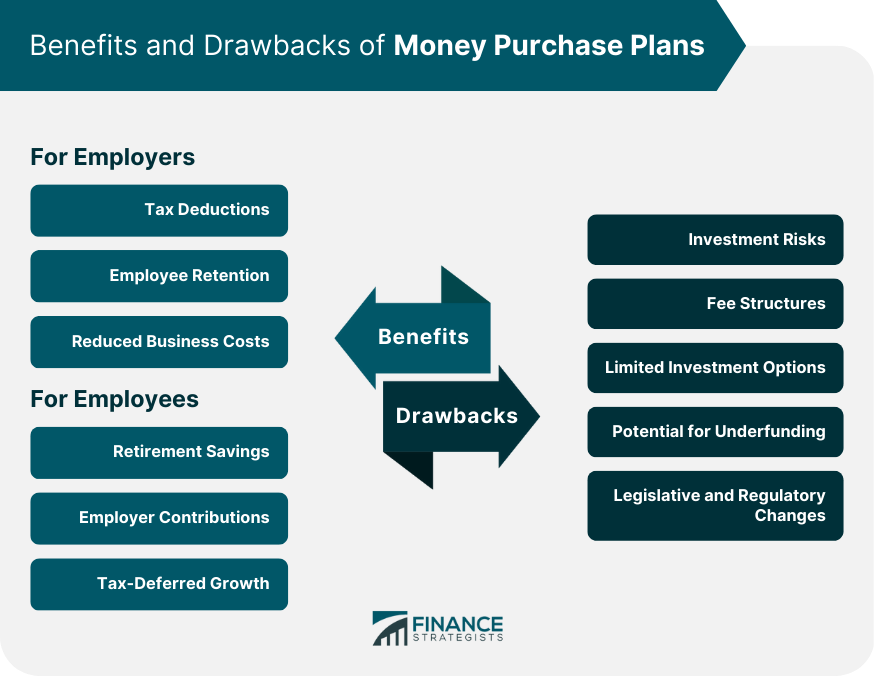
Benefits: Predictable Costs, High Contribution Limits
One significant advantage for employers is the predictability of contributions. Unlike profit-sharing plans where contributions might be zero in a down year, a Money Purchase Plan mandates a fixed percentage, allowing for easier budgeting and financial forecasting. This consistency also signals a strong commitment to employee welfare, potentially enhancing recruitment and retention efforts.
Money Purchase Plans can also offer high contribution limits, often allowing employers to contribute a substantial percentage of an employee’s salary up to the IRS maximum (which combines employer and, if allowed, employee contributions). This makes them attractive for highly compensated employees or business owners looking to maximize their own tax-deferred retirement savings. From a tax perspective, employer contributions are typically tax-deductible as a business expense.
Drawbacks: Mandatory Contributions, Administrative Burden
The flip side of predictable contributions is the mandatory nature of the commitment. Employers are legally bound to make these contributions every year, regardless of the company’s financial performance. This lack of flexibility can be a significant drawback during economic downturns or periods of reduced profitability, as the obligation remains.
Money Purchase Plans also come with an administrative burden. They are subject to ERISA (Employee Retirement Income Security Act) regulations, requiring extensive record-keeping, annual reporting (Form 5500), non-discrimination testing, and adherence to complex compliance rules. This often necessitates the involvement of third-party administrators, adding to the overall cost and complexity of the plan.
Ideal Candidates for Implementation
Money Purchase Plans are often well-suited for businesses that have:
- Stable and predictable cash flow: The mandatory contribution requires consistent financial health.
- A strong desire to offer a robust, employer-funded retirement benefit: Ideal for companies looking to provide a significant, guaranteed contribution to their employees’ retirement.
- Higher-earning employees or owners: The generous contribution limits can be particularly appealing for maximizing retirement savings for key personnel.
- A willingness to manage the administrative complexities: The commitment to compliance and reporting must be embraced.
In many cases, businesses today might opt for a combination of a 401(k) and a profit-sharing plan or even a “new comparability” profit-sharing plan to gain more flexibility while still offering competitive benefits. The rigid nature of the Money Purchase Plan has led to a decline in its standalone popularity, with many evolving into or being replaced by more flexible defined contribution structures.
Benefits and Considerations for Employees
For employees, a Money Purchase Plan offers a distinct set of advantages and requires careful consideration of its long-term implications for their retirement planning.
Guaranteed Employer Contributions
The most significant benefit for employees is the guaranteed employer contribution. Unlike discretionary plans, employees in a Money Purchase Plan can count on their employer making a fixed percentage contribution to their retirement account year after year. This provides a stable and predictable foundation for their retirement savings, reducing reliance on individual saving discipline or company performance fluctuations. Over decades, these consistent contributions, combined with tax-deferred investment growth, can accumulate into a substantial retirement nest egg.
Potential for Significant Retirement Savings
Due to the often generous contribution limits and the mandatory nature of employer funding, Money Purchase Plans can facilitate significant retirement savings. For employees who might otherwise struggle to save consistently on their own, or those in companies that don’t offer matching 401(k) contributions, a Money Purchase Plan ensures a steady flow of funds into their retirement account. This consistent investment can leverage the power of compounding over a long career, leading to substantial wealth accumulation by retirement age.
Understanding Vesting and Portability
While contributions are guaranteed, employees must understand the vesting schedule. Their ownership of the employer’s contributions depends on their years of service. If an employee leaves before being fully vested, they may forfeit a portion of the employer’s contributions. This is a critical factor to consider when evaluating job changes.
Upon leaving, the portability of vested funds is also important. Employees can typically roll over their vested balance into an IRA or another employer’s qualified plan, preserving the tax-deferred status of their savings. This flexibility ensures that the retirement savings built through a Money Purchase Plan can move with the employee throughout their career.
Planning for Distributions and Retirement Income
As with any retirement plan, employees need to plan for distributions in retirement. Understanding the tax implications – that distributions will be taxed as ordinary income – is crucial for financial planning. Strategically timing withdrawals, considering required minimum distributions (RMDs) starting at a certain age, and coordinating with other income sources will be key to maximizing the longevity of their retirement funds. Consulting with a financial advisor can help employees develop a comprehensive retirement income strategy that incorporates their Money Purchase Plan assets.
Regulatory Compliance and Future Trends
The regulatory environment plays a critical role in the operation and evolution of Money Purchase Plans, ensuring employee protection and fair administration.
IRS Regulations and ERISA Requirements
Money Purchase Plans are subject to stringent regulations from both the Internal Revenue Service (IRS) and the Department of Labor (DOL) under the Employee Retirement Income Security Act of 1974 (ERISA). These regulations dictate everything from eligibility requirements, vesting schedules, and contribution limits to disclosure rules, fiduciary responsibilities, and non-discrimination testing. Non-discrimination testing, for instance, ensures that the plan does not disproportionately favor highly compensated employees over rank-and-file workers. Compliance is paramount, as violations can lead to significant penalties for the employer.
Administrative Responsibilities and Fiduciary Duties
Employers sponsoring a Money Purchase Plan take on significant administrative responsibilities and fiduciary duties. Fiduciaries are legally obligated to act in the best interests of plan participants and beneficiaries. This includes prudently selecting and monitoring investment options, ensuring proper plan administration, and adhering to all ERISA and IRS requirements. Many employers outsource these complex duties to third-party administrators (TPAs) and investment advisors to ensure compliance and manage the inherent risks.
Evolution of Retirement Plans and Emerging Alternatives
The landscape of employer-sponsored retirement plans is continually evolving. While Money Purchase Plans historically served as a significant component of retirement offerings, their rigid, mandatory contribution structure has led many businesses to favor more flexible alternatives. Today, it is common to see hybrid plans or combinations of plans, such as a 401(k) paired with a discretionary profit-sharing component, offering employers the ability to contribute generously when the business thrives while maintaining flexibility during leaner times. The rise of “new comparability” profit-sharing plans, which allow for different contribution rates among employee groups based on specific objectives, further highlights the trend towards customized and flexible defined contribution strategies.
Despite the shift in popularity, understanding Money Purchase Plans remains essential for anyone navigating the complexities of retirement savings. They represent a significant commitment from employers to their employees’ financial future, embodying a principle of guaranteed contribution that, for decades, has provided a sturdy foundation for retirement security.
In conclusion, a Money Purchase Plan is a powerful, employer-funded defined contribution plan characterized by its mandatory and fixed annual contributions. While its administrative demands and rigid structure have led many businesses to explore more flexible alternatives, its core promise of predictable, significant employer contributions continues to make it a noteworthy component of the diverse world of retirement planning. For employers, it offers a way to demonstrate strong commitment to their workforce’s financial well-being, and for employees, it provides a reliable pathway to build substantial retirement wealth, underscoring its enduring relevance in the domain of Money and financial security.
aViewFromTheCave is a participant in the Amazon Services LLC Associates Program, an affiliate advertising program designed to provide a means for sites to earn advertising fees by advertising and linking to Amazon.com. Amazon, the Amazon logo, AmazonSupply, and the AmazonSupply logo are trademarks of Amazon.com, Inc. or its affiliates. As an Amazon Associate we earn affiliate commissions from qualifying purchases.