
In the rapidly evolving landscape of digital technology, certain fundamental mathematical concepts serve as the invisible scaffolding for the tools we use every day. One such concept is the “lattice point.” While it originates in the realm of discrete geometry, the lattice point has become a cornerstone of modern tech, influencing everything from the way our smartphone screens render images to the highly complex algorithms protecting our data from future quantum threats.
To understand the trajectory of next-generation technology, one must first understand what a lattice point is and why it has become the bedrock of digital security and spatial computing.
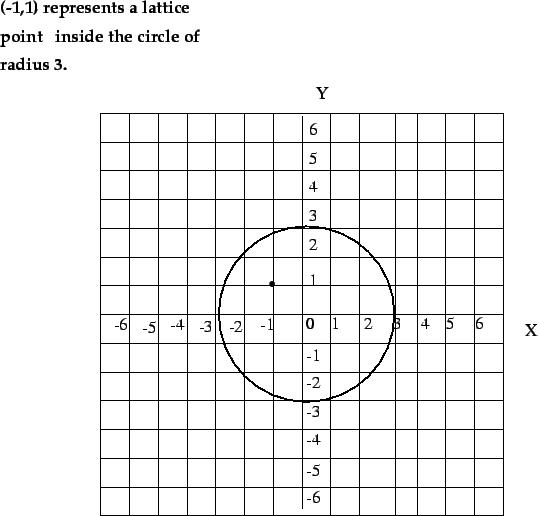
Understanding the Mathematical Blueprint: What is a Lattice Point?
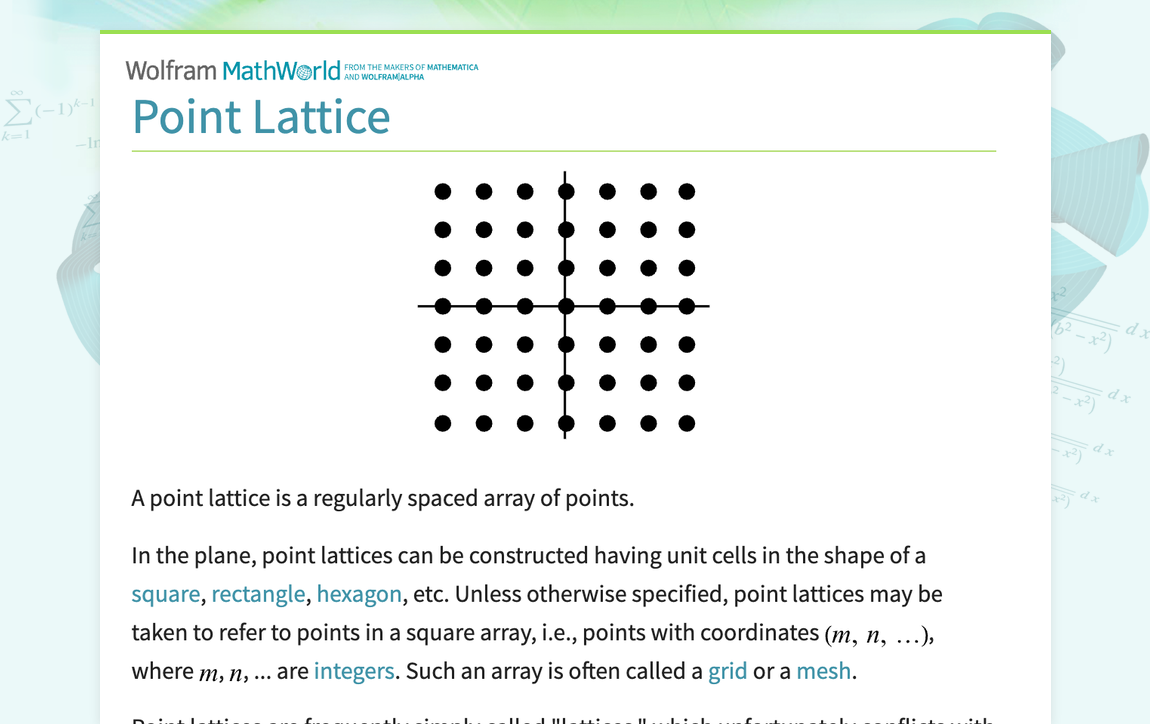
At its simplest level, a lattice point is a point in a coordinate system where all the coordinates are integers. If you imagine a sheet of graph paper, every intersection where the horizontal and vertical lines meet represents a lattice point. In a two-dimensional plane, these are points $(x, y)$ where both $x$ and $y$ are whole numbers.
Defining the Geometric Grid
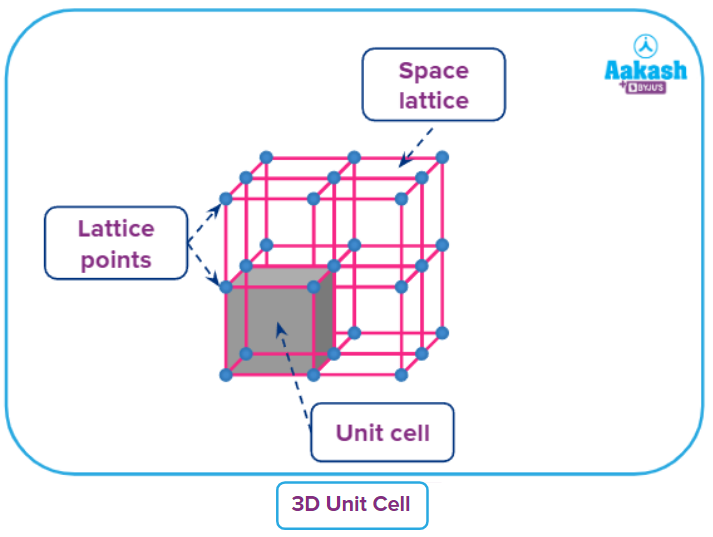
A lattice is defined as a regular, repeating arrangement of points. In computational terms, we refer to this as a discrete structure. Unlike a continuous line—which contains an infinite number of points between any two values—a lattice is composed of distinct, individual nodes. This distinction is vital for technology because digital systems are, by their very nature, discrete. Computers operate using bits (0s and 1s), and pixels are arranged in fixed grids. The lattice point is the mathematical abstraction that allows software to map continuous real-world data into a structured digital format.
From Discrete Math to Digital Logic
The transition from theoretical mathematics to digital logic occurs when we apply these points to multidimensional spaces. In high-level computer science, a lattice is not limited to two or three dimensions. Data scientists and software engineers often work in “n-dimensional” lattices. Here, a lattice point represents a specific state or a unique piece of data within a massive, structured set. This organization allows for efficient indexing, searching, and processing, which are the fundamental requirements for any high-performance software application.
The Role of Lattice Points in Computer Graphics and Spatial Computing
Every time you look at a high-definition display or interact with an Augmented Reality (AR) application, you are interacting with the practical application of lattice points. The digital world is built upon the precision of these coordinates.
Pixel Mapping and Rasterization
The screen you are currently reading this on is a 2D lattice. Each pixel acts as a lattice point within a specific coordinate system. When a graphics card renders an image, it performs a process called rasterization. It takes vector data (smooth lines and curves) and converts it into a grid of discrete pixels.
The challenge for modern software is “aliasing”—the jagged edges that appear when a smooth line doesn’t perfectly align with the lattice points of the screen. Advanced anti-aliasing algorithms essentially calculate the distance between the intended “perfect” line and the nearest lattice points (pixels) to determine how to blend colors, creating the illusion of smoothness. This interplay between the continuous and the discrete is what defines modern visual tech.
Voxel Grids in 3D Modeling and AI
Moving beyond the screen, 3D modeling and spatial computing utilize 3D lattices. In these environments, we refer to “voxels” (volume pixels). A voxel is essentially a lattice point in three-dimensional space $(x, y, z)$.
For Artificial Intelligence tools involved in computer vision—such as those used in self-driving cars—the world is perceived as a series of lattice points. LiDAR sensors scan the environment, generating a “point cloud.” The software then maps these points onto a 3D lattice to identify objects like pedestrians, other vehicles, and road boundaries. By treating the environment as a structured lattice, the AI can perform distance and velocity calculations with the mathematical precision required for safety-critical tasks.
Lattice-Based Cryptography: The Future of Digital Security
Perhaps the most critical application of lattice points today is in the field of digital security. As we move closer to the era of quantum computing, our current encryption methods (like RSA and Elliptic Curve Cryptography) are becoming vulnerable. This has led to the rise of “Lattice-Based Cryptography,” a tech trend that is currently being standardized by organizations like NIST (National Institute of Standards and Technology).
Solving the Shortest Vector Problem (SVP)
Lattice-based cryptography relies on the mathematical complexity of finding specific lattice points in high-dimensional spaces. One of the most famous problems used in this field is the “Shortest Vector Problem” (SVP).
In a simple 2D grid, finding the lattice point closest to the origin is easy. However, imagine a lattice with hundreds of dimensions. Finding the “shortest vector”—or the lattice point closest to a specific target—becomes computationally “hard.” Even with massive processing power, calculating the exact location of a specific lattice point in a high-dimensional grid is nearly impossible unless you have the “key” (the basis of the lattice).
Post-Quantum Resilience in a Hyper-Connected World
Why is this important for the tech industry? Traditional encryption relies on the difficulty of factoring large prime numbers. Quantum computers, using Shor’s algorithm, can solve those problems almost instantly. However, quantum computers currently have no known efficient way to solve lattice-based problems.
Tech giants and cybersecurity firms are now integrating lattice-based algorithms into their VPNs, browser security protocols, and cloud storage solutions. By utilizing the geometric properties of lattice points, these software tools ensure that data remains secure even if a powerful quantum computer attempts to intercept it. This shift represents one of the most significant pivots in the history of digital security.
Data Engineering and Neural Networks: Multidimensional Lattice Points
In the era of Big Data and Generative AI, the concept of the lattice point has found a new home in the architecture of neural networks and vector databases.
Feature Spaces and Vector Databases
When an AI model like a Large Language Model (LLM) processes information, it converts words and concepts into “embeddings.” These embeddings are vectors in a high-dimensional space. You can visualize this space as a massive, invisible lattice.
Each concept is a point in this lattice. For example, in a 500-dimensional lattice, the word “Apple” (the fruit) and “Orange” would be lattice points located very close to each other, while the word “Algorithm” would be located much further away. AI tools use the distance between these lattice points to understand context and relationships. Vector databases (such as Pinecone or Milvus) are specifically designed to store and query these lattice points, enabling the rapid retrieval of relevant information that powers modern AI search engines.
Quantization in Large Language Models (LLMs)
Another vital tech application is “quantization.” High-performance AI models require a massive amount of memory. To make these tools run on consumer-grade gadgets—like laptops or smartphones—developers use quantization to compress the model.
This process involves mapping the continuous range of neural network weights to a discrete set of lattice points. By forcing the data to align with a specific grid, the file size of the AI model is drastically reduced without a significant loss in intelligence. This is the technology that allows “on-device AI” to function efficiently, bringing powerful generative tools directly to the user’s pocket.
Conclusion: Why Lattice Points Matter for the Next Tech Frontier
While “lattice point” may sound like a term confined to dusty mathematics textbooks, it is, in reality, a fundamental unit of the digital age. It is the bridge between the fluid, analog world we inhabit and the structured, binary world of our devices.
From the pixels on our screens to the high-dimensional vectors powering the AI revolution, the lattice point provides the structure necessary for complex computation. Most importantly, as we face the looming shadow of the quantum era, the mathematical “hardness” of lattice structures offers our best hope for maintaining digital privacy and security.
As technology continues to advance toward more immersive spatial computing and more powerful artificial intelligence, our reliance on the humble lattice point will only grow. It is more than just a coordinate on a grid; it is the geometric foundation of our digital future.
aViewFromTheCave is a participant in the Amazon Services LLC Associates Program, an affiliate advertising program designed to provide a means for sites to earn advertising fees by advertising and linking to Amazon.com. Amazon, the Amazon logo, AmazonSupply, and the AmazonSupply logo are trademarks of Amazon.com, Inc. or its affiliates. As an Amazon Associate we earn affiliate commissions from qualifying purchases.