
Purchasing a vehicle is often the second-largest financial commitment a person makes, surpassed only by the purchase of a home. While most consumers spend hours researching engine specifications, safety ratings, and fuel efficiency, the most critical component of the purchase often happens behind a desk in the finance office. The interest rate on a car loan—frequently referred to as the “cost of money”—is the primary factor that determines the total amount you will pay over the life of the loan. Understanding how these rates are calculated, what influences them, and how to optimize your financial profile can save you thousands of dollars in unnecessary interest expenses.
The Mechanics of Auto Loan Interest Rates
To navigate the world of personal finance effectively, one must first understand that an interest rate is not merely a random number assigned by a dealership. It is a calculated reflection of risk and the prevailing economic climate. When you borrow money to buy a car, the lender is taking a risk that you might default. The interest rate is their compensation for that risk and for the loss of liquidity of their capital.
APR vs. Interest Rate: Understanding the Difference
One of the most common points of confusion in auto finance is the distinction between the “interest rate” and the “Annual Percentage Rate” (APR). The interest rate is the base percentage charged on the principal amount borrowed. However, the APR is a more comprehensive figure; it includes the interest rate plus any additional fees, such as origination fees, documentation charges, or prepaid interest. From a financial planning perspective, the APR is the most important number because it represents the true yearly cost of the loan.
Simple Interest and the Power of Amortization
Most modern car loans are structured as “simple interest” loans. Unlike some credit cards that compound interest daily on the remaining balance, simple interest is calculated based on the principal balance on the day the payment is due. This is why paying more than the minimum or making bi-weekly payments can significantly reduce the total interest paid over time.
Furthermore, car loans are “amortized.” This means that in the early stages of your loan, a larger portion of your monthly payment goes toward interest, while a smaller portion goes toward the principal. As the balance decreases, the interest charge shrinks, and more of your payment is applied to the principal. Understanding this schedule is vital for anyone looking to trade in their vehicle early, as they may find they owe more than the car is worth—a state known as being “underwater.”
The Role of the Down Payment in Rate Reduction
From a lender’s perspective, the “Loan-to-Value” (LTV) ratio is a key metric. If you buy a $30,000 car and put $0 down, your LTV is 100%. If you put $6,000 down, your LTV drops to 80%. Lenders view lower LTV ratios as lower risks because the borrower has “skin in the game.” Consequently, a significant down payment doesn’t just lower your monthly payment; it can actually lower the interest rate itself, as the lender feels more secure in the collateral.
Factors That Determine Your Specific Rate
Interest rates are not “one size fits all.” They are highly personalized based on a variety of data points that signal your creditworthiness and the value of the asset being financed.
The Power of Your Credit Score
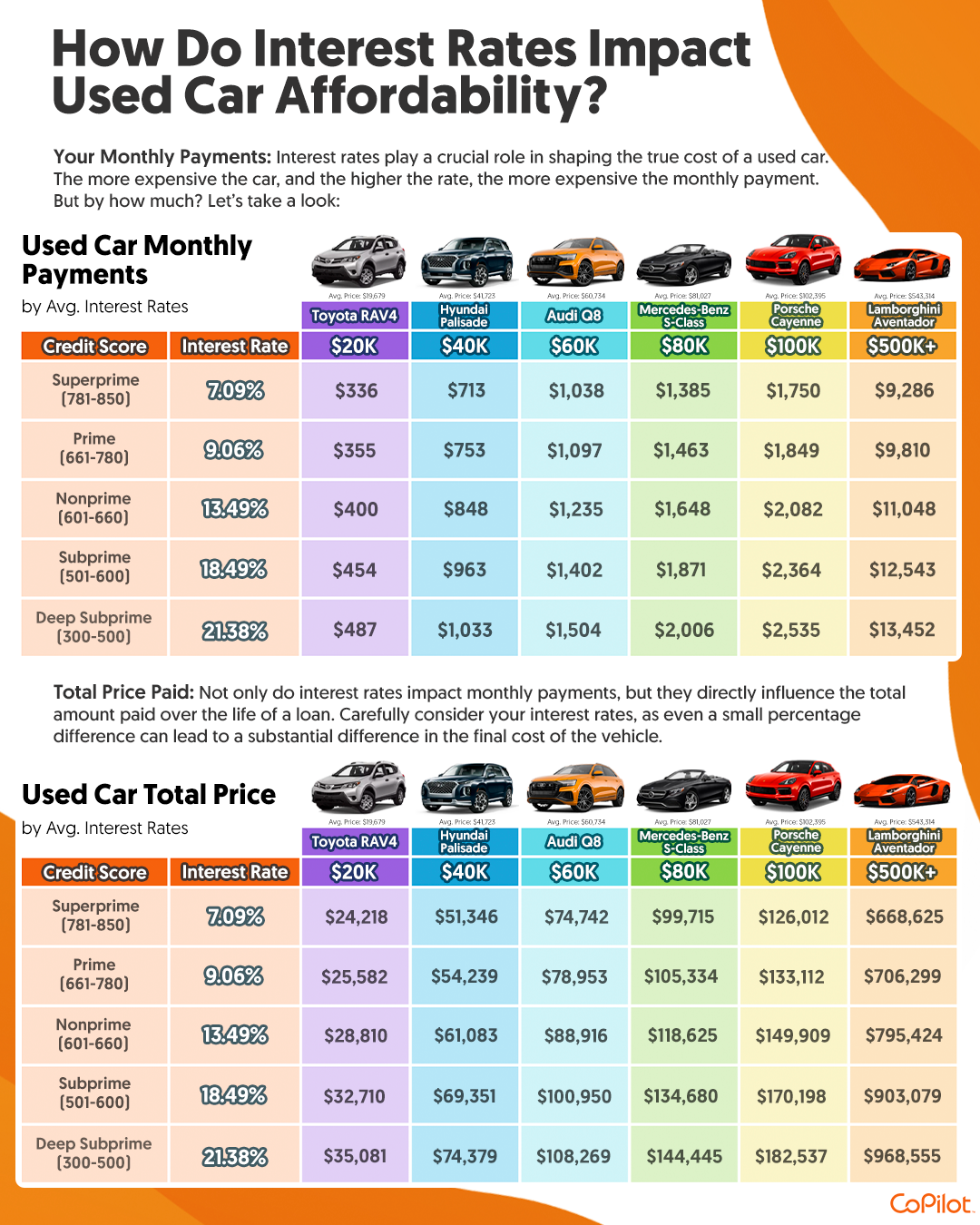
Your credit score is the single most influential factor in determining your interest rate. Lenders generally categorize borrowers into tiers:
- Super Prime (781–850): These borrowers receive the lowest possible rates, often very close to the prime rate.
- Prime (661–780): These borrowers are considered highly reliable and receive competitive rates.
- Nonprime (601–660): Rates begin to climb as lenders perceive a moderate risk.
- Subprime (501–600) and Deep Subprime (300–500): Borrowers in these tiers may face double-digit interest rates, as the risk of default is statistically much higher.
Even a 50-point difference in a credit score can result in a 2% to 4% difference in APR, which, over a 60-month loan, can translate to several thousand dollars in extra costs.
Loan Term Length and Its Impact
While a longer loan term (such as 72 or 84 months) offers the allure of lower monthly payments, it almost always carries a higher interest rate. Lenders charge more for longer terms because their money is tied up longer, increasing the “opportunity cost” and the risk that economic conditions or the borrower’s financial status will change. Additionally, since cars are depreciating assets, a long-term loan increases the likelihood that the vehicle’s value will drop below the loan balance, creating a “negative equity” situation.

New vs. Used Vehicles
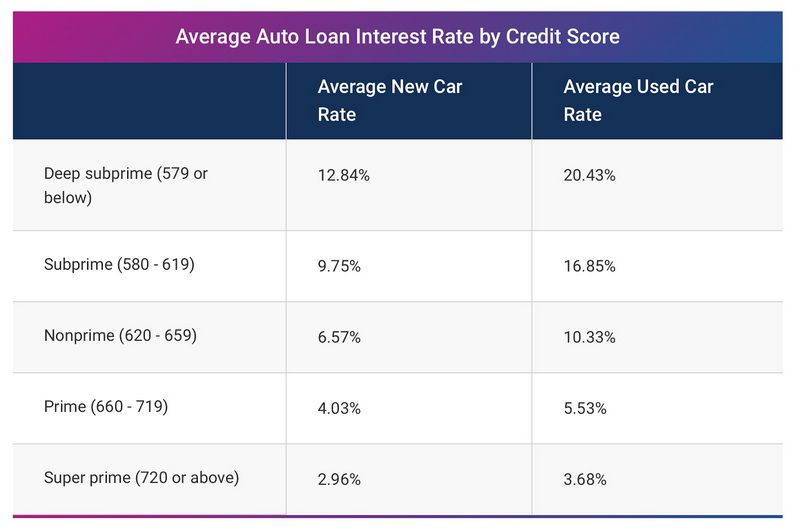
Generally, new cars come with lower interest rates than used cars. This may seem counterintuitive since a new car is more expensive, but there are two primary reasons for this. First, new cars are easier for a lender to value accurately. Second, if a borrower defaults, a newer car is easier for the bank to resell at a predictable price. Used cars, particularly those older than five years or with high mileage, carry higher rates because they are riskier collateral; they are more prone to mechanical failure, which increases the chance that a borrower will stop making payments.
The Current Economic Landscape and Market Benchmarks
Individual factors aren’t the only things at play. The broader economy sets the “floor” for how low an interest rate can go. Even a borrower with a perfect 850 credit score will face higher rates if the central bank has raised the cost of borrowing across the board.
The Role of the Federal Reserve
The Federal Reserve (the Fed) does not set auto loan rates directly, but its decisions regarding the federal funds rate influence the “Prime Rate”—the rate banks charge their most creditworthy corporate customers. When the Fed raises rates to combat inflation, banks find it more expensive to borrow money themselves, and they pass those costs on to consumers in the form of higher APRs on car loans, mortgages, and credit cards.
Average Rates by Credit Tier
In a typical economic environment, “Super Prime” borrowers might see rates between 4% and 5% for a new car, while “Subprime” borrowers might see rates exceeding 15% to 20%. It is essential to research the current national averages before walking into a dealership. Knowing that the average rate for your credit score is 6% prevents you from blindly accepting a 9% offer from a dealer who may be “marking up” the rate to increase their own profit margin.
Strategies to Secure the Lowest Interest Rate
Securing a favorable interest rate is a proactive process that should begin months before you actually visit a dealership. By treating the financing as a separate transaction from the car purchase itself, you gain significant leverage.
Shopping Around: Banks, Credit Unions, and Dealerships
Most car buyers make the mistake of only looking at the financing offered by the dealership. While “captive lenders” (like Toyota Financial or Ford Credit) sometimes offer 0% or low-interest promotional rates to move inventory, they aren’t always the best deal.
- Credit Unions: Often offer the most competitive rates because they are member-owned non-profits.
- Online Lenders: Digital-first banks often have lower overhead costs, which can translate into lower APRs.
- Pre-approval: The most powerful tool a buyer has is a pre-approval letter from an outside lender. This sets a “ceiling” on your interest rate. If the dealer wants your financing business, they must beat the rate you already have in hand.
Improving Your Financial Profile
If your credit score is on the cusp of a higher tier, it may be worth waiting three to six months to buy a car while you improve your profile. You can do this by paying down high-balance credit cards to reduce your “credit utilization ratio” and ensuring every single payment is made on time. In the world of personal finance, a few months of discipline can result in a lower interest rate that saves you money for the next five years.
The Art of Refinancing
Many people do not realize that auto loans can be refinanced just like mortgages. If you were forced to take a high-interest loan because your credit was poor at the time of purchase, but you have made on-time payments for a year and your score has improved, you should look into refinancing. Moving from a 12% APR to a 6% APR can drastically reduce your monthly burden and the total interest paid over the remaining life of the loan.
Final Financial Considerations
When asking “what is an interest rate on a car,” the answer is that it is a dynamic figure representing your financial reputation, the value of the vehicle, and the state of the global economy. By focusing on the APR rather than just the monthly payment, you protect your long-term wealth.
A car is a tool for mobility, but the loan used to acquire it is a financial product. Wise consumers shop for that product with the same scrutiny they apply to the vehicle itself. By maintaining a high credit score, providing a substantial down payment, opting for shorter loan terms, and arriving at the dealership with a pre-approval in hand, you ensure that the “cost of money” remains as low as possible, allowing more of your hard-earned income to stay in your pocket rather than in the lender’s vaults.
aViewFromTheCave is a participant in the Amazon Services LLC Associates Program, an affiliate advertising program designed to provide a means for sites to earn advertising fees by advertising and linking to Amazon.com. Amazon, the Amazon logo, AmazonSupply, and the AmazonSupply logo are trademarks of Amazon.com, Inc. or its affiliates. As an Amazon Associate we earn affiliate commissions from qualifying purchases.