
For decades, the amusement park industry was divided by a binary choice: the classic, rattling charm of wooden roller coasters or the smooth, gravity-defying loops of steel titans. However, the last decade has seen the rise of a revolutionary middle ground that has fundamentally changed the landscape of theme parks globally. This is the hybrid roller coaster.
But a hybrid roller coaster is more than just a fusion of materials; it is a masterclass in modern engineering technology, a brilliant tool for brand revitalization, and a savvy financial strategy for park operators. By combining the structural aesthetics of wood with the high-performance capabilities of steel, these machines represent the pinnacle of the “More with Less” philosophy in the 21st century.

The Engineering Frontier: How Tech Redefined the Wooden Coaster
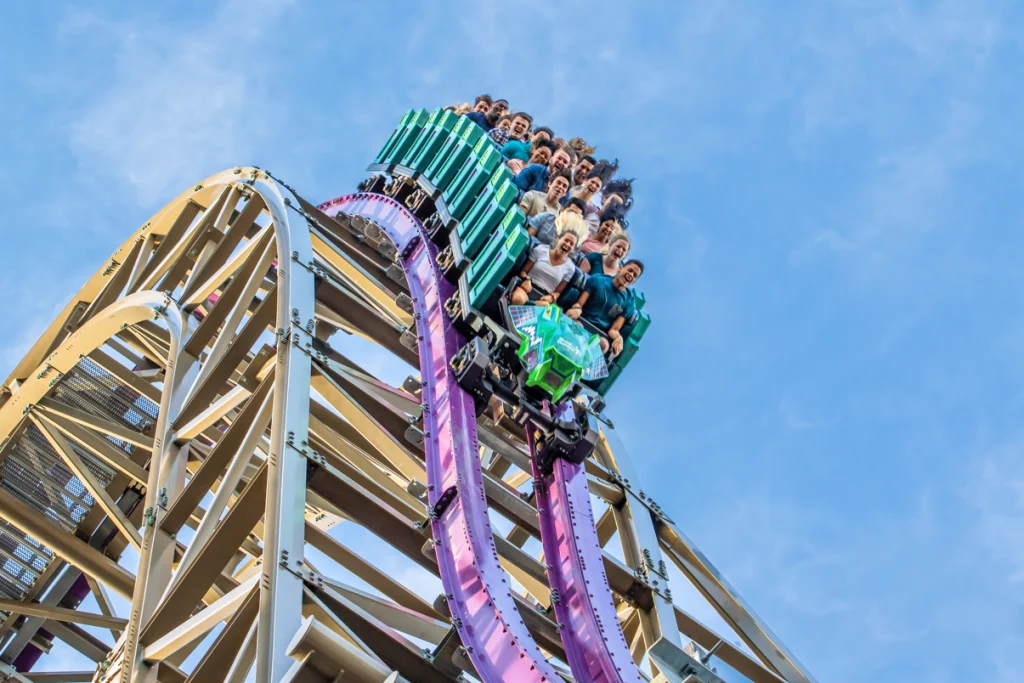
At its most basic level, a hybrid roller coaster is defined by using a mixture of wood and steel for the two main components of a ride: the support structure and the track. Most commonly, this involves a massive, intricate wooden support frame topped with a high-strength steel track. While the concept of mixing materials isn’t entirely new, the technology that drives modern hybrids is lightyears ahead of its predecessors.
The RMC Revolution and the I-Box Track
The true “tech” breakthrough in this field came from a company called Rocky Mountain Construction (RMC). Before their intervention, wooden coasters were limited by the physical properties of timber. Wood flexes, rots, and requires constant, expensive maintenance. Moreover, you couldn’t put a wooden coaster through an inversion (a loop or roll) without extreme structural stress.
RMC introduced the “I-Box” track—a patented steel track shaped like a capital letter “I.” Unlike traditional tubular steel tracks, the I-Box is designed to be mounted directly onto existing wooden structures. Using advanced Computer-Aided Design (CAD) and laser-cutting technology, engineers can now design elements that were previously thought impossible. We are talking about 90-degree drops, outward-banked turns that throw riders toward the horizon, and “barrel roll” inversions that feel as smooth as glass while being supported by a lattice of Georgia pine.
Precision Physics and Digital Simulations
The technology isn’t just in the steel; it’s in the software. Modern hybrid coasters are designed using sophisticated simulation tools that calculate “heartlining”—the practice of rotating the track around the rider’s center of gravity to minimize uncomfortable lateral forces. This tech allows for “airtime” (the feeling of weightlessness) to be sustained for longer periods, maximizing the thrill without sacrificing rider safety or comfort. These simulations also allow engineers to predict exactly how the wooden structure will respond to the stress of a 70-mph steel train, ensuring the longevity of the ride.
Brand Revitalization: Turning “Old Wood” into “New Gold”
In the world of marketing and brand strategy, “relevance” is the most valuable currency. For many theme parks, aging wooden coasters built in the 1980s or 90s had become “brand liabilities.” They were too rough for families, too boring for enthusiasts, and too expensive for the maintenance department.
Case Study: The Rebirth of a Legend
Consider the “New Texas Giant” at Six Flags Over Texas. The original Texas Giant was once the tallest wooden coaster in the world, but over time, it became a “head-banger”—a ride so rough it actually hurt the park’s reputation. By partnering with RMC to convert it into a hybrid coaster, Six Flags didn’t just fix a ride; they rebranded an entire section of their park.
The “Hybrid” brand stands for the perfect marriage of nostalgia and innovation. It appeals to the “Purist” brand segment who loves the look of a classic boardwalk coaster, while simultaneously capturing the “Thrill-Seeker” segment who demands the intensity of a modern steel machine. This dual-market appeal is a potent marketing tool, allowing parks to claim “World’s First” or “World’s Steepest” titles without the astronomical costs of building a ground-up steel gigacoaster.
Identity and Competitive Advantage
In a crowded market, a hybrid coaster serves as a unique “Product Identity.” When Busch Gardens Tampa transformed the aging “Gwazi” (a dual-track wooden coaster) into “Iron Gwazi,” they didn’t just build a ride; they created a destination. The branding focused on the “evolution” of the predator—using the hybrid nature of the ride to symbolize a creature that had become stronger, faster, and more lethal. This narrative-driven marketing, powered by the physical transformation of the ride, creates a “must-see” factor that drives domestic and international tourism.

The Financial Blueprint: Why Hybrids are a Smart Business Investment
From a “Money” and business finance perspective, hybrid coasters are arguably the most efficient capital expenditures (CapEx) in the amusement industry. When a park looks at its five-year financial plan, they have to balance the high cost of new attractions against the projected ROI in terms of ticket sales and season pass renewals.
Capital Expenditure (CapEx) Efficiency
Building a massive steel coaster from scratch can cost anywhere from $20 million to $30 million, largely due to the cost of the steel supports and the extensive foundation work required. A hybrid conversion, however, utilizes the “sunk cost” of the existing wooden structure. By reusing the multi-million dollar timber frame already in place, parks can debut a “new” world-class attraction for a fraction of the cost—often between $8 million and $15 million.
This allows smaller regional parks to compete with global giants like Disney or Universal. They can offer a ride that ranks in the “Top 5 in the World” without taking on the debt load typically associated with such a feat.
Operational Savings and Maintenance ROI
Traditional wooden coasters are “maintenance pits.” They require daily inspections, frequent “re-tracking” (replacing the wooden layers), and massive amounts of manual labor. Steel tracks on a hybrid coaster, however, are far more durable. They don’t warp with the weather, and they don’t splinter under the friction of the train’s wheels.
For the finance department, this means:
- Lower Labor Costs: Fewer man-hours spent on track inspections and repairs.
- Increased Uptime: The ride stays open more days per year, increasing guest satisfaction and per-capita spending.
- Longevity: A hybrid track can last 20-30 years with minimal intervention, whereas a wooden track might need significant work every 5 years.
Boosting the “S-Curve” of Attendance
In the theme park business model, new rides create a “spike” in attendance that slowly decays over time. Because hybrid coasters are often record-breakers (like Steel Vengeance at Cedar Point, which broke ten world records upon debut), the “spike” is higher and the “decay” is slower. The ROI is realized much faster through increased gate admissions, premium “Fast Pass” sales, and merchandise revenue.
The Future: AI and the Next Generation of Hybrids
As we look toward the future, the “Tech” aspect of hybrid coasters is moving into the realm of data and artificial intelligence. We are seeing the implementation of “Predictive Maintenance” sensors. These IoT (Internet of Things) devices are placed along the track and on the trains to monitor vibrations and heat in real-time. By using AI to analyze this data, parks can identify a bolt that is loosening or a wheel assembly that is wearing down before it causes a ride stoppage.
Furthermore, the “Money” side of the industry is looking at sustainability. Hybrid coasters are more eco-friendly than all-steel coasters because they use renewable timber for the bulk of their mass. As corporate ESG (Environmental, Social, and Governance) scores become more important to investors, the ability to build world-class thrills with a lower carbon footprint becomes a significant brand and financial advantage.
Conclusion
A hybrid roller coaster is much more than a pile of wood and a ribbon of steel. It is the physical manifestation of how Technology can breathe new life into old ideas, how Branding can transform a liability into an icon, and how Financial Strategy can maximize ROI in a high-stakes industry.
Whether you are a tech enthusiast marvelling at the CAD-designed inversions, a brand strategist studying the “RMC Effect,” or a business owner looking for a lesson in CapEx efficiency, the hybrid coaster offers a compelling case study. It proves that the best way to move forward is often to take what you already have and reinvent it with the tools of the future. The next time you see those wooden supports topped with a vibrant steel track, you aren’t just looking at a ride—you’re looking at the smartest business move in the park.
aViewFromTheCave is a participant in the Amazon Services LLC Associates Program, an affiliate advertising program designed to provide a means for sites to earn advertising fees by advertising and linking to Amazon.com. Amazon, the Amazon logo, AmazonSupply, and the AmazonSupply logo are trademarks of Amazon.com, Inc. or its affiliates. As an Amazon Associate we earn affiliate commissions from qualifying purchases.