
Understanding the intricacies of craps betting is crucial for anyone engaging with this popular casino game, particularly when considering its financial implications. While many players are familiar with the fundamental Pass Line or Don’t Pass Line bets, the game offers a spectrum of wagers, each with its own risk profile and payout structure. Among these, the “hop bet” stands out as a high-volatility, single-roll proposition that carries significant monetary considerations for the player. Delving into the mechanics and financial calculus behind a hop bet reveals much about capital allocation, risk management, and the true cost of entertainment in a gambling environment.
Understanding Craps Bets: A Primer for Financial Prudence
At its core, craps is a game of chance where players wager on the outcome of a roll or series of rolls of a pair of dice. For the financially astute individual, every bet placed on the craps table represents a micro-investment decision, balancing potential returns against inherent risks. The game features bets with varying house edges, which directly impact a player’s long-term expected value.
Basic craps bets like the Pass Line or Don’t Pass Line offer some of the lowest house edges in the casino, making them relatively “prudent” choices for extended play. These multi-roll bets allow players to manage their exposure over several outcomes, often by adding “odds bets” which carry no house edge at all. However, as one explores the myriad of available wagers, the financial landscape shifts dramatically. Many proposition bets, including the hop bet, are designed for instant gratification but come with a significantly higher cost to the player over time, a cost reflected in their elevated house advantage. Understanding this spectrum of risk and return is the first step towards sound financial strategy at the craps table.
Deconstructing the Hop Bet: Mechanics and Monetary Impact
The hop bet is a direct, single-roll wager on a specific combination of the two dice. Unlike a Place Bet, which covers a number until it’s rolled or a seven appears, a hop bet is resolved on the very next roll. This immediate gratification is a key characteristic that appeals to some players, but it also underscores its high-risk nature.
Defining the Hop Bet
A hop bet is placed by verbally declaring the exact combination of the two dice you anticipate will appear on the next roll. For example, a player might say, “Hopping 5 and 4,” indicating a bet that the next roll will be a 5 and a 4 (totaling 9). Alternatively, a player might say, “Hopping Hard 8,” meaning they are betting on a 4-4 roll. The term “hardway” refers to a double (e.g., 2-2, 3-3, 4-4, 5-5, 6-6), while “easyway” refers to any other combination that totals a specific number (e.g., 3-5 is an easyway 8, 2-6 is another easyway 8). The critical distinction is that a hop bet targets specific dice faces, not just the sum. A bet on “hopping 5 and 4” is distinct from “hopping 6 and 3,” even though both total 9.
How to Place a Hop Bet and Its Payouts
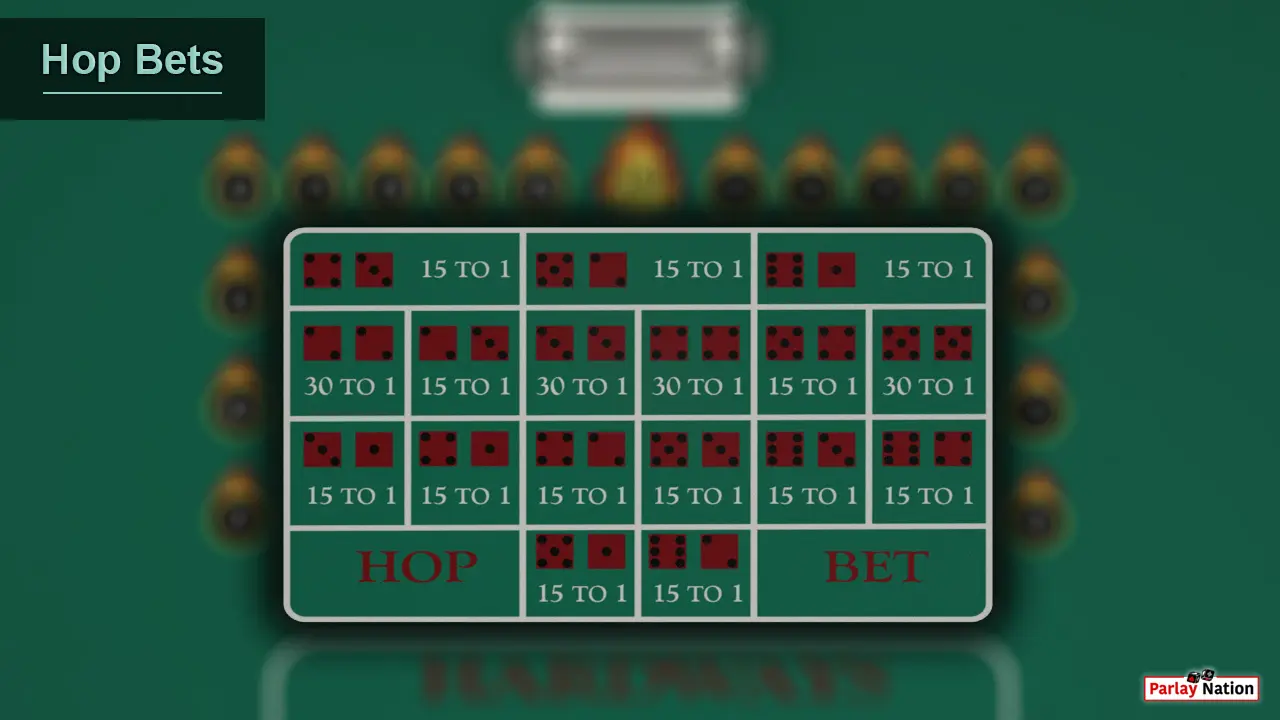
To place a hop bet, a player simply tells the dealer their desired combination and places their chips on the table, indicating it’s for the dealer. The dealer will confirm the bet. The payouts for hop bets vary depending on whether the combination is a “hardway” (a pair) or an “easyway” (non-pair).
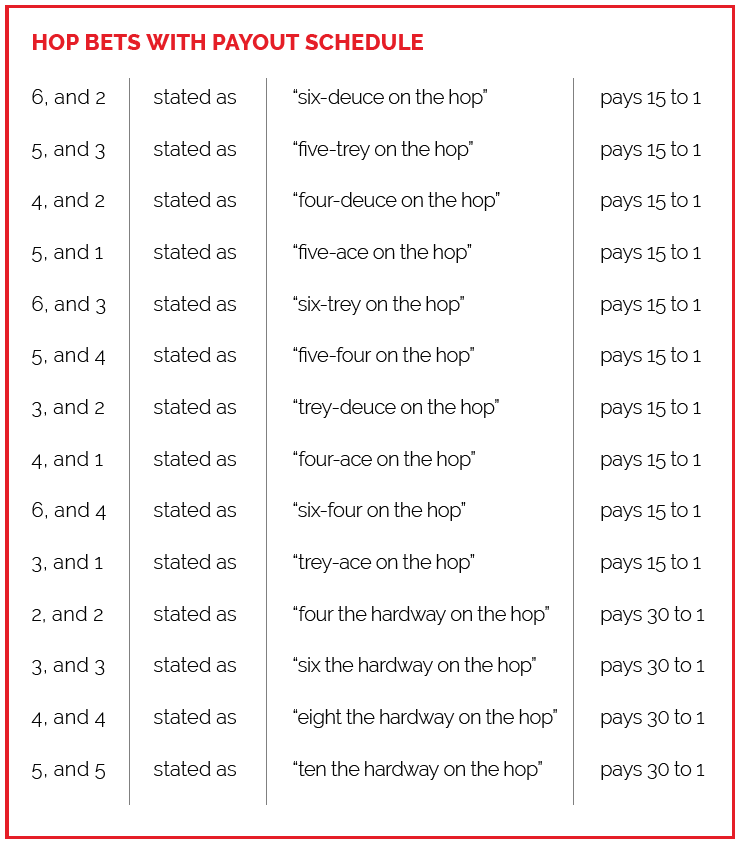
- Non-doubles (Easyway combinations): If you bet on a combination like 5-4, 6-3, or 2-5, and that exact combination appears, the payout is typically 15 to 1. This means a $10 bet would return $150 plus your original $10 stake.
- Doubles (Hardway combinations): If you bet on a specific pair, such as 2-2, 3-3, 4-4, 5-5, or 6-6, and that exact combination appears, the payout is typically 30 to 1. A $10 bet on a hardway hop would yield $300 plus your original $10 stake.
These high payout multiples immediately highlight the significant monetary swings involved. A small wager can lead to a substantial return, but the infrequency of these specific outcomes is the financial counterpoint.
The Immediate Financial Outcome
The defining characteristic of a hop bet is its immediacy. It is a “one-and-done” wager. Once the dice are rolled, the bet is resolved. If your chosen combination appears, you win. If any other combination appears, you lose your stake. This stands in stark contrast to multi-roll bets like the Pass Line, which can remain active for several rolls. The rapid resolution of a hop bet contributes to its appeal for those seeking quick action, but also to its potential for rapid depletion of a bankroll if not managed judiciously. From a financial perspective, this instant resolution translates to a high turnover rate for capital, which can amplify losses over a short period if luck is not on your side.
Risk vs. Reward: The Financial Calculus of Hop Bets
Like any financial endeavor, gambling on craps involves a careful assessment of risk and reward. Hop bets, in particular, embody a high-risk, high-reward proposition, demanding a clear understanding of probabilities and the inherent house edge.
High-Risk, High-Reward Proposition
The allure of the hop bet lies in its substantial payout ratios. Winning 15 or 30 times your stake can be highly tempting. However, these attractive payouts are a direct reflection of the extremely low probability of any specific two-dice combination hitting on a single roll.
Consider the possible outcomes when rolling two dice. There are 36 unique combinations.
- For an “easyway” combination like 5-4 (total 9), there are only two ways to roll a 9 (3-6, 4-5, 5-4, 6-3). But for a specific hop of “5 and 4”, there are only two possibilities (a 5 on die 1 and 4 on die 2, or a 4 on die 1 and a 5 on die 2). If the bet is strictly “5 and 4” in order, it’s just one way. Typically, craps hop bets consider the combination regardless of the order, so “5 and 4” refers to getting a 5 and a 4, which has 2 ways out of 36. This gives true odds of 17 to 1 against.
- For a “hardway” combination like 4-4 (total 8), there is only one way for this specific combination to occur (4 on die 1, 4 on die 2). The true odds against rolling a specific hardway are 35 to 1.
When comparing these true odds to the casino’s payout odds (15:1 for easyway and 30:1 for hardway), the discrepancy reveals the house edge. This situation mirrors highly speculative investments in traditional finance, where the potential for large returns is offset by a significantly increased risk of total capital loss.
House Edge and Expected Value
The house edge is the casino’s mathematical advantage over the player, expressed as a percentage of the amount wagered. It represents the expected long-term loss for the player per unit bet. For hop bets, the house edge is notoriously high:
- For easyway combinations (e.g., 5 and 4), with a payout of 15 to 1 against true odds of 17 to 1, the house edge is approximately 11.11%.
- For hardway combinations (e.g., 4 and 4), with a payout of 30 to 1 against true odds of 35 to 1, the house edge is approximately 13.89%.
These figures are among the highest in the entire casino, significantly greater than the house edge on Pass Line bets (1.41%) or even some Place Bets (e.g., 4% for placing the 5 or 9). From a financial perspective, a high house edge translates directly to a negative expected value over time. For every dollar wagered on a hop bet, a player can statistically expect to lose 11 to 14 cents in the long run. This makes hop bets a poor choice for any strategy aimed at sustained profitability or even minimizing losses. They are, quite literally, an expensive form of entertainment.
Strategic Allocation of Capital
Given the significant house edge, hop bets should never form the core of a player’s long-term craps strategy, especially if the goal is capital preservation or incremental gains. Instead, they should be viewed as a highly discretionary expenditure. Similar to allocating a small portion of a diversified investment portfolio to high-risk, high-reward speculative assets, a craps player might consider a small fraction of their bankroll for occasional hop bets. The key is to recognize that these are “fun” bets designed for excitement rather than a serious attempt at generating income. Over-reliance on hop bets or increasing wager sizes to chase losses on them is a recipe for rapid bankroll depletion, illustrating poor financial discipline.
Integrating Hop Bets into a Broader Craps Financial Strategy
While the financial drawbacks of hop bets are clear, understanding their place within a comprehensive craps strategy, particularly concerning bankroll management, is essential.
When to Consider a Hop Bet
A hop bet might be considered under specific, limited circumstances, purely for entertainment value:
- During a “Hot Roll”: If the dice appear to be producing a flurry of specific numbers, a player might place a small hop bet on a feeling, understanding it’s purely speculative.
- As a Small Treat: A player might budget a very small, predefined amount for such high-risk bets, treating it as the cost of a thrill, akin to buying a lottery ticket.
- Never for Recovery: Critically, hop bets should never be used in an attempt to recover losses from other bets. Their high house edge makes them an exceptionally inefficient tool for recouping capital. This is a fundamental principle of sound financial management in any high-risk environment.
Comparing Hop Bets to Other Craps Bets (Financial Implications)
To further illustrate the financial impact, it’s useful to compare hop bets with other common craps wagers:
- Pass Line/Don’t Pass Line: These bets offer a low house edge (1.41%) and become even better with “odds bets” (0% house edge), making them the foundation of a financially sensible craps strategy. They represent a steady, low-cost approach to play.
- Place Bets: Placing numbers like 6 or 8 (1.52% house edge) or 5 or 9 (4% house edge) offers moderate returns with a manageable house advantage. They allow for consistent action over multiple rolls.
- Other Proposition Bets: Many other single-roll “prop bets” (e.g., Any Seven, Any Craps) also carry high house edges (ranging from 9% to over 16%). Hop bets fit into this category of high-cost, instant-resolution wagers.
From a financial planning perspective, hop bets represent the extreme end of the risk-reward spectrum at the craps table. They are the equivalent of ultra-short-term, highly volatile options trades with a significant built-in premium for the “house.”
The Mindset of a Financially Savvy Craps Player
A player who approaches craps with a financially astute mindset prioritizes bankroll management, understands odds, and views gambling primarily as a form of entertainment with a predetermined cost. This means:
- Budgeting: Setting a strict budget for gambling sessions and sticking to it, regardless of wins or losses.
- Understanding Expected Value: Knowing that over the long run, the house edge guarantees a loss, and therefore, gambling losses should be accounted for as entertainment expenses, not investment losses.
- Discipline: Avoiding emotional betting, especially when it comes to high-house-edge bets like hops. The thrill of a big payout should not override sound judgment.
- Strategic Play: Focusing the majority of capital on bets with a lower house edge, reserving speculative wagers for minor, predefined amounts.
Responsible Financial Management in Gaming
The discussion around hop bets serves as a microcosm for broader principles of responsible financial management within the context of gaming. The high house edge and instant resolution make these bets particularly susceptible to poor decision-making if not approached with discipline.
It is paramount to reiterate the importance of setting a strict budget for any gaming activity. This budget should be considered a non-recoverable entertainment expense. The psychological pull of high-payout bets, combined with the fast pace of craps, can easily lead players to exceed their financial limits. Tools such as self-imposed wagering limits, setting time limits, or even utilizing self-exclusion programs offered by casinos can be vital safeguards against impulsive decisions that can have adverse financial consequences. Ultimately, understanding “what is a hop bet in craps” is not just about its mechanics, but about its profound implications for your personal finance and your approach to managing risk in leisure activities.
aViewFromTheCave is a participant in the Amazon Services LLC Associates Program, an affiliate advertising program designed to provide a means for sites to earn advertising fees by advertising and linking to Amazon.com. Amazon, the Amazon logo, AmazonSupply, and the AmazonSupply logo are trademarks of Amazon.com, Inc. or its affiliates. As an Amazon Associate we earn affiliate commissions from qualifying purchases.