
Investing in Exchange Traded Funds (ETFs) has become a cornerstone of modern portfolio management, offering diversification, flexibility, and often, lower costs compared to traditional mutual funds. However, a critical factor often overlooked by new investors, and sometimes even seasoned ones, is the ETF’s expense ratio. This seemingly small percentage can have a profound impact on an investor’s long-term returns, subtly eroding wealth over decades. Understanding what constitutes a “good” expense ratio isn’t a simple one-size-fits-all answer; it’s a nuanced consideration dependent on the ETF’s category, investment strategy, and the broader market context.
Understanding the ETF Expense Ratio
At its core, an ETF expense ratio represents the annual fee charged by the fund provider to cover the costs of managing and operating the fund. Expressed as a percentage of the fund’s total assets, this fee is deducted from the fund’s assets before returns are distributed to investors. It’s not a separate bill you receive, but rather an invisible drag on your investment performance.
What an Expense Ratio Covers
The expense ratio typically encompasses several operational costs:
- Management Fees: Compensation for the fund managers, especially in actively managed ETFs.
- Administrative Costs: Legal, auditing, and regulatory compliance fees.
- Marketing and Distribution Fees (12b-1 fees): Costs associated with promoting the fund, though these are less common and often lower for ETFs compared to mutual funds.
- Custodial Fees: Costs for holding the fund’s assets.
For index-tracking ETFs, where the fund simply aims to replicate the performance of a specific market index, the management component of the fee is inherently lower because there is no active stock picking involved. This passive approach is a primary reason why index ETFs generally boast significantly lower expense ratios than their actively managed counterparts.
How Expense Ratios Impact Returns
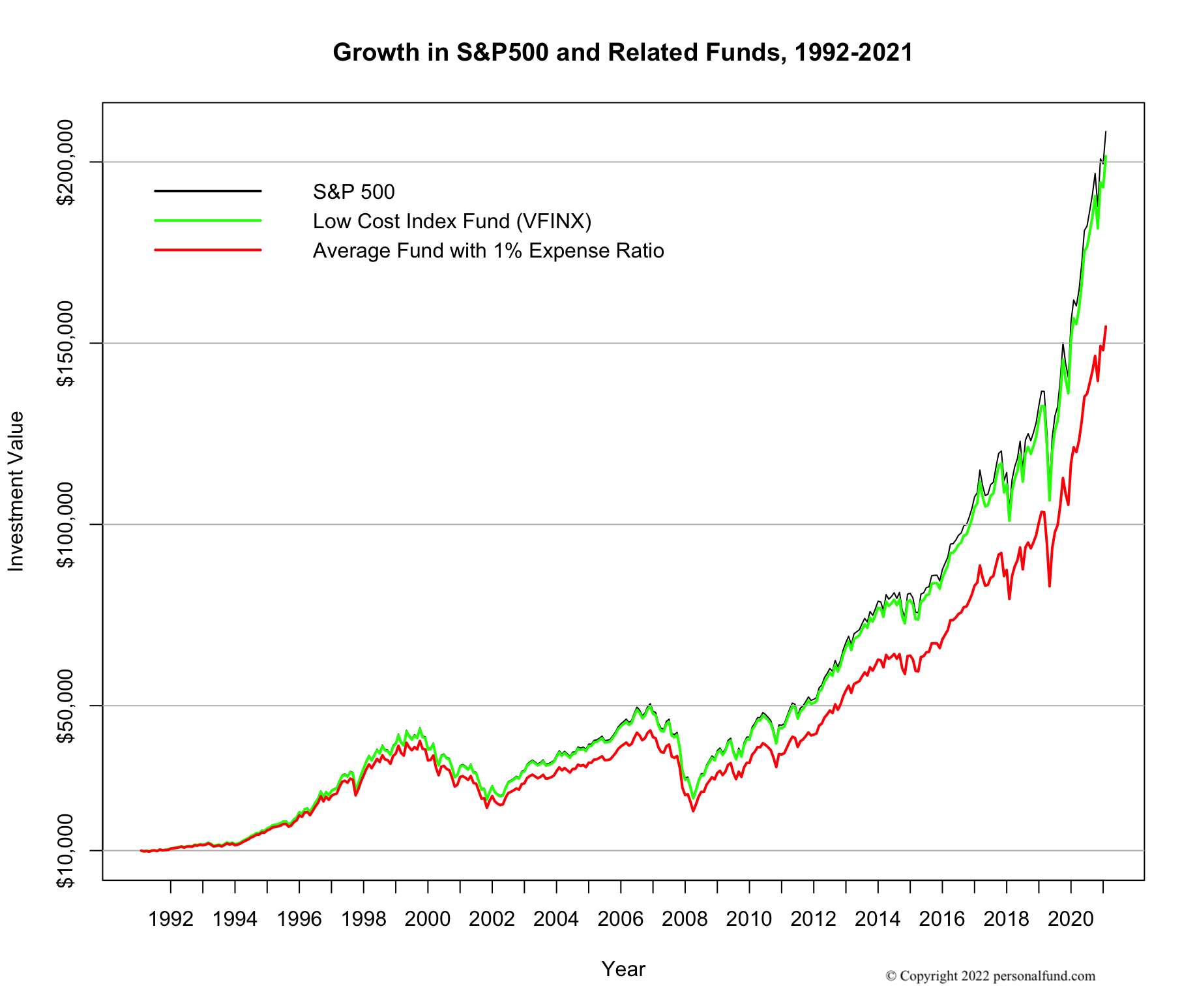
The impact of expense ratios on an investor’s portfolio is often underestimated because it appears small on an annual basis. However, due to the power of compounding, even a difference of a few basis points (one basis point equals 0.01%) can translate into tens of thousands, or even hundreds of thousands, of dollars over an investing lifetime.
Consider two ETFs, both tracking the same market index and returning 7% annually before fees. ETF A has an expense ratio of 0.05%, while ETF B has an expense ratio of 0.50%. Over 30 years, an initial investment of $10,000 would grow significantly more in ETF A than in ETF B, purely due to the difference in fees. This effect is magnified as more capital is invested and as the investment horizon lengthens. The lost returns due to higher fees are not just the fees themselves, but also the compounding growth that money could have generated.
Expense Ratios vs. Trading Costs
It’s crucial to differentiate expense ratios from other costs associated with ETF investing, primarily trading costs. Trading costs include:
- Brokerage Commissions: Fees charged by your brokerage to buy or sell ETF shares (though many brokers now offer commission-free trading for ETFs).
- Bid-Ask Spread: The difference between the highest price a buyer is willing to pay and the lowest price a seller is willing to accept. A wider spread means higher transaction costs, especially for frequently traded or less liquid ETFs.
- Impact Costs: For very large orders, buying or selling can move the market price of the ETF, incurring additional costs.
While trading costs are one-time expenses for each transaction, the expense ratio is an ongoing, annual charge that continually diminishes your net returns regardless of whether you buy or sell shares. Therefore, for long-term investors, the expense ratio often represents the more significant and persistent drag on performance.
Benchmarking Good Expense Ratios Across ETF Categories
What constitutes a “good” expense ratio is relative and depends heavily on the specific asset class, investment strategy, and the level of specialization an ETF offers. Broad market index funds, by their nature, will have much lower expense ratios than highly specialized or actively managed funds.
Broad Market Index ETFs
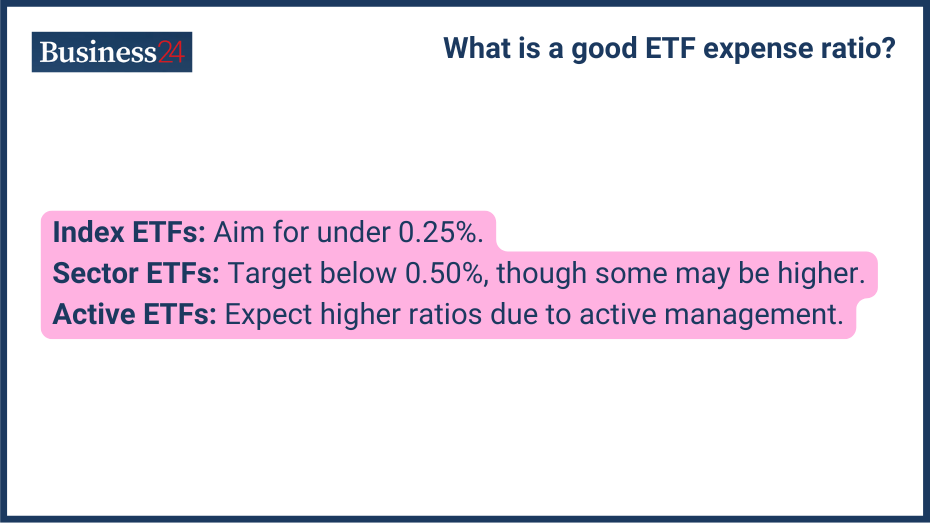
These ETFs aim to track major market indices such as the S&P 500, the total U.S. stock market, or broad international indices. Due to their passive management style, high liquidity, and competitive landscape, these funds typically have the lowest expense ratios.
- Good Range: 0.03% to 0.10%. Many excellent options are available at or below 0.05%.
- Examples: ETFs tracking the S&P 500 or the total U.S. stock market.
Sector-Specific and Thematic ETFs
These funds focus on particular industries (e.g., technology, healthcare) or emerging themes (e.g., clean energy, artificial intelligence). The narrower focus often requires more specialized research and can sometimes lead to lower liquidity, justifying slightly higher fees.
- Good Range: 0.20% to 0.60%. For truly innovative or niche themes, investors might accept slightly higher.
- Consideration: Ensure the specialization truly adds value and isn’t just marketing hype.
Bond ETFs
Bond ETFs invest in various types of fixed-income securities, including government bonds, corporate bonds, municipal bonds, and high-yield bonds. Their expense ratios vary based on the complexity and liquidity of the underlying bond market.
- Good Range: 0.05% to 0.30%. Core aggregate bond funds tend to be at the lower end, while specialized or high-yield bond funds might be higher.
- Note: Bond yields are generally lower than stock returns, so expense ratios take a larger bite out of net returns.
International and Emerging Markets ETFs
These ETFs invest in companies outside an investor’s home country, including developed international markets and potentially more volatile emerging markets. Higher fees can be attributed to the complexities of international investing, such as foreign currency conversions, different regulatory environments, and potentially lower liquidity in some markets.
- Good Range: 0.15% to 0.50%. Broad developed international funds are often closer to the lower end, while emerging markets can be higher.
Actively Managed ETFs
Unlike index funds, actively managed ETFs employ portfolio managers who make investment decisions with the aim of outperforming a specific benchmark. This active management comes at a higher cost.
- Good Range: 0.40% to 1.00%+. While higher, the justification for these fees lies in the expectation of alpha (outperformance).
- Challenge: Consistently outperforming the market after fees is notoriously difficult for active managers. Investors must critically assess past performance and the manager’s strategy.
Commodity and Alternative ETFs
These funds invest in physical commodities (like gold, oil) or utilize complex strategies (e.g., leveraged, inverse ETFs). The unique storage, insurance, and management requirements, along with specialized trading strategies, often lead to higher expense ratios.
- Good Range: 0.40% to 1.00%+. These are typically used for tactical allocation rather than core holdings.
- Warning: Leveraged and inverse ETFs come with significant risks and are generally not suitable for long-term buy-and-hold investors.
The Trade-off: Expense Ratio vs. Performance and Specialization
While a low expense ratio is generally desirable, it’s not the only factor to consider. Sometimes, a slightly higher expense ratio might be justified if the fund offers a truly unique benefit or demonstrates consistent outperformance.
When a Higher Expense Ratio Might Be Justified
- Niche Market Access: If an ETF provides access to a specific, hard-to-reach market or industry segment that perfectly aligns with your investment strategy and cannot be accessed efficiently through lower-cost alternatives, a slightly higher fee might be acceptable.
- Proven Active Management: In rare cases, an actively managed ETF might consistently deliver superior returns after fees. However, verifying this requires extensive historical analysis and a deep understanding of the fund’s strategy. Be wary of funds with short track records.
- Unique Investment Strategies: Funds employing sophisticated strategies (e.g., factor-based investing, specific option strategies) might have higher operational costs. The value lies in whether these strategies genuinely enhance risk-adjusted returns.
The Myth of “You Get What You Pay For” in Index Funds
For passive, index-tracking investments, the adage “you get what you pay for” rarely holds true for expense ratios. In fact, the opposite is often the case: for broad market exposure, lower expense ratios almost invariably lead to better long-term returns because the fund’s objective is merely to track an index, not to beat it. The value proposition of an index fund is its efficient, low-cost replication of a market segment, and higher fees simply erode that efficiency without providing any corresponding benefit.
Considering Total Cost of Ownership
Beyond the expense ratio, investors should consider the “total cost of ownership,” which includes:
- Bid-Ask Spread: As mentioned, a wide spread effectively increases your transaction cost. This is more critical for less liquid ETFs.
- Tracking Error: How closely the ETF’s performance mirrors its underlying index. A higher expense ratio doesn’t guarantee a lower tracking error.
- Tax Efficiency: ETFs are generally more tax-efficient than mutual funds due to their creation/redemption mechanism, which often allows them to avoid distributing capital gains to shareholders. However, some ETFs, particularly those holding certain types of bonds or commodities, might have different tax implications.
- Dividend Yield and Reinvestment: While not a cost, the ability to reinvest dividends seamlessly and cost-effectively contributes to overall return.
Strategies for Minimizing Expense Ratio Impact
For most long-term investors, prioritizing low expense ratios is a cornerstone of a sound investment strategy.
Prioritize Low-Cost Core Holdings
Build the foundation of your portfolio with broad market index ETFs that have ultra-low expense ratios (e.g., total U.S. stock market, total international stock market, aggregate bond market). These core holdings should represent the largest portion of your portfolio.
Diversify Thoughtfully
While diversification is crucial, avoid over-diversification or investing in numerous overlapping ETFs, each with its own expense ratio. Justify each specialized ETF’s inclusion by ensuring it truly adds a unique exposure or strategic advantage not covered by your core holdings.
Reinvest Dividends Automatically
Many brokerage platforms offer automatic dividend reinvestment for ETFs. This allows your dividends to immediately buy more shares of the ETF, compounding your returns without incurring additional transaction costs.
Adopt a Long-Term Perspective
The impact of expense ratios is most pronounced over long investment horizons. By committing to low-cost funds for decades, you allow the power of compounding to work for you, rather than against you through fees. Regularly review your portfolio’s expense ratios as new, lower-cost options may emerge.
Utilize Commission-Free ETF Platforms
Many brokerages now offer commission-free trading for a wide selection of ETFs. This eliminates one layer of cost, making it even more advantageous to invest in ETFs, especially if you plan to make frequent contributions or rebalance regularly.
The Future of ETF Expense Ratios
The ETF industry is intensely competitive, driven by a continuous race to attract assets. This competition has led to a consistent downward pressure on expense ratios over the past two decades.
The Race to Zero
For the most popular, highly liquid, broad-market index ETFs, expense ratios have already approached, and in some cases, reached zero. Fund providers are willing to offer extremely low or even zero-fee funds to capture market share, betting on revenue from securities lending or other product offerings. While “zero-fee” ETFs might come with other considerations (e.g., less popular indices, specific broker-dealer requirements), the trend is undeniable.
Implications for Investors
This trend is overwhelmingly positive for investors. It means:
- More Accessible Investing: High-quality, diversified portfolios are becoming even more affordable.
- Enhanced Returns: Lower costs directly translate to higher net returns over the long term.
- Increased Competition: The pressure on fees forces all fund providers to be more efficient and innovative.

The Rise of Robo-Advisors and Model Portfolios
Robo-advisors and automated investing platforms predominantly utilize low-cost ETFs to construct diversified portfolios for their clients. Their emergence further solidifies the role of low-expense-ratio ETFs as the backbone of cost-effective, passive investment strategies, making professional-grade portfolio management accessible to a wider audience.
In conclusion, a “good” expense ratio for an ETF is generally as low as possible for the specific market segment it targets, ideally below 0.10% for broad market core holdings and under 0.50% for most specialized funds. While the expense ratio is a crucial metric, it should be evaluated in conjunction with the fund’s investment objective, tracking accuracy, liquidity, and overall fit within your long-term financial strategy. By prioritizing low-cost funds, investors can significantly improve their odds of achieving their financial goals.
aViewFromTheCave is a participant in the Amazon Services LLC Associates Program, an affiliate advertising program designed to provide a means for sites to earn advertising fees by advertising and linking to Amazon.com. Amazon, the Amazon logo, AmazonSupply, and the AmazonSupply logo are trademarks of Amazon.com, Inc. or its affiliates. As an Amazon Associate we earn affiliate commissions from qualifying purchases.