
In the saturated global jewelry market, where heritage brands like Tiffany & Co. and Cartier have reigned supreme for over a century, a relatively new player has managed to disrupt the industry not through manufacturing innovation or lower price points, but through a radical brand strategy. Darry Ring (DR) has become a cultural phenomenon by answering a simple question: What if a brand’s greatest strength was its refusal to sell to its customers more than once?
Understanding the “Darry Ring meaning” requires a deep dive into brand strategy, consumer psychology, and the mechanics of scarcity marketing. By imposing a strict “one ring per person” rule, Darry Ring has transformed a physical commodity—the diamond engagement ring—into a potent symbol of lifelong commitment, fundamentally changing how a brand can monetize exclusivity.
The Core Brand Philosophy: “One Ring, One Life, One Person”
At the heart of Darry Ring’s identity is a mission statement that functions as a binding contract: “One Ring, One Life, One Person.” While most retail brands focus on Customer Lifetime Value (CLV) through repeat purchases, Darry Ring intentionally caps its transaction frequency at one.
Redefining the Engagement Ring Market
Traditionally, the diamond industry has relied on the 4Cs (Cut, Color, Clarity, and Carat) to determine value. Darry Ring shifted this paradigm by introducing a fifth “C”: Commitment. By positioning their product as a “true love” verification tool, they moved the brand from the category of luxury goods to the category of emotional milestones. In this niche, the price of the diamond becomes secondary to the social and emotional weight of the purchase. The brand isn’t just selling jewelry; it is selling the narrative that the buyer is a person of integrity and lifelong loyalty.
The ID Verification Process: Building Trust Through Commitment
To enforce its unique selling proposition (USP), Darry Ring implements a rigorous identity verification process. A male purchaser is required to present his national ID card, which is then linked to a permanent record in the brand’s database. Once a purchase is made, the system “locks” that identity, preventing the individual from ever buying another Darry Ring for a different recipient.
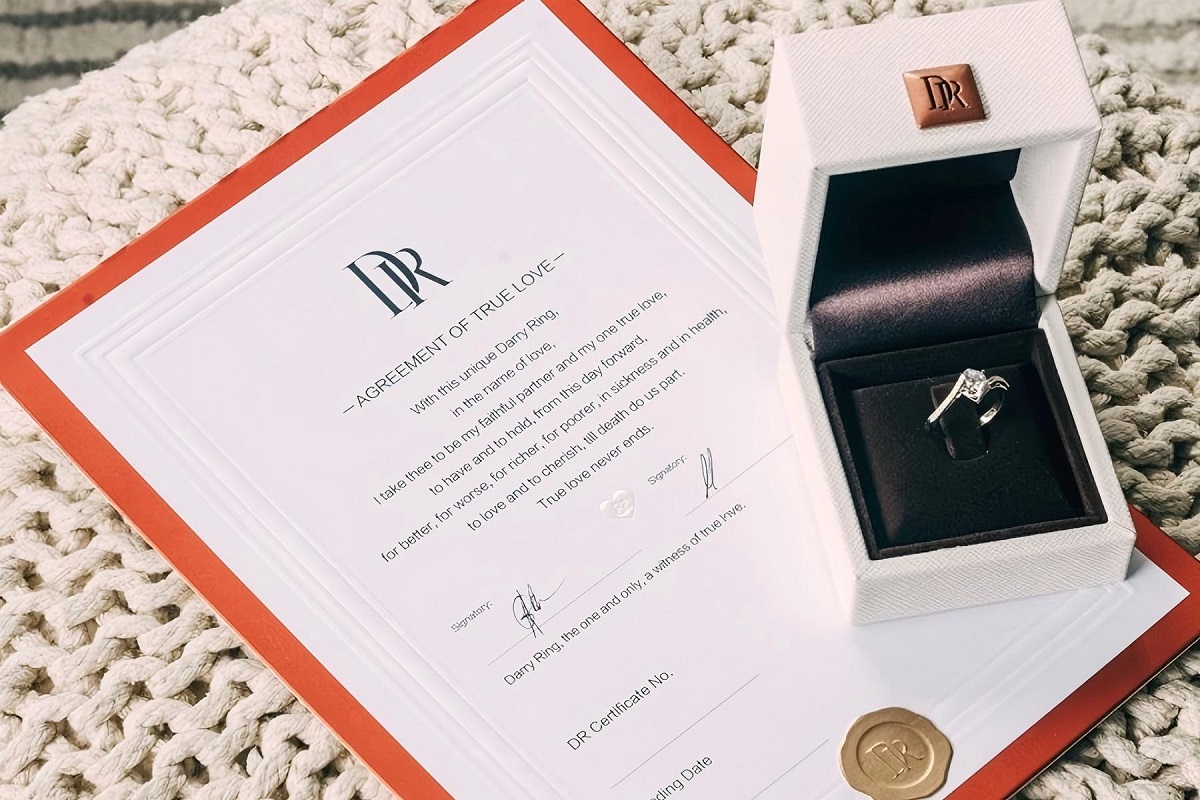
This process serves as a powerful branding tool. It transforms the act of buying into a ceremony. The friction involved in the purchase—providing an ID, signing a “True Love Agreement,” and entering a permanent database—actually increases the perceived value of the brand. In marketing terms, this is a “barrier to entry” that filters for a specific type of high-intent, emotionally driven consumer.
Strategic Scarcity: How Darry Ring Mastered Modern Marketing
Scarcity is a fundamental principle of luxury branding, but Darry Ring applies it in a way that is uniquely structural rather than temporal. Unlike a “limited edition” drop that expires over time, Darry Ring’s scarcity is personal and permanent.
The Psychology of “Only One”
Human psychology is wired to value things that are rare or difficult to obtain. By telling a customer, “You are only allowed to buy this once,” Darry Ring triggers a sense of profound significance. This strategy leverages the “scarcity effect,” where the limited availability of an opportunity makes it more attractive.
From a brand strategy perspective, this creates an elite club of owners. When a person wears a Darry Ring, they are communicating to the world that their partner has officially “spent” their one and only lifetime purchase on them. This creates a powerful form of social validation that traditional brands, which will sell a ring to anyone with a credit card, cannot replicate.
Creating a Barrier to Entry as a Value Proposition
In most business models, friction is the enemy. Amazon spent decades perfecting “1-Click” ordering to remove barriers. Darry Ring does the opposite. By making the purchase difficult and restrictive, they ensure that the brand remains synonymous with “seriousness.”
This strategy effectively segments the market. It alienates the casual buyer or the repeat jeweler-shopper, but it creates intense brand loyalty among those who subscribe to the “true love” ideology. This is a classic example of “polarizing branding”—by being “not for everyone,” they become “everything” to their target demographic.

Brand Identity and Social Currency in the Digital Age
In the era of Instagram and TikTok, a brand is only as strong as its shareability. Darry Ring’s meaning has been amplified through a sophisticated understanding of social currency and user-generated content (UGC).
Viral Marketing and the “True Love” Narrative
Darry Ring’s marketing campaigns rarely focus on the technical specifications of their diamonds. Instead, they focus on the stories of the couples. Their content strategy revolves around the “moment of commitment”—the ID verification, the signing of the agreement, and the emotional weight of the “one and only” promise.
This narrative is tailor-made for social media algorithms. Videos of men proving their identity to buy a ring often go viral because they tap into universal themes of romance and exclusivity. The brand doesn’t have to pay for all its reach; its customers are eager to post their “True Love Agreements” online as a form of social proof. In this context, the ring becomes a “badge of honor” in the digital social hierarchy.
Leveraging User-Generated Content (UGC)
The “True Love Agreement” that comes with every Darry Ring is a masterstroke of design and branding. It is an aesthetically pleasing document that begs to be photographed and shared. By providing customers with a physical artifact of their commitment, Darry Ring facilitates a constant stream of free advertising. Every time a user shares their ring and agreement, they are reinforcing the brand’s core message to their entire social circle, creating a network effect that drives brand awareness without traditional ad spend.
The Future of Purpose-Driven Branding
Darry Ring’s success offers a blueprint for brands looking to move beyond transactional relationships with their customers. It proves that in a world of infinite choice, consumers are increasingly looking for brands that stand for a specific set of values.
Moving Beyond the Product to the Promise
The Darry Ring meaning is ultimately about a shift from product-centric marketing to purpose-centric branding. The diamond is merely the vessel; the “promise” is the actual product. This allows the brand to maintain high margins because the customer is paying for the emotional security and the status that the “one life, one person” rule provides.
This model challenges the traditional retail wisdom that more transactions are always better. By prioritizing the meaning of the transaction over the volume of transactions, Darry Ring has built a brand fortress that is incredibly difficult for competitors to storm. To copy Darry Ring, a competitor would have to adopt the same restrictions, which would often contradict their own multi-purchase business models.
Sustainability of the One-Purchase Model
Critics of the Darry Ring model often point to the limitation of growth. If you can only sell to a customer once, how do you sustain a multi-billion dollar business? The answer lies in the sheer size of the global marriage market and the potential for horizontal brand expansion.
While a customer might only buy one engagement ring, the trust built through that singular, high-stakes transaction can be leveraged. Darry Ring has already begun expanding into wedding bands, anniversary gifts (which can only be bought by existing “one ring” members), and even jewelry for children, all framed within the context of “continuing the story of love.” By owning the “commitment” niche, they can expand their product line while keeping the core “one ring” restriction as the ultimate lead generator and brand anchor.

Conclusion: The Power of a Singular Identity
The meaning of Darry Ring extends far beyond a piece of jewelry. It is a sophisticated brand ecosystem built on the pillars of scarcity, identity verification, and emotional storytelling. In an age of fast fashion and disposable relationships, Darry Ring has successfully commodified the concept of “forever.”
By daring to say “no” to potential sales, the brand has created a “yes” that is more valuable than almost any other in the jewelry industry. For brand strategists and marketers, the Darry Ring case study serves as a powerful reminder: sometimes, the best way to increase a brand’s value is not by doing more, but by standing firmly for one thing—even if that thing is “only one.”
aViewFromTheCave is a participant in the Amazon Services LLC Associates Program, an affiliate advertising program designed to provide a means for sites to earn advertising fees by advertising and linking to Amazon.com. Amazon, the Amazon logo, AmazonSupply, and the AmazonSupply logo are trademarks of Amazon.com, Inc. or its affiliates. As an Amazon Associate we earn affiliate commissions from qualifying purchases.