
In the fast-paced world of high-frequency trading and globalized financial markets, volatility is an inherent characteristic. While price movements are a natural part of price discovery, extreme and rapid declines can trigger a feedback loop of panic selling, potentially leading to a total market collapse. To prevent such catastrophic scenarios, stock exchanges utilize a sophisticated regulatory mechanism known as a circuit breaker. Much like the electrical component in a home that shuts off power during an overload to prevent a fire, a stock market circuit breaker is an automated temporary trading halt designed to curb panic selling and restore a semblance of order to the marketplace.
Understanding the mechanics of circuit breakers is essential for any investor, from the retail trader to the institutional fund manager. These safeguards serve as a “timeout” for the market, providing participants with the opportunity to digest news, reassess their positions, and facilitate more rational decision-making during periods of extraordinary stress.
The Mechanics of Market-Wide Circuit Breakers
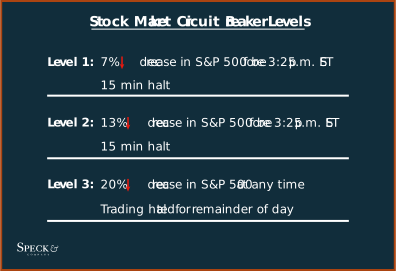
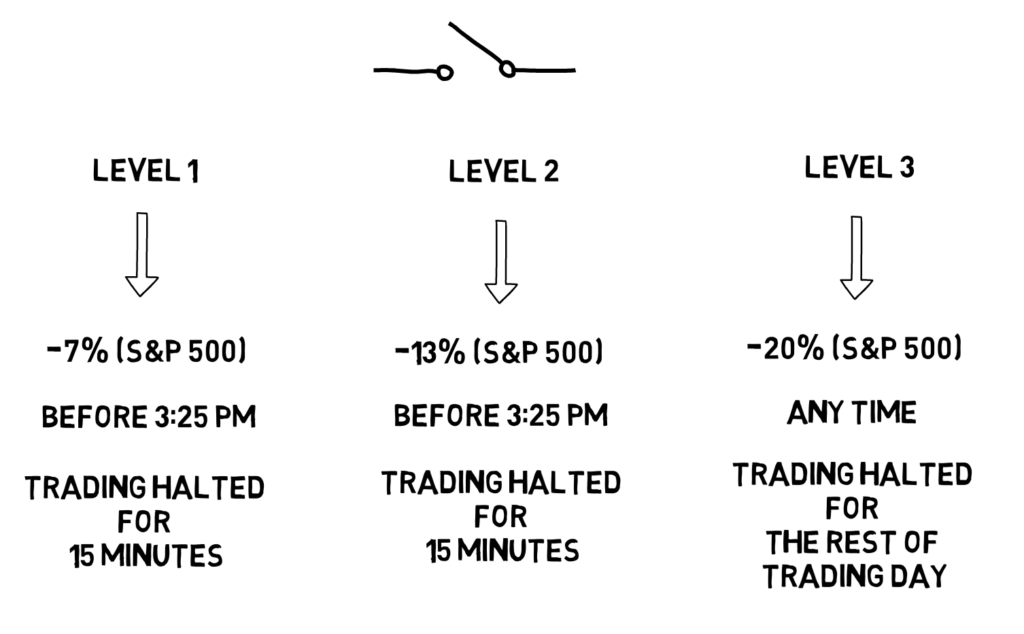
Market-wide circuit breakers (MWCBs) are regulatory measures that apply to the entire stock market, typically triggered by significant declines in a broad-based index. In the United States, the S&P 500 serves as the primary benchmark for determining these halts. The Securities and Exchange Commission (SEC) has established three distinct levels of circuit breakers, each corresponding to a specific percentage decline from the previous day’s closing price.
Level 1 and Level 2 Thresholds
A Level 1 circuit breaker is triggered if the S&P 500 index drops by 7% from the previous session’s close. Once this threshold is hit, all trading on the exchanges—including the New York Stock Exchange (NYSE) and NASDAQ—is halted for 15 minutes. This brief pause is intended to let the initial wave of selling subside and allow liquidity providers to reset their quotes.
A Level 2 circuit breaker is triggered if the index declines by 13%. Similar to Level 1, a Level 2 halt results in a 15-minute suspension of all trading activity. However, there are specific timing rules regarding these levels. If a Level 1 or Level 2 decline occurs before 3:25 PM ET, the 15-minute halt is enforced. If the decline occurs at or after 3:25 PM ET, trading continues unless a Level 3 decline is reached. This is because the final 35 minutes of the trading day are considered critical for price discovery and closing auctions.
Level 3: The Market Shutdown
The Level 3 circuit breaker is the ultimate safety net. It is triggered by a massive 20% decline in the S&P 500 at any time during the trading day. Unlike the 15-minute pauses of the first two levels, a Level 3 trigger results in the immediate suspension of trading for the remainder of the day. This extreme measure is reserved for the most severe market shocks, ensuring that the market does not enter a free-fall that could jeopardize the entire financial system. By closing the market, regulators give investors an entire night to process information before the next day’s opening bell.
The Role of the S&P 500
Historically, the Dow Jones Industrial Average (DJIA) was used as the benchmark for circuit breakers. However, following the “Flash Crash” of 2010, regulators shifted the benchmark to the S&P 500. This change was implemented because the S&P 500 is a broader and more accurate representation of the overall U.S. equity market, making it a more reliable indicator of systemic volatility.
The History and Evolution of Market Safeguards
The concept of the circuit breaker did not emerge from a vacuum; it was born out of one of the darkest days in financial history: Black Monday. On October 19, 1987, the Dow Jones Industrial Average plummeted by 22.6% in a single session. The lack of automated halts at the time meant that selling pressure snowballed, exacerbated by early computer-driven “program trading” that lacked the sophisticated guardrails we have today.
From 1987 to the Modern Era
Following the 1987 crash, the Brady Commission recommended the implementation of circuit breakers to prevent a repeat of such a catastrophic liquidity vacuum. The initial rules were quite different from today’s, often based on point drops rather than percentages. However, as the market grew, point-based triggers became obsolete, leading to the adoption of the current percentage-based system.
The rules were further refined after the May 6, 2010, Flash Crash, during which the Dow Jones dropped nearly 1,000 points in minutes only to recover most of it shortly after. This event highlighted the vulnerability of a high-speed, fragmented market. The SEC responded by tightening the MWCB rules and introducing single-stock circuit breakers to prevent localized volatility from spiraling out of control.
The 2020 Pandemic Test
The most significant recent application of these rules occurred in March 2020, during the onset of the COVID-19 pandemic. In a span of just two weeks, Level 1 circuit breakers were triggered four times (March 9, 12, 16, and 19). These were the first times the modern MWCB system had been activated since its 2013 overhaul. While the halts were jarring, many analysts believe they successfully prevented a total technical breakdown of the exchanges by allowing market makers to maintain orderly books amidst unprecedented uncertainty.
Individual Stock Halts: Limit Up-Limit Down (LULD)
While market-wide circuit breakers address systemic risk, individual stocks can also experience extreme volatility that requires a pause. These are governed by the “Limit Up-Limit Down” (LULD) mechanism. Unlike MWCBs, which are based on a single index, LULD rules apply to specific tickers and are triggered throughout the trading day based on price bands.
How LULD Price Bands Work
The LULD mechanism prevents a stock from trading outside of a specific price range, usually based on the average price of the security over the preceding five minutes. These bands are typically set at 5%, 10%, or wider percentages depending on the stock’s liquidity and price. If a stock’s price moves outside these bands and stays there for more than 15 seconds, a five-minute trading halt is triggered.
Trading Pauses vs. Regulatory Halts
It is important to distinguish LULD halts from regulatory halts. A regulatory halt might occur if a company has significant pending news (such as a merger or a major legal settlement) that has not yet been disseminated to the public. In contrast, LULD pauses are purely technical and volatility-based. They ensure that a sudden “fat-finger” error or a momentary imbalance in buy/sell orders doesn’t result in an irrational price execution.
Why Circuit Breakers Matter for Investors
For the average investor, circuit breakers can feel like an inconvenience or a sign of impending doom. However, they serve several vital functions that protect the integrity of personal portfolios and the broader economy.
Providing a Psychological Cooling-Off Period
Human psychology plays a massive role in market movements. During a crash, the “fight or flight” response often takes over, leading investors to sell at any price just to escape the perceived danger. By forcing a 15-minute pause, circuit breakers break the momentum of fear. This time allows investors to step back from their screens, consult with financial advisors, and evaluate whether the sell-off is based on fundamental shifts or temporary panic.
Ensuring Market Liquidity
In a free-falling market, liquidity—the ability to buy or sell an asset without causing a significant change in its price—often evaporates. Market makers, who are responsible for providing buy and sell quotes, may withdraw from the market if they cannot accurately price assets. Circuit breakers provide these professionals with a window to recalibrate their algorithms and ensure that when trading resumes, there is actually someone on the other side of the trade. Without this, the “bid-ask spread” could widen to a point where selling becomes nearly impossible.
Protection Against Algorithmic Anomalies
In the modern era, a significant portion of trading is conducted by algorithms and high-frequency trading (HFT) firms. These systems are designed to react in milliseconds. If an algorithm encounters an unexpected price movement, it may trigger a cascade of sell orders. Circuit breakers act as a “firewall” against these automated feedback loops, ensuring that the market remains a human-centric institution governed by rational valuation rather than just lines of code.
The Debate: Safety Net or Price Distorter?
Despite their widespread use, circuit breakers are not without their critics. Some economists and market purists argue that any intervention in the free flow of trading can have unintended consequences.
The “Magnet Effect”
One of the most common criticisms of circuit breakers is the “magnet effect.” This theory suggests that as a stock or index approaches a circuit breaker threshold, investors rush to sell before the halt occurs, effectively “pulling” the price toward the trigger point. Instead of slowing down the decline, the presence of the circuit breaker might actually accelerate it in the final moments before the halt.
Price Discovery Concerns
Critics also point out that halts interfere with “price discovery”—the process by which the market determines the fair value of an asset based on supply and demand. By stopping trade, the exchange prevents the market from reaching its natural equilibrium. This can lead to even greater volatility when the market reopens, as a massive backlog of orders hits the tape simultaneously.
The Necessity of Order
However, the prevailing consensus among regulators and institutional leaders is that the benefits of stability outweigh the drawbacks of temporary price distortion. In a world of interconnected global markets, a total collapse of the U.S. stock market due to a technical or psychological glitch would have devastating real-world consequences, from the solvency of pension funds to the stability of the banking system.

Conclusion
The circuit breaker is a vital piece of financial infrastructure that balances the need for free-market price discovery with the necessity of systemic stability. By providing structured pauses during periods of extreme volatility, these mechanisms protect investors from the worst impulses of the market—and themselves. While they cannot prevent a bear market or stop a stock from declining based on poor fundamentals, they ensure that the process of decline happens in an orderly, transparent, and fair manner. For the modern investor, recognizing the levels and triggers of these breakers is not just a matter of technical trivia; it is a fundamental component of navigating the complexities of the financial landscape.
aViewFromTheCave is a participant in the Amazon Services LLC Associates Program, an affiliate advertising program designed to provide a means for sites to earn advertising fees by advertising and linking to Amazon.com. Amazon, the Amazon logo, AmazonSupply, and the AmazonSupply logo are trademarks of Amazon.com, Inc. or its affiliates. As an Amazon Associate we earn affiliate commissions from qualifying purchases.