
In the dynamic world of mathematics, science, and engineering, tools that enhance computation and understanding are invaluable. Among the most sophisticated of these tools is the CAS calculator, an acronym for Computer Algebra System. Far more than a mere numerical processor, a CAS calculator is a powerful handheld device or software that can perform symbolic manipulation, solve complex equations, and even graph functions, revolutionizing how students and professionals approach mathematical problems. It stands as a testament to the continuous evolution of technology, bridging the gap between theoretical mathematical concepts and practical computational solutions. This article will delve into the intricacies of CAS calculators, exploring their fundamental capabilities, their transformative impact on education and various professions, and what sets them apart in the ecosystem of mathematical tools.

Deconstructing the “CAS”: The Power of Symbolic Computation
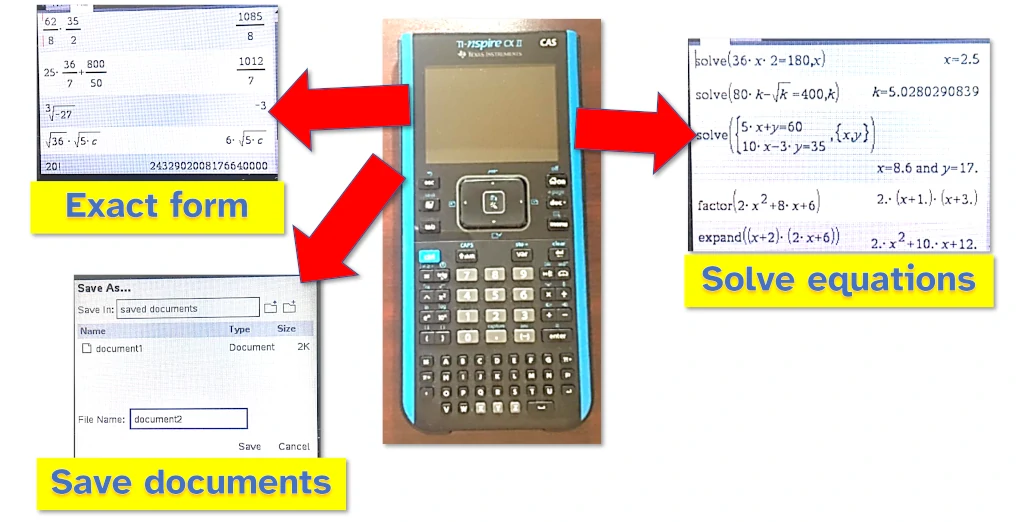
At its core, a CAS calculator’s defining feature is its ability to perform symbolic computation, a capability that elevates it significantly beyond traditional scientific or graphing calculators. While conventional calculators are designed to handle numerical operations and provide approximate answers, a CAS calculator works with mathematical expressions as symbols, offering exact answers and manipulating equations algebraically.
Beyond Numerical Solutions: Embracing Symbolic Manipulation
To understand the profound difference, consider the task of simplifying an algebraic expression like $(x+1)^2$. A standard calculator might struggle to process this symbolically, whereas a CAS calculator can instantly expand it to $x^2 + 2x + 1$. Similarly, if asked to find the derivative of $x^3$, a CAS calculator won’t just evaluate it at a point but will return the symbolic expression $3x^2$. This capability extends to complex scenarios, allowing users to factor polynomials, solve systems of equations involving variables, and even perform operations with matrices that contain symbolic entries. The beauty of symbolic manipulation lies in its precision; it provides exact mathematical forms, preserving the inherent structure and relationships within equations, which is crucial for deep understanding and advanced problem-solving. This isn’t just about getting an answer, but understanding the mathematical journey to that answer.
Core Capabilities: A Toolkit for Advanced Mathematics
The range of operations a CAS calculator can perform symbolically is extensive, making it an indispensable tool for advanced mathematics. Its repertoire typically includes:
- Algebra: Factoring, expanding, simplifying expressions, solving equations (linear, quadratic, polynomial, transcendental), and working with inequalities.
- Calculus: Performing symbolic differentiation and integration, finding limits, computing series expansions (like Taylor or Maclaurin series), and solving differential equations.
- Linear Algebra: Manipulating matrices (addition, subtraction, multiplication), finding determinants, inverses, eigenvalues, and eigenvectors symbolically.
- Polynomial Manipulation: Operations like polynomial division, finding roots, and greatest common divisors (GCDs).
- Trigonometry: Simplifying trigonometric identities and solving trigonometric equations.
- Number Theory: Operations involving prime factorization and modular arithmetic.
This comprehensive suite of capabilities transforms the calculator from a mere arithmetic aid into a powerful computational assistant, capable of tackling problems that would traditionally require extensive manual computation or specialized software on a computer.
The Significance of Exact Answers
One of the most understated yet critical advantages of symbolic computation is the provision of exact answers. When dealing with irrational numbers like $sqrt{2}$ or constants like $pi$, a numerical calculator will provide a decimal approximation. While often sufficient, these approximations can introduce rounding errors that compound over multiple steps, leading to inaccuracies in complex calculations. A CAS calculator, however, will retain $sqrt{2}$ or $pi$ in its symbolic form, only converting to a decimal if explicitly requested. This commitment to exactness ensures mathematical purity and precision, particularly vital in fields where even minute discrepancies can have significant consequences, such as engineering design, theoretical physics, or advanced financial modeling. It allows users to work with mathematical concepts at their purest form, fostering a deeper engagement with the underlying principles rather than being bogged down by numerical approximations.
How CAS Calculators Revolutionize Learning and Problem-Solving
The advent of CAS calculators has fundamentally reshaped both educational methodologies and professional problem-solving approaches. By automating complex manual computations, these devices allow users to shift their focus from the mechanics of calculation to the conceptual understanding of mathematics.
Enhancing Mathematical Understanding
For students, the CAS calculator serves as a powerful learning aid. Instead of spending hours on repetitive algebraic manipulations or differentiation problems, students can use the calculator to perform these tasks quickly and accurately. This frees up valuable time and mental energy, allowing them to concentrate on the ‘why’ and ‘how’ behind mathematical concepts. They can explore different scenarios, test hypotheses, and observe the immediate effects of changing variables, fostering a deeper, more intuitive grasp of the subject matter. For instance, a student learning about derivatives can quickly compute the derivative of various functions and visualize their graphs, understanding the relationship between a function and its rate of change without getting lost in the arithmetic. This interactive exploration transforms abstract concepts into tangible experiences, making mathematics more accessible and engaging.
Bridging Theory and Application
In both academic and professional environments, the CAS calculator excels at bridging the gap between theoretical mathematical principles and their practical applications. Engineers can model complex systems, scientists can analyze experimental data, and economists can build sophisticated financial models, all leveraging the calculator’s ability to handle intricate mathematical expressions. It allows users to focus on setting up the problem correctly, interpreting the results, and making informed decisions, rather than getting bogged down by the sheer volume of calculations. For example, an engineer designing a bridge might use a CAS calculator to solve complex structural equations involving multiple variables, quickly iterating through different parameters to optimize the design for safety and efficiency. This seamless transition from theory to application accelerates innovation and facilitates more robust problem-solving across various disciplines.
Efficiency in Complex Computations
The most immediate and apparent benefit of a CAS calculator is the unparalleled efficiency it brings to complex computations. Tasks that would take minutes or even hours to perform manually—such as integrating a highly complex function, solving a large system of linear equations, or factoring a high-degree polynomial—can be accomplished in mere seconds. This efficiency is not just about saving time; it’s about enabling the exploration of problems that would otherwise be impractical or impossible to tackle without computational assistance. In research and development, where rapid prototyping and iterative testing are common, the speed of a CAS calculator can significantly accelerate discovery and innovation. It democratizes access to advanced computational power, putting sophisticated mathematical tools directly into the hands of users in various settings.
Key Features and Advanced Functionalities
Beyond its core symbolic capabilities, modern CAS calculators boast a plethora of features designed to enhance user experience and expand the scope of problems they can address. These functionalities often intertwine, creating a cohesive and powerful mathematical environment.
Symbolic Differentiation and Integration
At the heart of a CAS calculator’s calculus capabilities lies its ability to perform symbolic differentiation and integration. Users can input a function and request its derivative or indefinite integral, receiving the exact symbolic expression as output. This is invaluable for students learning calculus, allowing them to verify their manual calculations and gain confidence. For professionals, it automates a fundamental part of mathematical analysis, enabling them to focus on interpreting physical meanings or theoretical implications. The calculator can also handle definite integrals, displaying not just the numerical result but sometimes even the steps involved in certain simplified cases, further aiding in understanding.
Equation Solving and Simplification
The ability to solve equations symbolically is another cornerstone feature. From simple linear equations to complex polynomial, exponential, logarithmic, and trigonometric equations, a CAS calculator can often find exact solutions, including those involving imaginary numbers. Furthermore, it excels at simplifying algebraic expressions, rational functions, and complex fractions, reducing them to their simplest forms. This capability is critical for algebraic manipulation, a prerequisite for almost any advanced mathematical pursuit. It eliminates the tedious and error-prone process of manual simplification, ensuring accuracy and saving significant time.
Matrix Operations and Linear Algebra
For linear algebra, CAS calculators are indispensable. They can perform a full range of matrix operations symbolically, including addition, subtraction, multiplication, scalar multiplication, transposition, and finding determinants and inverses. More advanced functions often include computing eigenvalues, eigenvectors, and solving systems of linear equations using matrix methods. This is particularly useful in fields like engineering, physics, and computer science, where linear algebra forms the basis for modeling and simulation. The calculator’s ability to handle symbolic matrix entries means that general solutions can be found, not just numerical ones, providing deeper insights into the underlying structure of problems.
Enhanced Graphing and Visualization
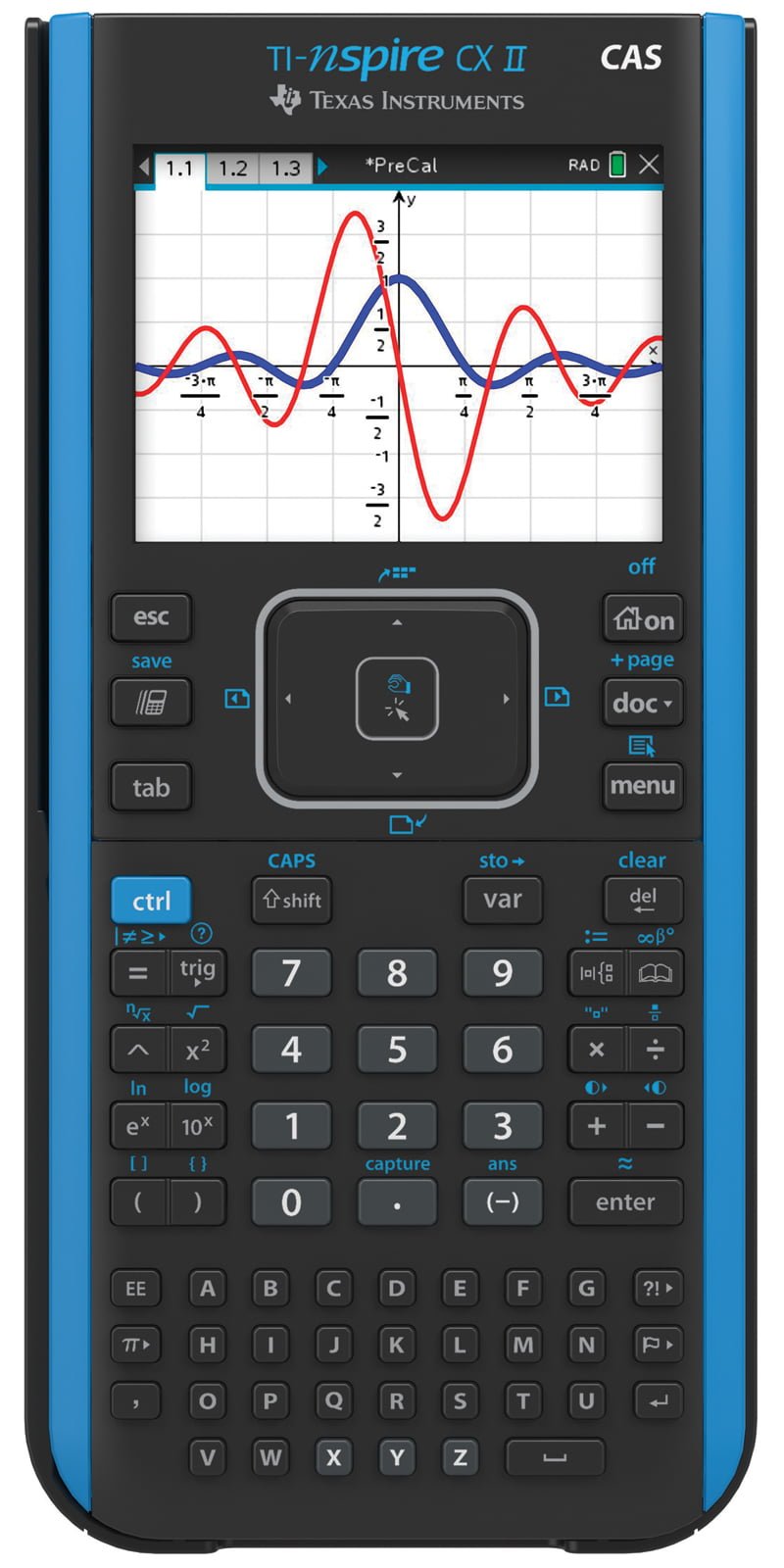
While standard graphing calculators can plot functions, CAS calculators often offer enhanced graphing capabilities. They can plot not only explicit functions but also implicit equations, parametric equations, polar coordinates, and sometimes even 3D graphs (often through connection to external software or specific models). More importantly, the graphing functions are seamlessly integrated with the symbolic capabilities. Users can graph a function, its derivative, and its integral on the same screen, observing their relationships dynamically. Features like finding roots, intersections, critical points, and inflection points are typically built-in and can be performed with high precision directly from the graph, often providing exact symbolic coordinates. This visualization power is crucial for understanding the behavior of functions and the geometric interpretation of mathematical concepts.
Programming Capabilities
Many advanced CAS calculators also include robust programming capabilities, allowing users to write and execute custom programs. These programs can automate repetitive tasks, implement specific algorithms, or create interactive teaching tools. Users can define their own functions, create macros, and develop scripts that extend the calculator’s built-in functionalities. This opens up a world of customization, allowing professionals to tailor the calculator to their specific workflows and enabling students to explore computational thinking and algorithmic design within a mathematical context. The programming environments often support structured programming paradigms, making them powerful mini-computers in their own right.
CAS Calculators in Educational and Professional Settings
The versatility and power of CAS calculators make them invaluable tools across a spectrum of environments, from classrooms to research labs. Their role, however, is often nuanced and subject to specific guidelines and contexts.
High School and University Mathematics
In high school, CAS calculators are typically introduced in advanced mathematics courses like pre-calculus, calculus, and linear algebra. They help students visualize complex functions, verify algebraic manipulations, and solve problems that would otherwise be computationally prohibitive. For university students, especially those pursuing degrees in STEM fields, the CAS calculator becomes an essential companion throughout their academic journey. It supports higher-level courses, assists in homework assignments, and is often permitted (or even required) for certain examinations. Educators often integrate CAS technology into their teaching strategies, using it to demonstrate concepts, allow for deeper exploration of topics, and foster a more investigative approach to learning. The goal is not to replace understanding, but to augment it by offloading the computational burden.
Engineering and Scientific Research
In professional fields such as engineering, physics, chemistry, and computer science, CAS calculators serve as powerful portable workstations. Engineers use them for rapid prototyping, on-site calculations, and analyzing system behaviors. Scientists employ them for data analysis, modeling phenomena, and solving complex equations derived from experimental observations. The ability to perform sophisticated calculations quickly and accurately in the field or in a lab setting, without needing a full computer setup, is a significant advantage. This portability and self-contained power make them ideal for tasks where immediate computational feedback is critical, such as diagnosing problems, optimizing parameters, or validating hypotheses. They become an extension of the professional’s analytical toolkit, allowing for real-time problem-solving and decision-making.
Standardized Tests: Navigating the Rules
The use of CAS calculators in standardized tests is a topic of ongoing debate and varies significantly between different examining bodies and test levels. For instance, many advanced placement (AP) calculus exams allow the use of specific graphing calculators, including some with CAS functionality, for certain sections. Similarly, some university-level exams might permit their use. However, tests like the ACT generally prohibit calculators with CAS capabilities, and the SAT has specific lists of acceptable models. The concern often revolves around whether the calculator gives an “unfair advantage” by solving problems symbolically that are intended to test conceptual understanding and manual calculation skills. Therefore, it is absolutely crucial for students to be aware of the specific calculator policies for any exam they are taking. Misunderstanding these rules can lead to disqualification or a significant disadvantage.
Choosing the Right CAS Calculator: Key Considerations
Selecting a CAS calculator is an important decision, as it represents a significant investment in a powerful mathematical tool. Several factors should guide your choice to ensure it meets your specific needs and context.
User Interface and Ergonomics
The user interface (UI) is paramount. A well-designed UI should be intuitive, making it easy to input complex expressions, navigate menus, and interpret results. Consider the screen size and resolution; a larger, higher-resolution screen can display more information, especially when graphing or working with multiple lines of output. The keyboard layout, button responsiveness, and overall ergonomics (how comfortably it fits in your hand) are also important, particularly for prolonged use. Some models offer touchscreens, color displays, or even QWERTY keyboards, which can enhance usability but may also increase cost. Prioritize a calculator that feels natural and efficient to operate for your specific tasks.
Specific Features for Your Needs
Not all CAS calculators are created equal, and their feature sets can vary. Consider what mathematical areas you will primarily be focusing on. Do you need extensive linear algebra capabilities? Or is your focus primarily on advanced calculus and differential equations? Some models excel in certain domains more than others. Look for features like advanced programming environments, statistical analysis tools, geometric construction capabilities, or even connectivity options to computers for data transfer and software updates. If you have specific software in mind that you want to integrate with, check for compatibility. Researching model-specific reviews and comparing feature lists will help you find a calculator tailored to your academic or professional requirements.
Cost and Brand Reputation
CAS calculators represent a premium category among calculators, and their price can reflect their advanced capabilities. Budget constraints will naturally play a role in your decision. However, consider the calculator as a long-term investment; a durable and feature-rich model can serve you well for many years. Leading brands like Texas Instruments (e.g., TI-Nspire CAS) and Hewlett-Packard (e.g., HP Prime G2) have established reputations for reliability, support, and innovation. Casio also offers powerful models (e.g., ClassPad series). Researching different brands and models within your price range, and comparing their reputation for build quality, customer support, and software updates, can help ensure a wise purchase.
Permissibility in Exams
As highlighted earlier, the rules regarding CAS calculator use in standardized tests and specific course exams are critical. Before purchasing, verify whether the models you are considering are permitted for any upcoming exams you plan to take. Many examination boards publish lists of approved calculators. Some CAS calculators have a “press-to-test” or “exam mode” feature that temporarily disables CAS functionality or memory, making them acceptable for tests that usually prohibit full CAS capabilities. Understanding and adhering to these rules is paramount to avoid issues during crucial assessments.
Conclusion
The CAS calculator is a marvel of modern technology, embodying a sophisticated blend of hardware and software designed to tackle the complexities of mathematics with unparalleled precision and efficiency. By transcending the limitations of numerical approximation and embracing symbolic manipulation, it empowers users to explore mathematical concepts with greater depth, solve intricate problems with confidence, and bridge the gap between abstract theory and real-world application. From revolutionizing how students learn calculus to becoming an indispensable tool for engineers and scientists in their daily work, its impact is profound and far-reaching. While navigating its use in standardized testing requires careful attention, the strategic integration of a CAS calculator into academic and professional pursuits undeniably enhances understanding, accelerates problem-solving, and ultimately pushes the boundaries of what is mathematically achievable. It is more than just a calculator; it is a gateway to deeper mathematical insight and computational power.
aViewFromTheCave is a participant in the Amazon Services LLC Associates Program, an affiliate advertising program designed to provide a means for sites to earn advertising fees by advertising and linking to Amazon.com. Amazon, the Amazon logo, AmazonSupply, and the AmazonSupply logo are trademarks of Amazon.com, Inc. or its affiliates. As an Amazon Associate we earn affiliate commissions from qualifying purchases.