
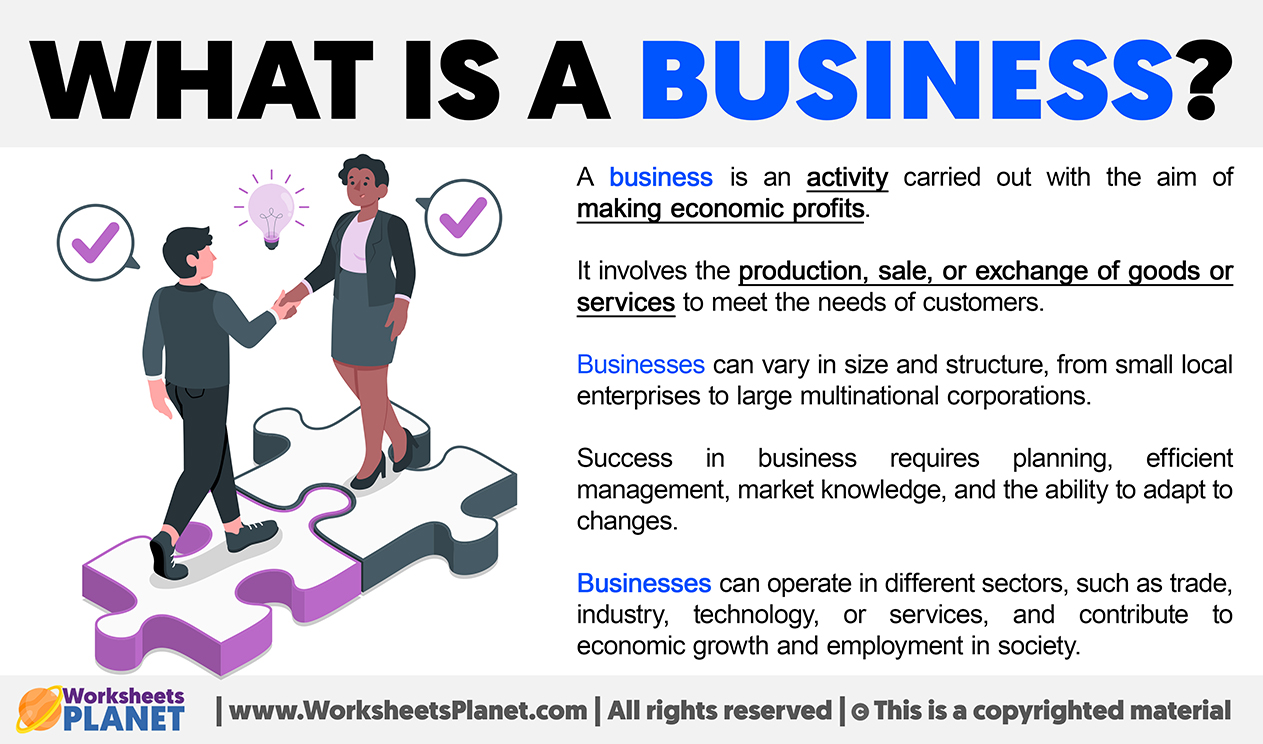
At its most fundamental level, a business is an organized entity or enterprising individual engaged in commercial, industrial, or professional activities. While the dictionary might define it as a trade or a calling, from a financial perspective, a business is a structured mechanism designed to create value, solve problems, and—most importantly—generate a sustainable profit. In the modern economy, the definition of a business has expanded beyond the traditional brick-and-mortar storefront to include digital ecosystems, solo-operated side hustles, and global conglomerates. Understanding what a business is requires looking past the products or services it sells and examining the financial framework that keeps it alive.
The Fundamental Financial Anatomy of a Business
To understand a business, one must look at its internal combustion engine: the flow of money. Without a clear financial structure, an organization is merely a hobby or a non-profit endeavor. A business operates on the principle of value exchange, where a customer’s need is met in exchange for currency, which then fuels the operation’s growth and rewards its stakeholders.
Defining the Profit Motive and Value Exchange
The core of any business is the profit motive. This is the intent to achieve a financial gain from an enterprise. However, profit does not exist in a vacuum; it is the byproduct of value exchange. A business identifies a pain point or a desire in a specific market and provides a solution. The difference between the cost of delivering that solution and the price the market is willing to pay constitutes the margin.
In the realm of personal finance and wealth building, understanding this exchange is crucial. Whether you are selling a physical gadget, a digital course, or consulting hours, the financial health of the business depends on your ability to widen the gap between cost and price without compromising the perceived value. This is the first rule of business finance: if you cannot generate more value than you consume in resources, the business is not viable.
Cash Flow vs. Net Income: The Vital Signs
A common mistake among new entrepreneurs is conflating net income with cash flow. A business might appear profitable on paper—meaning its total revenue exceeds its total expenses—but still fail because it lacks liquidity.
Cash flow refers to the net amount of cash being transferred into and out of a business. At any given time, a business must have enough “cash on hand” to meet its immediate obligations, such as payroll, rent, and inventory costs. Net income, or the “bottom line,” is what remains after all operating expenses, taxes, and interest have been deducted. In the world of business finance, cash flow is the oxygen that keeps the business breathing today, while net income is the nourishment that allows it to grow tomorrow.
Assets, Liabilities, and Equity
Every business is composed of a balance sheet that tracks what it owns (assets), what it owes (liabilities), and the value belonging to the owners (equity).
-
Assets can include cash, inventory, equipment, intellectual property, and accounts receivable.
-
Liabilities include loans, accounts payable, and deferred taxes.
-
Equity represents the owner’s residual interest in the business after all liabilities are paid.
For someone looking to build an online income or a side hustle, treating the business as a separate financial entity with its own balance sheet is the first step toward professional financial management.
Modern Pathways to Business Ownership: Side Hustles and Digital Income
The 21st century has democratized the concept of “what is a business.” No longer do you need a massive bank loan or a physical warehouse to be a business owner. The rise of the digital economy has paved the way for leaner, more agile business models that prioritize high margins and low overhead.
The Evolution of the Solopreneur
A solopreneur is an individual who runs their business single-handedly, often leveraging automation and freelance networks to handle tasks that once required a full team. This is a legitimate business structure, often organized as a Sole Proprietorship or a Single-Member LLC. The financial advantage of the solopreneur model is the minimization of “bloat.” By keeping fixed costs low, a solopreneur can achieve a high percentage of net profit, which can then be reinvested into personal wealth-building vehicles or scaled further into a larger enterprise.
Scalability in the Digital Economy
The primary differentiator between a traditional service business (like a local landscaping company) and a modern digital business (like a Software-as-a-Service or SaaS platform) is scalability. Scalability is the ability of a business to increase its revenue without a proportional increase in its costs.

For instance, a consultant trades time for money; to double their income, they must roughly double their hours. A digital business, however, might spend $50,000 developing a mobile app but can sell that app to 100 people or 1,000,000 people with very little additional cost per user. This high scalability is why tech-heavy businesses often attract the most significant investment and produce the highest returns on capital.
Transitioning from Side Hustle to Full-Time Enterprise
Most modern businesses begin as side hustles—low-risk experiments conducted alongside a primary job. The transition from a side hustle to a formal business is marked by a shift in financial management. This involves setting up dedicated business bank accounts, implementing professional bookkeeping, and perhaps most importantly, shifting from a “survival” mindset to a “growth” mindset. When the income from a side hustle consistently covers its own operating costs plus a significant portion of the owner’s living expenses, it has graduated into a sustainable business entity.
Strategic Capital Management and Growth
A business is not just a place where you work; it is an investment vehicle. To treat it as such, one must master the art of capital management. This involves deciding where to allocate the money the business earns to ensure long-term sustainability and exponential growth.
Bootstrapping: The Art of Lean Financial Growth
Bootstrapping refers to the process of starting a business with little to no external capital, relying instead on personal savings and the initial revenue generated by the business to fund growth. This approach forces financial discipline. In a bootstrapped business, every dollar must be accounted for, and investments are only made when there is a clear path to a return. While growth may be slower than a venture-backed startup, the owner retains 100% equity and total control over the financial destiny of the company.
Understanding ROI and Reinvestment
The most successful business owners are those who view every expense through the lens of Return on Investment (ROI). If you spend $1,000 on marketing, does it generate $2,000 in new revenue? If you spend $5,000 on a new piece of software, does it save $10,000 worth of employee time over the year?
Strategic reinvestment is the process of taking profits and putting them back into the business’s highest-performing “engines.” Instead of drawing out all the profit for personal consumption, a growth-oriented business owner reinvests in inventory, talent, or technology to compound the business’s value over time.
Risk Mitigation and Financial Diversification
Business ownership is inherently risky. Markets change, consumer preferences shift, and economic downturns occur. A robust business structure includes financial safeguards. This includes maintaining an emergency fund (often three to six months of operating expenses), carrying appropriate insurance, and diversifying revenue streams. A business that relies on a single client or a single platform (like an Amazon FBA seller who only sells one product) is financially fragile. A true business builds a “moat” around its profits through diversification and strategic planning.
The Business as an Investment Asset
Ultimately, a business should be viewed as an asset that can eventually be sold or managed by others. If the business cannot function without your constant physical presence, you don’t own a business; you own a high-paying job. To transform a job into a business asset, you must focus on systems and valuation.
Calculating Valuation and Market Worth
The financial value of a business is typically determined by its earnings before interest, taxes, depreciation, and amortization (EBITDA), multiplied by a factor relevant to its industry. For example, a stable service business might sell for 2–3 times its annual profit, while a fast-growing tech company might sell for 10–20 times its revenue. Understanding how your business is valued by the market allows you to make decisions that increase its ultimate “exit price,” which is often the largest single financial event in an entrepreneur’s life.
Building for Exit: Scalability and Systems
To make a business an attractive asset for a buyer, it must be systematized. This means having Standard Operating Procedures (SOPs), a clear organizational chart, and automated marketing funnels. When the financial success of the business is decoupled from the owner’s individual labor, the business becomes a “turnkey” asset. This transition is what separates the self-employed from the true business owner.
Tax Efficiency and Wealth Preservation
From a money management perspective, a business is one of the most powerful tax-advantaged tools available. In many jurisdictions, business owners can deduct legitimate business expenses—such as travel, equipment, and home office costs—before calculating their taxable income. Furthermore, sophisticated business structures allow for tax-efficient ways to pay oneself, such as through dividends or capital gains, rather than just a standard salary. This allows the business owner to keep a larger portion of their earnings to reinvest in other financial tools, such as stocks, real estate, or other business ventures.
In conclusion, “what is a business” is a question that can be answered through the lens of finance. It is a structured entity that creates value, manages cash flow, and acts as a vehicle for wealth creation. Whether it is a small online side hustle or a multi-million dollar corporation, the principles of profit margins, ROI, and asset building remain the same. By treating a business as a financial engine rather than just a source of income, an individual can move from the uncertainty of labor to the security of ownership.
aViewFromTheCave is a participant in the Amazon Services LLC Associates Program, an affiliate advertising program designed to provide a means for sites to earn advertising fees by advertising and linking to Amazon.com. Amazon, the Amazon logo, AmazonSupply, and the AmazonSupply logo are trademarks of Amazon.com, Inc. or its affiliates. As an Amazon Associate we earn affiliate commissions from qualifying purchases.