
In the rapidly evolving landscape of modern electrical infrastructure, efficiency, scalability, and thermal management have become the cornerstones of power distribution. While traditional cabling methods have served the industry for decades, the increased power density required by modern data centers, industrial automation, and renewable energy grids has necessitated a more robust solution. Enter the busbar—a metallic strip or bar, typically composed of copper or aluminum, that serves as the central artery for power distribution within switchgear, panelboards, and busway systems.
Understanding what a busbar is used for requires looking beyond its simple appearance. It is a fundamental component of high-current power distribution, offering distinct mechanical and electrical advantages over traditional stranded or solid-core copper wiring.

The Core Functionality and Engineering Advantages
At its most basic level, a busbar acts as a common junction point where multiple electrical circuits converge. By consolidating power from a primary source and distributing it to various sub-circuits, it minimizes the complexity of point-to-point wiring. However, the true utility of a busbar lies in its performance characteristics under high electrical loads.
Thermal Efficiency and Surface Area
Unlike round electrical cables, which have a limited surface area relative to their cross-sectional mass, busbars are typically flat. This geometry is intentional. High-current electricity naturally gravitates toward the surface of a conductor—a phenomenon known as the “skin effect.” The flat surface of a busbar provides an optimal path for electrons to travel, which reduces electrical resistance and, consequently, heat buildup. Furthermore, the large surface area allows for superior heat dissipation into the surrounding air, enabling busbars to carry significantly higher currents than cables of equivalent cross-sectional area.
Mechanical Rigidity and Reliability
In industrial settings, busbars offer unparalleled mechanical stability. Because they are rigid, they do not suffer from the “thermal cycling” issues that can cause flexible cables to loosen or fray over time. In a short-circuit event, the electromagnetic forces generated are immense. Flexible cables can whip violently, potentially causing insulation damage or connection failure. Busbars, when supported by high-strength insulators, remain stationary, ensuring the structural integrity of the electrical system during catastrophic surges.
Applications in Industrial Power Distribution
The industrial sector is perhaps the largest consumer of busbar technology. From heavy manufacturing plants to chemical processing facilities, the demand for continuous, reliable, and easily maintainable power is non-negotiable.
Switchgear and Power Distribution Units (PDUs)
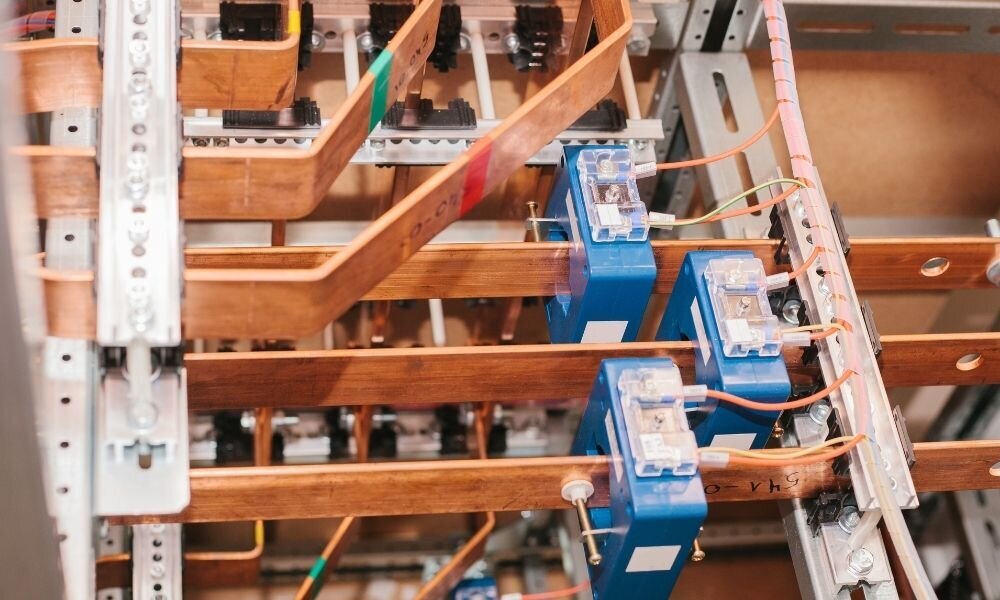
Within switchgear, busbars are the backbone of the system. They provide the necessary connections between circuit breakers, transformers, and distribution panels. The modular nature of busbar systems allows for “plug-and-play” scalability. If a facility needs to increase its power capacity, engineers can often add new vertical sections or tap boxes into an existing busway run without the need to tear out miles of messy, complicated cable runs.
Data Centers and Critical Infrastructure
Modern data centers are essentially massive power-hungry machines. The transition from traditional cable-fed racks to Overhead Busway Systems has revolutionized how data centers handle power. Using a busway system suspended above the server cabinets allows for greater airflow, as cables are no longer obstructing the cooling paths under the floor. Furthermore, it allows for the rapid reconfiguration of the server hall. As server density changes, technicians can simply move a tap-off box along the busbar, providing localized power exactly where it is needed without de-energizing the entire aisle.
Integration in Renewable Energy and Electrification
The global shift toward green energy and electric mobility has placed busbars at the forefront of the technological transition. As power conversion becomes more decentralized, the need for compact, highly conductive interconnection systems has surged.
Electric Vehicle (EV) Battery Packs
One of the most critical applications for busbar technology today is in the assembly of high-capacity lithium-ion battery packs for electric vehicles. In this context, busbars are used to connect individual battery cells in series or parallel to create the high-voltage modules that power the vehicle’s drivetrain.
Copper busbars are preferred in these applications due to their exceptional conductivity and ease of stamping or bending into custom shapes that fit the tight, irregular dimensions of a vehicle chassis. They also facilitate laser welding, a high-speed manufacturing technique that provides a much more reliable, vibration-resistant connection than traditional mechanical fasteners or crimped wires could ever offer.
Solar Photovoltaic (PV) Systems
In large-scale solar farms, busbars play a critical role in the collection of direct current (DC) from arrays of panels. They function within the combiner boxes, where the output of multiple solar strings is unified before being fed into the central inverters. By using busbars, solar installation firms can reduce the total volume of copper required for the project, lowering both the capital expenditure and the resistive power losses that occur during transmission from the field to the grid.
Design Considerations and Maintenance
While busbars offer clear benefits, they are not a “set it and forget it” component. Effective deployment requires careful consideration of environmental factors and material science.
Material Selection: Copper vs. Aluminum
The choice between copper and aluminum often comes down to a trade-off between conductivity and cost. Copper is the gold standard for conductivity and offers a smaller footprint, which is essential in space-constrained environments. Aluminum, conversely, is significantly lighter and less expensive. However, aluminum requires larger cross-sections to match the current-carrying capacity of copper and necessitates specialized oxidation inhibitors and bimetallic connectors to prevent galvanic corrosion at the contact points.
Maintenance and Monitoring
The most common point of failure for any power distribution system is the connection point. Over time, vibration and thermal expansion/contraction can cause bolt tension to relax, leading to “hot spots” caused by increased contact resistance.
Modern busbar systems are increasingly equipped with integrated thermal monitoring sensors. By using infrared thermography or permanently installed temperature sensors, maintenance teams can identify potential failures before they manifest as arc flashes or equipment downtime. Regular maintenance typically involves tightening hardware to specific torque requirements and cleaning contact surfaces to ensure that the oxidation of the metal does not impede electron flow.
Future Outlook
As we look toward the future of power distribution, busbars are becoming increasingly integrated with smart grid technology. We are seeing the rise of “smart busways” that provide real-time data on voltage drop, load balancing, and power quality. This shift toward intelligent infrastructure allows facility managers to optimize power usage, reduce waste, and extend the lifespan of their electrical assets.
In conclusion, the busbar is far more than just a piece of metal. It is a sophisticated component of modern electrical engineering that enables the high-density, reliable power delivery required by our digital and industrial world. Whether it is powering the latest AI-driven data center, facilitating the rapid growth of the electric vehicle market, or stabilizing the heavy-duty machinery of an automated factory, the busbar remains an essential, evolving technology that defines the efficiency of the modern electrical grid. By leveraging its thermal advantages, structural rigidity, and adaptability, engineers continue to push the boundaries of what is possible in the age of electrification.
aViewFromTheCave is a participant in the Amazon Services LLC Associates Program, an affiliate advertising program designed to provide a means for sites to earn advertising fees by advertising and linking to Amazon.com. Amazon, the Amazon logo, AmazonSupply, and the AmazonSupply logo are trademarks of Amazon.com, Inc. or its affiliates. As an Amazon Associate we earn affiliate commissions from qualifying purchases.