
Understanding the IRS Form 1040 is fundamental to navigating personal finance in the United States. Far more than just a piece of paper, the 1040 serves as the primary conduit for individuals to report their annual income, calculate their tax liability, and determine whether they owe additional taxes or are due a refund. It’s the cornerstone of the federal income tax system, reflecting a taxpayer’s entire financial picture for a given year and acting as their annual financial report card to the Internal Revenue Service (IRS). For anyone earning an income, whether through traditional employment, self-employment, investments, or other sources, the 1040 is an indispensable tool for fulfilling their civic duty and managing their financial obligations.

The Core Purpose of Form 1040
At its heart, the Form 1040 is designed to facilitate the collection of federal income taxes. It’s a comprehensive document that synthesizes various aspects of a taxpayer’s financial life into a single, cohesive declaration.
Your Annual Financial Report to the IRS
Think of the 1040 as an annual financial snapshot presented to the federal government. It requires taxpayers to disclose all sources of income earned throughout the calendar year, from wages and salaries to interest, dividends, business profits, rental income, and capital gains. This comprehensive reporting ensures that the IRS has a complete picture of an individual’s financial standing and their ability to contribute to the nation’s public services through taxation. It’s the mechanism by which the principle of progressive taxation, where those with higher incomes pay a higher percentage in taxes, is practically applied.
Determining Taxable Income and Liability
A crucial function of the 1040 is to systematically arrive at a figure known as “taxable income.” This isn’t simply your gross earnings; rather, it’s the amount of income remaining after applying various deductions and adjustments permitted by tax law. The form guides taxpayers through a series of calculations, starting with total income, then subtracting “above-the-line” deductions (like contributions to IRAs or student loan interest), and finally allowing for either the standard deduction or itemized deductions. The resulting taxable income is then subjected to the applicable tax brackets to determine the initial tax liability. This structured approach ensures fairness and adherence to the complex tapestry of tax regulations designed to incentivize certain behaviors or provide relief in specific circumstances.
Calculating Refunds or Payments Due
The ultimate outcome of filing a 1040 is the determination of whether a taxpayer is owed a refund or must pay additional taxes. Throughout the year, most individuals have federal income taxes withheld from their paychecks or make estimated tax payments if they are self-employed or have significant non-wage income. The 1040 reconciles these pre-payments with the actual tax liability calculated on the form. If the total amount withheld or paid in estimated taxes exceeds the final tax liability, the taxpayer receives a refund. Conversely, if the pre-payments fall short, the taxpayer must remit the difference to the IRS by the tax deadline. This reconciliation process is vital for sound personal financial planning, allowing individuals to adjust their withholding or estimated payments to avoid large tax bills or excessively large refunds, which can be seen as an interest-free loan to the government.
Key Sections and Their Significance
The Form 1040 is structured logically, guiding taxpayers through a series of steps to accurately report their financial data. Each section plays a vital role in the overall calculation.
Personal Information and Dependents
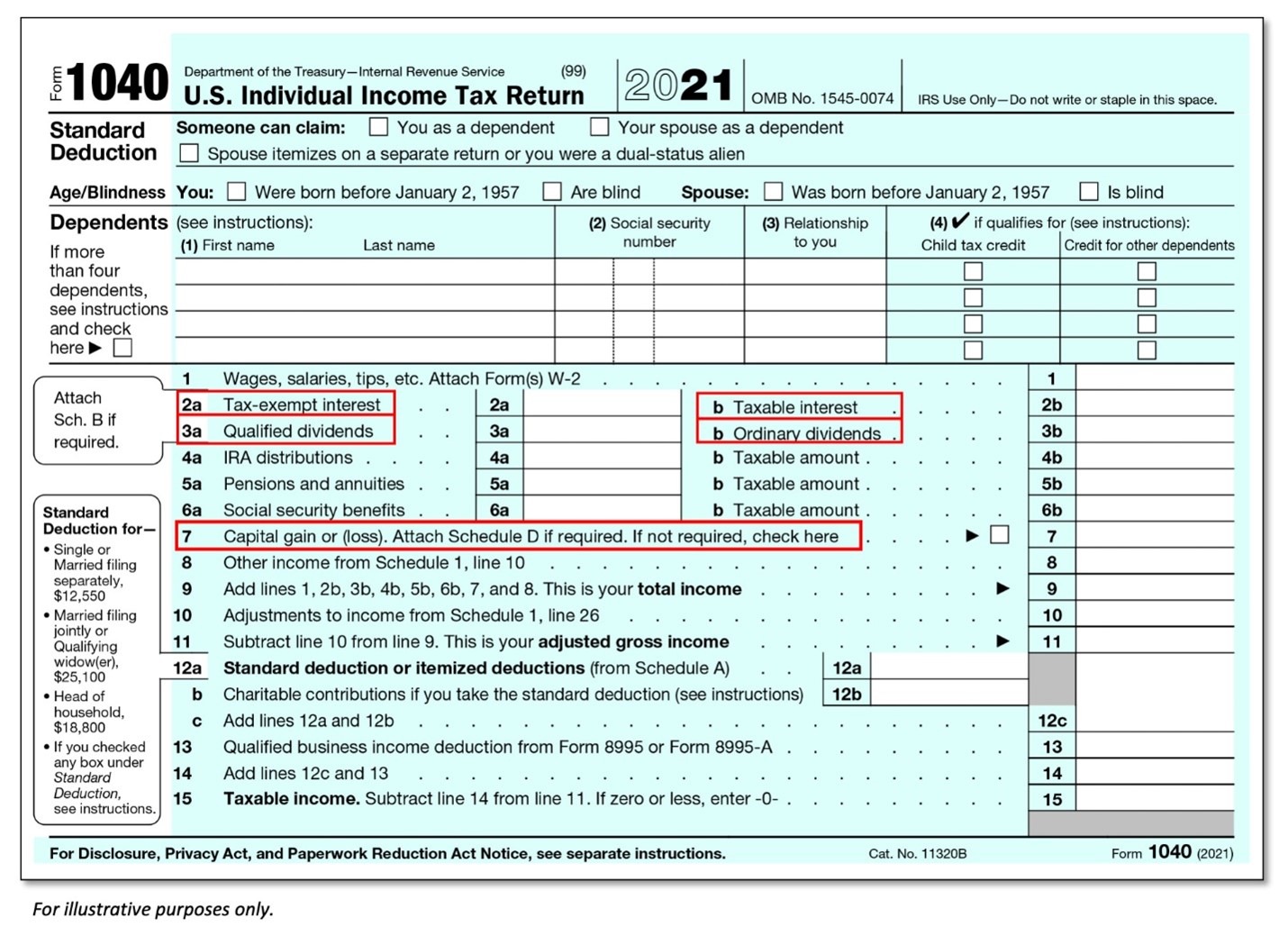
The top section of the 1040 captures basic identifying information: name, address, Social Security number, and filing status (Single, Married Filing Jointly, Married Filing Separately, Head of Household, or Qualifying Widow(er)). This section also includes details about dependents, as claiming eligible dependents can significantly impact tax liability through various credits and deductions. Accuracy here is paramount, as it forms the foundation for all subsequent calculations and communications with the IRS.
Income Sources: W-2s, 1099s, and More
This is where all gross income for the year is reported. It encompasses wages, salaries, and tips (reported on Form W-2), interest income (Form 1099-INT), ordinary dividends (Form 1099-DIV), capital gains and losses (Schedule D, often from Form 1099-B), business income (Schedule C), rental and royalty income (Schedule E), and other miscellaneous income. Each line item on the 1040 corresponds to a specific type of income, ensuring comprehensive reporting and allowing the IRS to cross-reference with third-party reports.
Adjustments to Income (Above-the-Line Deductions)
Before arriving at Adjusted Gross Income (AGI), taxpayers can claim certain deductions that reduce their gross income. These are often referred to as “above-the-line” deductions because they are deducted directly on the 1040 before the AGI is calculated. Examples include contributions to traditional IRAs, student loan interest paid, health savings account (HSA) deductions, and self-employment tax deductions. A lower AGI is often beneficial, as it can qualify taxpayers for other credits and deductions that have AGI-based limitations.
Standard Deduction vs. Itemized Deductions (Schedule A)
Once AGI is determined, taxpayers face a critical choice: take the standard deduction or itemize their deductions. The standard deduction is a fixed dollar amount based on filing status, designed to simplify tax filing for many. Itemized deductions, reported on Schedule A, allow taxpayers to deduct specific expenses like medical and dental expenses exceeding a certain threshold, state and local taxes (SALT) up to a limit, home mortgage interest, and charitable contributions. Taxpayers typically choose the option that results in the larger deduction, thereby lowering their taxable income.
Tax Credits: Reducing Your Tax Bill Directly
Tax credits are distinct from deductions in that they directly reduce the amount of tax owed, dollar for dollar, rather than just reducing taxable income. The 1040 includes sections for various credits, which can be nonrefundable (reducing tax liability to zero, but no more) or refundable (potentially resulting in a refund even if no tax was owed). Common credits include the Child Tax Credit, Earned Income Tax Credit (EITC), education credits (like the American Opportunity and Lifetime Learning Credits), and the Premium Tax Credit for health insurance purchased through the marketplace. Maximizing eligible tax credits is a key strategy in reducing overall tax burden.
Payments and Withholding
This section summarizes all payments made towards federal income tax throughout the year. It includes federal income tax withheld from wages (from W-2s), estimated tax payments made by self-employed individuals, and any excess Social Security tax withheld. This sum is then compared against the total tax liability to determine the final refund or amount due.
Who Needs to File a 1040?
Not everyone is required to file a federal income tax return, but a significant portion of the population falls within the filing requirements.
Income Thresholds and Filing Status
The primary determinant of whether an individual must file a 1040 is their gross income relative to their filing status and age. The IRS sets minimum income thresholds each year. If an individual’s gross income is above this threshold, they are generally required to file. Even if income is below the threshold, filing may still be necessary to claim a refund for withheld taxes or to receive certain refundable tax credits, such as the Earned Income Tax Credit.
Self-Employed Individuals and Business Owners
Individuals who are self-employed or operate a small business are almost always required to file a 1040, regardless of their gross income. If net earnings from self-employment are $400 or more, they must file and pay self-employment taxes (Social Security and Medicare taxes for self-employed individuals) via Schedule SE, alongside their income tax. This makes the 1040 an essential document for business finance, serving as the vehicle for reporting business income, expenses, and calculating relevant taxes.
Special Filing Situations
There are various other scenarios that necessitate filing a 1040, even if general income thresholds aren’t met. These include having received certain types of unearned income, such as unemployment compensation, having wages from which Medicare tax was not withheld, or owing certain special taxes. Additionally, individuals who received advance payments of the Premium Tax Credit may need to file to reconcile those payments, regardless of their income.
Navigating the Filing Process
Filing a 1040 can seem daunting, but breaking it down into manageable steps simplifies the process.
Gathering Essential Documents
The first and most critical step is to collect all necessary financial documents. This includes W-2 forms from employers, 1099 forms for various income types (1099-INT, 1099-DIV, 1099-MISC, 1099-NEC), K-1 forms for partnership or S-corp income, records of itemized deductions (medical bills, mortgage interest statements, charitable donation receipts), and any other documentation related to income or potential deductions and credits. Organization is key to accurate and efficient filing.
Software, Professional Help, or DIY?
Taxpayers have several options for preparing and filing their 1040. Tax software programs (e.g., TurboTax, H&R Block Tax Software) guide users through the process with step-by-step questions, making it accessible for many. Professional tax preparers (CPAs, Enrolled Agents) offer expertise for complex financial situations or for those who prefer hands-off assistance. For individuals with straightforward tax situations and lower incomes, free filing options are available through the IRS Free File program or community-based volunteer programs. The “Do-It-Yourself” method involves manually filling out the forms, which is generally only recommended for those with very simple returns and a strong understanding of tax law.
Important Deadlines and Extensions
The primary deadline for filing Form 1040 for most individual taxpayers is April 15th of the following year (or the next business day if April 15th falls on a weekend or holiday). However, it’s possible to file for an automatic six-month extension, pushing the filing deadline to October 15th. It’s crucial to remember that an extension to file is not an extension to pay. Any taxes owed are still due by the original April 15th deadline, and interest and penalties may accrue on underpayments.
Beyond the Basics: Related Forms and Schedules
While the Form 1040 is the central document, it often requires various accompanying schedules and forms to provide detailed information about specific income types, deductions, and credits. These schedules expand upon the summary information on the 1040.
Schedule B: Interest and Ordinary Dividends
Used to report interest income over a certain threshold ($1,500) and all ordinary dividend income, detailing the sources of these earnings.
Schedule C: Profit or Loss from Business (Sole Proprietorship)
Essential for self-employed individuals, this schedule reports income and expenses from a business operated as a sole proprietorship, ultimately flowing the net profit or loss to the 1040.
Schedule D: Capital Gains and Losses
This schedule is used to report sales of capital assets, such as stocks, bonds, and real estate, and to calculate capital gains or losses, which are then transferred to the 1040.
Schedule E: Supplemental Income and Loss (e.g., Rental Real Estate)
Individuals with income or loss from rental properties, royalties, partnerships, S corporations, estates, or trusts report these on Schedule E.
Schedule SE: Self-Employment Tax
Required for self-employed individuals, this schedule calculates the amount of Social Security and Medicare taxes they owe on their net earnings from self-employment.
Form 8863: Education Credits
Used to figure and claim the American Opportunity and Lifetime Learning education credits, which can significantly offset the costs of higher education.

Form 8962: Premium Tax Credit
Individuals who purchased health insurance through a Health Insurance Marketplace and received advance payments of the premium tax credit must file this form to reconcile the advanced payments with the actual credit they are eligible for.
In conclusion, the Form 1040 is the lynchpin of individual financial responsibility in the U.S. tax system. It consolidates all income, deductions, and credits to determine a taxpayer’s final federal income tax liability. A thorough understanding of its purpose and components is not just a matter of compliance, but a fundamental aspect of effective personal finance management, allowing individuals to optimize their tax position and ensure accuracy in their dealings with the IRS.
aViewFromTheCave is a participant in the Amazon Services LLC Associates Program, an affiliate advertising program designed to provide a means for sites to earn advertising fees by advertising and linking to Amazon.com. Amazon, the Amazon logo, AmazonSupply, and the AmazonSupply logo are trademarks of Amazon.com, Inc. or its affiliates. As an Amazon Associate we earn affiliate commissions from qualifying purchases.