
At first glance, the question “what is 8 3 as a mixed number?” might seem like a simple mathematical exercise, a relic from a school textbook. However, for those navigating the intricate world of personal finance, investing, and business, understanding the nuances behind such a query—and the broader concept of mixed numbers—is anything but trivial. In finance, numbers aren’t just figures; they represent value, risk, opportunity, and the very foundation of sound decision-making.
Let’s address the mathematical core of the question directly. The phrasing “8 3” as a mixed number typically implies a whole number part and a fractional part where ‘3’ somehow contributes to the fraction. The most common interpretation in a real-world, financially relevant context is often when “8 3” is shorthand for the decimal “8.3”. In this case, 8.3 as a mixed number is 8 and 3/10. This means you have eight whole units and three-tenths of another unit.

Beyond this direct conversion, the question serves as a powerful gateway into understanding the critical role of numerical literacy in financial health. Whether it’s dissecting interest rates, understanding stock performance, or allocating a budget, the ability to comprehend and manipulate mixed numbers—whole numbers combined with fractions—is an indispensable skill. It underpins transparency, empowers informed choices, and acts as a shield against potential financial misinterpretations. This article will explore why such fundamental mathematical comprehension is not just academic, but a cornerstone of robust financial intelligence in the “Money” category.
The Foundation of Financial Numeracy: Understanding Fractions and Mixed Numbers
Financial literacy is often touted as the bedrock of economic well-being, yet its importance often overshadows the foundational numerical skills required to truly grasp financial concepts. Understanding fractions and mixed numbers is not merely about passing a math test; it’s about building the fundamental mental models necessary to interpret, analyze, and act upon financial information effectively.
Deciphering the “8 3” – A Quick Refresher
As established, interpreting “8 3” as a mixed number usually leads to thinking about a whole number (8) and a fractional component derived from (3).
-
If “8 3” implies 8.3 (eight and three-tenths): The decimal 8.3 means 8 whole units and 0.3 of a unit. Since 0.3 is 3/10, the mixed number is 8 3/10.
-
If “8 3” implies a general concept like “eight and one-third”: This would be written as 8 1/3. Here, 8 is the whole number, and 1/3 is the fractional part.
-
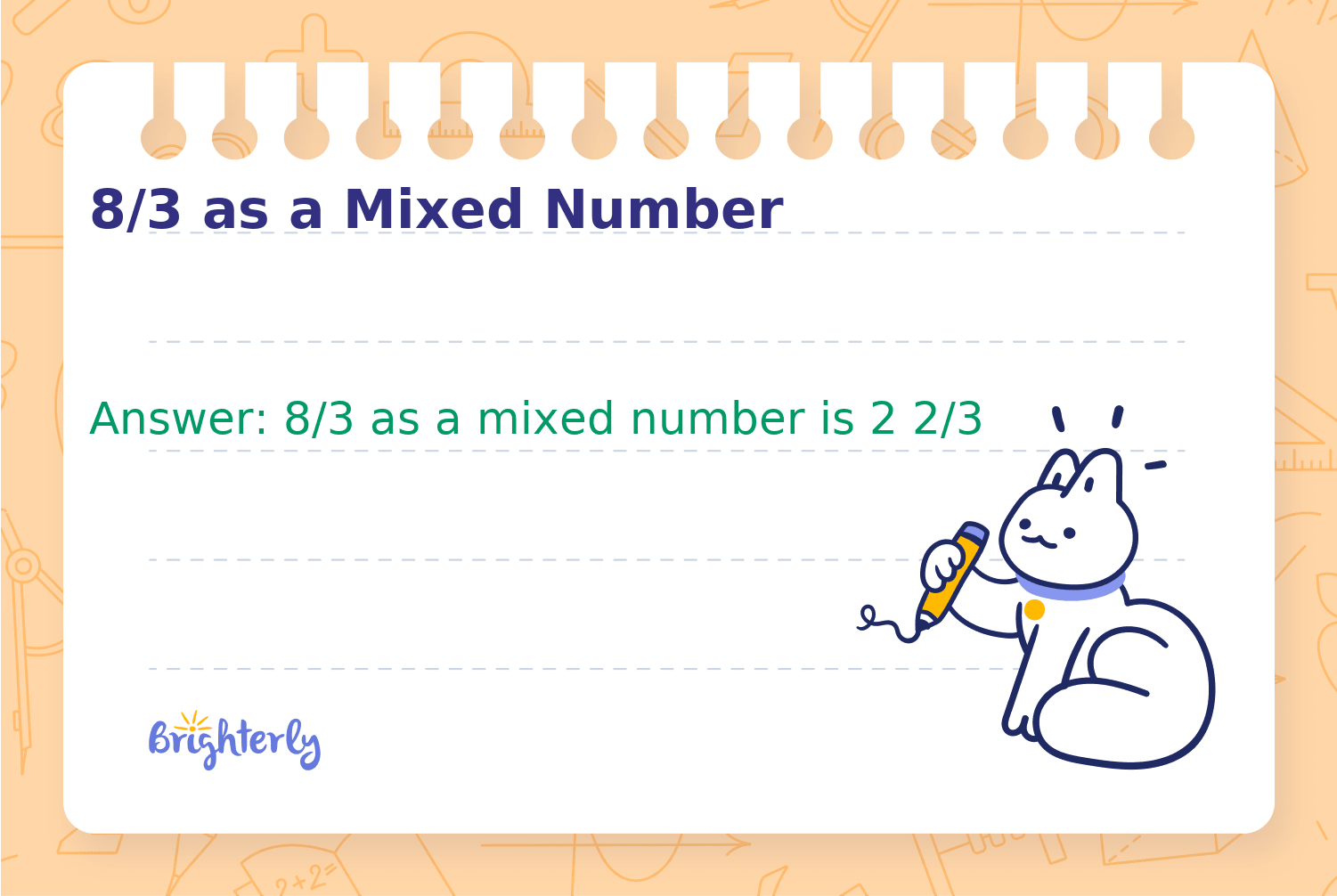
If “8 3” were an improper fraction “8/3”: Then the mixed number would be 2 2/3 (two and two-thirds). While this interpretation is less likely given the phrasing “8 3 as a mixed number,” it highlights another way fractions are converted.
The common thread among these interpretations is the fusion of whole numbers with parts of numbers. In finance, very few things come in perfectly rounded, whole figures. Interest rates are rarely exact integers, investment returns often have fractional components, and budgeting often involves dividing resources into non-whole portions. Grasping these basic conversions and representations is the first step toward true financial fluency.
Beyond Whole Numbers: Why Fractions Are Everywhere in Finance
The world of money rarely deals exclusively in whole dollars or percentages. From an investment yielding 7.5% to a property ownership stake of “one-eighth,” or even understanding sales tax at 6.25%, fractions and decimals are embedded in the fabric of financial transactions. Ignoring or misunderstanding these fractional components can lead to significant miscalculations, missed opportunities, or costly errors.
Consider the simple act of splitting a dinner bill, or more complex scenarios like calculating prorated rent, understanding dividend yields, or comparing different mortgage interest rates. All these activities demand an intuitive understanding of how parts relate to the whole, and how to represent these relationships using fractions, decimals, and ultimately, mixed numbers.
Bridging the Gap: From Abstract Math to Real-World Money
The transition from abstract mathematical concepts to their tangible financial implications is crucial. When you see an advertisement for a “3.75% APY” savings account, your brain should immediately process that as “three and three-quarters percent.” This isn’t just an academic exercise; it dictates how much actual money you will earn. Similarly, understanding that “eight and three-tenths” of something is nearly an entire nine units, but not quite, provides precision that can be vital in financial forecasting or evaluating business shares. The ability to fluidly move between decimal, fractional, and mixed number representations empowers individuals to extract deeper meaning from financial statements, news, and opportunities, moving beyond mere surface-level comprehension.
Practical Applications: Mixed Numbers in Personal Finance
The relevance of mixed numbers extends deeply into the practicalities of managing personal finances. From daily budgeting decisions to long-term investment strategies, the ability to confidently work with whole numbers and their fractional counterparts directly impacts financial health and success.
Budgeting and Expense Allocation: Slicing Your Income
Budgeting is fundamentally about allocating your income across various categories. While you might allocate whole dollar amounts, understanding proportional spending often involves fractions. For instance, you might decide to dedicate “one-quarter” of your income to housing, or find that “one-third” of your spending goes towards discretionary items. If your income is $X, and you allocate 1/3 to a certain category, this is directly calculating a fraction of a whole. Furthermore, if you manage a budget on a weekly or bi-weekly basis, and some bills are monthly, you are constantly breaking down whole amounts into fractional parts of a larger period. Understanding something like “8 and 3/10” of your savings goal being achieved can provide a much clearer picture of your progress than just a decimal point.
Interest Rates and Returns: Understanding “X and a Fraction” Percent
Perhaps the most ubiquitous application of mixed numbers in finance is in interest rates. Whether it’s the Annual Percentage Rate (APR) on a loan, the Annual Percentage Yield (APY) on a savings account, or the expected return on an investment, these figures rarely come in neat whole numbers.
A loan might have an interest rate of 6.25%, which is 6 and 1/4 percent. An investment might promise an 8.5% return, equivalent to 8 and 1/2 percent. Misinterpreting these fractional components can lead to significant errors in calculating interest payments, projected earnings, or the true cost of borrowing. A small fractional difference, compounded over time, can equate to hundreds or even thousands of dollars in real money. The clarity that comes from understanding 8.3% as 8 and 3/10% prevents misjudgment of financial products.
Investment Portfolios: Owning Portions and Splits
Investing inherently involves fractional ownership and performance. When you buy shares in a company, you are purchasing a fractional part of that business. Stock splits, fractional shares (increasingly common with robo-advisors), and unit trusts all involve understanding proportions. If a stock splits 2-for-1, you suddenly own “double” the number of shares, but each share is worth “half” its previous value. Understanding that your ownership stake is a certain fraction of the total outstanding shares gives you insight into your actual influence and potential returns. Similarly, mutual funds and ETFs are priced in units that often include decimals, representing a precise fraction of the fund’s net asset value.
Business Finance and Entrepreneurship: The Role of Fractional Thinking
For entrepreneurs and business owners, the principles of mixed numbers extend beyond personal financial management into strategic operational and financial planning. Precision in numerical understanding can make the difference between profit and loss, growth and stagnation.
Profit Sharing and Equity Distribution
In partnerships, startups, or even employee bonus schemes, profit sharing and equity distribution often involve fractional allocations. A co-founder might own 49% of the company, while another owns 51%. Or, a profit-sharing model might dictate that employees receive “one-tenth” of the quarterly profits. Understanding these fractional stakes is vital for legal agreements, clear communication, and fair compensation. Imagine a situation where a business deal results in a “8 3/4” ownership stake for a new investor; accurately calculating the implications of that exact fraction is paramount.
Analyzing Financial Ratios and Performance Metrics
Businesses rely heavily on financial ratios to assess performance, solvency, and efficiency. Ratios such as debt-to-equity, current ratio, or profit margins are often expressed as decimals or fractions. A debt-to-equity ratio of 0.83, for example, could be interpreted as 83/100 or approximately 4/5, meaning for every dollar of equity, the company has 83 cents of debt. This allows for quick comparisons and benchmarking against industry standards. Without a solid grasp of how these fractions or decimals represent a portion of a whole, interpreting these critical business health indicators becomes challenging and prone to error.
Projecting Growth and Resource Allocation
When projecting future growth or allocating resources, businesses often deal with incremental increases or decreases that involve fractions. A marketing budget might increase by 8.3% next quarter, or a production line’s efficiency might improve by 1.5%. Understanding these fractional growth rates allows for more accurate forecasting, better strategic planning, and more precise resource deployment. Whether it’s estimating future sales based on a fractional growth rate or distributing limited inventory among several sales channels, the ability to think in terms of mixed numbers ensures more granular and effective management.
Avoiding Financial Pitfalls: The Cost of Numerical Illiteracy
The inability to fully grasp basic mathematical concepts like mixed numbers can lead to significant financial disadvantages. From misinterpreting contract terms to making suboptimal investment choices, numerical illiteracy can be a costly blind spot.
Misinterpreting Loan Terms and Agreements
Loan agreements, credit card terms, and mortgage documents are replete with percentages, interest calculations, and payment schedules that often involve mixed numbers. A small fraction difference in an interest rate or an annual fee can accumulate into substantial costs over the life of a loan. Misunderstanding what 8.75% truly means in terms of monthly payments versus 8.5% can lead to unexpected financial burdens. The small print often hides fractional charges or conditions that, if overlooked, can erode your financial stability.
Overlooking Hidden Fees and Fractional Charges
Many financial products and services come with fees that are expressed as fractions or decimals of a transaction amount or account balance. From ATM fees that are a percentage of the withdrawal to investment management fees that are a small fraction of your total assets, these can add up significantly. If a fee is 0.8% of your portfolio, understanding that this is 8/10 of a percent, or 83 cents per hundred dollars, helps you evaluate the true cost. Failing to convert these fractional charges into tangible dollar amounts can lead to unknowingly paying more than anticipated.
Making Informed Investment Decisions
Investment prospectuses and performance reports are dense with numbers, including average annual returns, expense ratios, and dividend yields, all of which frequently include fractions and decimals. An expense ratio of 0.75% (3/4 of a percent) might seem small, but over decades, it can significantly eat into your investment returns. Similarly, understanding that an investment’s current yield is 2.8% means it’s returning “two and four-fifths” of a percent on its current price, allowing for a more nuanced comparison with other opportunities. Investors who struggle with these concepts are at a disadvantage, unable to critically evaluate and compare investment options, potentially leading to suboptimal choices.
Cultivating a Savvy Financial Mindset
Ultimately, the question “what is 8 3 as a mixed number?” transcends a simple math problem. It serves as a reminder that robust financial literacy is deeply rooted in fundamental numerical competence. Developing a savvy financial mindset requires not just knowledge of products and strategies, but a profound comfort with the numbers that define them.
The Continuous Learning Curve
Financial markets and products are constantly evolving. New investment vehicles, changing interest rates, and innovative financial tools mean that the numerical challenges never cease. Embracing a continuous learning curve for basic math skills, especially in areas like fractions, decimals, and mixed numbers, ensures that individuals remain adaptable and informed. This isn’t about becoming a mathematician, but about developing the confidence to tackle numbers in any financial context.
Empowering Yourself with Basic Math Skills
The power of understanding basic math concepts like mixed numbers lies in empowerment. It allows individuals to take control of their finances, critically analyze information, and make independent, informed decisions rather than relying solely on the interpretations of others. It demystifies financial jargon and sheds light on the actual mechanisms of wealth creation and preservation. From negotiating a better loan rate to confidently investing in the stock market, foundational numerical skills are the ultimate tools for financial self-reliance.
Conclusion
The seemingly straightforward question “what is 8 3 as a mixed number?” reveals a deeper truth about financial literacy. Whether interpreted as 8 and 3/10 or a general representation of a whole and a fractional part, the ability to understand, convert, and apply mixed numbers is indispensable in the financial realm. From budgeting and interest calculations in personal finance to complex ratio analysis in business, these foundational mathematical skills empower individuals to make smarter decisions, avoid pitfalls, and ultimately build a more secure and prosperous financial future. In a world saturated with numerical data, comfort and precision with numbers, especially fractions and mixed numbers, is not just an advantage—it’s a necessity for anyone serious about mastering their money.
aViewFromTheCave is a participant in the Amazon Services LLC Associates Program, an affiliate advertising program designed to provide a means for sites to earn advertising fees by advertising and linking to Amazon.com. Amazon, the Amazon logo, AmazonSupply, and the AmazonSupply logo are trademarks of Amazon.com, Inc. or its affiliates. As an Amazon Associate we earn affiliate commissions from qualifying purchases.